

The Salento region in Italy is full of treasures. Among them, I highly recommend visiting Otranto, whose medieval old town is surrounded by city walls. Wander through the narrow streets lined with white houses and discover its monuments, with the cathedral as the city’s iconic landmark. The surrounding area is just as appealing, as it is home to some of the most beautiful beaches in Puglia.
What are the best things to do in Otranto ? What are the must-see sights ? Where to stay in Otranto ? I explain everything in this blog guide following our 10-days trip to Puglia in October.
What to do in Otranto : the old town
All the things to do in Otranto are located in the historic center, inside the city walls. It’s easy to visit Otranto on foot, as the monuments and points of interest are all concentrated within a small area. For history lovers, I recommend this guided walking tour. The price is for the whole group, so it becomes more cost-effective from 4 people onwards (duration: 1.5-2 hours).
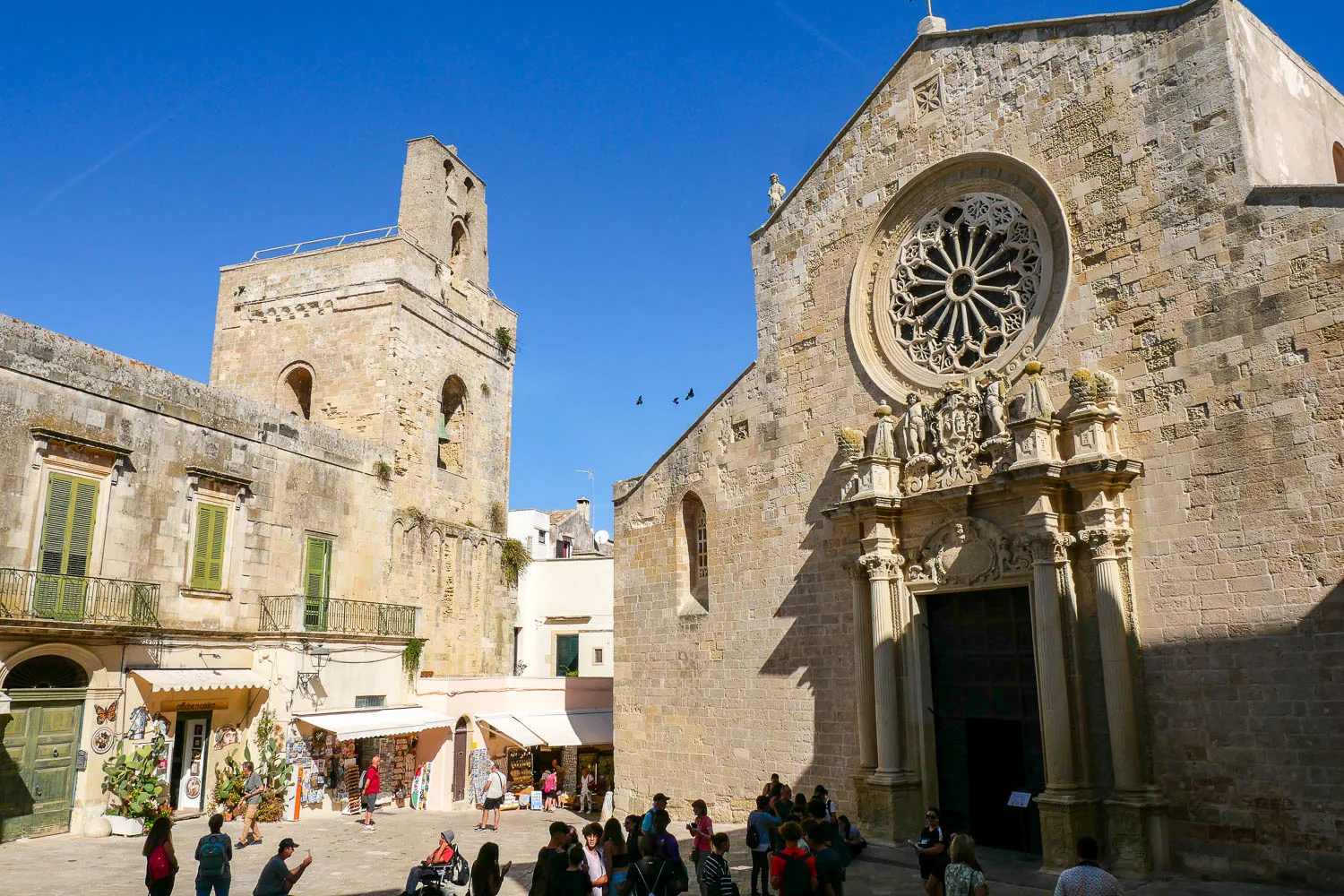
Cathedral
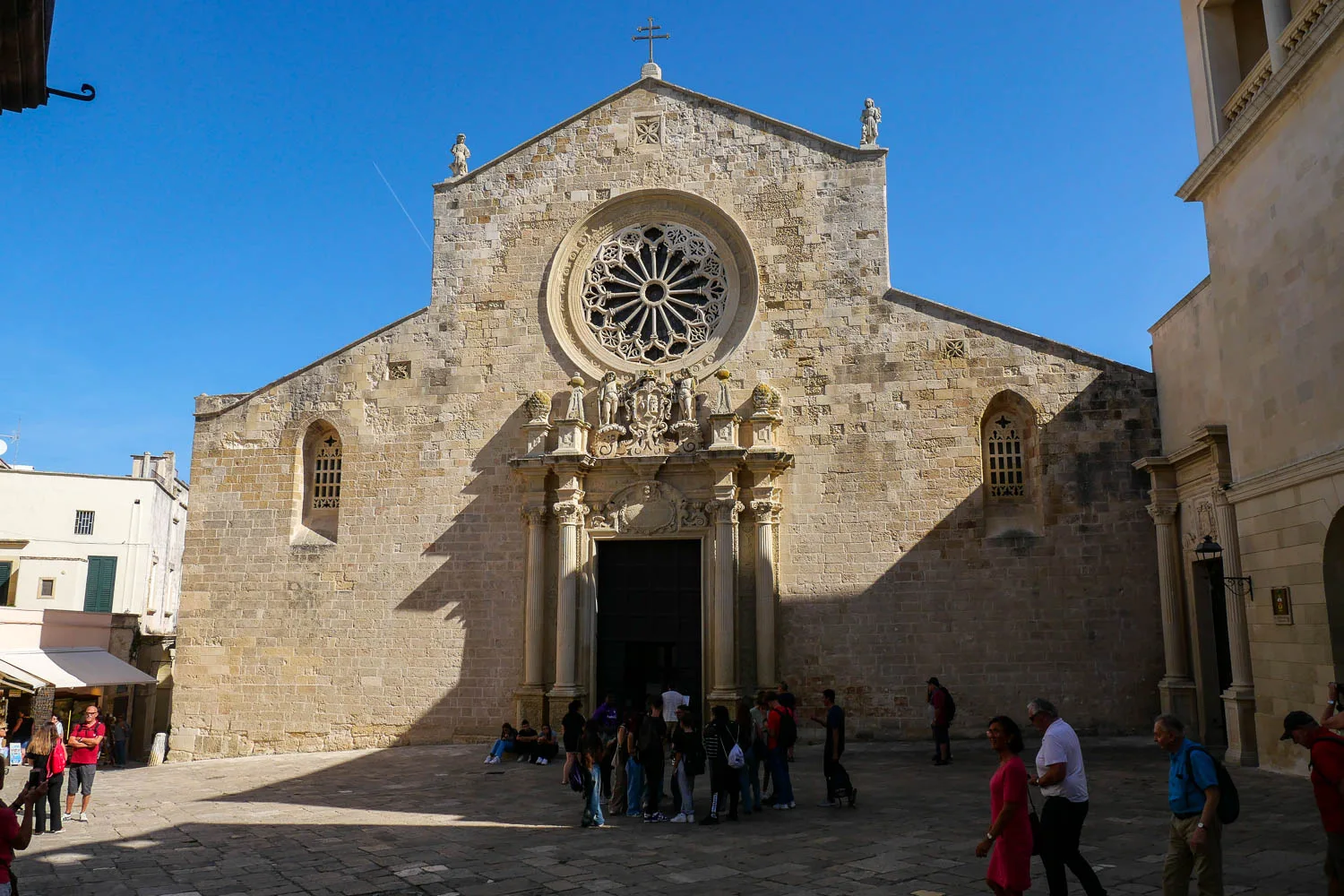
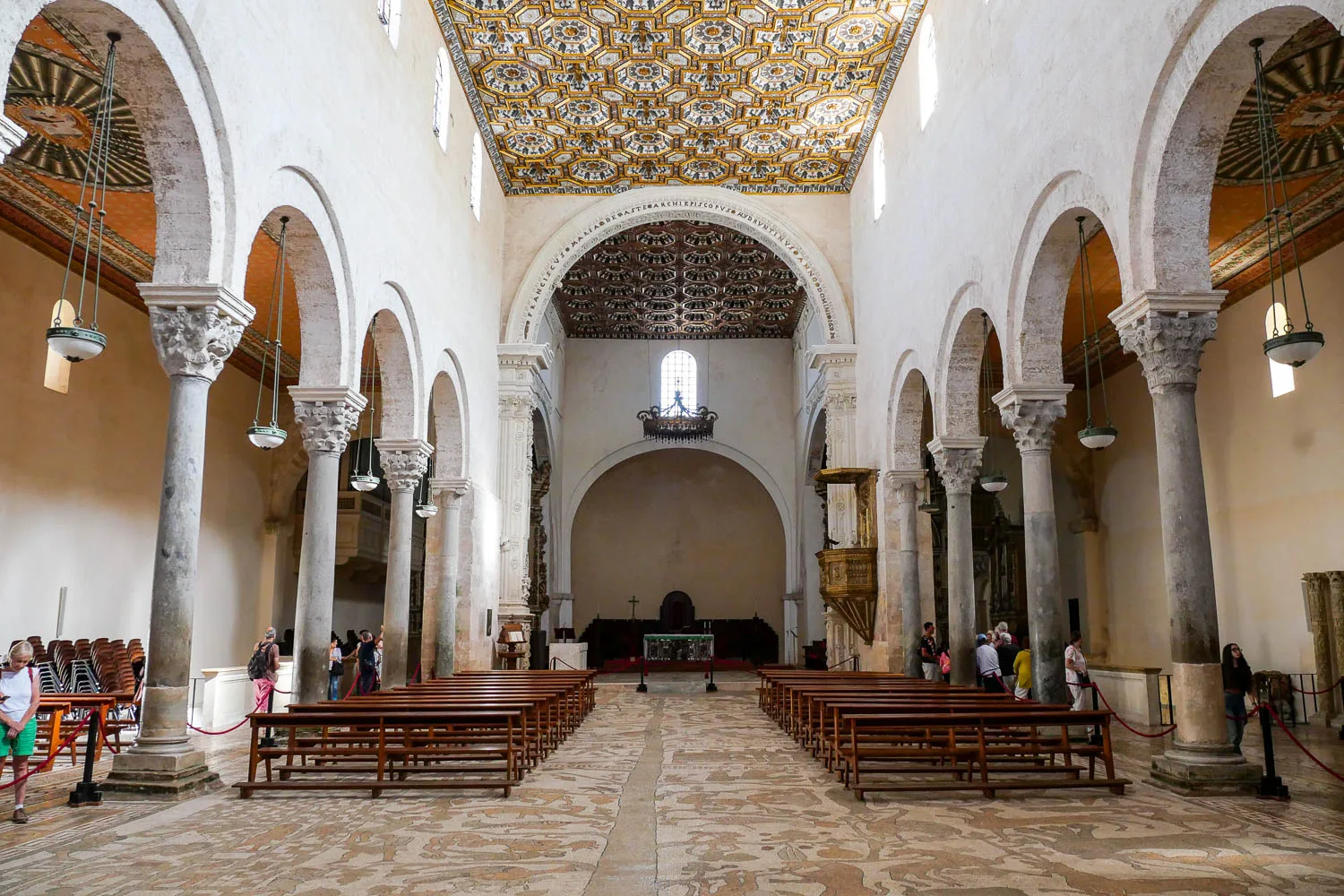
The Cattedrale di Santa Maria Annunziata is the main religious building in Otranto. It was built by the Normans in 1068 on the ruins of a Christian temple. The Baroque portal dates from 1764 (the cathedral was remodeled twice). The floor is entirely covered with an immense mosaic representing a Tree of Life. It was created by a monk in 1166 using nearly 600,000 tesserae. Looking up, you can admire a beautiful blue and gold coffered ceiling made in the 17th century.
In the chapel to the right of the nave are preserved the bones of the Holy Martyrs of Otranto. These 800 people were beheaded by the Turks on August 14, 1480, for refusing to convert to Islam. Otranto is therefore considered a martyr city.
In the basement of the cathedral is an 11th-century crypt containing 42 columns made of granite and marble. The capitals show various influences : Romanesque-Doric, Ionic, and Corinthian.
At the entrance, the Salentomnibus association offers a free guided tour of the cathedral (donations welcome). I believe it is only in Italian, as I didn’t think to ask.
Opening hours : 8:00–12:00 and 3:00–6:45 pm (masses at 9:30 am, 11:00 am, and 6:30 pm).


Byzantine Church of Saint Peter
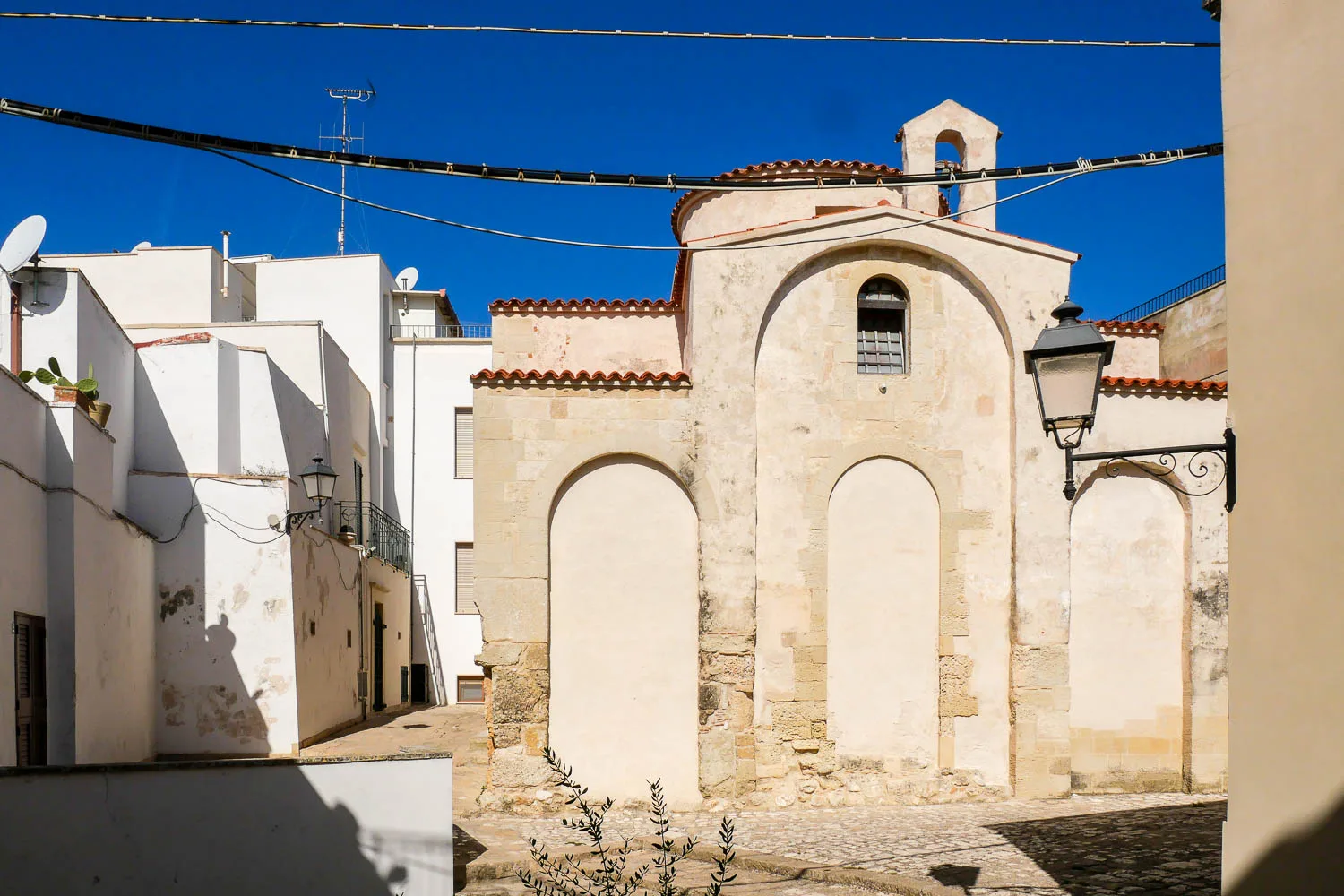
The Chiesa di San Pietro is well hidden among the narrow streets of the historic center and is easy to miss. Yet it is one of the best things to do in Otranto. Built on the highest point of the city between the 9th and 10th centuries, it is an exceptional testimony to the Byzantine presence in Puglia.
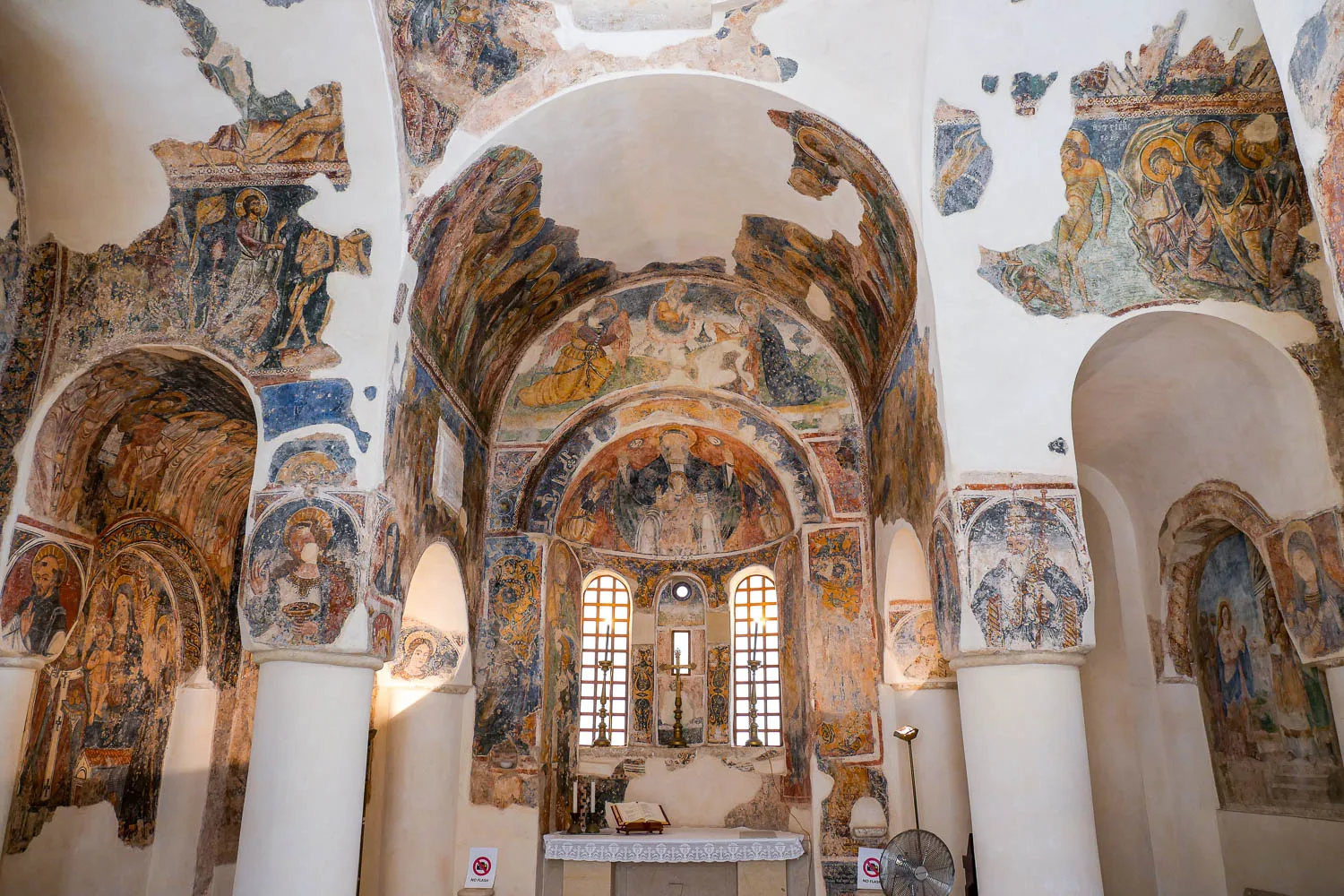
The simple façade topped with a semi-circular dome houses an interior with three naves laid out on the square plan of a Greek cross. But the most interesting feature is the superb frescoes covering the vaults and walls of the church. Originally, the Byzantine paintings covered the entire interior, but over the centuries they were concealed. Among the oldest frescoes are The Washing of the Feet and The Last Supper, dating from the late 9th century (they are in the left nave). On the columns, the paintings of the saints date from the 16th century. Surprisingly, above the altar arch there is a Kufic decoration, an ancient Arabic decorative motif.
Opening hours : 10:00 am–1:00 pm and 4:30–7:30 pm.
Otranto Castle
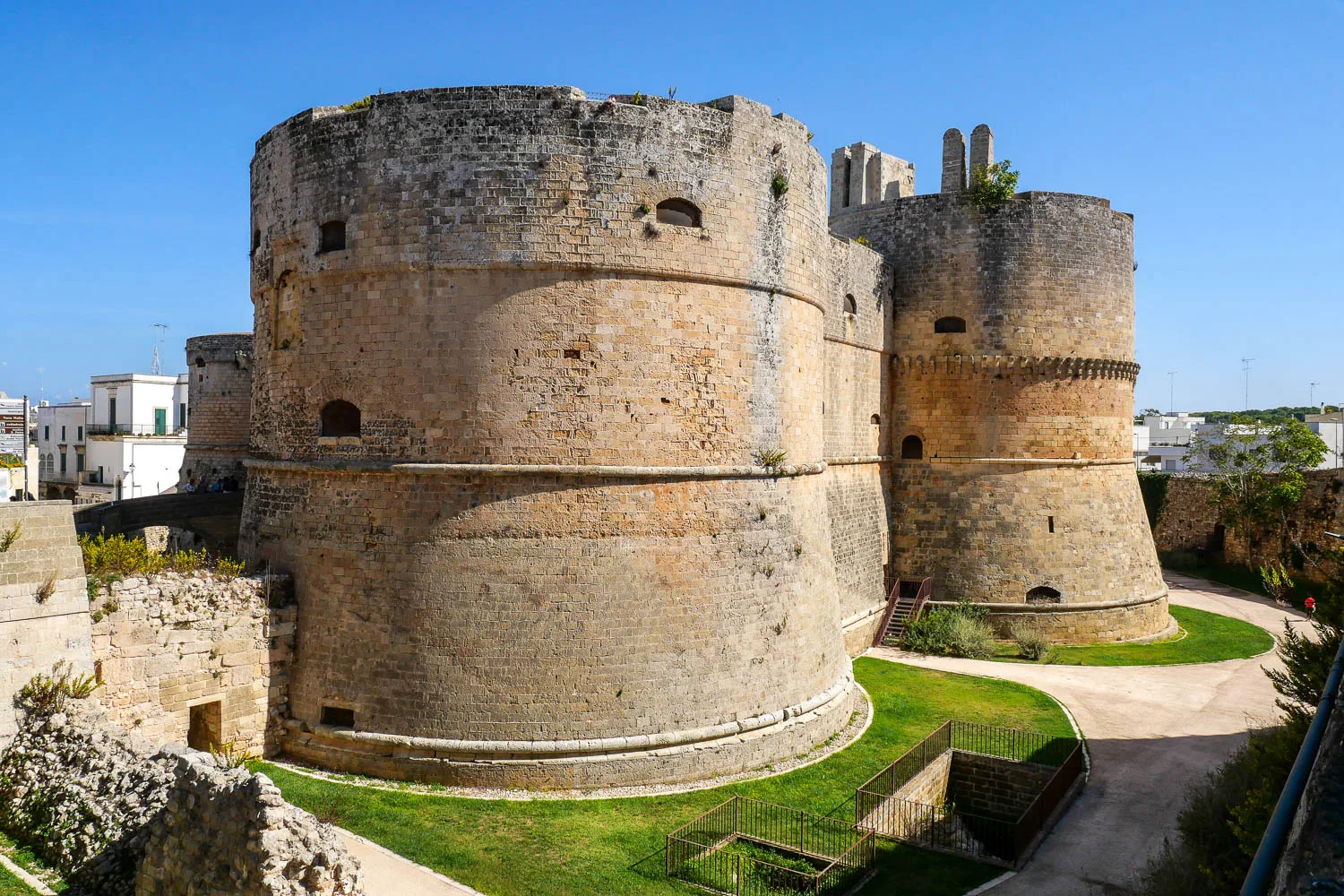
The Castello Aragonese underwent many transformations over the centuries. Its current appearance was created by Alfonso of Aragon in the 15th century, following the sack of the city by the Turks in 1480. In the following years, the castle was reinforced by the Venetians and then by the Spanish viceroys, who equipped it with the latest military technologies of the time (1578). From the Aragonese period, the keep and part of the walls remain (as in Alghero in Sardinia).
The interior of the Aragonese castle hosts temporary exhibitions. During our stay in Otranto, there was an exhibition on Marc Chagall (from March 30 to November 5, 2023). On the ground floor and the second floor, there are permanent exhibitions about Otranto and the castle, as well as Prehistory. At the very top, the panoramic terrace offers beautiful views.
Admission : €12 (free for children under 18 accompanied).
Opening hours : Monday to Friday : 10:00 am–1:00 pm and 3:00–6:00 pm. Saturday and Sunday : 10:00 am–8:00 pm.
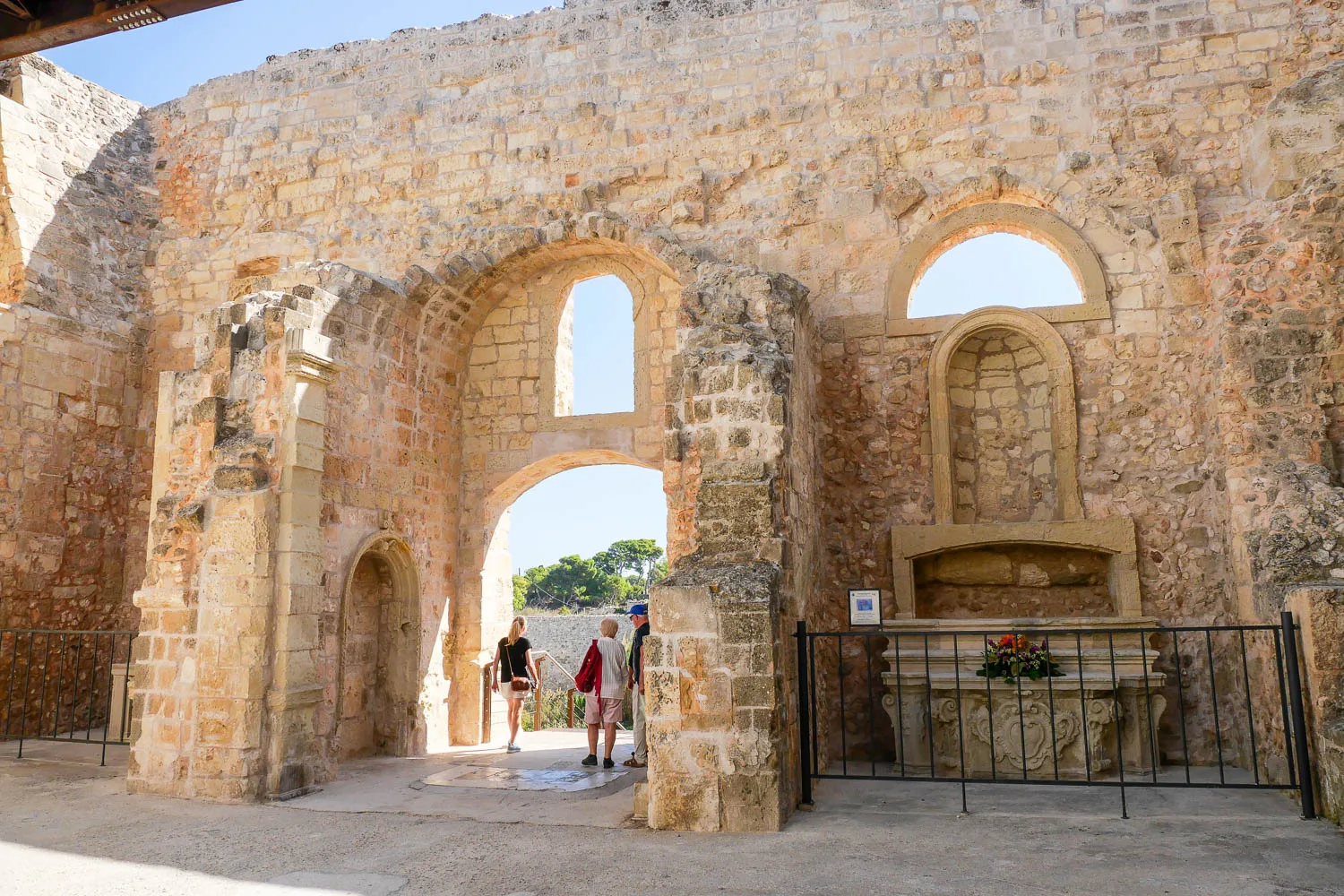
Ruins of the Chiesa dell’Immacolata
The Church of the Immaculate collapsed in 1970 following heavy rains. However, part of the 17th-century building can still be seen. There is nothing particularly noteworthy to see, but you will likely pass by during your visit to Otranto. The church is located beneath the metal walkway of the city walls that connects the Torre Matta to the castle. To reach it, take Via Immacolata, which exits the fortified city toward the marina.
Streets of the old town
There’s nothing better than getting lost in the small streets of the old town to visit Otranto. We wandered around following our instincts, often choosing the less touristy alleys. It sometimes feels like a labyrinth, but you always end up finding your way again. Proof : we didn’t miss any of the things to do in Otranto 🙂
I recommend leaving the most touristy streets, where souvenir shops are located, to head toward the quieter streets deserted by visitors. It’s in these streets that you best enjoy the charm of the white façades and the calm (although in October there weren’t many people anyway).


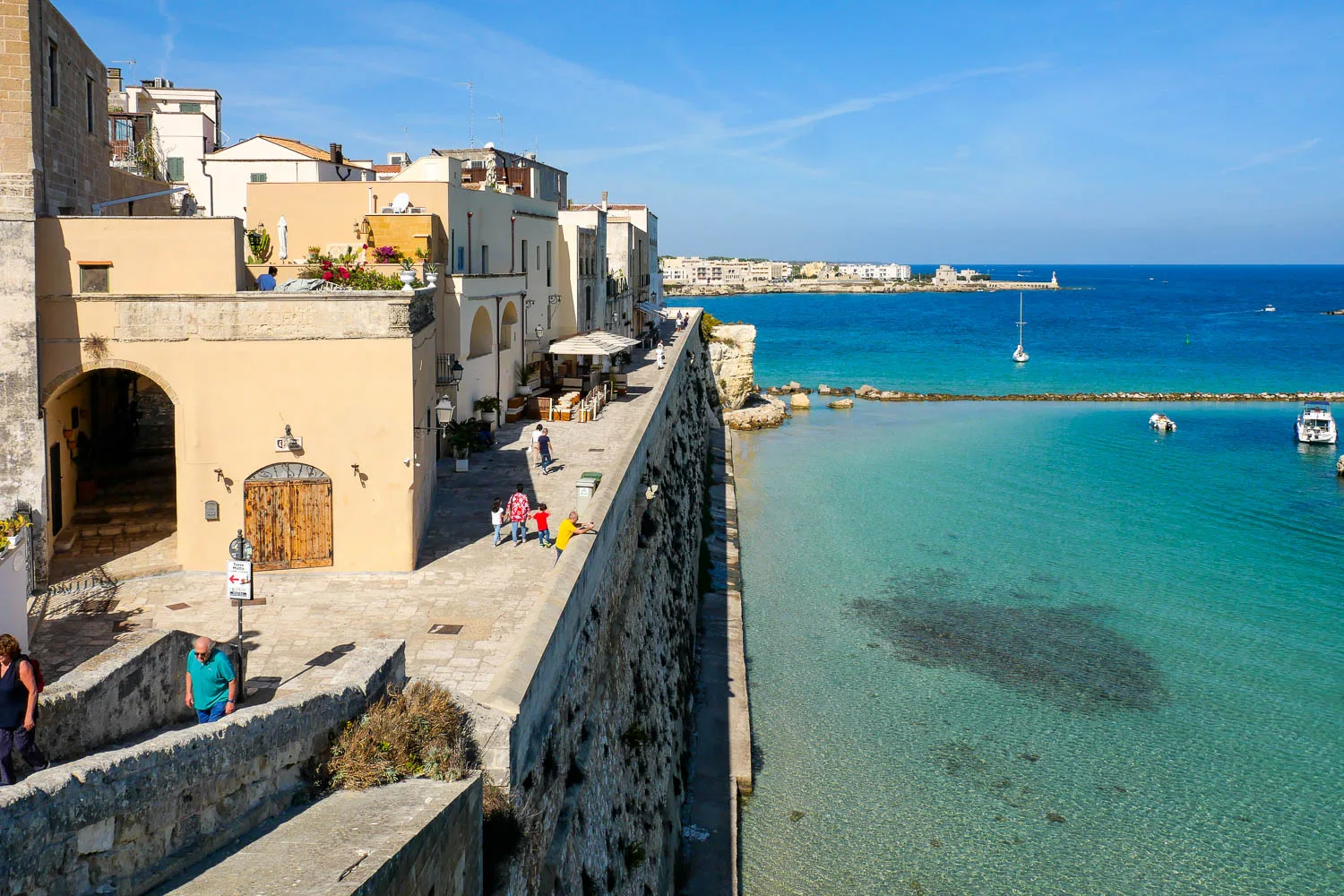
Otranto city walls
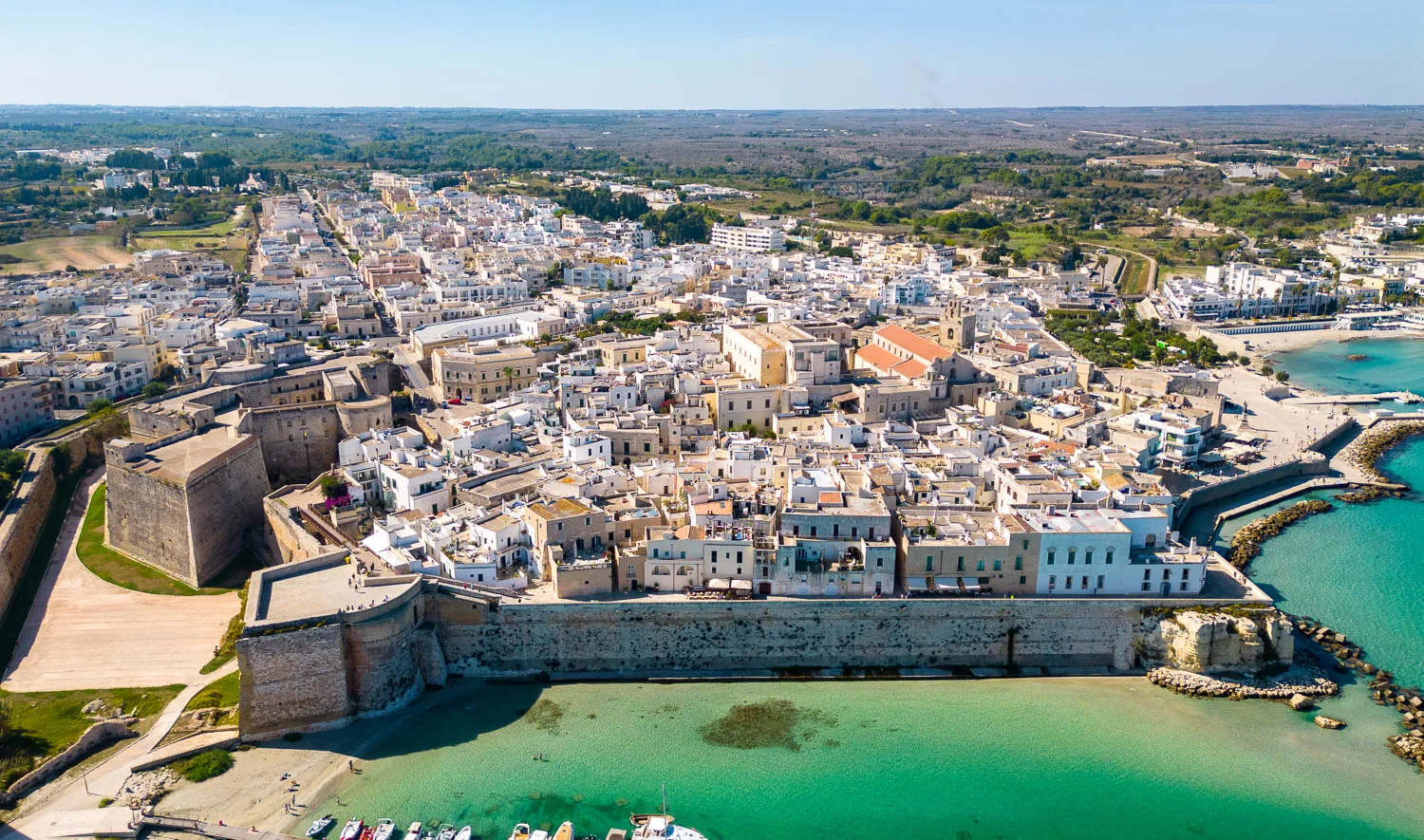
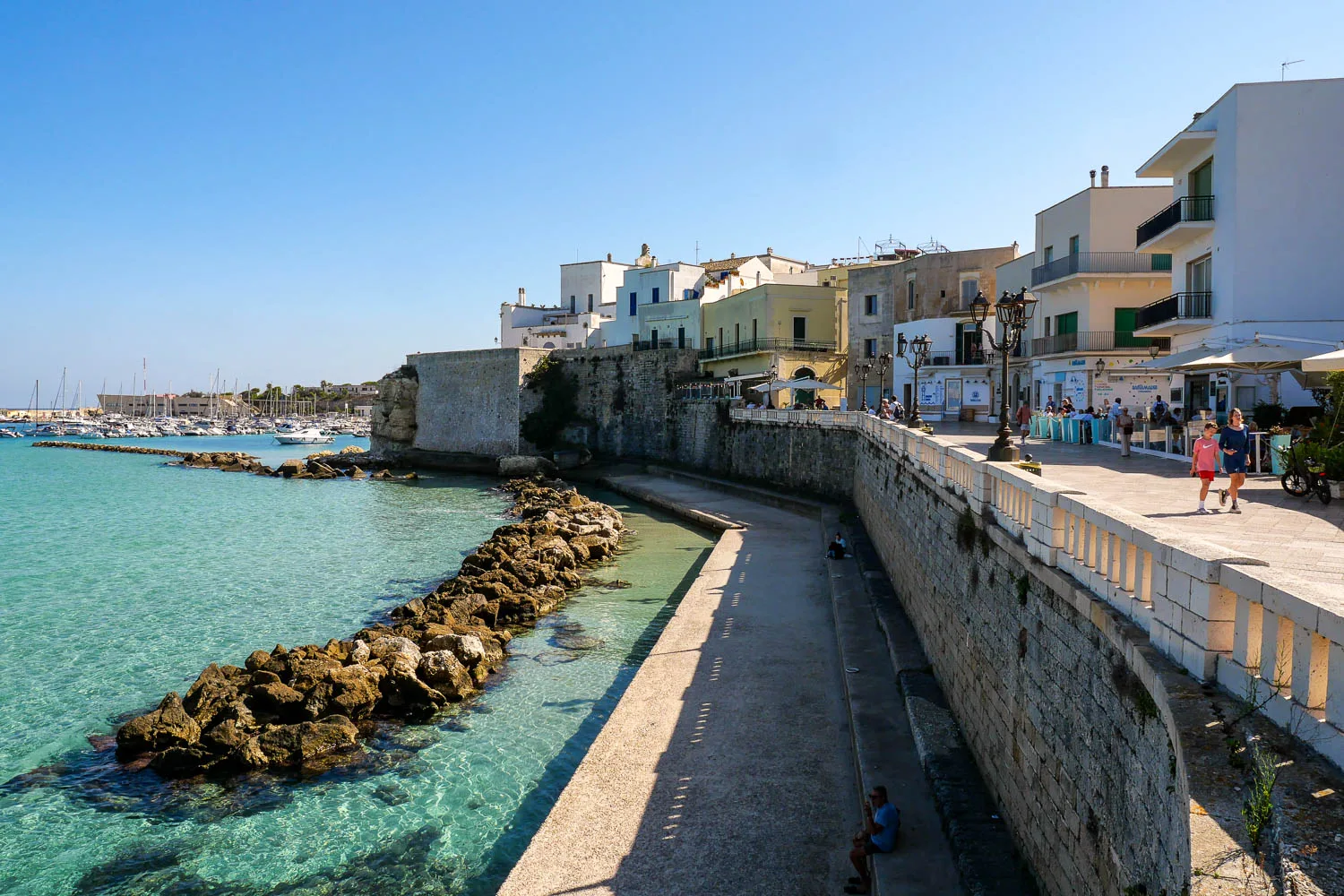
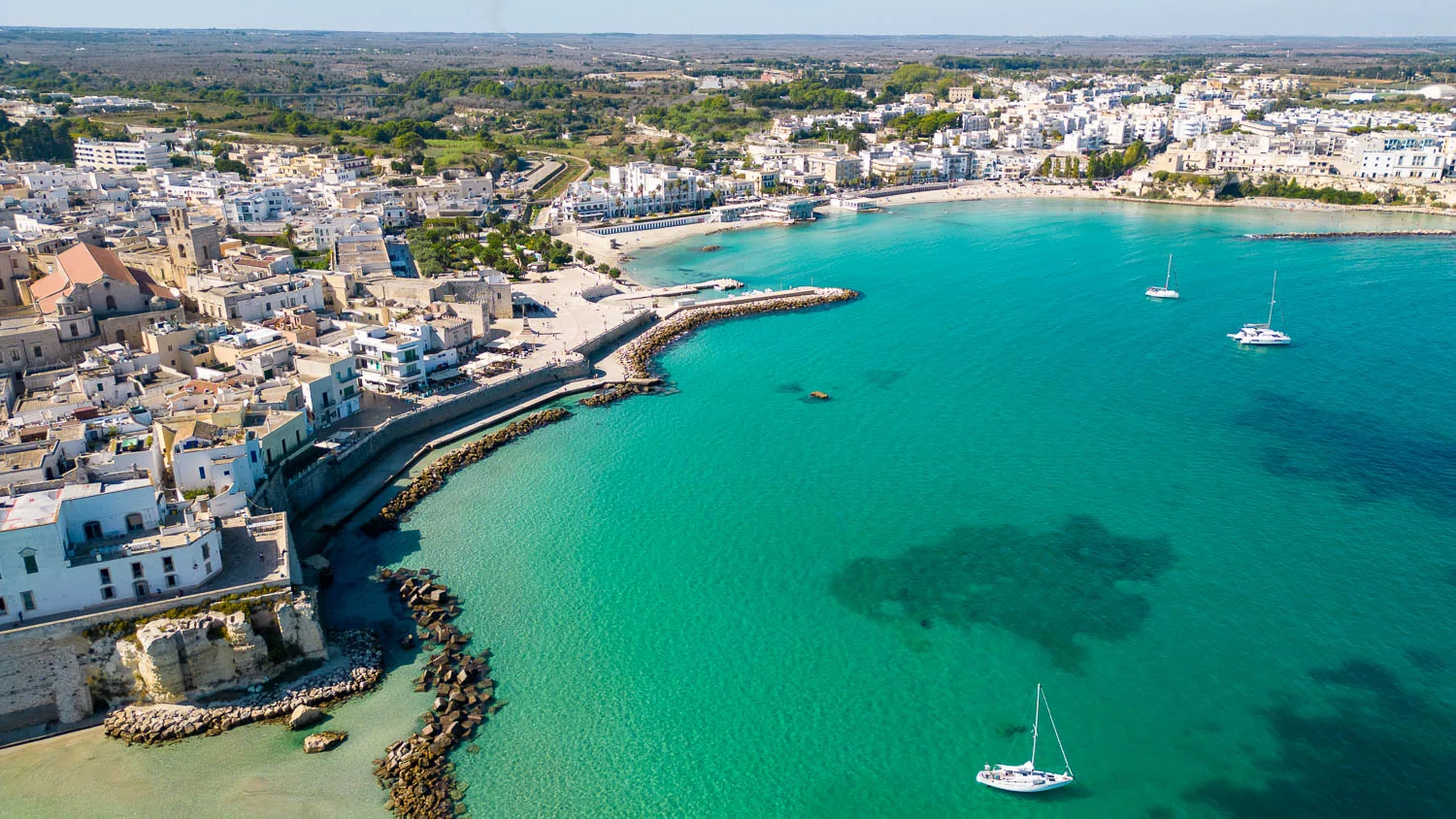
A walk along the city walls allows you to admire the view of the sea with its turquoise water. Along the way, there are terraces of bars and restaurants where you can take a break. This defensive system, originating from the Byzantine period, was remodeled over the centuries by the Normans (1081), the Angevins, and later by the Kingdom of Spain. The walls are built as a continuation of the castle.
To enjoy the best view, climb the stairs to reach the Torre Matta, where the panorama takes in the sea, the marina, and the small sandy beaches at the foot of the walls. Then walk to the bastione dei Pelasgi for a view over the bay of Otranto.
Lungomare degli Eroi
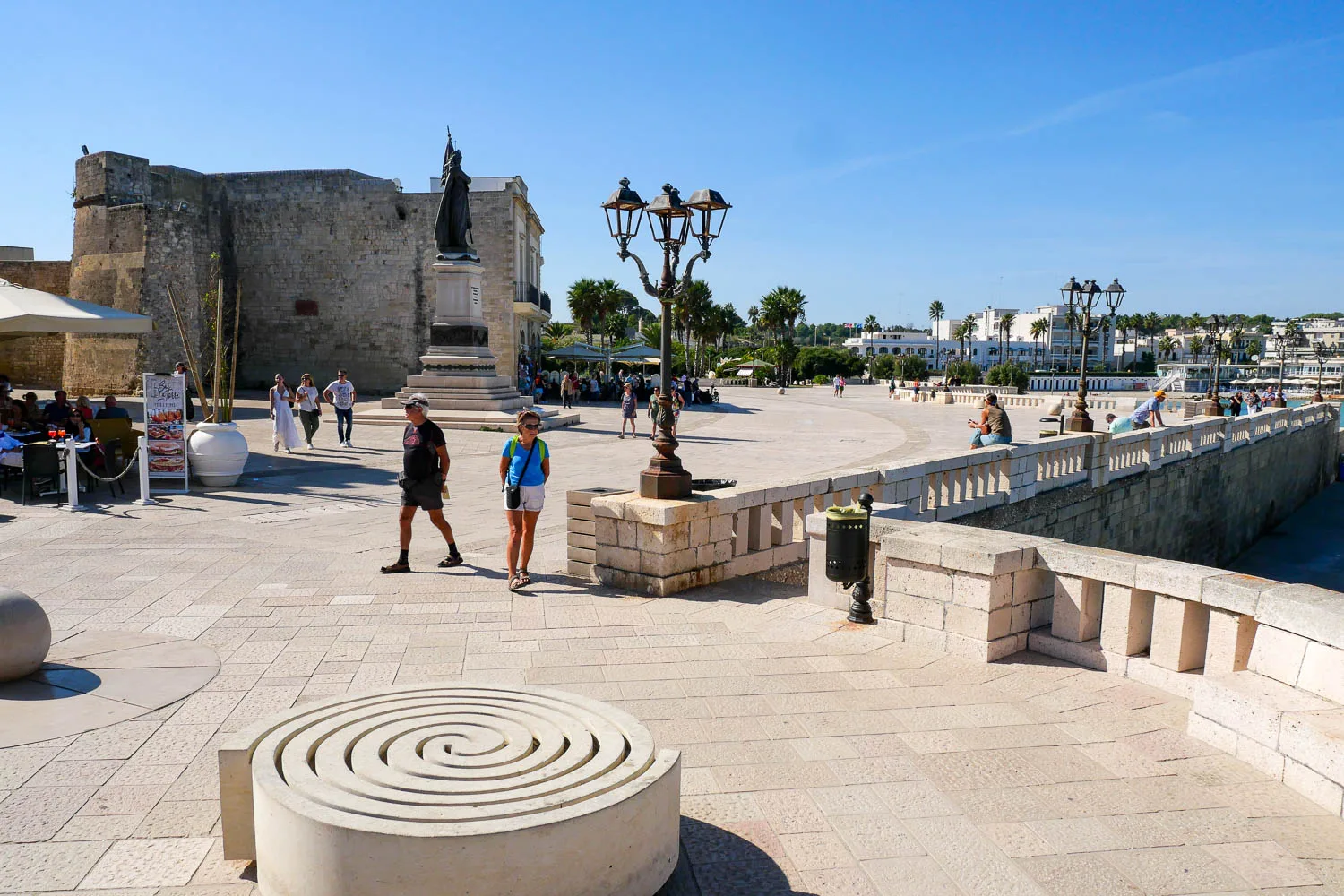
This seaside promenade called Lungomare degli Eroi connects the city walls (Bastione dei Pelasgi) to the large square at the entrance of the city. It is the liveliest area of Otranto, with many bars and restaurants. It’s also the ideal place for the passeggiata, the stroll Italians love so much. The view over the seafront and the beaches is superb. On the square stands a statue honoring the heroes and martyrs of Otranto executed in 1480.
Stairs lead down to the quays below to enjoy the sea. However, there is no beach here, only rocks forming a breakwater against the waves. Just behind the square is the Torre Alfonsina (1481), which was the main entrance to the city during the Aragonese period.
Beaches of Otranto
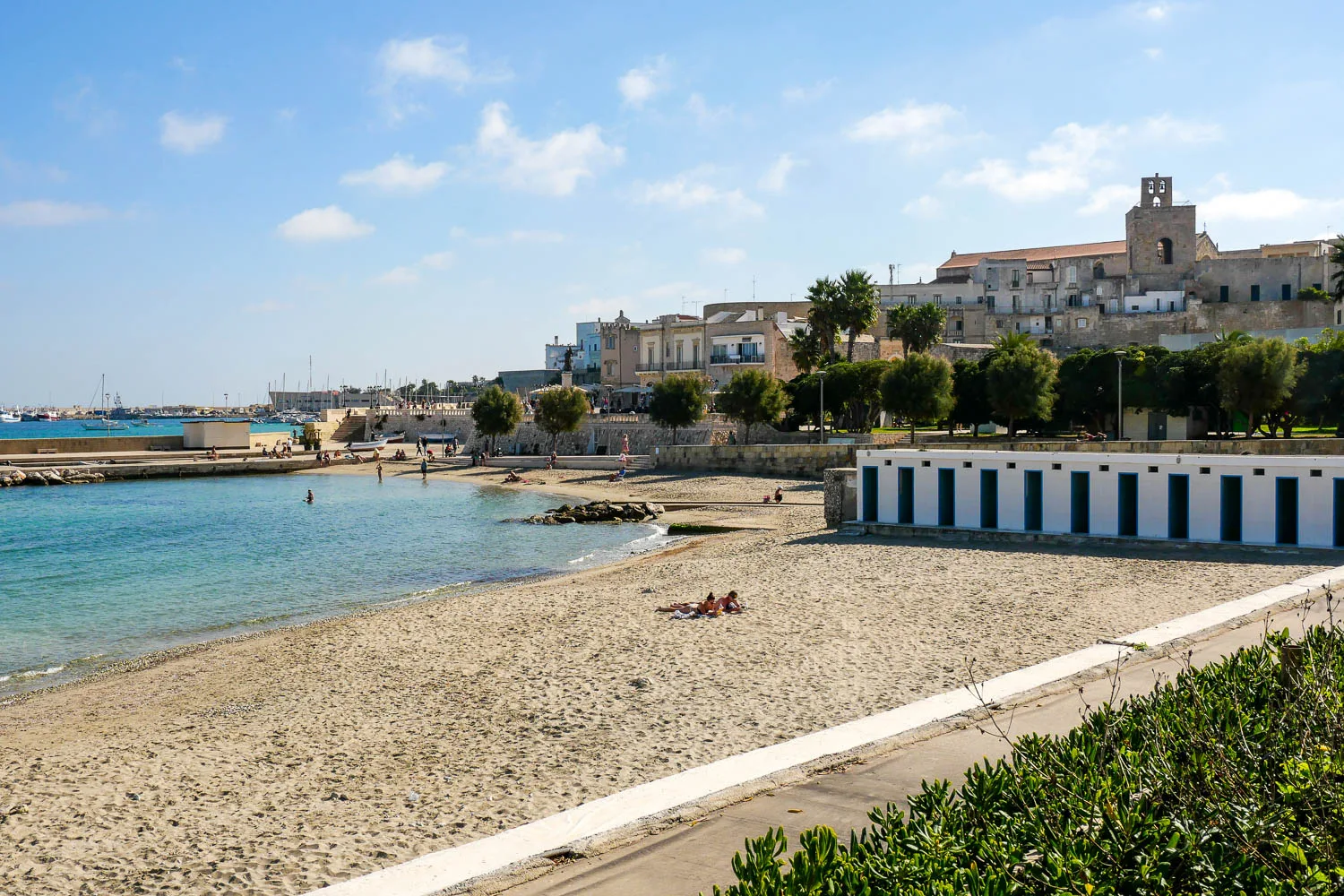
The main sandy beach in Otranto is spiaggia del Molo (also called spiaggia dei Bambini). It is located just before the Lungomare degli Eroi when coming from the modern city center. It’s a sandy beach with very calm water, perfect for families with children (hence its nickname). The western part after the river is occupied during the season by sun loungers and umbrellas from a private beach. On the other side, you can settle for free.
Walking a little further (barely 10 minutes from the old town), you’ll reach spiaggia dei Gradoni. It is entirely free (no private beach), and the turquoise water is magnificent.
Otherwise, the last beach easily accessible on foot from the old town is located near the marina (spiaggia Bastioni). A small strip of sand allows you to swim in equally beautiful water, but it’s really too close to the boats for my taste.
Things to do around Otranto
Bauxite quarry
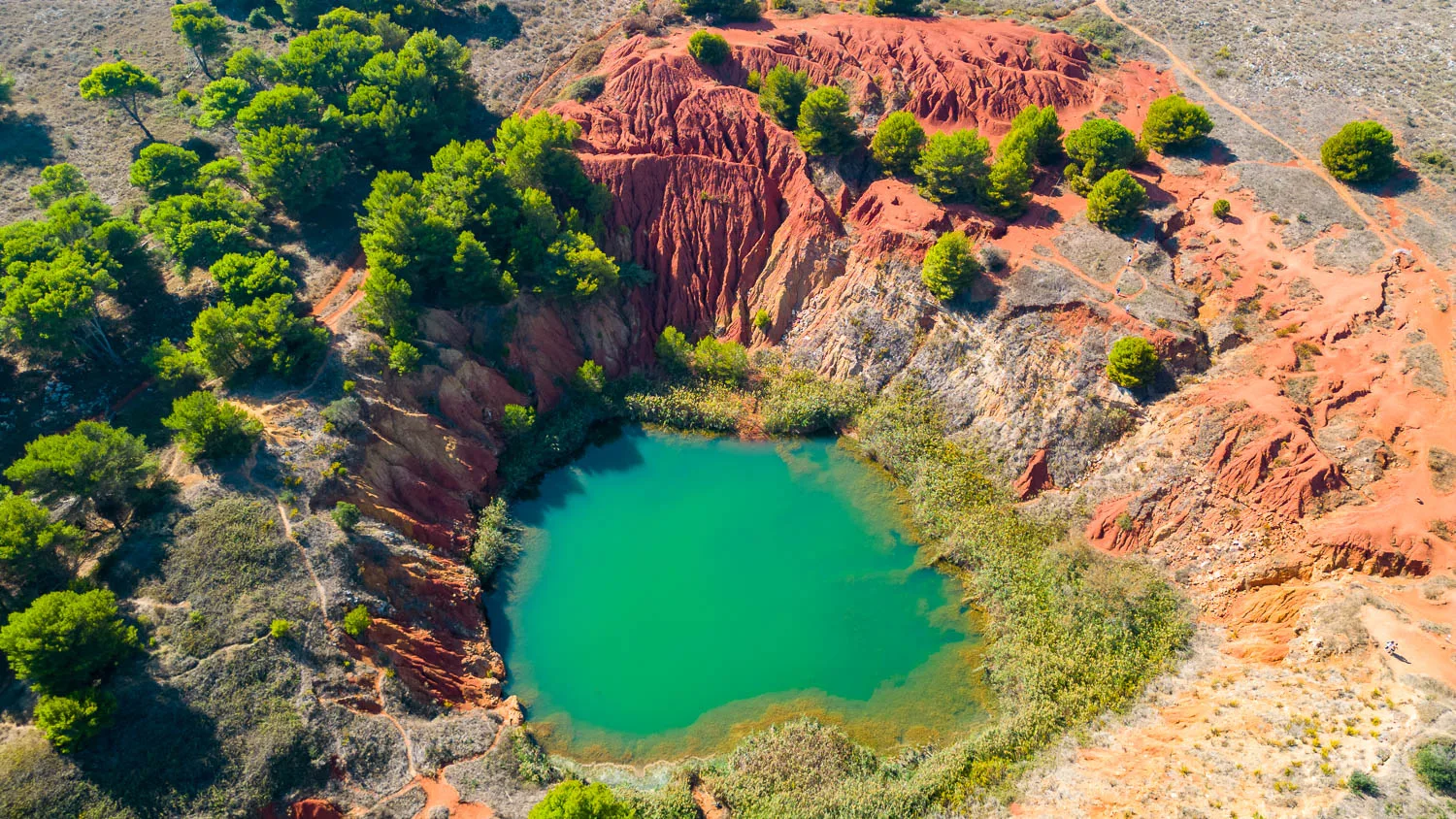
2.6 km south of Otranto (less than 10 minutes by car) is a bauxite quarry. This red rock, rich in alumina and iron oxide, was used for aluminum production. The quarry, discovered in 1940 by a student of a natural history professor, was exploited until 1976. Since then, an emerald-green lake has formed thanks to groundwater and runoff water that created ravines. Its color contrasts with the rust-red rock, creating a stunning scene. You might think you’re in the American West. This bauxite quarry has become popular on social media (like the Eye of Cetina in Croatia). However, here too, the result looks best in aerial drone photos. From ground level, it’s less spectacular.
To access the bauxite quarry, you need to park at the paid parking lot (€3) located at this spot. A road allows you to get closer, but a sign indicates that it’s prohibited except for authorized vehicles. You then have to walk just under 10 minutes along a path in full sun to reach the quarry. It is forbidden to go down to the lake level.
Faraglioni di Sant’Andrea
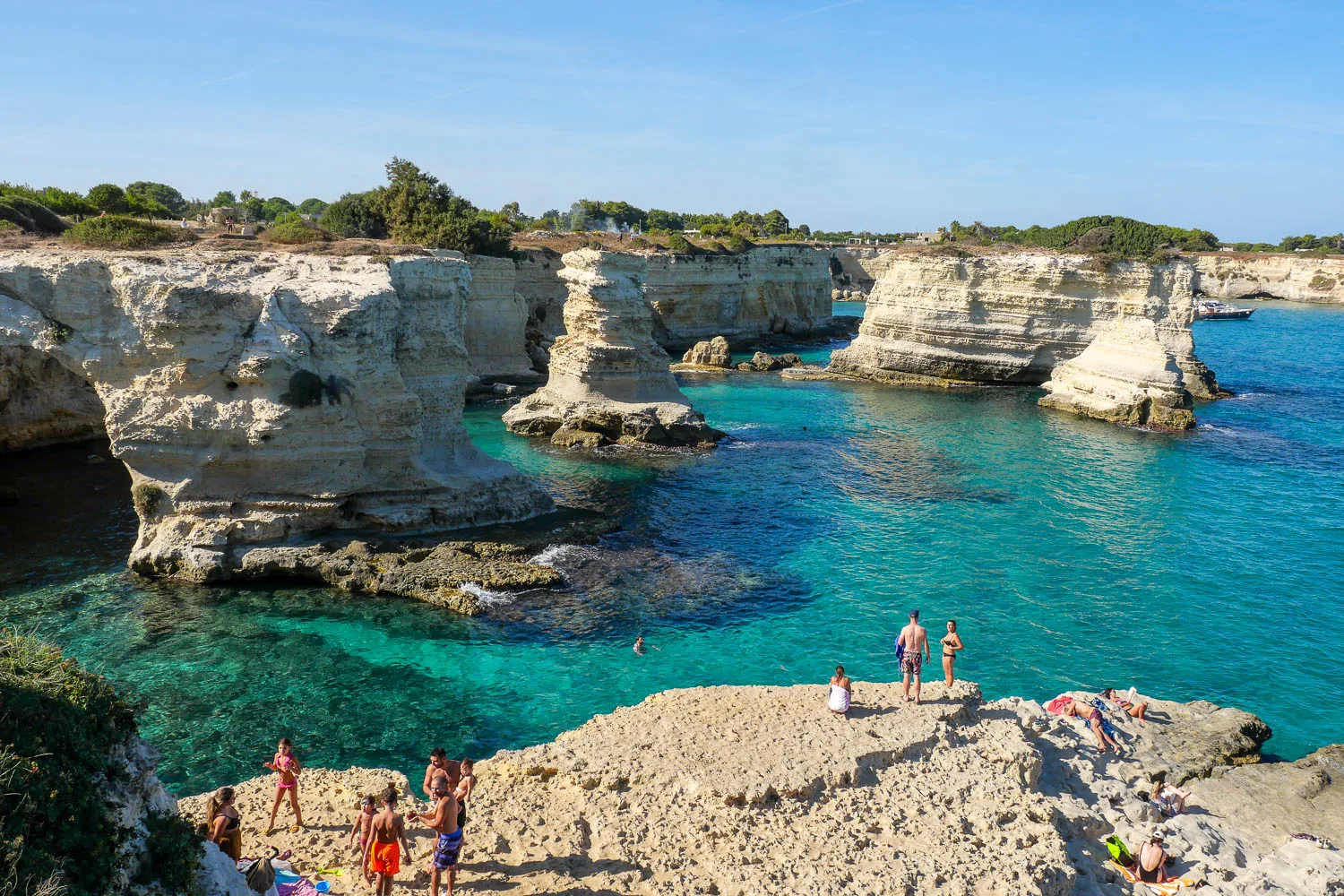
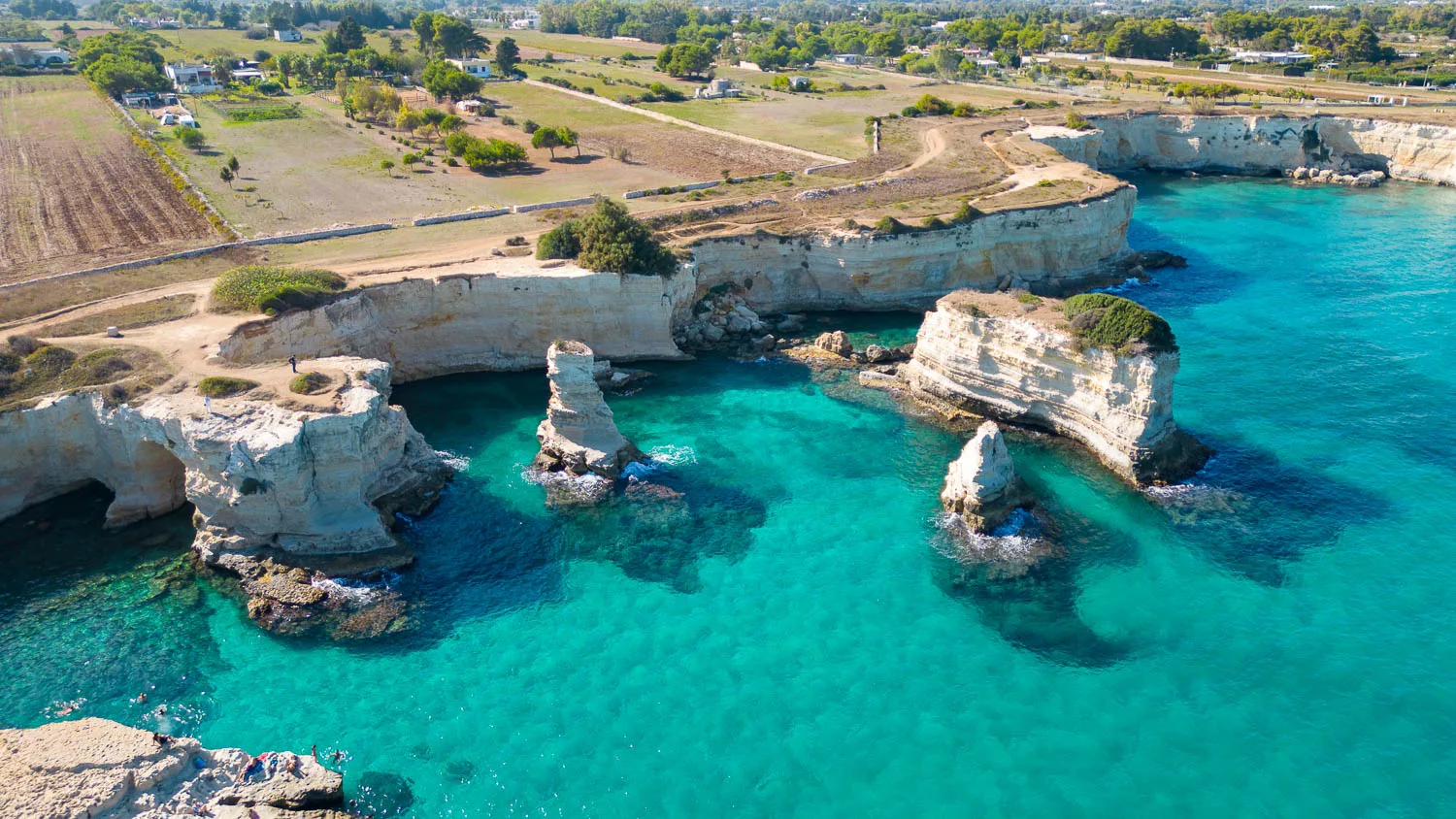
Faraglioni are rock stacks detached from the cliff and located in the open sea. The most famous in Italy are those of Capri, but they can also be found along the coast of Puglia. They create a spectacular landscape, with the added advantage here that you can swim and float under the natural arches.
The Faraglioni di Sant’Andrea are located 14 km north of Otranto near Torre Sant’Andrea. While this fishing village is quiet out of season, in summer it’s overrun by tourists who come to enjoy the sea (there’s also a large sandy beach). The turquoise-blue water clearly invites you to take a dip. To do so, simply take the staircase carved into the rock to reach a large flat rock. From there, you just have to jump into the water. To climb back up, you need to scramble a bit on the rock; it’s best to bring water shoes like this model.
If you visit Otranto outside of summer (although we did enjoy the sea in mid-October), you can replace swimming with a walk between Torre Sant’Andrea and Torre dell’Orso, the village just to the north. Allow about 30 minutes on foot following the coast. This is the stretch where the cliff scenery is the most beautiful. Still, it wasn’t as impressive as what we saw in the Algarve in Portugal.
To access the Faraglioni di Sant’Andrea, you need to use the public parking lot (GPS coordinates), which is paid only between May 1 and September 30 from 8:30 am to midnight. The rate is €1.50 per hour, and it is forbidden for camper vans (there is a campsite just behind).
Grotta della Poesia
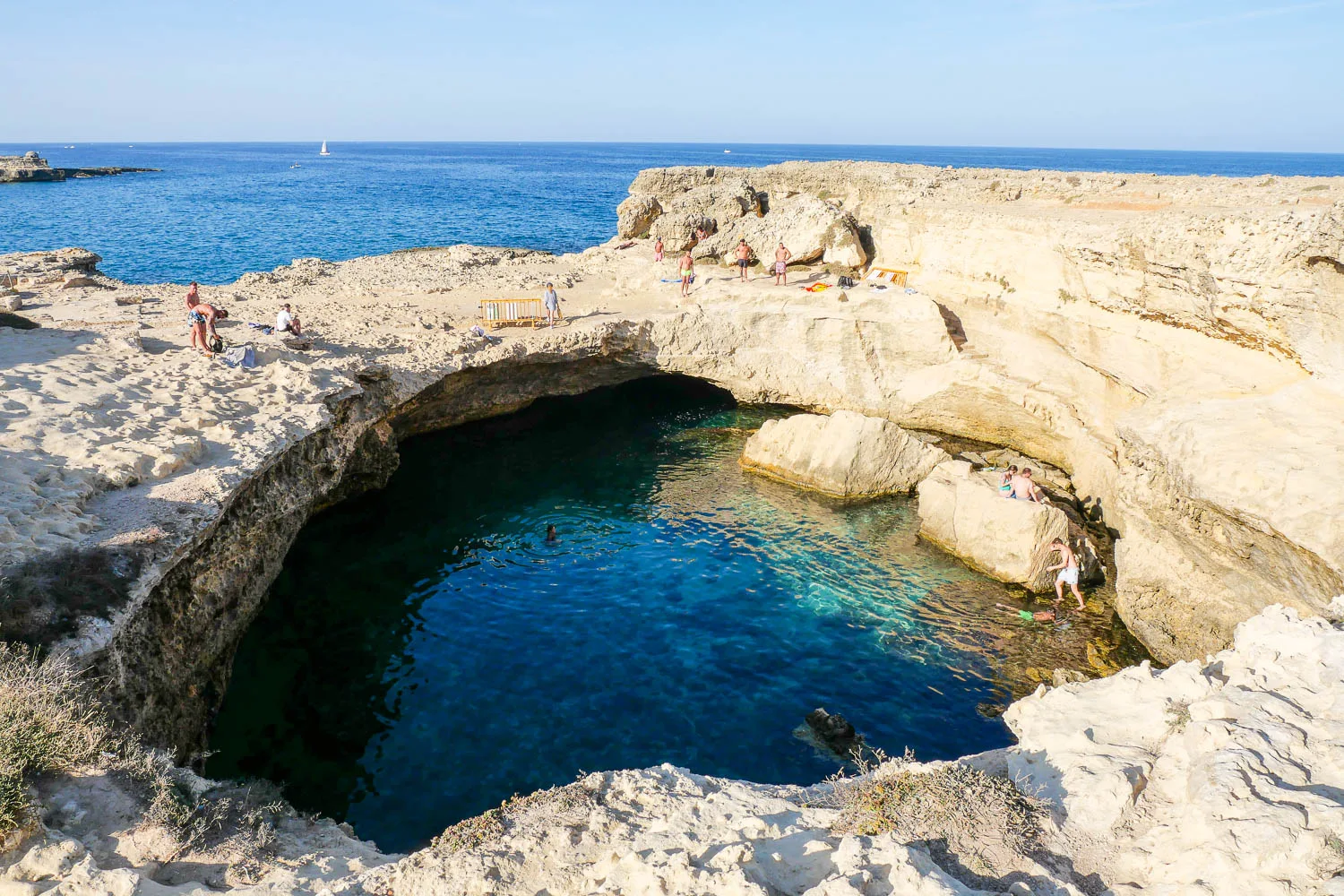
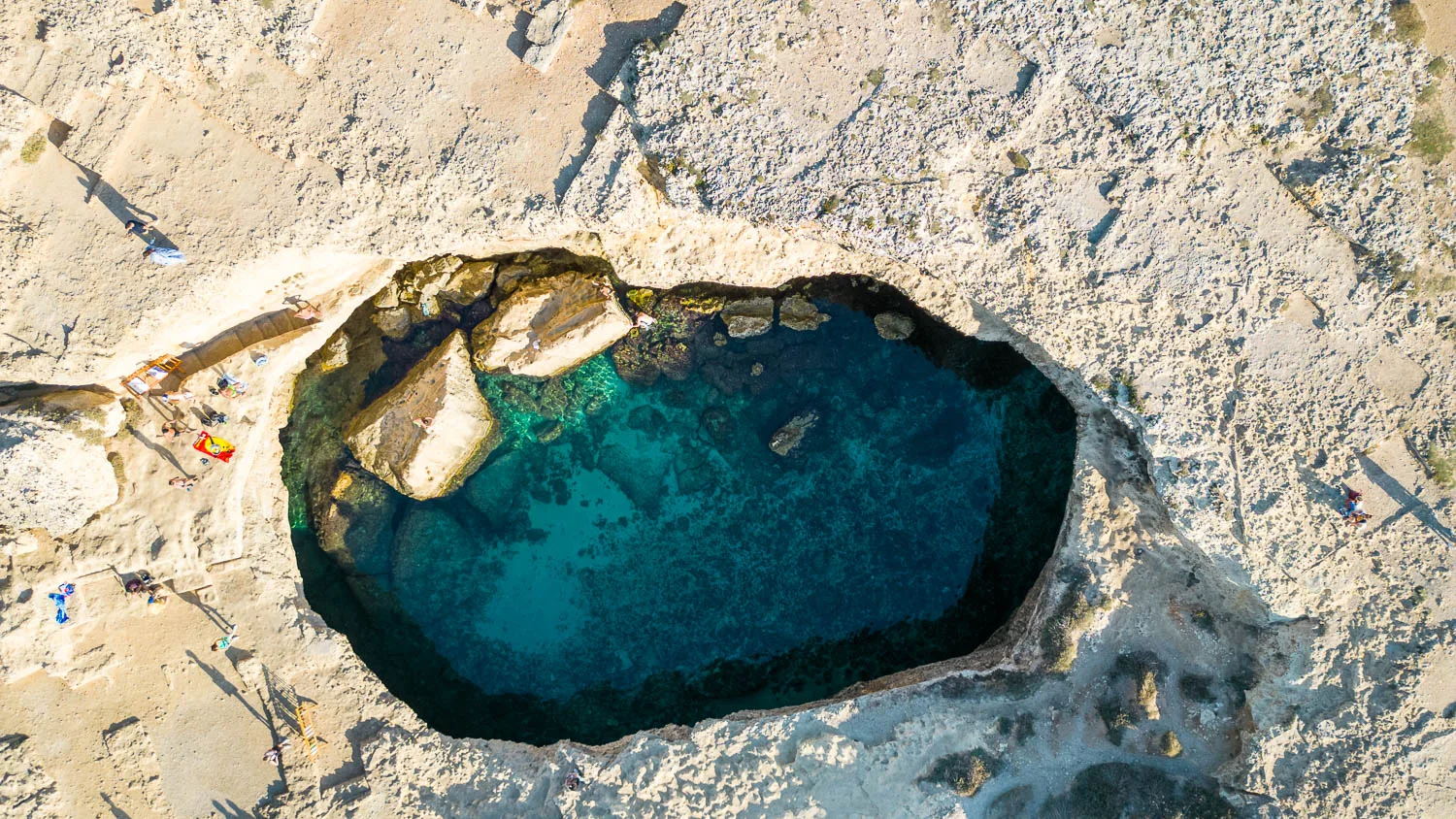
A 10-minute drive from Torre Sant’Andrea is another highlight to visit near Otranto : the Grotta della Poesia. It’s a karst cave whose roof collapsed (like the Benagil Cave in Portugal). The result is a large natural pool with a tunnel that connects to the sea. In summer, the site is very crowded with tourists and locals, even though a sign at the entrance states that swimming is strictly forbidden. There doesn’t seem to be any enforcement, so it’s up to you to decide whether you want to try the experience. However, it remains dangerous because the ground is unstable.
The park encompassing the Grotta della Poesia is an archaeological site. Messapian inscriptions (as well as Latin and Greek ones) have been discovered on the cave walls. It was used in ancient times (before the roof collapsed) for the worship of the god Taotor.
The entrance fee to access the Grotta della Poesia is €3 (free for residents). It includes a guided tour of the Roca Vecchia archaeological site (English / Italian). Allow 1.5 hours to visit both sites during the guided tour. However, most tourists only go to the Grotta della Poesia. Yet, aside from the historical aspect, the panorama is far from spectacular.
If your main goal is swimming and you don’t want to break the rules, I recommend instead the coves and caves north of Torre di Maradico, a 16th-century watchtower. It’s next to the Roca Vecchia archaeological site and opposite the parking lot (coordinates) of the Grotta della Poesia.
Speaking of parking, the only option on site is the paid parking lot (€1.80 per hour every day between 8:30 am and midnight). It’s a ticket machine, so you need to estimate how long you’ll stay. Payment by card or coins.
Admission : €3 (€2 for under 14s and over 65s).
Opening hours : 9:00 am–5:00 pm from May 1 to October 15 | 9:00 am–12:00 pm and 3:00–6:00 pm from October 16 to April 30. Reservation required out of season (see official website).
Where to stay in Otranto ?
Staying in Otranto is a great idea for those who want to explore Salento while enjoying proximity to the beaches. The city is midway between Lecce and the southern tip (like Gallipoli on the west coast). Here is a list of accommodations I recommend for staying in Otranto. Prices depend on the booking period with a peak in July and August. Don’t hesitate to book well in advance for your stay in Otranto, especially if you’re coming in summer.
- 58 € : Appartamento Memorie, the cheapest accommodation to stay in Otranto, with excellent reviews. The well-equipped 36 m² apartment (with washing machine and fully equipped kitchen) is located 800 meters from the old town. Free street parking.
- 81 € : Bed&Belvedere, located 500 meters from the beach, this bed and breakfast offers modern rooms with balconies, some with sea views. Also available is a 3-bedroom apartment for large families.
- 84 € : Hotel Miramare, close to the historic center, this 3-star hotel offers rooms for 2 to 4 people with sea views. Breakfast included, and private parking available at an extra cost.
- 99 € : Hotel San Giuseppe Dimora Storica, this 4-star hotel occupies a typical 16th-century farmhouse from the Puglia region. Located in the old town, 300 meters from the sea. Breakfast can be included.
- 115 € : Vittoria Resort Pool & SPA, a 4-star complex offering modern rooms. The big plus is the outdoor pool with spa, free private parking, and breakfast included. A 5-minute walk from the center.
- 185 € : Palazzo De Mori, this Otranto accommodation is the place to treat yourself. Located in the heart of the old town, it offers rooms with exceptional sea views. Breakfast is served on a stunning terrace.
Travel guide and tips for visiting Otranto
How to get to Otranto ?
Otranto is located 45 km south of Lecce, the most important city in the region. The easiest way to get there is by car. This will also allow you to explore the surrounding area. If you haven’t rented one yet, I recommend checking this comparison site, which offers the best car rental rates.
For those traveling by public transport, it’s possible to visit Otranto by bus from Lecce. Departures are from the bus station on Piazza Carmelo Bene in Lecce (coordinates), and the journey takes 1 hour.
The last option to visit Otranto if you don’t have a car and don’t want to use public transport is to join an organized excursion. I recommend this tour departing from Lecce, which includes Otranto, Galatina, and Gallipoli.
Where to park in Otranto ?
There are several paid parking lots north of Otranto’s old town. We used this parking lot (€2 per hour) located less than a 10-minute walk from the lungomare. It’s quite large, and in October there weren’t many people (it must be different in summer). Payment is made at a ticket machine, and the ticket must be placed in the car. The drawback of this type of parking is that you have to estimate how long you’ll stay. To give you an idea, we paid €5 for 2.5 hours of parking, which allowed us to see all the sites presented in this Otranto travel guide.
How much time to spend in Otranto ?
As I just mentioned, we spent 2.5 hours on site and visited all the must-see sights of the old town (without entering the castle or eating there). Everyone visits differently, but to plan your trip to Puglia, allow at least half a day to visit Otranto. If you want to see the surrounding area (the Grotta della Poesia, the Faraglioni di Sant’Andrea, and the bauxite quarry), you should plan for a full day.
You know now the best things to do in Otranto in Puglia. If you still have questions, feel free to ask them in the blog comments.