
Are you planning a road trip in the Dolomites ? This mountain range in northern Italy, straddling the region of Alto Adige (also known as South Tyrol) and Veneto, is absolutely stunning. It is characterized by steep mountain peaks and numerous lakes that will delight hikers and lovers of wide open spaces. The best way to discover this region, where Austrian and Italian cultures blend together, is to choose a driving tour in the Dolomites in order to be completely free when it comes to your itinerary and the sites you want to visit.
Follow us on our 5-day road trip in the Dolomites and South Tyrol in this blog article, where I share my tips, the must-see places, hiking ideas, and our favorite accommodations to stay in the Dolomites.
Once there, you will notice that all places have two names, as the South Tyrol region has three official languages : Italian and German (the third being Ladin, a Romance language). On the blog, I mention the names of the places to see in both Italian and German so that you can find your way more easily.
Dolomites road : how to get to South Tyrol ?
Two options are available to you for visiting the Dolomites : either drive your own vehicle, or fly to Italy and rent a car once there (I will not talk about public transportation, even though it is well developed in the region).
Driving to the Dolomites with your own vehicle
Given the number of kilometers and the cost of tolls, this option is best for those who do not live too far from the Italian border or who are opting for a road trip lasting several weeks (visiting the rest of Italy or continuing on to Austria or Slovenia). This is the option we chose, as after South Tyrol we visited Innsbruck and southern Bavaria.
Combining flight with car rental
The closest airport for visiting the Dolomites is Venice, a 2-hour drive (150 km) from Cortina d’Ampezzo. Several low-cost airlines serve Venice from France. By booking in advance, you can get a good price ; the best option is to compare fares on the website I use every time I need to book a flight.
From Venice airport, all that’s left is to book a rental car. There’s no need for a specific model, the roads are wide and in good condition. To get the best rate for renting a car in the Dolomites, I recommend this comparison site. If you have some extra time, I suggest making a detour to Lake Garda before heading to South Tyrol.
Our Dolomites itinerary : 5 days and 300 km
The map below shows the itinerary of our road trip in the Dolomites, with the main places to see. From Merano to Lago di Braies, this represents a 300 km route that we completed in 5 days in June. Of course, it is possible to choose other itineraries, especially if you are staying for a week or more. Some sites, such as Santa Maddalena, are a bit out of the way and will require a round trip.
- Day 1 : Merano (night in Albergo alla Torre Siegler Im Thurm)
- Day 2 : Lago di Carezza – Santa Maddalena – Alpe di Siusi (night in Pension Haus Tirol)
- Day 3 : Seceda – Ortisei – Passo Sella (SS242 road) – Passo Pordoi (SR48 road) (night in Hotel Fiori)
- Day 4 : Lago di Sorapis hike (night in Hotel Fiori)
- Day 5 : Tre Cime di Lavaredo hike – Lago di Landro – Lago di Braies (night in Innsbruck, Austria)

Merano: the starting point of our Dolomites road trip
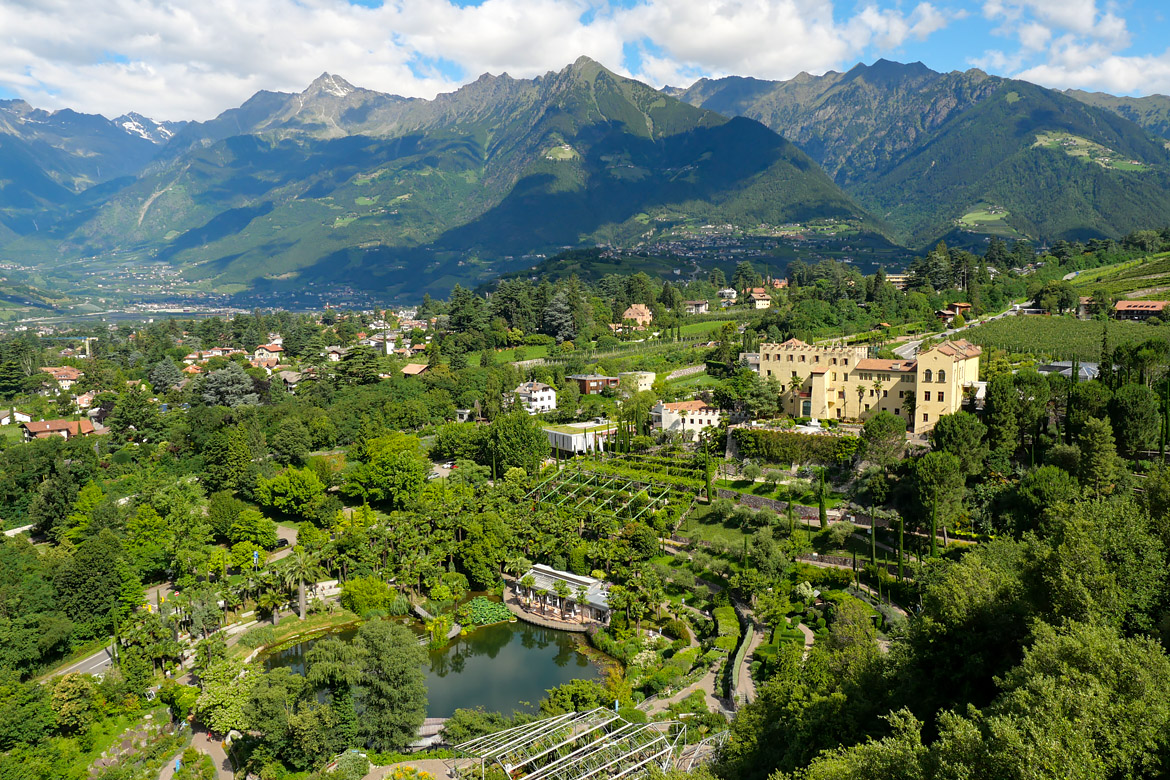
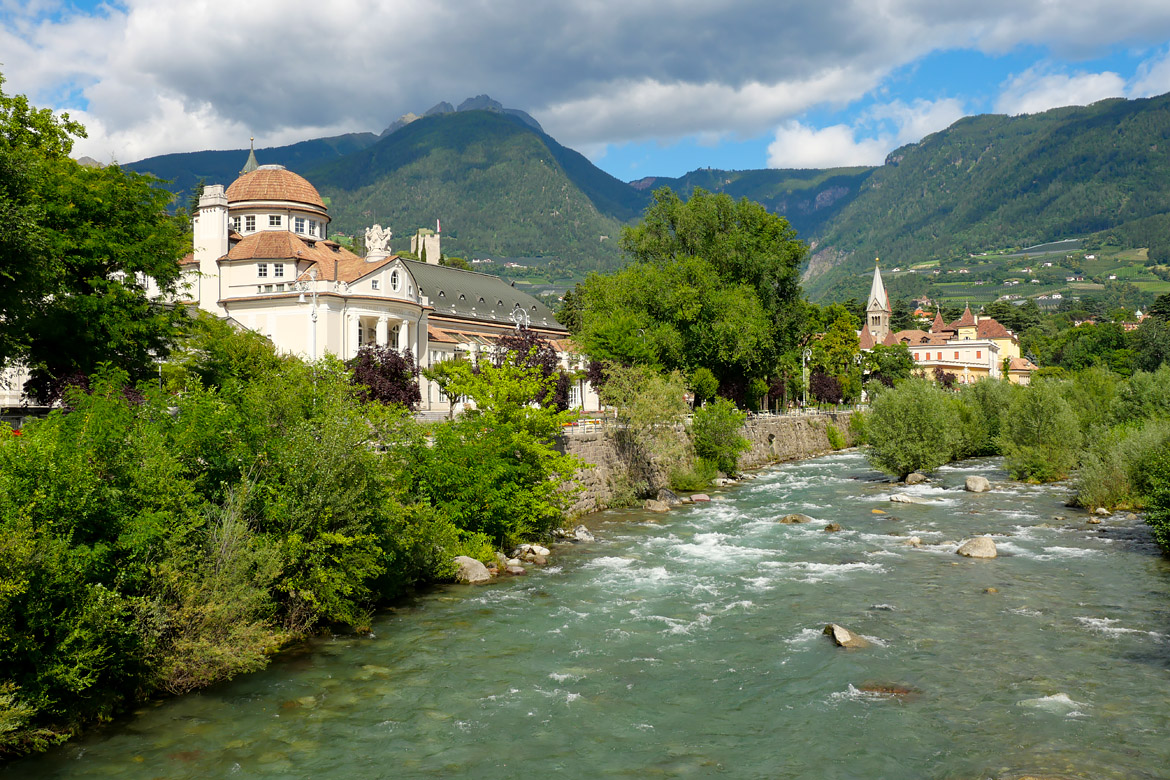
Most travelers arriving by car in South Tyrol choose to stay in Bolzano, the largest city in the region and the closest gateway for starting a road trip in the Dolomites. For our part, we preferred Merano, located 30 km further north. The city can easily keep you busy for a full day, or more if you want to enjoy its thermal baths. You can find the full article what to do in Merano on the blog.


Lago di Carezza (Karersee): the most beautiful lake in the Dolomites
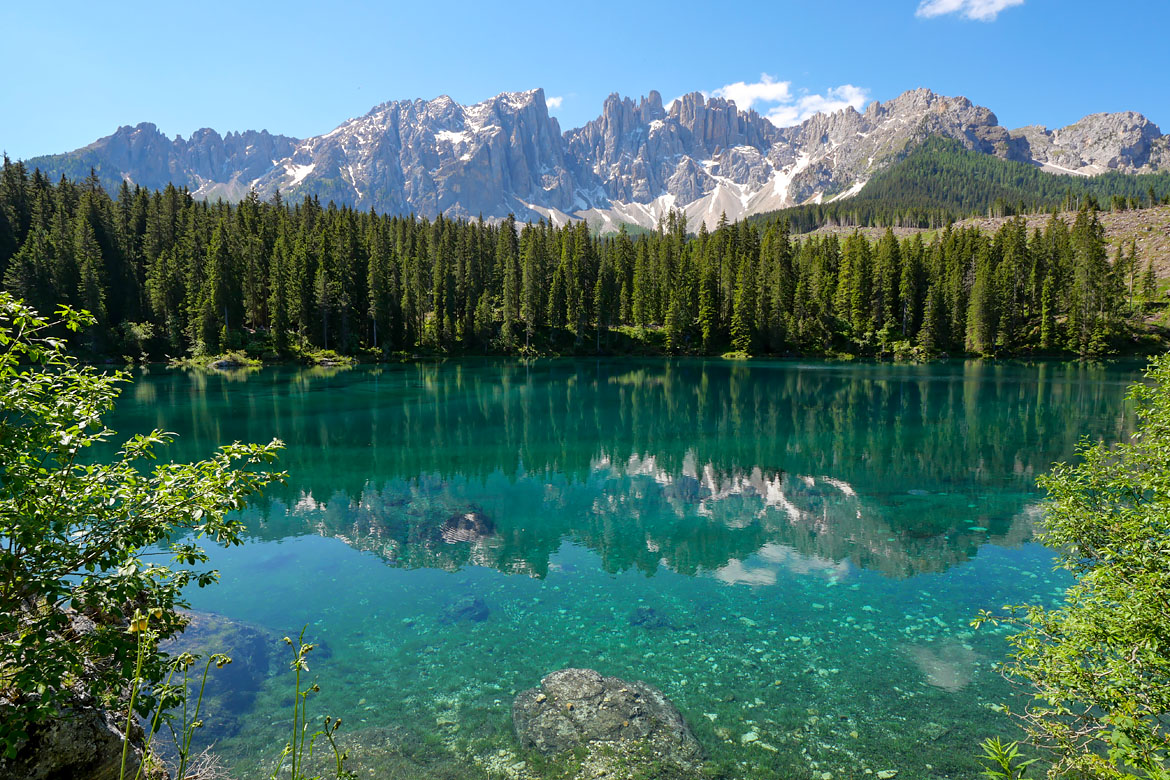
This morning, we leave Merano heading toward Lago di Carezza, 58 km away. Before taking a close look at this road trip, I had imagined a lake lost in the middle of the forest and accessible via a hike. I was quite surprised to see that it is actually located right along the SS241 road—you just need to walk through a tunnel for a few meters from the parking area to reach the lake. Lago di Carezza (1,534 m altitude) was hit by a storm in October 2018 that destroyed a large part of the fir forest. I was afraid I would only see a forest of dead trees, but in the end, the magic of the place is still very much there—you just have to avoid framing your photos too far to the right ! 🙂
The lake has magnificent colors, which has earned it the nickname “Rainbow Lake,” and the surrounding mountains are beautifully reflected in the water. It is the most beautiful lake we saw in the Dolomites. A trail allows you to walk all the way around the lake, but the best viewpoint remains on the road side.
Parking : €1 per hour (€10 for campervans).
Where to stay around Lago di Carezza ?
|

San Giovanni in Ranui Church in Santa Maddalena (St. Magdalena)
From Lago di Carezza, we turn back to head toward Santa Maddalena. The fastest route takes you back through the outskirts of Bolzano. Along the way, we stop in the village of Castelrotto (Kastelruth), which has a charming church and, above all, a Spar supermarket where we buy supplies to make sandwiches for lunch.
The small village of Santa Maddalena is home to the famous San Giovanni in Ranui Church (Sankt Johann), which has become an Instagram star in just a few years. The setting—this Tyrolean-style church standing in a field with the Dolomite mountains in the background—is postcard-perfect. The problem is that more and more tourists were entering this private land without necessarily respecting the place. The owners eventually got fed up and decided to fence off the field and introduce an entrance fee.
Today, you have to pay €4 per person to get close to San Giovanni in Ranui Church (it is not possible to go inside), not including parking (€4 for the day or €2 from 1 p.m.). Fortunately, there is a free alternative to enjoy the panorama : 200 m before the entrance to the hamlet, there is a wooden platform offering a viewpoint over the church and the mountains. At this spot, it is possible to park for free on the roadside, but there are very few spaces. Forget photos and videos with your drone—they are prohibited (this is private property).
Before leaving Santa Maddalena, stop by the center to enjoy the magnificent view of the village church with the mountains in the background (it was actually my desktop wallpaper at work). To reach this viewpoint, you need to take the road at this intersection. However, now—and unlike what you see on Google Maps—there is a “residents only” sign. We decided to go anyway ; after all, there was no one around and we were the only tourists in the area. That was without counting on a farmer who blocked the road a few hundred meters further on with his tractor, yelling at us to turn back. We weren’t even bothering him on this single-lane road—no, he actually came down from his farm on purpose with his tractor (the guy was really motivated). The solution to reach the viewpoint was to walk the entire way, so we gave up. Here is the location of the Santa Maddalena viewpoint if you want to try your luck.
Where to stay in Santa Maddalena ?
|


Alpe di Siusi (Seiser Alm) : the highest alpine meadow in Europe
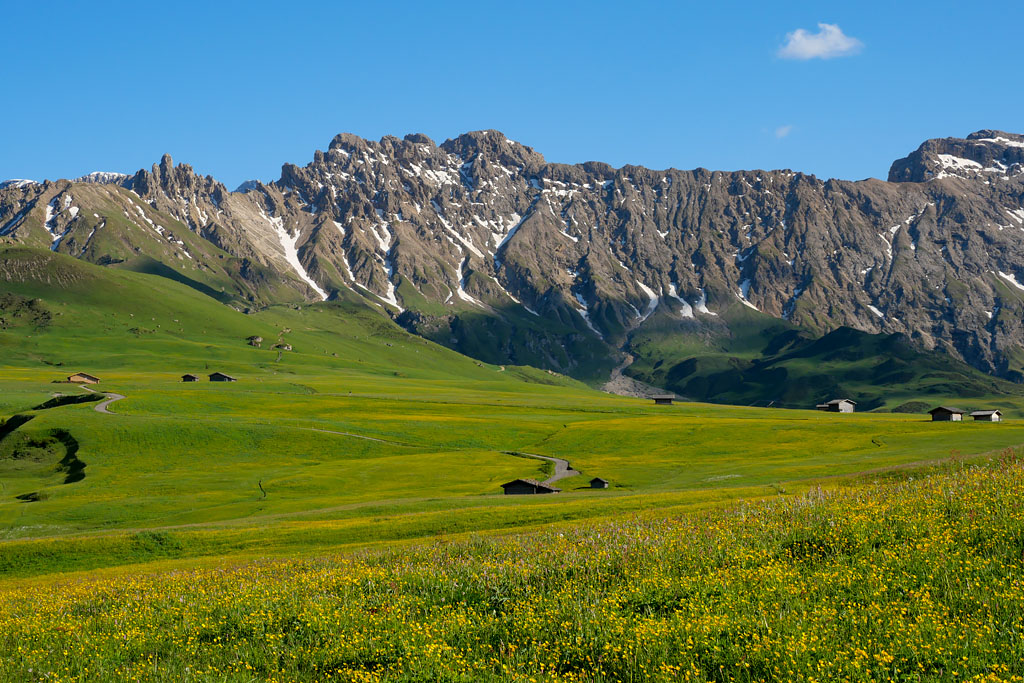
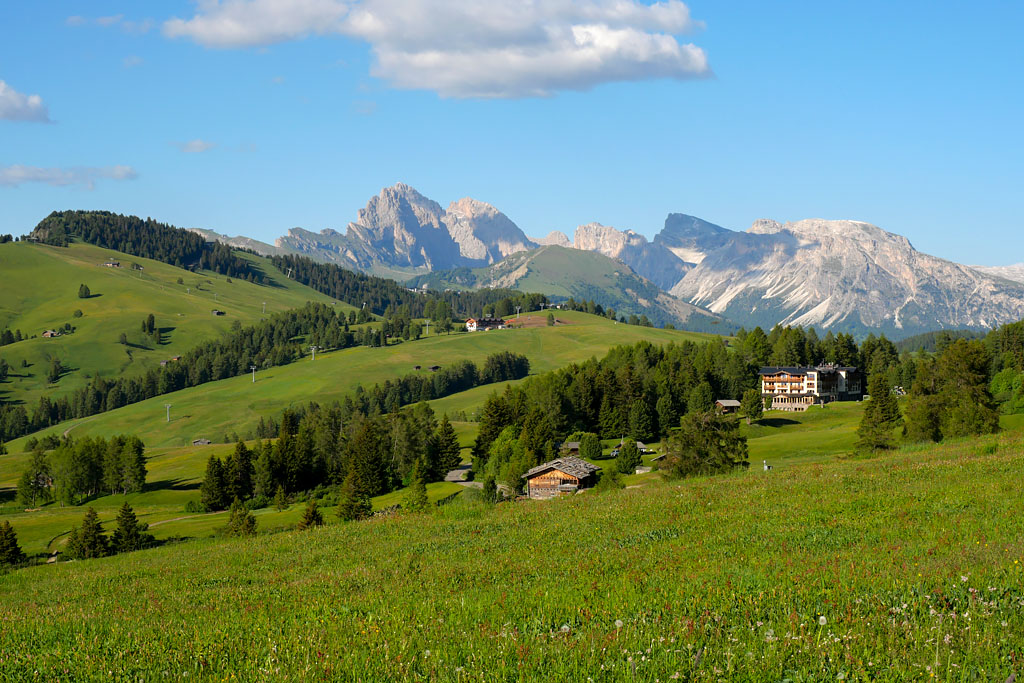
Alpe di Siusi is a vast alpine pasture dedicated to grazing, covering 52 km² at altitudes ranging from 1,680 m to 2,350 m. It is the highest alpine meadow in Europe. In summer, you can go hiking or mountain biking here, and in winter, skiing.
If you want to hike on Alpe di Siusi, you’ll find many routes on the official website, ranging from leisurely walks to multi-day treks with significant elevation gain. As for us, we simply drove up in the late afternoon, as the road is only open after 5 p.m.
How to get to Alpe di Siusi ?
- Cable car : From the village of Ortisei, a cable car operates from late May to early November, from 8 a.m. to 6 p.m. (7 p.m. in summer). Round-trip fare: €18. Parking on site.
- Bus : It is also possible to go up by bus; you’ll find all the information on this page.
- Car : There is a road leading up to Alpe di Siusi, but it is forbidden to use it between 9 a.m. and 5 p.m., under penalty of a heavy fine (unless, of course, you have accommodation there). This is the option to choose if you want to come for sunrise, for example. The turnoff for the road to Alpe di Siusi is located 2 km south of Castelrotto (Google Maps link).

Seceda : a breathtaking view
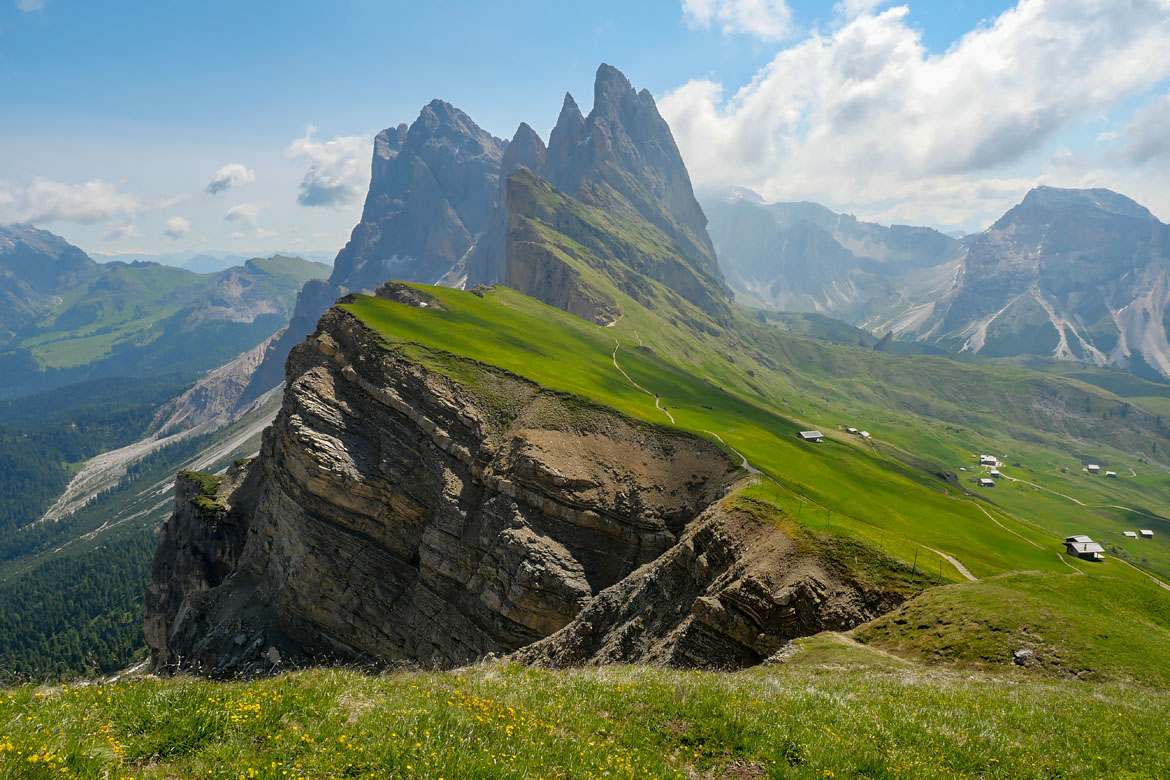
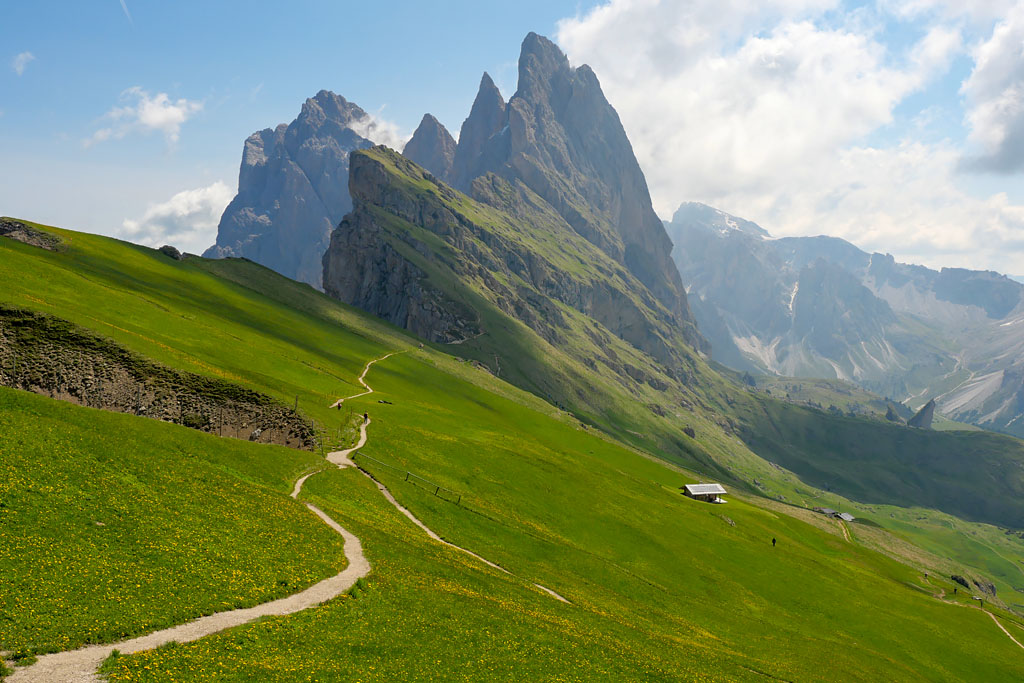
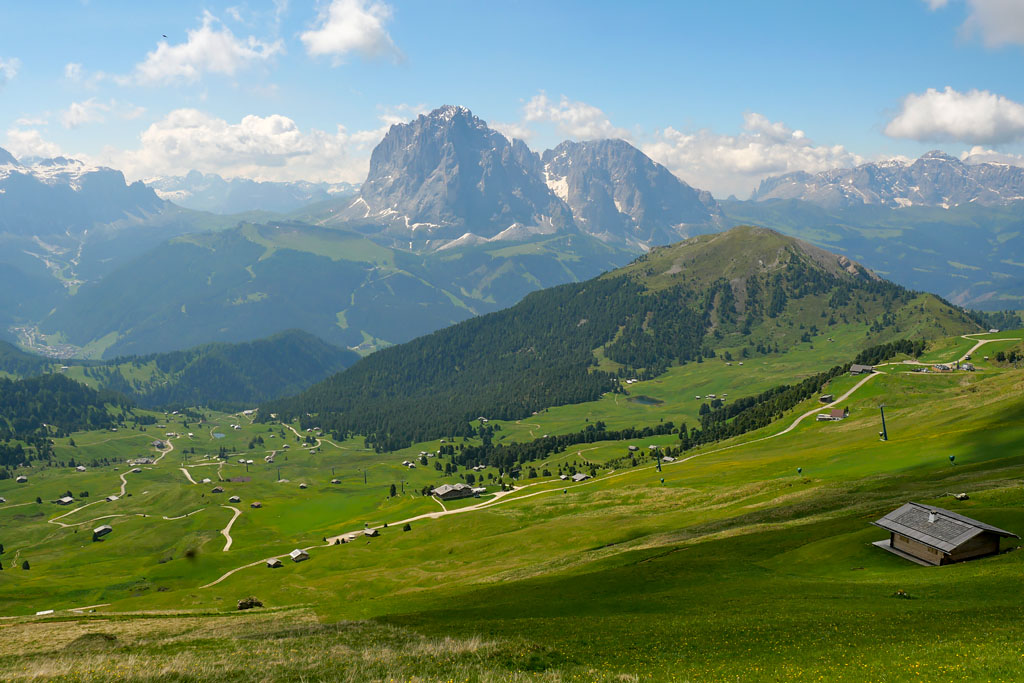
Mount Seceda (2,500 m), located in Val Gardena, is one of the must-see stops on a road trip in the Dolomites, the view is simply spectacular. To reach Seceda, you have two options :
- Take the gondola and cable car from Ortisei (€34 round trip per person), which will take you to the summit in about fifteen minutes.
- Take the hiking trail with its 1,275 m of elevation gain, the best way to discover the landscapes of the Puez-Odle Nature Park.
We chose to take the cable car, as the elevation gain was too much for Daniela. Once you arrive, you need to walk up to the orientation table and then follow the ridgeline path to admire the view. From the summit, you can continue hiking along several trails.
As for parking, the easiest option is to use the parking lot located below the cable car. The rate between 7 a.m. and 7 p.m. is €1.50 per hour, with a maximum of €8 (if you stay all day), and €0.30 per hour between 7 p.m. and 7 a.m. Two hours are free if you use the cable car.


The village of Ortisei (St. Ulrich in Gröden)
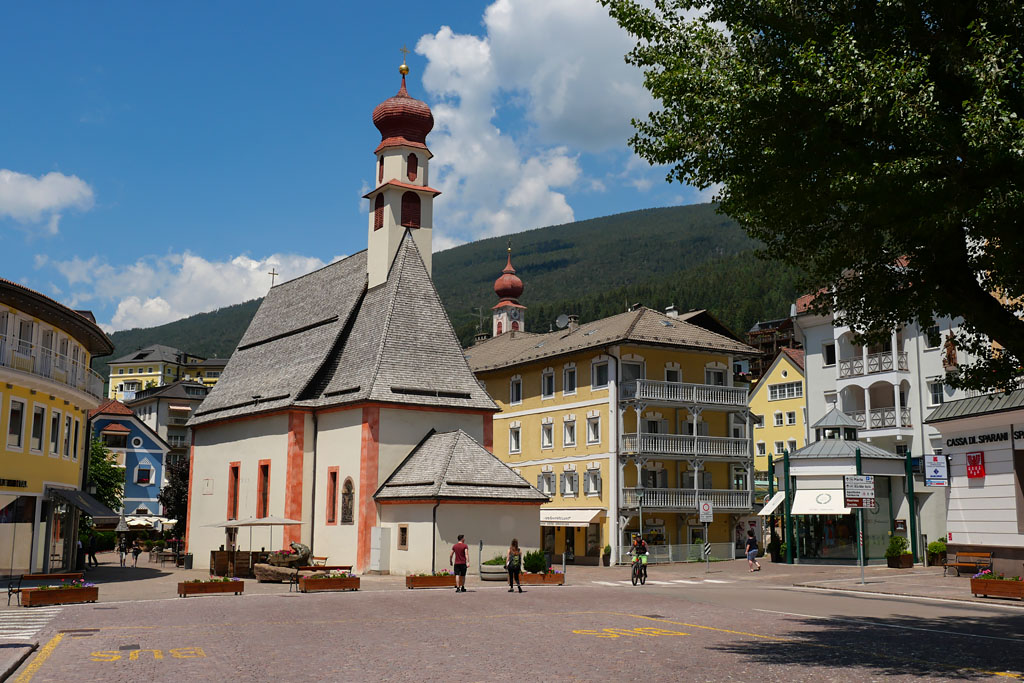
Don’t miss a stroll through the charming village of Ortisei (1,236 m) when you head up to Seceda or Alpe di Siusi. Ortisei is a very touristy village, but during our Dolomites road trip it was fairly deserted. It is known for its pedestrian shopping streets and its many remarkable buildings (including wood carvings). We took advantage of the calm atmosphere to eat our sandwiches in the village square.
Where to stay in Ortisei ?
|

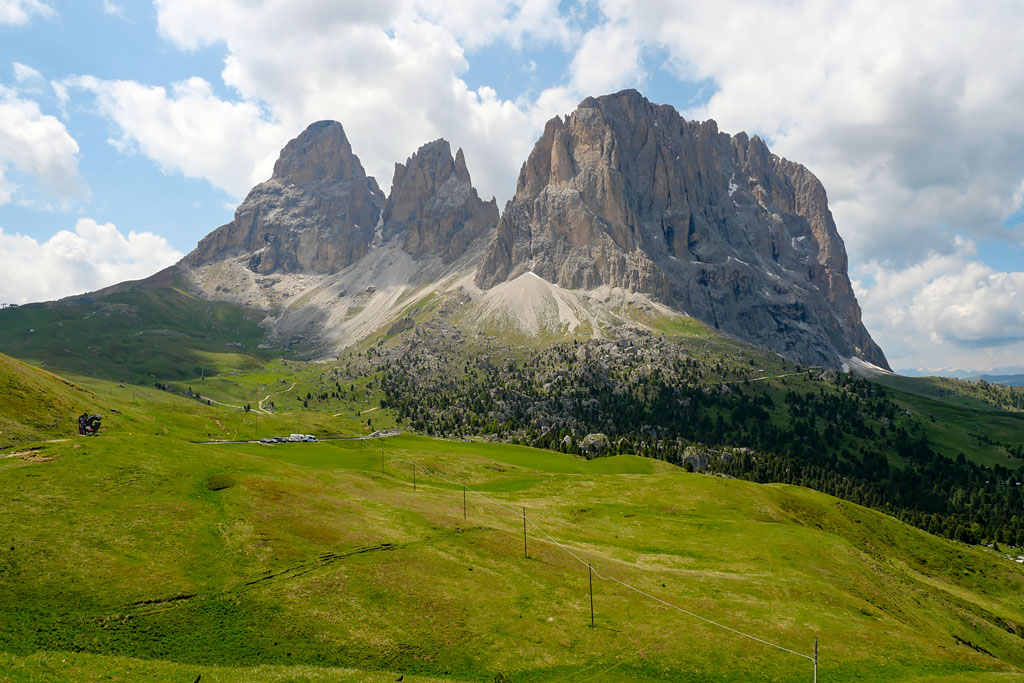
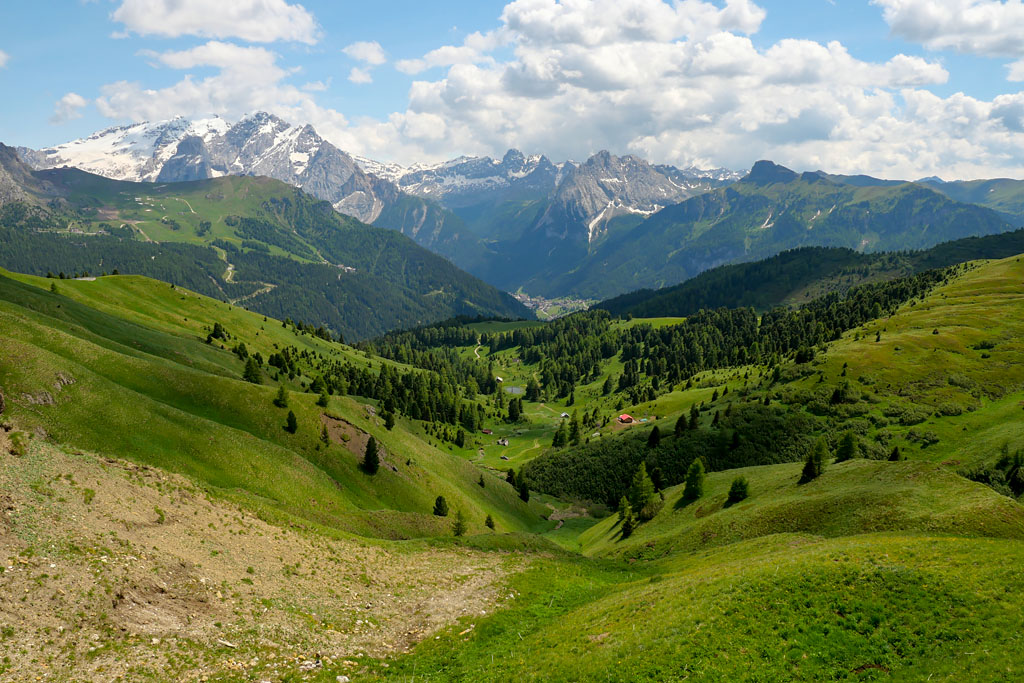
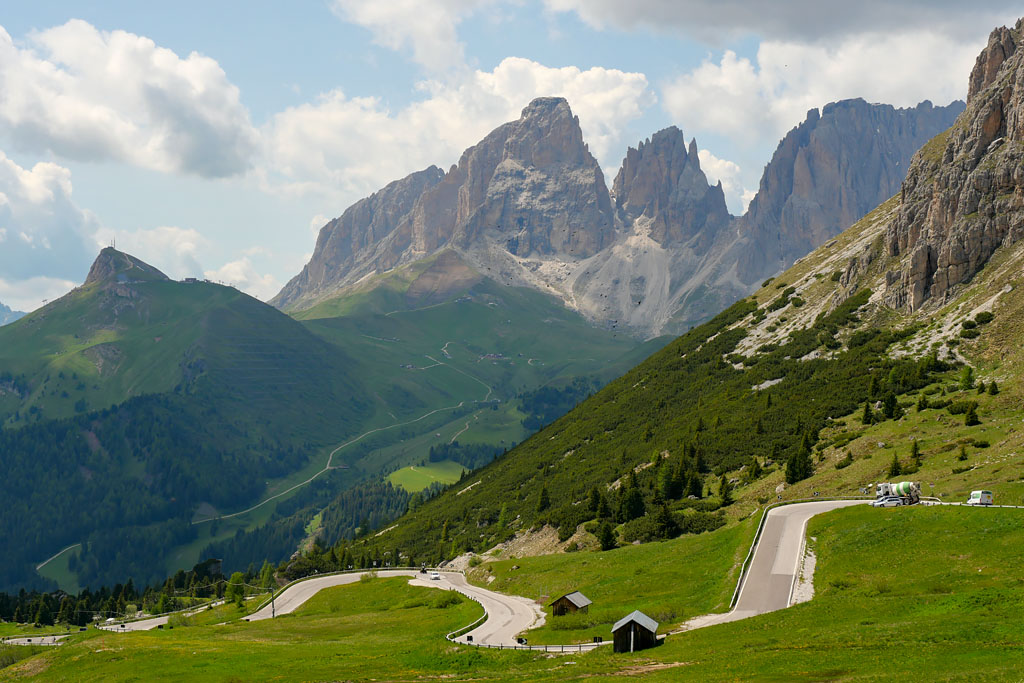
The mountain passes Passo Sella and Passo Pordoi
After leaving Ortisei, we take the SS242 road toward Passo Sella (2,244 m). The road winds through magnificent landscapes, with the “Torri del Sella,” a five-peaked mountain, as a dramatic backdrop. We then take the SR48 road toward Cortina d’Ampezzo, passing another mountain pass, Passo Pordoi.
Naturally, this entire region is ideal for hiking, with numerous trails to explore. From Passo Pordoi (2,240 m), a cable car takes you up to Sass Pordoi (2,950 m) for stunning panoramic views.
Cinque Torri hike
The Cinque Torri (not to be confused with the Cinque Terre) are a mountain complex made up of five rocky spires near Cortina d’Ampezzo. To reach this area, you need to take a small mountain road from the SR48 to the “Rifugio 5 Torri,” or take the chairlift (€17) up to Rifugio Scoiattoli. From here, several hikes are available, the most famous being the Cinque Torri loop (Giro delle Torri).
The Cinque Torri, Cortina d’Ampezzo, and Lago di Sorapis are located in Veneto rather than South Tyrol, as the Dolomite range spans both regions.

Via Ferrata in the DolomitesAre you familiar with via ferrata ? This activity involves progressing along a route equipped on a rock face using specific metal elements (cables, ladders, rungs, bridges, etc.). There are several difficulty levels, making via ferrata accessible to everyone, including children. Originally, the Italian army developed this activity at the beginning of the 20th century by equipping certain exposed passages in the Dolomites to allow alpine troops to cross them with heavy equipment. Today, it has become a tourist activity, and routes are generally open from April to October. You’ll find providers offering via ferrata experiences in the Dolomites in Bolzano and Cortina d’Ampezzo. Another option, to be sure of availability, is to book in advance using the links below :
|
Lago di Sorapis hike
- Elevation gain : +200 mètres / -200 mètres
- Hike time : 4 hours
- Distance : 10.4 km
- Altitude : between 1,725 and 1,925 m
- Hike difficulty : moderate ★★☆☆☆
Before setting off for this day of hiking, we grab two sandwiches from the excellent Fiori pastry shop (annex of Hotel Fiori). They are made to order with great local products (ham and cheese, among others). With our picnic packed, we head to the starting point of the Lago di Sorapis hike at a place called “Passo Tre Croci” (Google Maps link).
The Lago di Sorapis hike is one of the must-see spots in the Dolomites, so it’s no surprise that it can be very busy. Once again, as we were traveling just after the COVID-19 lockdown, there were very few people, and I was able to park along the road right in front of the starting point sign. Under normal circumstances, it’s best to come very early to avoid the crowds of hikers.
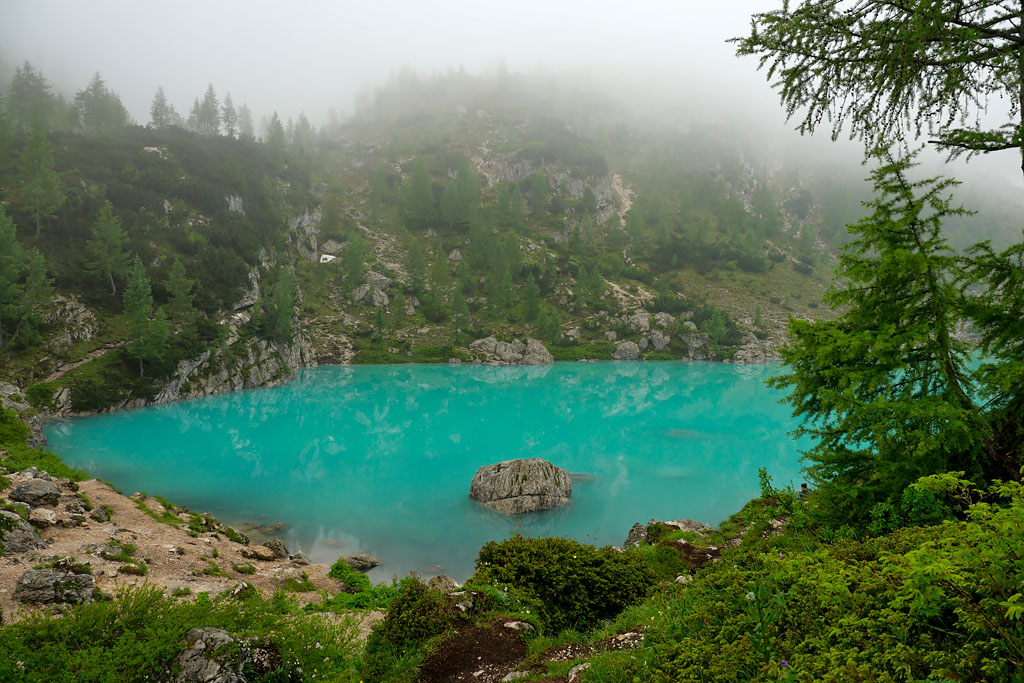
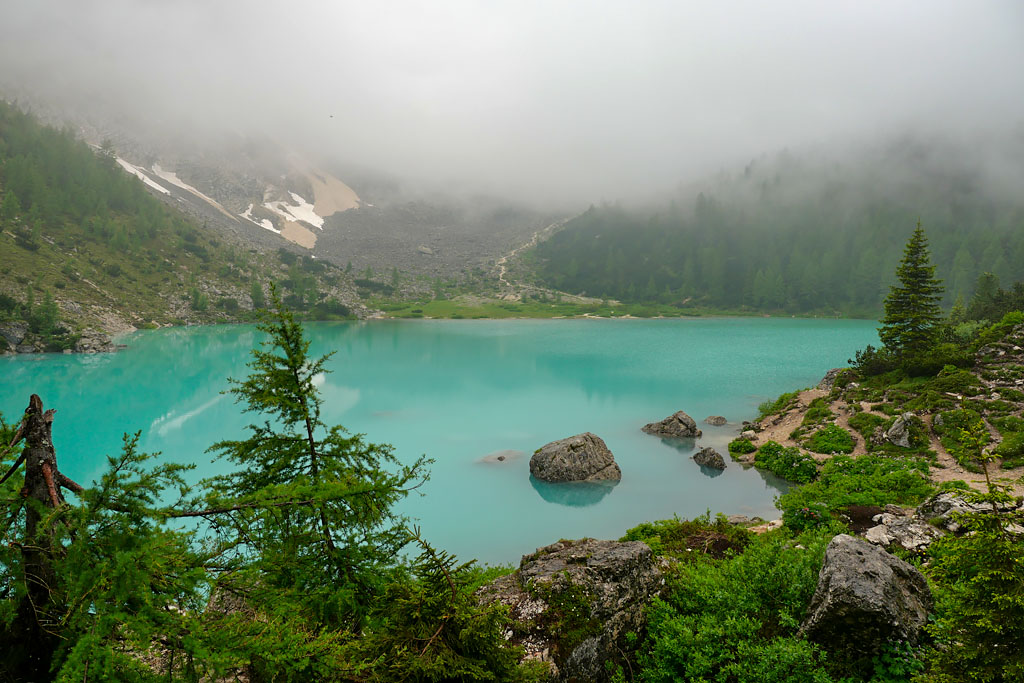
The weather is far from sunny today, there is a lot of fog. The hike begins with an almost flat forest path, where you pass through a snowfield (or a rocky scree in midsummer), before climbing a bit more toward the lake. There are a few sections that are quite exposed, but a metal handrail (similar to the ones I encountered while hiking in the Lofoten Islands) helps you along. In the end, you don’t really see the drop, which is good news for anyone with a fear of heights. We get caught in several downpours on the way up; between the fog and the rain, I didn’t take my camera out once.
When we arrive at Rifugio Vandelli (the Sorapis Lake refuge), the fog is so thick that we can’t even see the lake. Needless to say, we’re pretty disappointed. Eventually, we get a brief break in the fog and manage to take a few photos of Lago di Sorapis, but we never see the surrounding mountains. Weather in the Dolomites—especially in the mountains—is very unpredictable, even in summer.
On the way back, it’s even worse: nothing but fog (at least we can’t see the drop) and rain. With this weather, we head back to Hotel Fiori to relax and enjoy the complimentary afternoon snack (a good slice of Sacher torte with tea).

Tre Cime di Lavaredo hike
- Elevation gain : +230 meters/ -230 m
- Hike time : 3 hours
- Distance : 8 km
- Altitude : between 2,293 and 2,451 m
- Hike difficulty : easy ★☆☆☆☆
The next day, the weather hasn’t improved. We had planned two days of hiking in the Dolomites, and of course the weather had to turn bad at that exact moment. Too bad—we have no choice. This morning is dedicated to the Tre Cime di Lavaredo hike (out-and-back to Rifugio Locatelli), as we then need to continue our road trip north through South Tyrol and on to Austria.
To reach the Tre Cime, you need to drive to the large parking lot at “Rifugio Auronzo” (2,293 m). Get your wallet ready, because the toll to access the Tre Cime is exorbitant: €30 for cars and €45 for campervans.
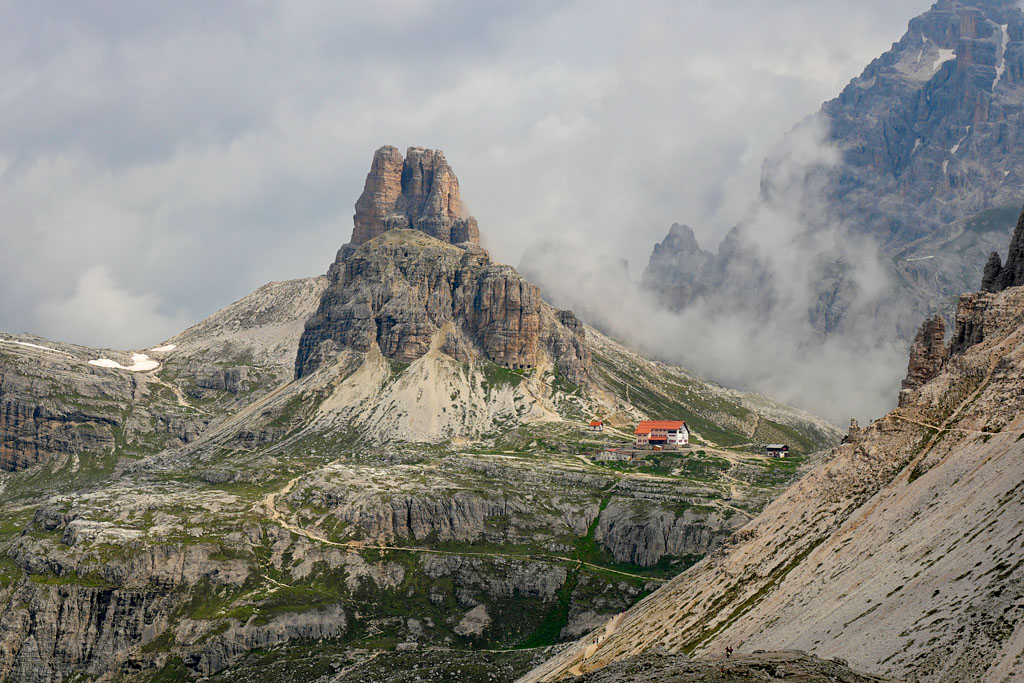
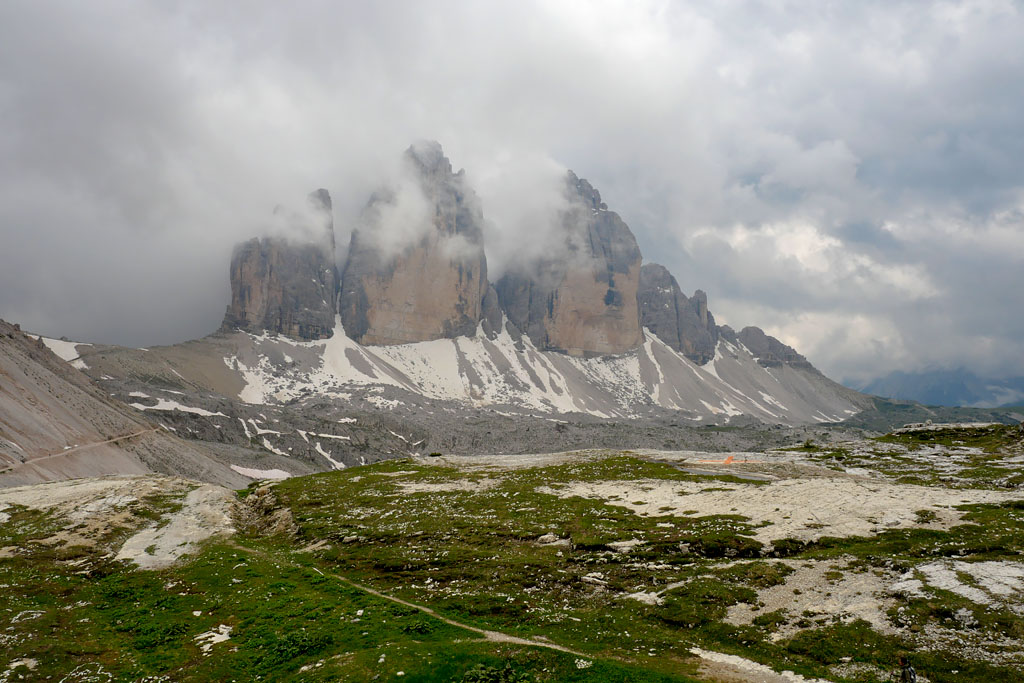
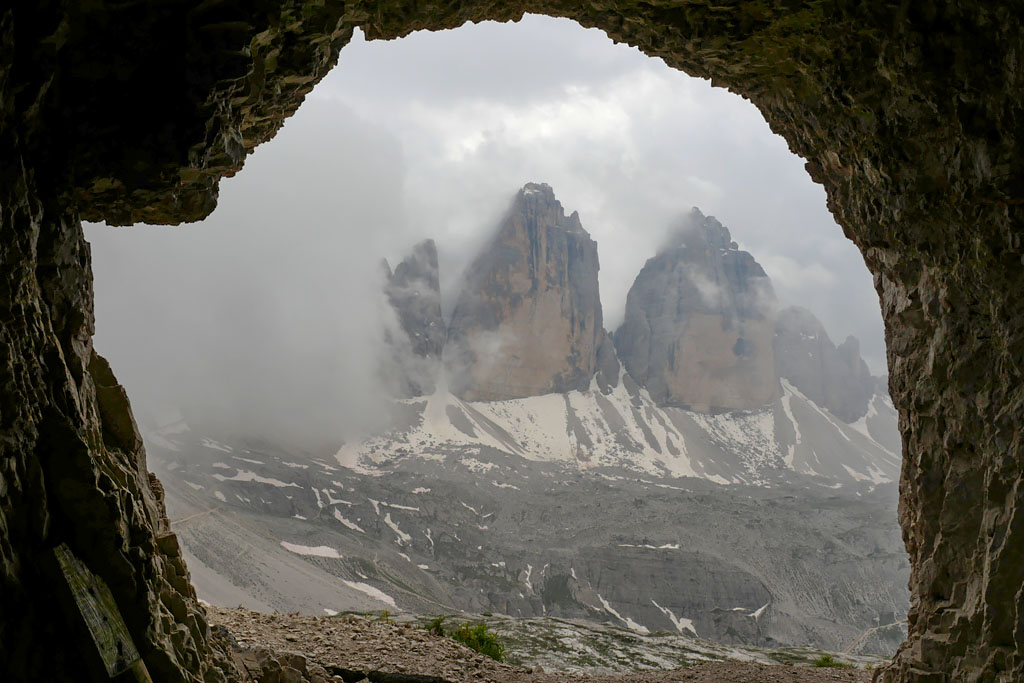
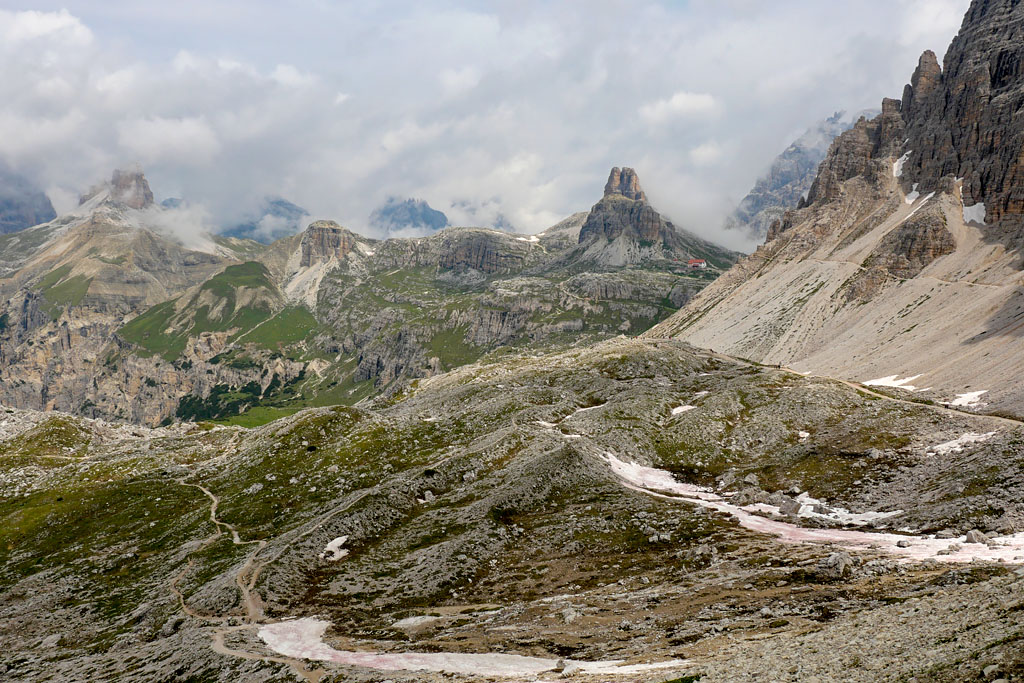
The hike begins on a wide, almost flat dirt road (used by vehicles to supply the refuges) leading to Rifugio Lavaredo (2,345 m). The fog is so dense that visibility is less than 50 meters, which is actually why I didn’t even recognize the Tre Cime when we were right at their base. It’s only when heading toward the third refuge (Rifugio A. Locatelli – 2,402 m) that we start to glimpse the famous three peaks behind us. For a nice viewpoint, climb up to the caves located above Rifugio Locatelli.
This hike is really easy, which explains why it’s so popular. It was the only time during our Dolomites road trip that we saw a lot of people. I can’t even imagine what it must be like under normal conditions. Try to come as early as possible.

Lago di Landro (Dürrensee) : a touch of the Rockies
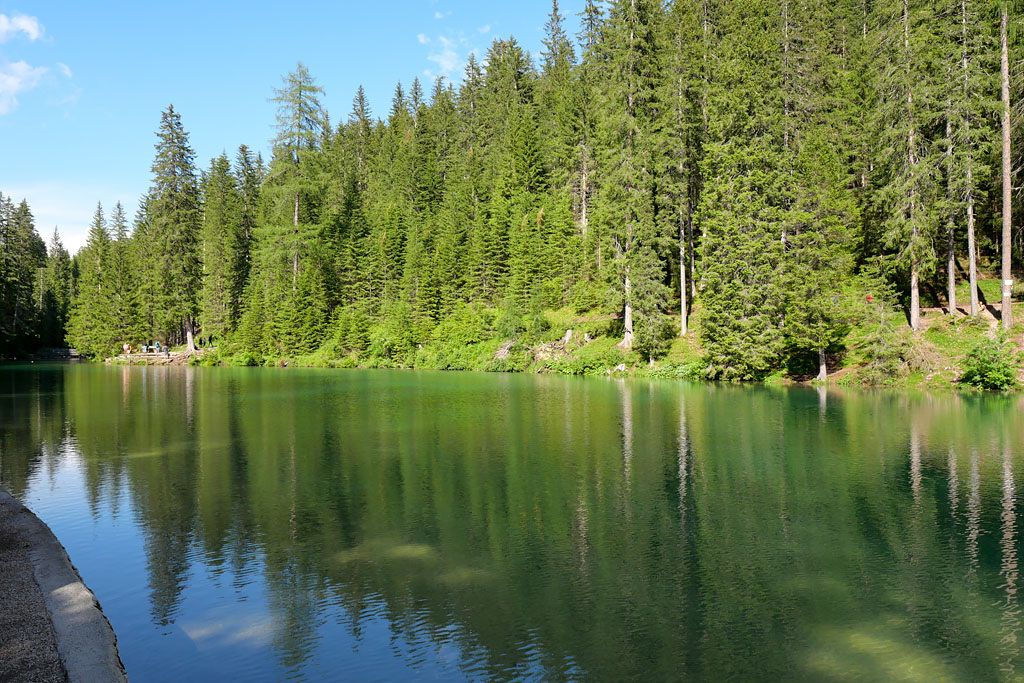
Since Lago di Landro is located right along the SS51 road toward Lago di Braies, we take advantage of the drive to stop for photos, even though with this cloudy weather the lake doesn’t show its full potential. With its larch forests and snow-capped peaks, you could almost think you were in the Canadian Rockies. To reach the viewpoint facing the mountains, cross the wooden bridge that spans the river at the very north end of the parking lot, then walk through the forest to reach the sandy shore of Lago di Landro.

Lago di Braies (Pragser Wildsee) : the highlight of the Dolomites
As if by magic, the sun comes out in the late afternoon when we arrive at Lago di Braies (1,495 m). This lake is one of the most beautiful places to see in the Dolomites, and it would have been a shame to have fog once again. The lake is extremely popular on Instagram—you’ve surely already seen photos of its wooden boats. It’s possible to rent them (the price is quite high, €19 for half an hour), but during our post-COVID trip everything was closed. A path still allows you to walk around the lake (about 1 hour), but the best photo viewpoints are located on the side of the boathouse where the boats are rented.
There are several parking lots along the road leading to Lago di Braies, with slightly varying prices. We used parking lot P2, where the rate is €5 for the day (someone comes by to collect payment and gives you a ticket). If you want to stay overnight right by the lake, you can spend the night at the iconic Hotel Lago di Braies.
Lago di Braies was the final stop on our 5-day road trip in the Dolomites. Since the Austrian border is very close, we then went on to visit Innsbruck in the Austrian Tyrol, followed by southern Bavaria in Germany.



Where to stay on a Dolomites road trip ?
If you don’t want to change accommodation every night, you can visit the Dolomites by choosing just two bases. This will allow you to explore the western part of the Dolomites, which includes Lago di Carezza, Alpe di Siusi, Seceda, and Santa Maddalena, and then the eastern part with Cinque Torri, Lago di Sorapis, Tre Cime, Lago di Landro, and Lago di Braies.
The areas of Ortisei and Cortina d’Ampezzo make two excellent bases for visiting the Dolomites. Since both are very touristy towns, you may want to look in the surrounding villages to find accommodation at more affordable prices. That’s what we did by staying at two great places that I highly recommend : Pension Haus Tirol, 12 km from Ortisei, and Hotel Fiori, 12 km from Cortina d’Ampezzo.
I hope this account of our 5-day road trip in the Dolomites will inspire you to discover this magnificent region and help you plan your itinerary. If you have any questions, feel free to ask them in the comments section of the blog below.
2 comments
Hello~ I’d like to go dolomites 2027 around June ~ july with this plane (5days). I’d like to know how much need ? Please
Hello Regina, it depends on what you plan to do and how you’ll be traveling (we came in our own car). It’s best to run through a budget estimate that includes transportation and accommodations. But you should expect to spend at least €100 per day per person.