

Are you going to Puglia in Italy and looking for the best things to do in Lecce ? The capital of Salento, with its Baroque architecture, boasts numerous palaces and churches built from local stone with a golden hue. You need to take the time to stroll through the historic center to admire all the details of Lecce Baroque and truly appreciate its beauty. Beyond its heritage, Lecce is an excellent base for exploring Salento, the southern part of Puglia. The surrounding area is home to beautiful beaches and stunning fortified towns.
So what to do in Lecce ? What are the must-see sights ? Where to stay in Lecce ? I share all my tips in this travel guide following our stay there in October.
What to do in Lecce in the Baroque center ?
The Duomo is the heart of Lecce’s Baroque old town. It is bordered by the main boulevards Gallipoli to the south, Università to the west, and Otranto – Michele De Pietro to the east. Within this perimeter you’ll find all the must-see sights in Lecce. The visit is easy to do on foot, as almost every street corner reveals a monument, a church, or a Baroque palace.
The sites are presented in the order we followed, starting from the parking lot next to the train station, in the southwest of the city (see the section “Where to park in Lecce”). I haven’t made an exhaustive list of all the monuments to see, but rather those we found the most interesting. This will already give you a good base for things to do in Lecce. After that, you simply need to wander through the alleyways to discover all its treasures.
Guided tours
Tours with a guide allow you to learn much more about history, discover local gastronomy, or more easily meet local people. There’s something for everyone. Here are a few activities I recommend :
- Baroque Architecture and Underground Walking Tour (1.5 hours)
- Guided Street Food Walking Tour with Food and Wine (2 hours)
- City Highlights Guided Tour by Rickshaw (1-3 hours)
Cathedral of Santa Maria dell’Assunta
The first version of Lecce Cathedral was built in 1144, but its current appearance dates from 1670, a period when many buildings in the city were rebuilt in the Baroque style. The Duomo has two entrances; we arrived from the south, where there is a fairly sober façade. It was only when leaving that we saw the majestic main entrance.
The interior of the Cathedral of Santa Maria dell’Assunta, with its Latin-cross plan and three naves, is superb. It has twelve particularly ornate altars. The second on the left features a lovely Nativity scene sculpted by Gabriele Riccardi (4th photo). The coffered ceiling is just as beautiful, with three canvases from the 17th and 18th centuries. There are many paintings in the cathedral, all from the Lecce school. In the basement there is a crypt with 92 columns whose capitals depict animals. Attached to the cathedral, the 70-meter bell tower is the tallest in Puglia.
Even if you’re not a big fan of architecture and don’t plan to do all things in Lecce, I recommend not missing the cathedral. The entrance ticket for the Duomo also includes other Baroque churches (LeccEcclesiae ticket). We bought it on the official website before visiting Lecce. Tickets can also be purchased on site ; the ticket office is on Piazza Duomo next to Palazzo del Seminario. Another ticket allows you to climb the bell tower to enjoy a 360° panorama at 43 meters high.
Prices : €11 (€5 for ages 12–17) for the LeccEcclesiae ticket | €12 (€9 for ages 6–17) to climb the bell tower | €21 for the combined ticket.
Opening hours : daily from 9 a.m. to 9 p.m. (until 6 p.m. from October to March).
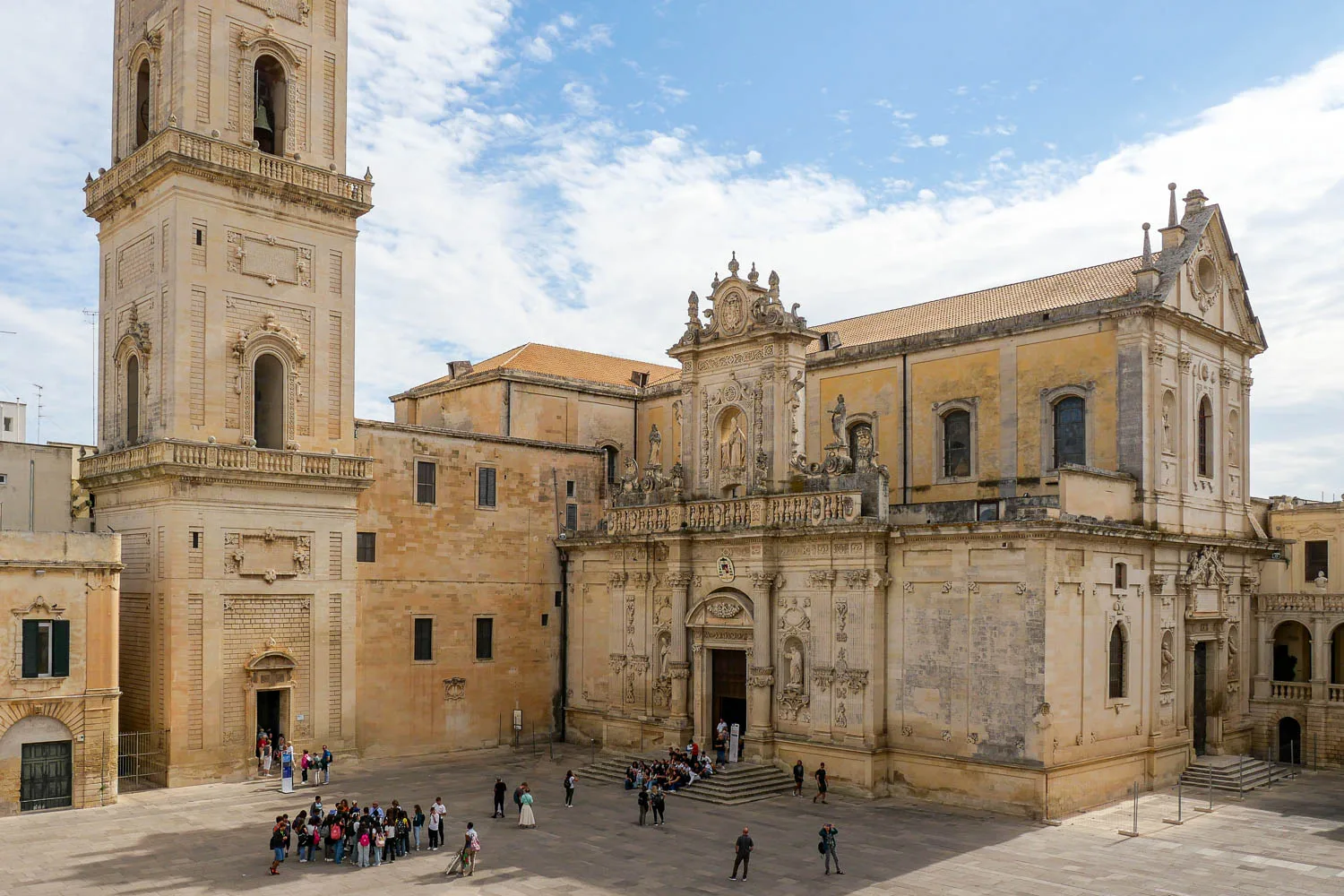
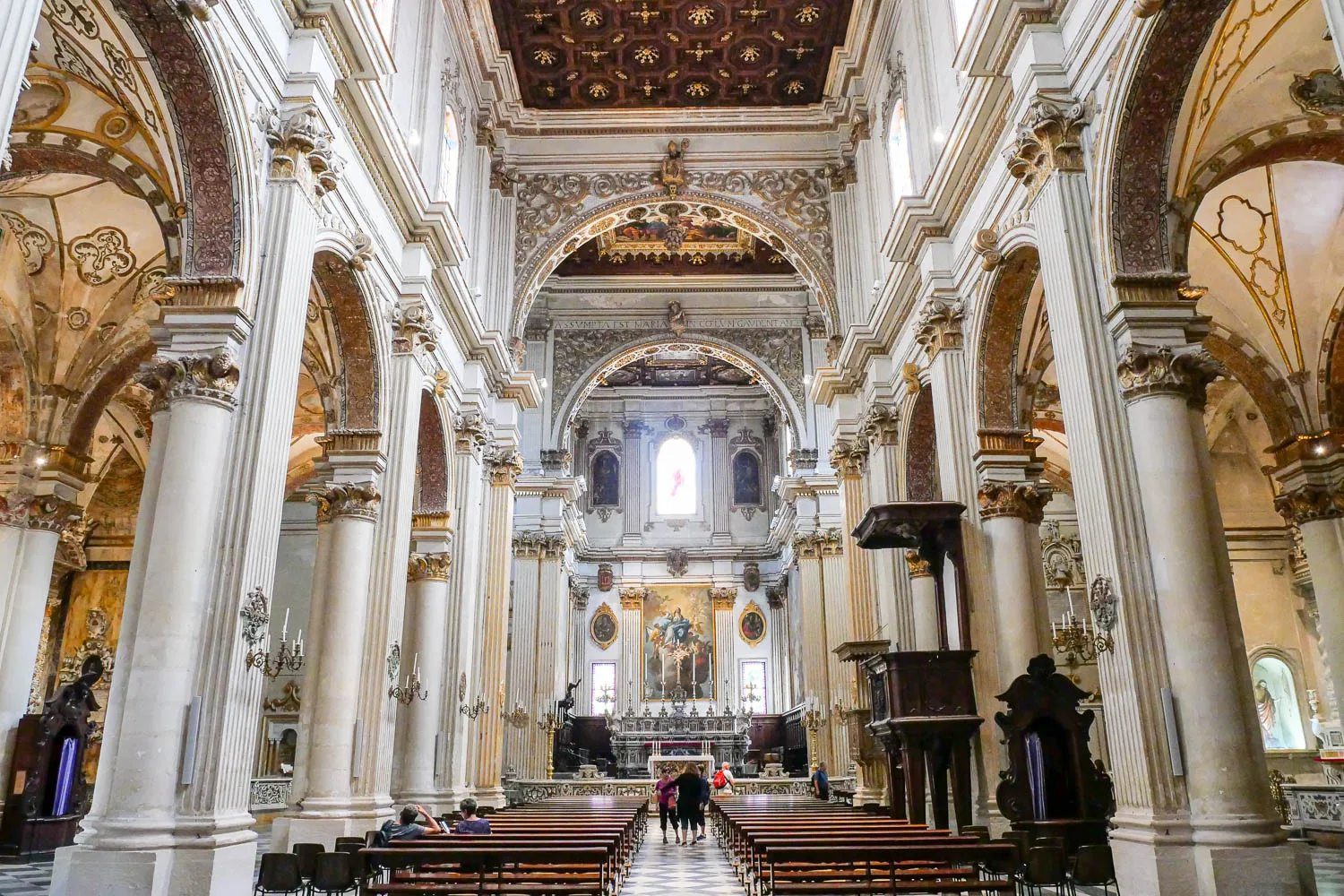


Piazza Duomo
If, like us, you entered the cathedral from the south, you’ll discover Piazza Duomo when you exit. Unlike most squares, which are open to the city, this one is enclosed by monuments, except to the north where a pedestrian street connects it to the rest of the historic center.
Surrounding Piazza Duomo are the cathedral, the bell tower, the Palazzo Arcivescovile (bishop’s palace), and the Palazzo del Seminario, which houses the Museum of Sacred Art. In my opinion, it’s the most beautiful square in Lecce. The entire ensemble of buildings and the square was created in the 17th and 18th centuries in the city’s typical Baroque style. To get a nice photo, you’ll need to come in the afternoon; otherwise the sun is right in front of you (unlucky for us, it was very cloudy).
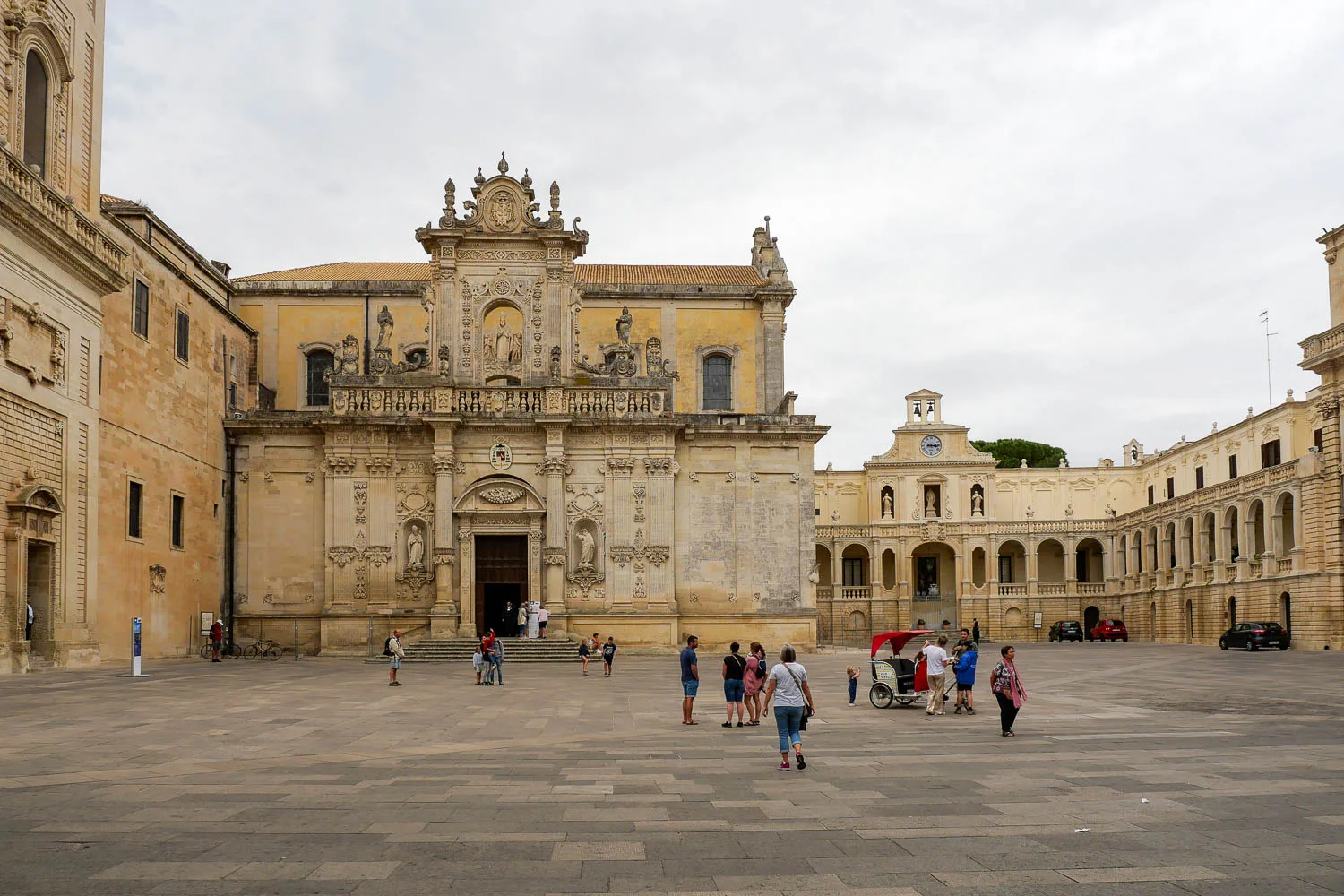
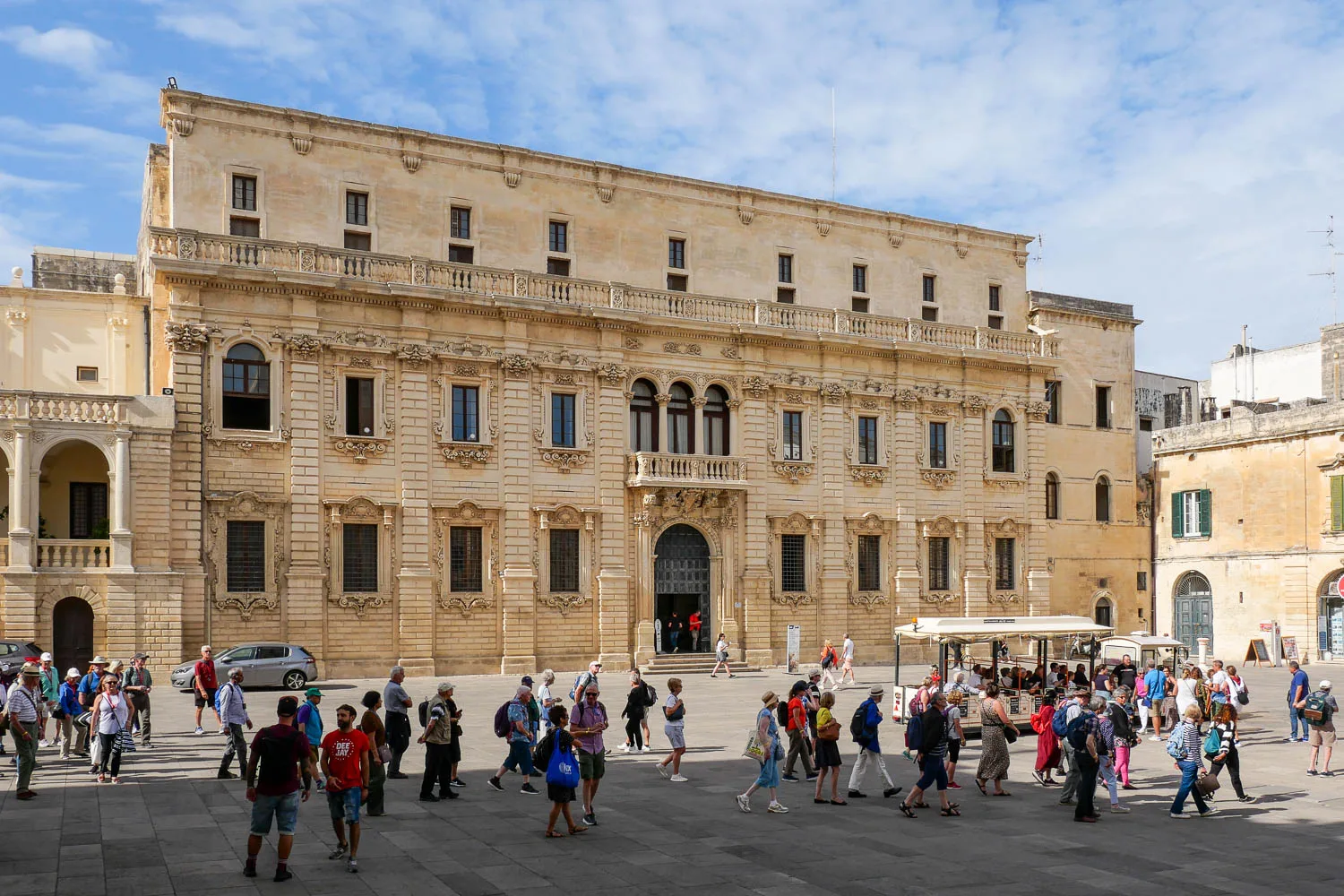
Palazzo del Seminario (MuDAS)
The Museum of Sacred Art (Museo Diocesano di Arte Sacra, or MuDAS) is located inside the Palazzo del Seminario. This lovely Baroque palace features a courtyard with a well. The staircase leading up to the first floor, where the museum is located, offers a beautiful photo viewpoint over the entire square and the bell tower.
As for the museum, which is included in the LeccEcclesiae ticket, it brings together a collection of liturgical objects (chalices and gold-embroidered chasubles), as well as sculptures and paintings. We’re not particularly fans of this type of museum, so we visited it fairly quickly since it was included in the Duomo ticket.
Price : same ticket as the Duomo ; there is no ticket for MuDAS alone.
Opening hours : daily from 9 a.m. to 9 p.m. (until 6 p.m. from October to March).


Church of Santa Chiara
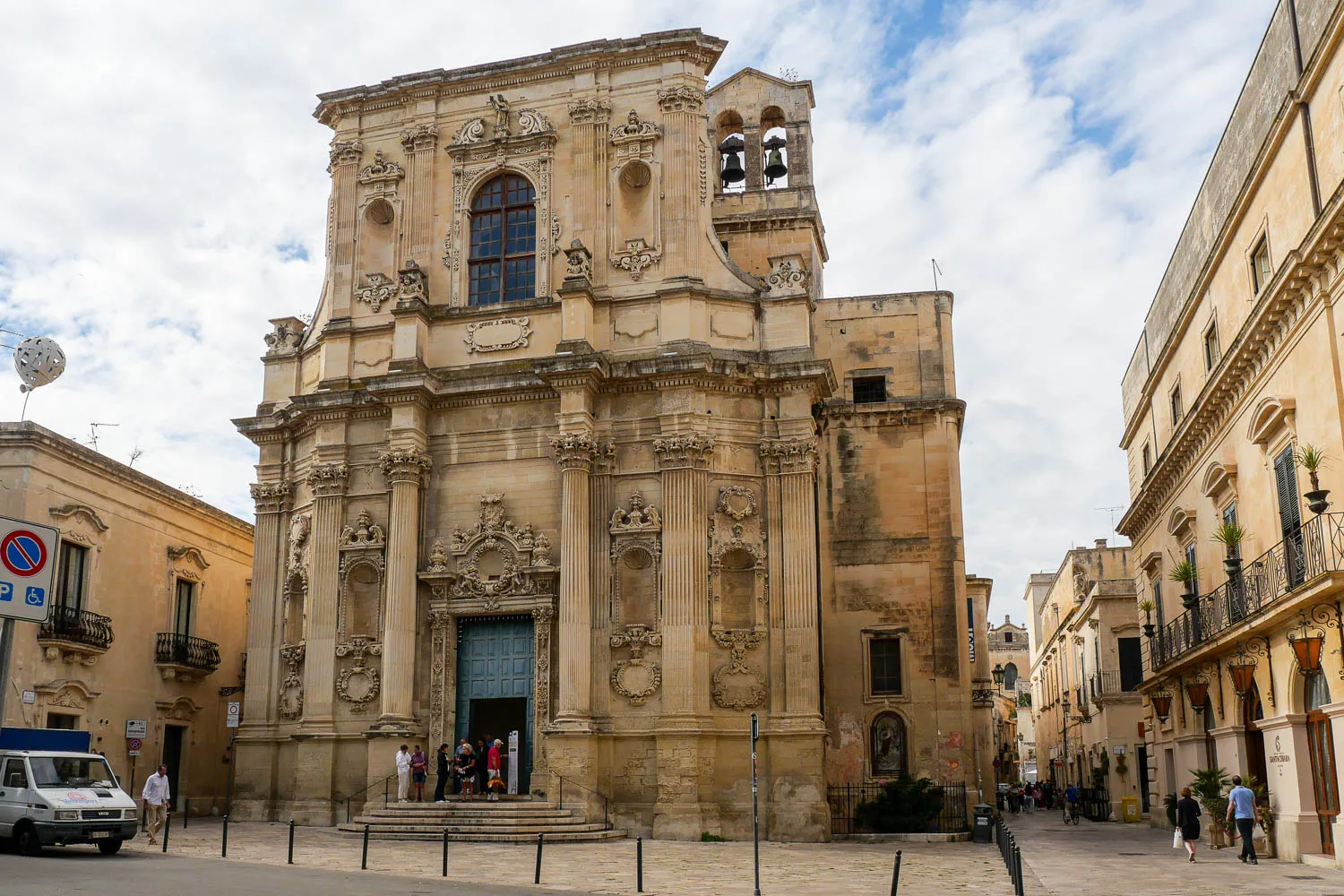
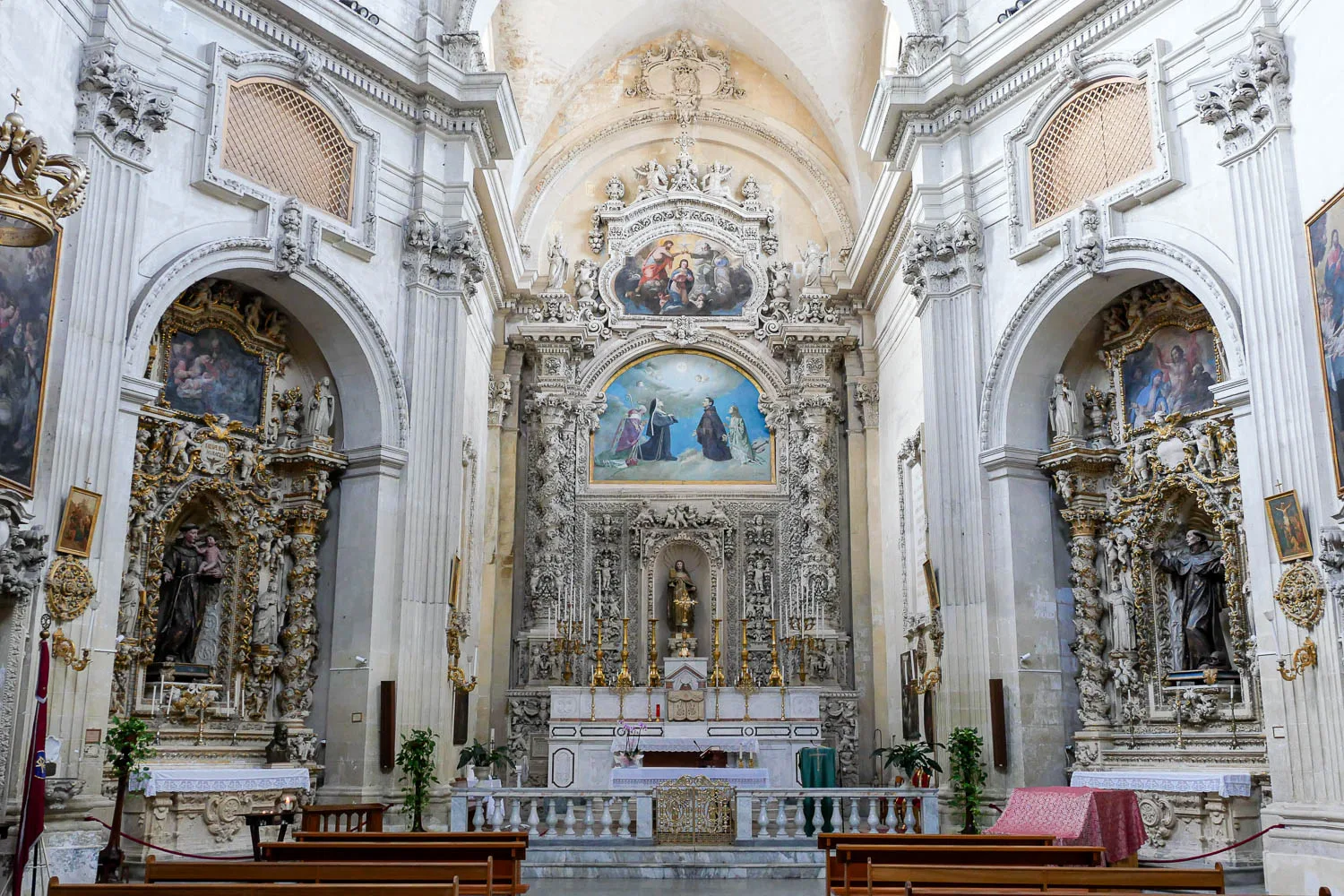
We continue our visit to Lecce with the Chiesa di Santa Chiara, located east of Piazza Duomo. This church, founded in 1429 with an adjoining monastery, was renovated in 1687 during the Baroque frenzy that swept the city. The architect Giuseppe Cino was responsible, the same one who built Palazzo del Seminario. The church has an unusual elongated octagonal shape, with gilded altars housing wooden statues made by two Neapolitan masters. At that time, Lecce was part of the Kingdom of Naples.
If you look at the coffered ceiling, you might think it’s made of wood, but that’s an illusion. It was created in papier-mâché in 1738. Several statues in Santa Chiara Church are also made of papier-mâché (20th century).
As in all Italian churches, appropriate dress is required. Avoid visiting Lecce in shorts and tank tops, as you won’t be able to enter the churches (unless you have something to cover up).
Price : LeccEcclesiae ticket (€11).
Opening hours : daily from 9 a.m. to 9 p.m. (until 6 p.m. from October to March).
Roman Theatre
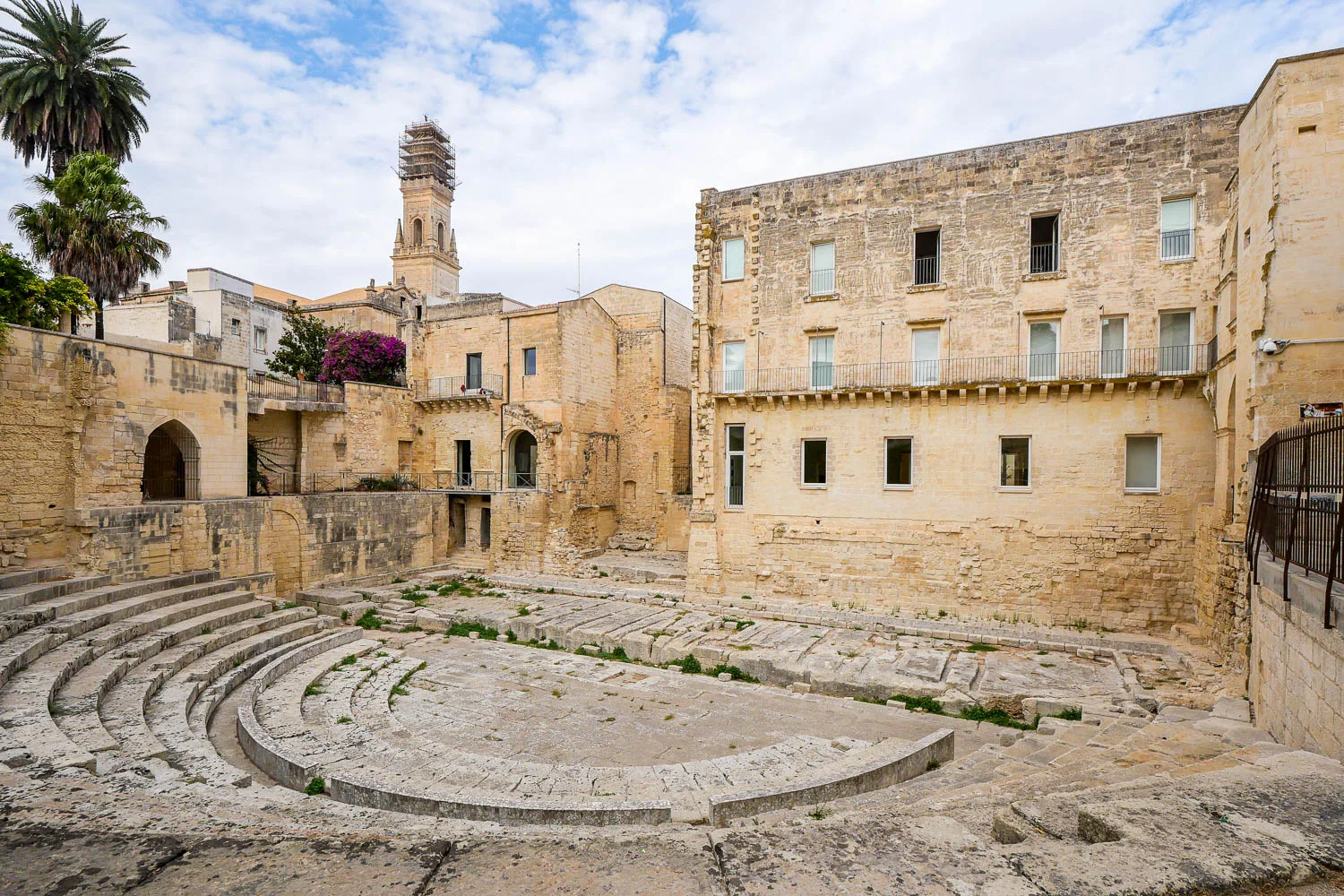
This Roman theatre, wedged between houses in the historic center, can easily be missed. You need to take a small alley (very pretty, by the way) to reach it. Here are the coordinates if you can’t find it. The building, dating from the 1st century, could seat up to 5,000 spectators. It is surrounded by a fence that only allows it to be observed from the outside. As often with Roman ruins, it was discovered by chance during construction work in 1929.
On the other side, the museum (Museo del Teatro Romano, 10 a.m.–2 p.m., closed Sundays) highlights the ancient monument as well as objects discovered during excavations. You can also see a series of nine theatre masks from Villa Adriana in Tivoli (on the outskirts of Rome).


Church of San Matteo
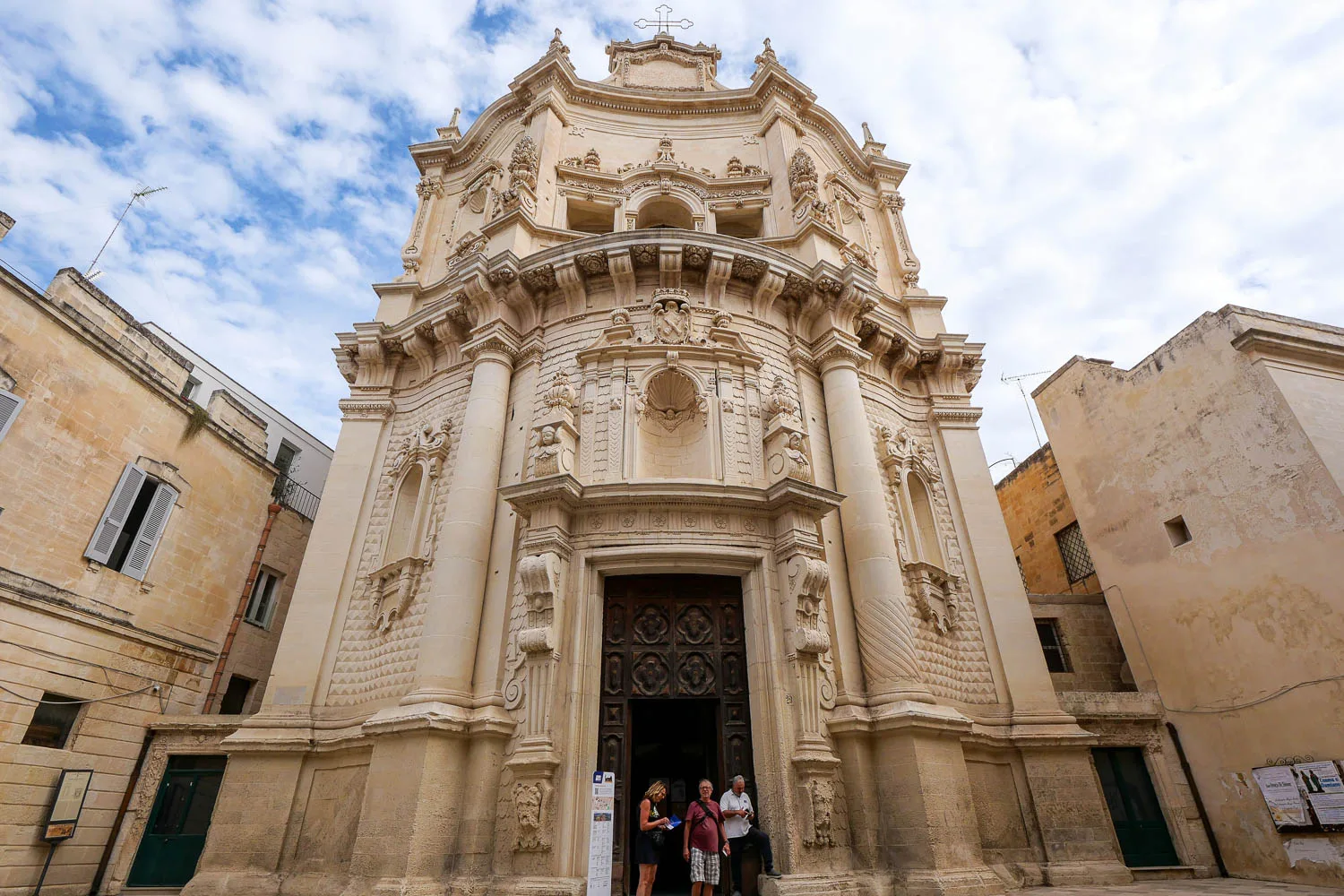
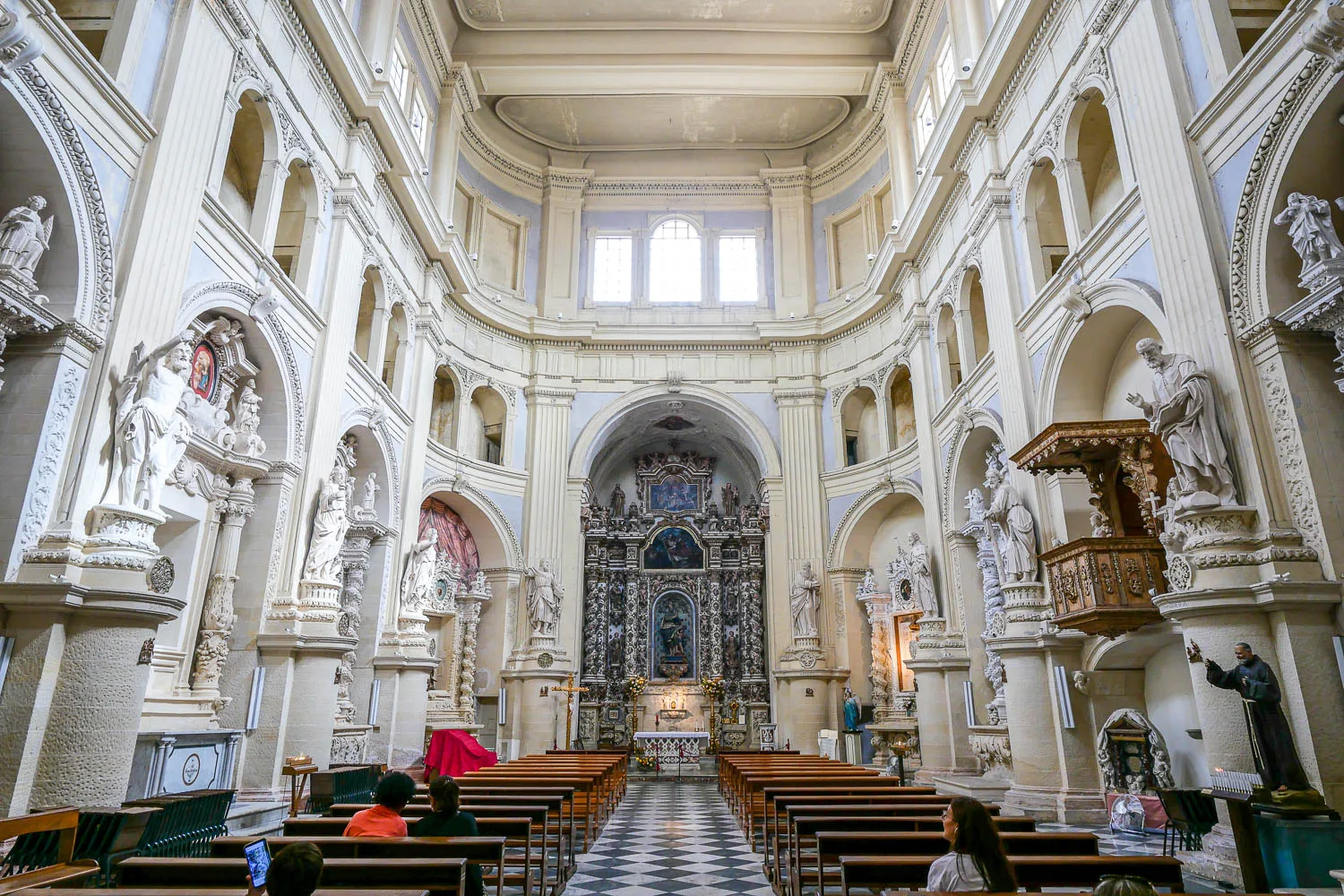
Unlike most churches in Lecce, which were modified later, this one was built in 1667 in the purest Baroque style. This is evident in its facade, which alternates between a convex lower section and a concave upper section. The architect took Rome’s San Carlo alle Quattro Fontane Church as a model.
The interior of the Chiesa di San Matteo features a single nave with an elliptical shape. The altars arranged all around house statues of the twelve apostles, created by students of Giuseppe Cino. The original wooden ceiling was replaced by a more modern one in the 19th century.
Price : LeccEcclesiae ticket (€11).
Opening hours : daily from 9 a.m. to 9 p.m. (until 6 p.m. from October to March).
Roman Amphitheatre
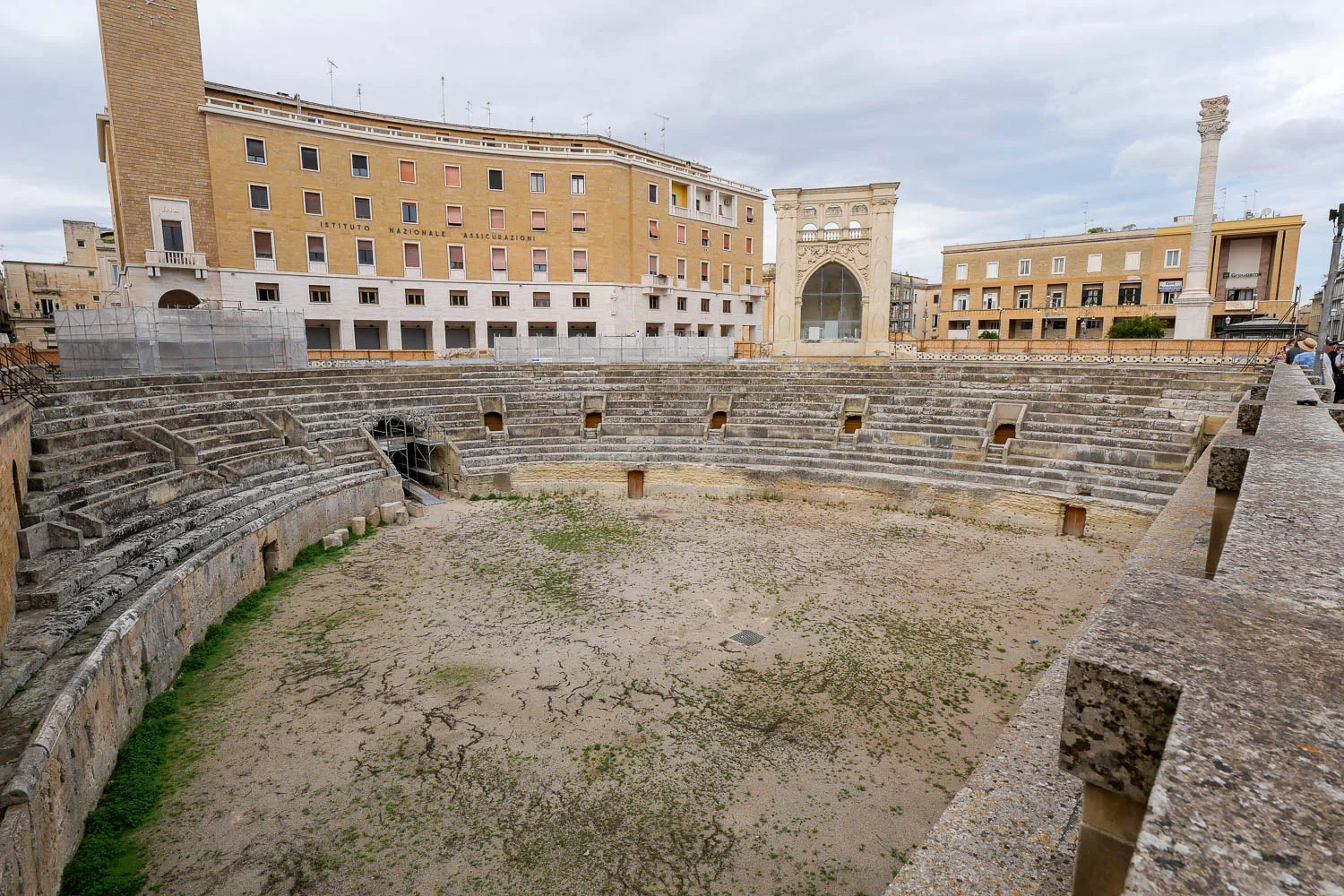
The Roman amphitheatre, not to be confused with the theatre, is located south of Piazza Sant’Oronzo. This building, which hosted gladiator fights, dates back to the 1st century. The Romans built around 230 amphitheatres across much of Europe, as well as in North Africa and the Near East. I’ve seen several, and this one is far from the most remarkable.
Only the lower seating tiers, the access gallery to the arena, and two corridors remain of the Roman amphitheatre. It is currently under restoration and cannot be visited.
Church of Santa Maria della Grazia
Located directly opposite the amphitheatre, the Chiesa di Santa Maria della Grazia was built in the 16th century. Its attractive façade is dominated by fluted Corinthian columns, four niches with statues, and a richly decorated portal. Inside, the Latin-cross-shaped nave has a carved wooden ceiling and, as outside, columns with Corinthian capitals. Entry to the church is free.


Piazza Sant’Oronzo
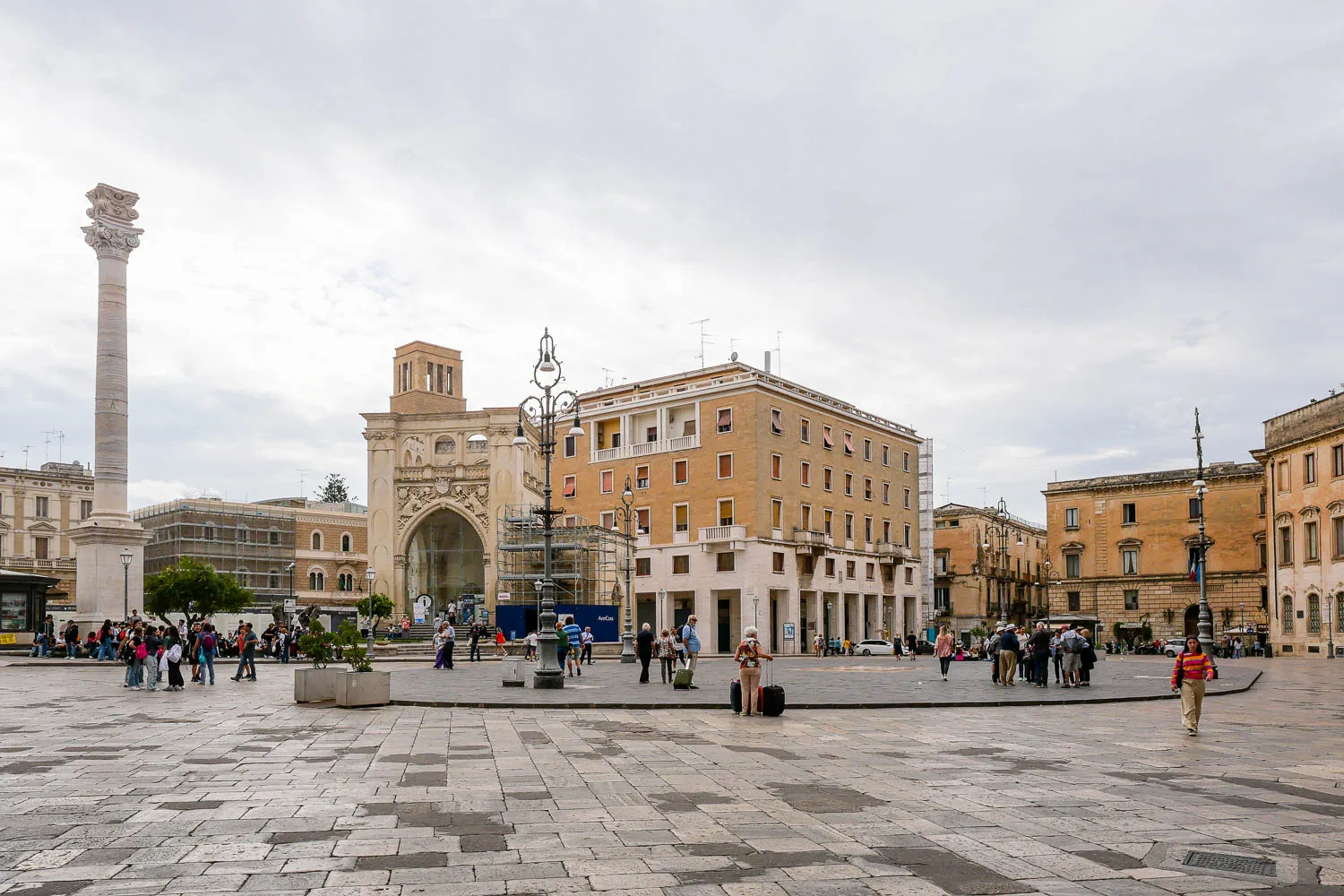
This is Lecce’s largest and liveliest square. It was already bustling in the past, as it was the center of the city’s economic activity with many merchants. Piazza Sant’Oronzo is surrounded by several buildings. To the north, Palazzo del Seggio (also known as the Sedile) is a palace blending Gothic and Renaissance styles, built in 1592. Right next to it, the small Church of San Marco dates from 1543 and was built at the request of the Venetian diaspora (hence its name). Unfortunately, it was completely covered in scaffolding during our stay in Lecce.
In the center of the square, the 29-meter-high Column of Sant’Oronzo is topped by the city’s patron saint, Oronzo. It was erected by the city in gratitude for his protection during the plague epidemic of 1656. It was built using stones from a Roman column that marked the end of the Via Appia in Brindisi.
I didn’t really like this place. I don’t find it particularly charming, as it’s also surrounded by some rather unattractive modern buildings. It’s a far cry from Piazza del Campo in Siena, for example. However, there is a very good address on the square that I recommend: Caffè Alvino. If you want to buy traditional Puglian pastries like the pasticciotto (as well as many biscuits), this is the place to go. They also sell rustico, a savory snack made from puff pastry with various fillings.
Castle of Carlo V
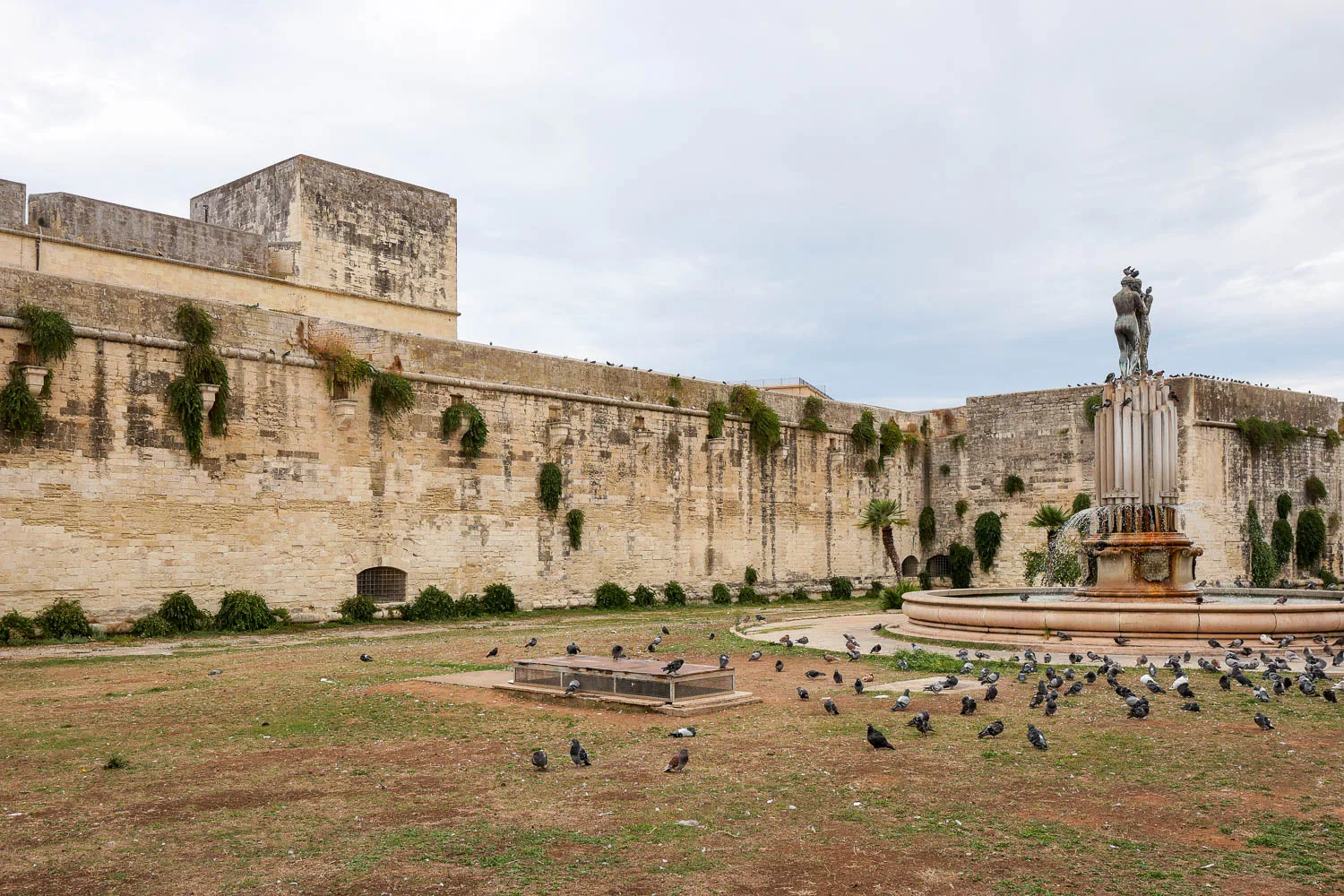
This immense castle, the largest in Puglia, is located east of the historic center beneath the Garibaldi Garden. Castello Carlo V was built in the 12th century, but its current configuration is the work of the Spanish ruler Charles V in 1553. The castle didn’t serve only defensive purposes; in the 18th century, one of its rooms was used as a theatre.
From the outside, it’s impossible to see anything other than the massive ramparts. Inside, there’s little to visit, as most rooms are empty. The one-hour guided tour takes you around the fortifications, passing through the Church of Santa Barbara and the prison. Access to the castle courtyard is free. We didn’t go inside Castello Carlo V. We had already visited several castles on this road trip through Puglia, and in the end, it feels like you’re always seeing the same thing. It’s better to prioritize a castle visit that offers a nice panorama from its ramparts.
Price : guided tour €8 (€4 for ages 12–17).
Opening hours : guided tours from Friday to Sunday at 10 a.m., 11 a.m. (in English), 12 p.m., 4 p.m., 5 p.m., 6 p.m., and 7 p.m.
Basilica of Santa Croce
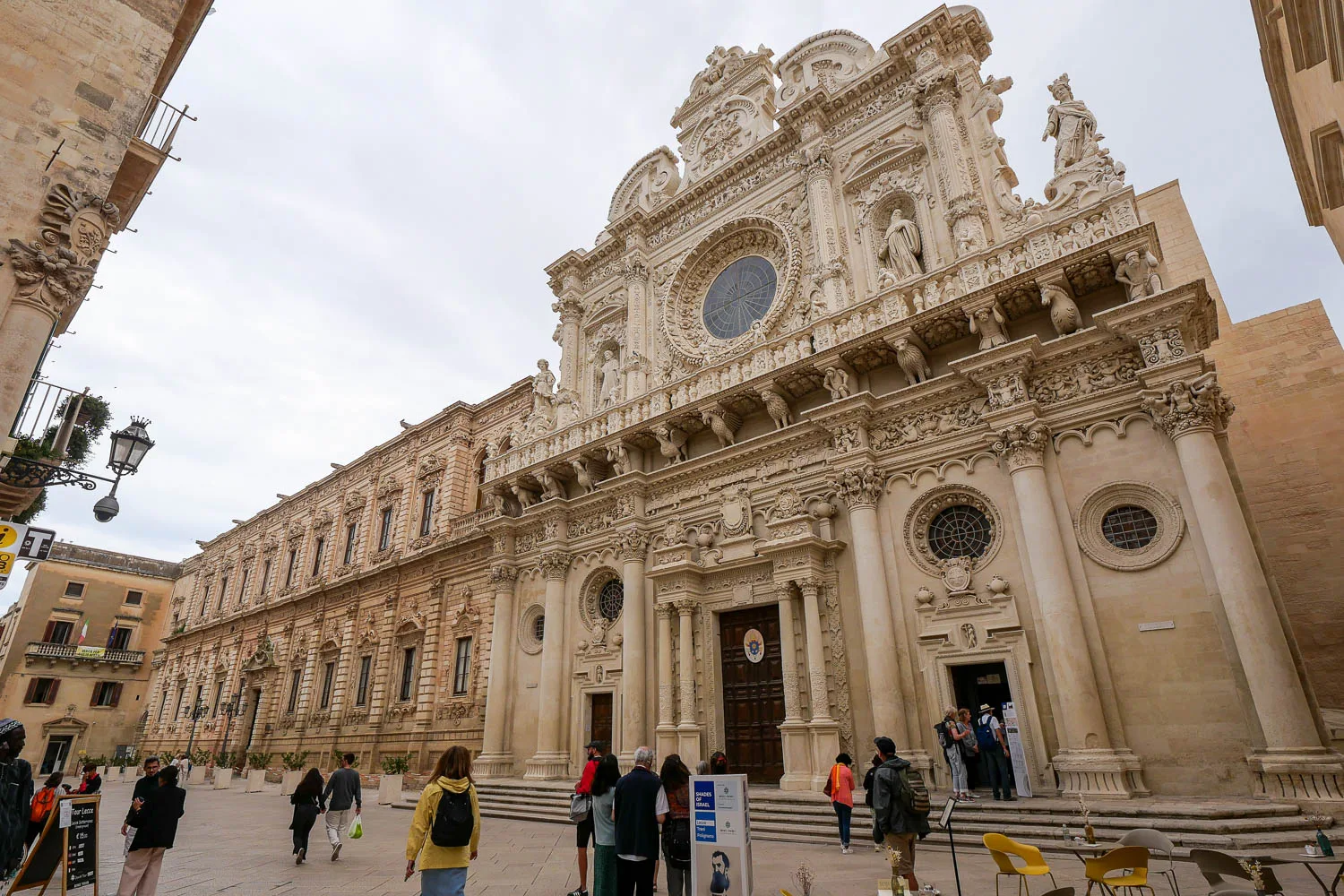
This is one of the best things to do in Lecce. The Basilica di Santa Croce is a masterpiece of Lecce Baroque and the most accomplished example of this architectural style that flourished in the 17th century.
Construction of the Basilica of Santa Croce began in 1549 and was completed a century later in 1646. It was built next to one of the city’s entrance gates, in the middle of the historic center’s alleyways. As a result, it’s not easy to photograph its magnificent facade. Even before entering the basilica, you’re blown away by all the details and sculptures it features. Lecce’s limestone, which is very soft, allows for all kinds of exuberance. It’s best to have a telephoto lens to admire the friezes and sculpted figures.
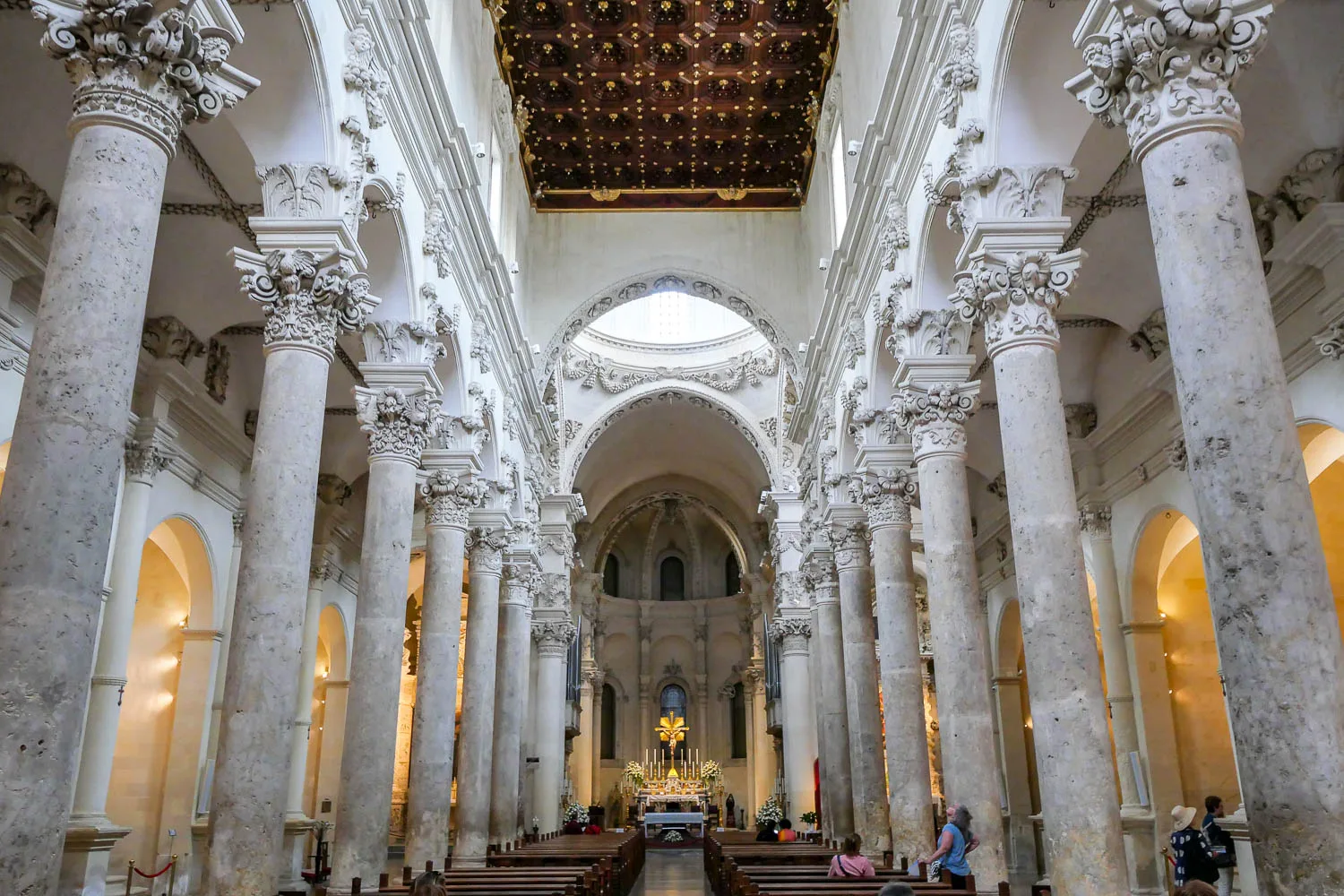
The interior of the church is Renaissance in style, as is the lower part of the façade with its columns. The nave, with its gilded coffered ceiling, is surrounded by 14 chapels, all richly decorated in the Baroque style. The most impressive chapel is that of San Francesco da Paola (photo 3). Created between 1614 and 1615 by Francesco Antonio Zimbalo, it is one of the greatest expressions of Lecce Baroque. The painting is the work of A. Calabrese (1833).
Located right next to the basilica, Palazzo dei Celestini allows you to leave the historic center by crossing its courtyard, arriving directly at Giuseppe Garibaldi Garden.
Price : LeccEcclesiae ticket (€11).
Opening hours : daily from 9 a.m. to 9 p.m. (until 6 p.m. from October to March).


Porta San Biagio
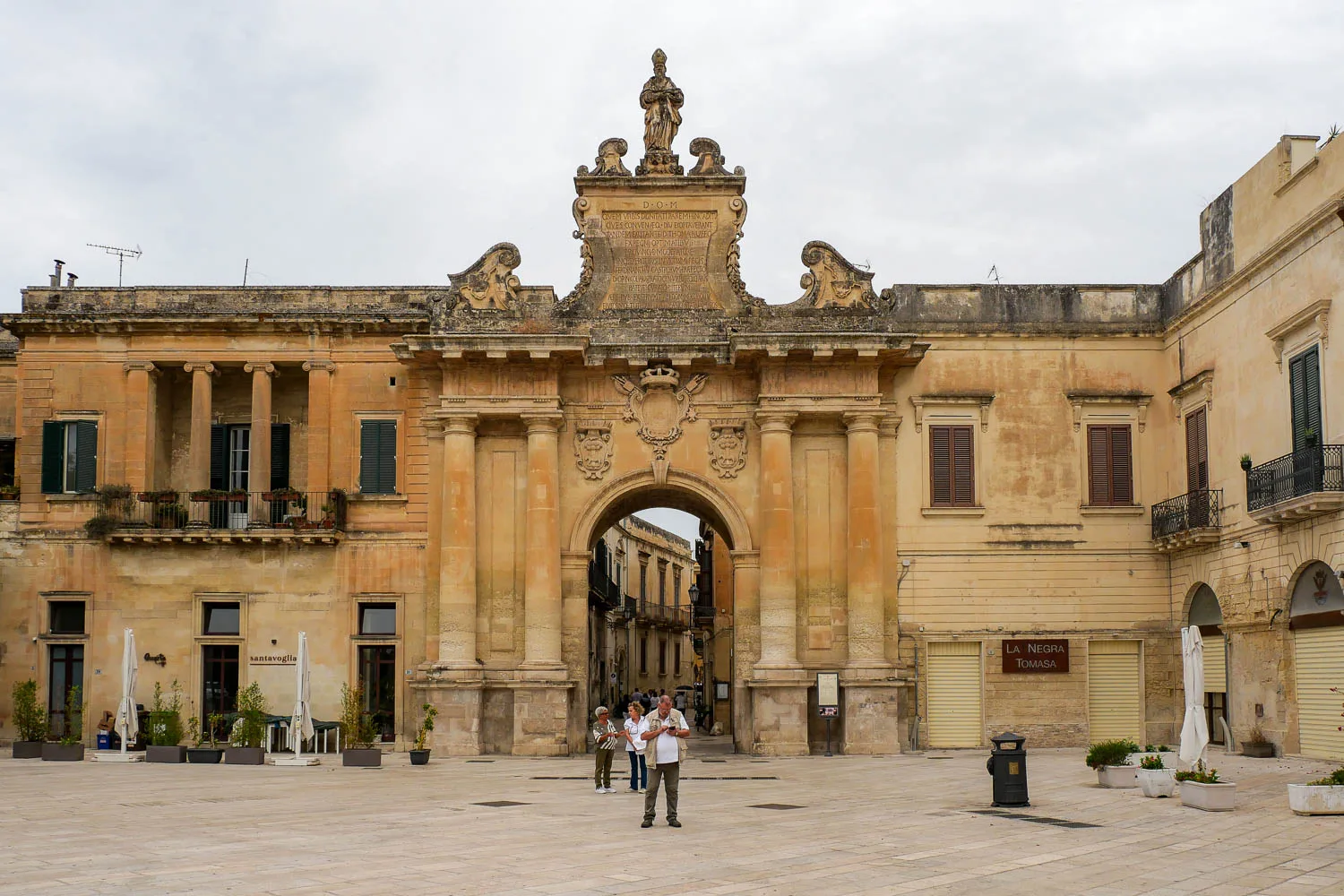
Porta San Biagio is one of the three gates of Lecce’s historic center. It was built in 1774 in the southeast of the old town, near Piazza d’Italia. It replaced an older gate commissioned by Charles V that had fallen into disrepair. Porta San Biagio is topped by a statue of Bishop Saint Blaise. It’s not the longest visit in Lecce, but if you’re passing by, it’s worth admiring its architecture (it looks much better in the sunshine).
Old town alleyways
Among the things to do in Lecce, you absolutely have to get lost in the alleyways of the historic center. That’s how you discover the city’s Baroque architecture. As you wander, you’ll inevitably come across a charming little square, a Baroque palace, or a church. There are many churches throughout the city (more than 40), and I couldn’t mention them all in this travel guide to Lecce. Some are closed most of the time (such as the Orthodox Church of San Nicolo dei Greci).
On Via Francesco Rubichi (map), you can see an ancient Roman paved road in perfect condition. Four meters wide and oriented northeast–southwest, it suggests that it connected the center of the ancient city to a hypothetical eastern gate toward the sea.
Lecce is nicknamed the “Florence of the South” for its exceptional Baroque architecture. You shouldn’t try to compare the two cities, as Florence is, in my opinion, much more beautiful with its Renaissance architecture.


Church of Santi Niccolò e Cataldo
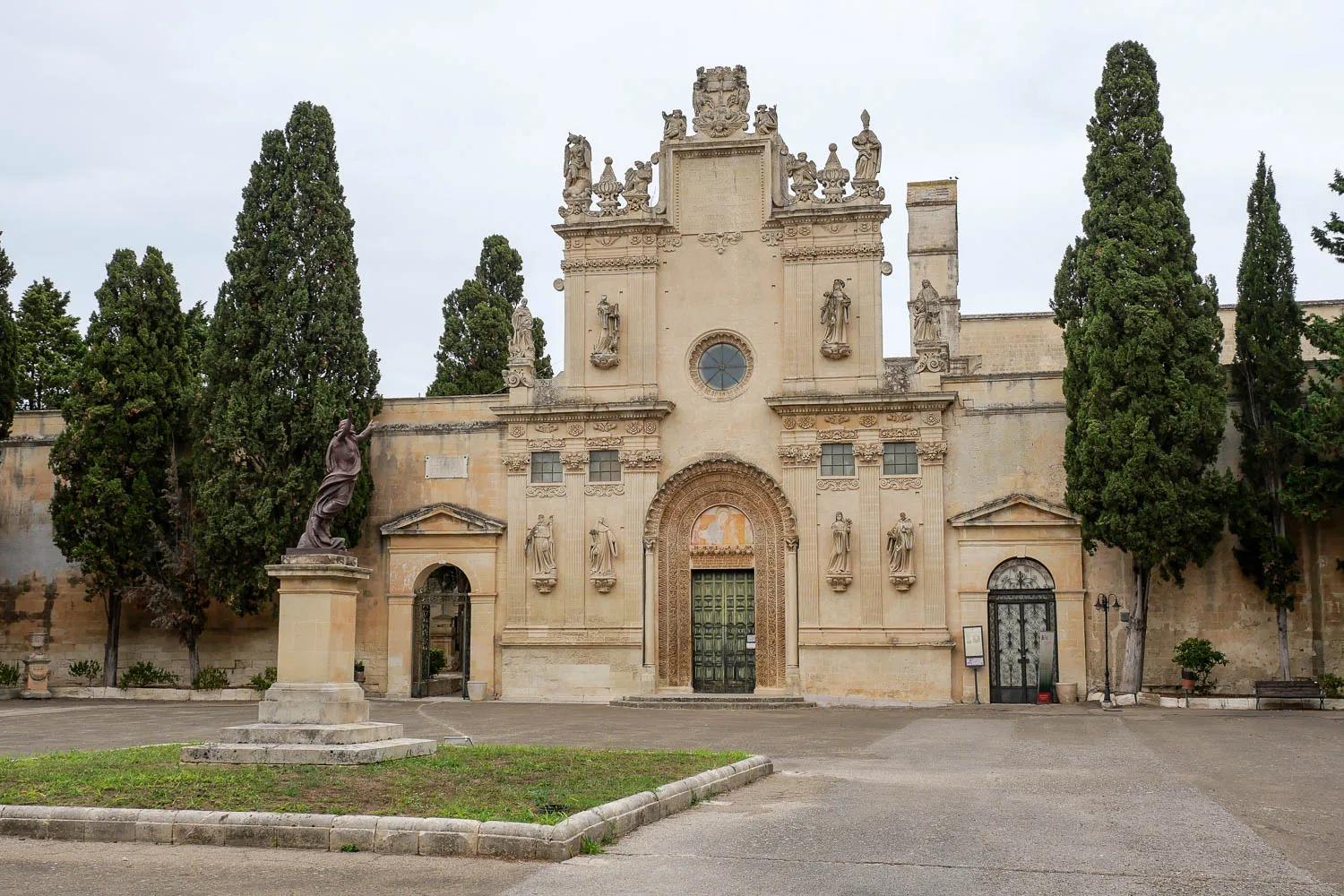
The Chiesa dei Santi Niccolò e Cataldo is located in the cemetery, slightly outside the center. We went there by car before leaving Lecce. On foot, it takes about 20 minutes from Piazza Sant’Oronzo. This church, with its adjacent monastery (now a university library), was founded in 1180. The façade is a mix of Baroque and other styles.
Above all, it’s the fresco-covered interior that’s worth the visit. Unfortunately, we weren’t able to go inside because opening hours are quite limited (mornings only, three days a week). We knew it would be closed when we went, but we hoped there might be a service and that we could see the interior. That didn’t work out, as services are held at 8:30 a.m. on weekdays and 10 a.m. on Sundays and public holidays.
Opening hours : 9:30 a.m.–12:30 p.m. on Monday, Thursday, and Saturday.
Visiting Lecce at night
Take advantage of going out to dinner one evening in Lecce to stroll through the deserted alleyways after nightfall. The atmosphere is completely different from daytime, with lantern lighting making you feel as if you’ve stepped into another era. The monuments, however, aren’t particularly highlighted by the lighting (especially the Roman theatre and amphitheatre). As for safety, we found the city to be safe even at night. There are always people out and about. The many restaurants, bars, and Airbnbs attract tourists.


What to do around Lecce ?
Abbazia Santa Maria di Cerrate
This abbey, located 15 km north of Lecce, is one of the rare examples of Romanesque style in Puglia. If you’ve covered all the things to do in Lecce and enjoy history and architecture, I recommend visiting it—especially if you’re heading toward Brindisi, as it’s on the way. The abbey is managed by the FAI foundation, the same organization that manages Villa Balbianello on Lake Como.
Abbazia Santa Maria di Cerrate was founded at the end of the 11th century by Greek monks of the Byzantine rite. It was located on the Roman road connecting Brindisi to Lecce. Beyond its religious role, the abbey was also an agricultural estate specializing in olive oil production. It prospered until 1711, when it was attacked and looted by Turkish pirates. It wasn’t until 1995 that the municipality of Lecce undertook restoration work on the buildings.
The Romanesque church is the most interesting part. Its portal is beautifully carved with a frieze of figures, and the interior houses numerous frescoes. These were partially damaged by Turkish pirates (you can see the pick marks on the walls).
The farm building to the right of the church houses the oven and mills used by the monks. On the first floor, there’s a small museum of Salento arts and traditions displaying tools and objects from rural life. Next door, eight panels with frescoes were detached from the church and restored (photo 4). In the building to the left of the church, don’t miss the film screening (with French subtitles) that tells the full history of the abbey.
Price : €8.50 (€4 for students, free for children under 5 and FAI members, family ticket €20). Tickets and reservations.
Opening hours : daily 9:30 a.m.–1 p.m. and 3:30 p.m.–7:30 p.m. from June to August | 10 a.m.–6 p.m. from February to May and in September–October (closed Mondays) | 10 a.m.–4 p.m. in November–December (closed Mondays).


Grotta della Poesia and Faraglioni di Sant’Andrea
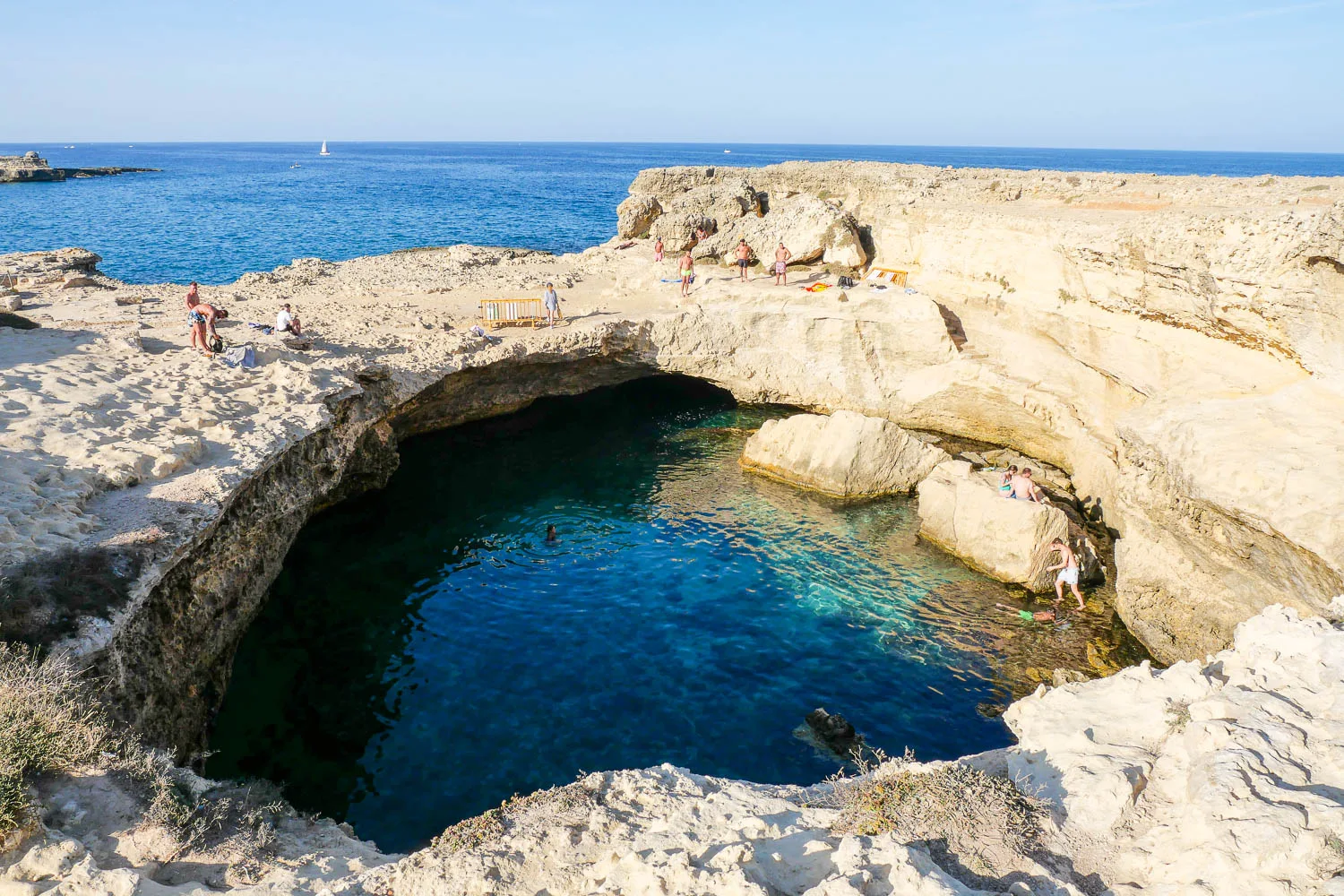
You can’t visit Lecce and Puglia without heading to the coast, where you’ll find magnificent beaches. On the eastern side of the peninsula, 26 km from Lecce, Grotta della Poesia is one of the most famous sites. It’s a cave whose roof has collapsed, leaving a pool connected to the sea by a tunnel. Officially, swimming is prohibited, but many locals come here to swim. Access to Grotta della Poesia is paid (€3 per person), as it’s located within an archaeological area (you can see Messapian inscriptions on the walls).
If you don’t want to pay, you can swim in the coves and caves north of Torre di Maradico, a 16th-century watchtower. It’s right next door, and you use the same paid parking lot (coordinates). The rate is €1.80 per hour daily between 8:30 a.m. and midnight.
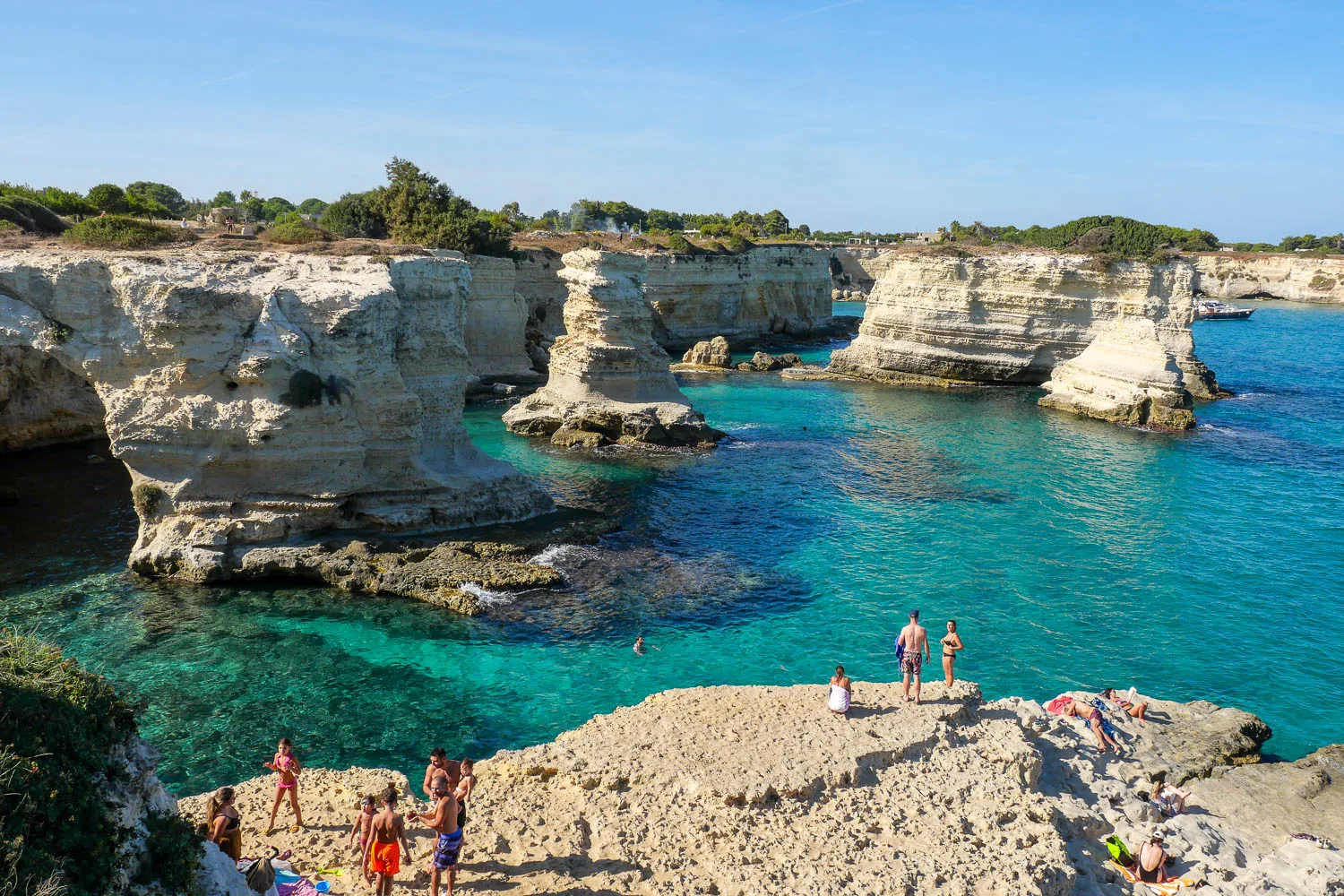
Ten minutes by car north of Grotta della Poesia is another must-things to do in Lecce : the Faraglioni di Sant’Andrea. These rocky stacks detached from the cliff, set in turquoise-blue water, provide a stunning setting for swimming. There’s no sandy beach here, though you have to climb over rocks and jump into the water. Parking to reach the Faraglioni di Sant’Andrea (GPS coordinates) is paid between May 1 and September 30 from 8:30 a.m. to midnight (€1.50 per hour).
Otranto
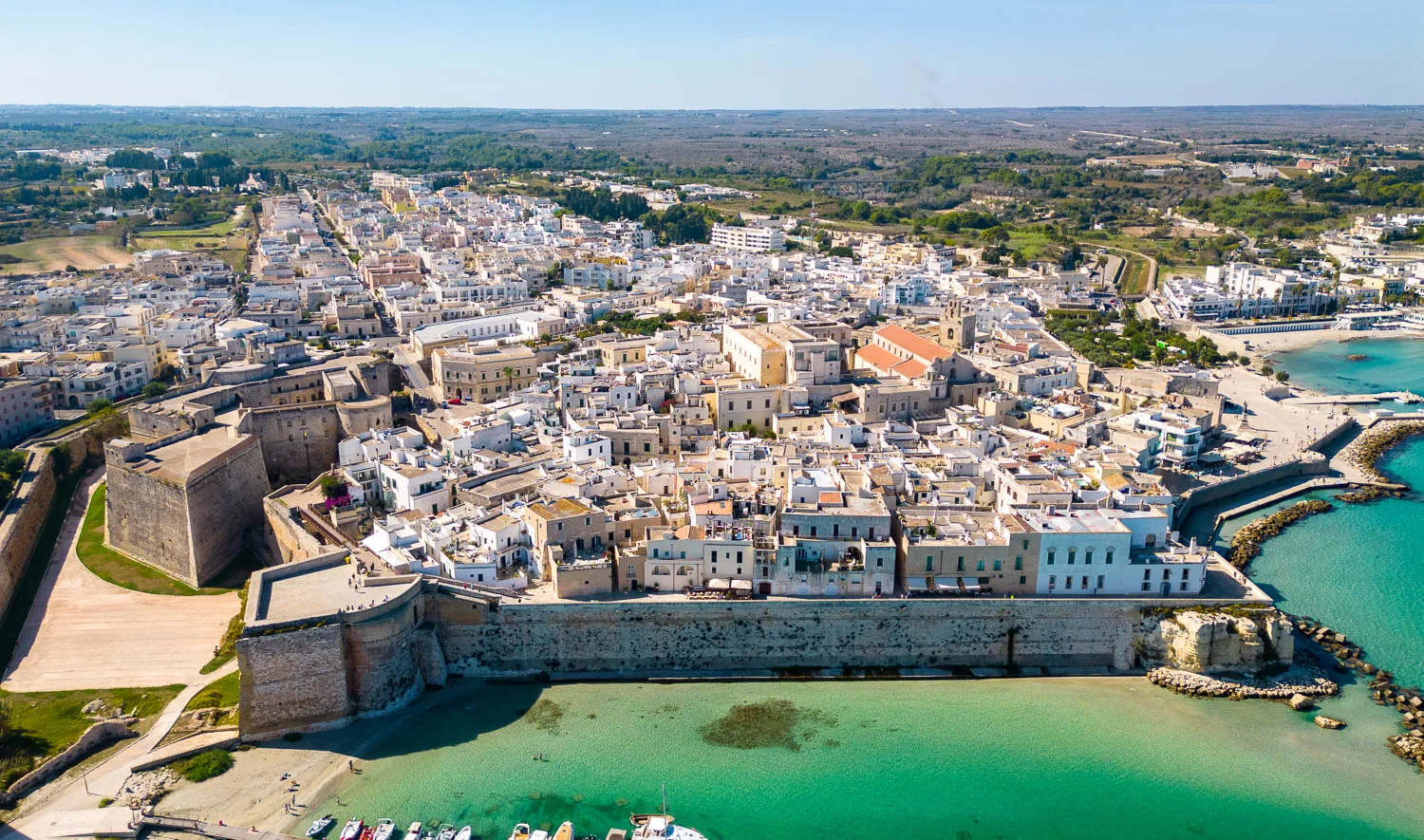
This is the city not to be missed on the eastern coast of Salento. It’s located 45 km from Lecce (35 minutes by car or 1 hour by bus). You need to stroll through its medieval old town, with alleyways lined with white houses and surrounded by ramparts. The castle, cathedral, and Byzantine church are among the monuments not to be missed. Otranto also has a pleasant seafront promenade (lungomare) and sandy beaches right in the city center. Visiting the old town and surrounding areas will easily fill a full day. It’s a great idea for a day trip if you’re visiting Lecce for two days or more.
For more information on the must-see sights in the old town and surrounding area, I invite you to read the article what to do in Otranto.
If you don’t have a vehicle, you can opt for a tour. I recommend this one departing from Lecce, which includes Otranto, Galatina, and Gallipoli.
Punta Prosciutto Beach
Forty kilometers from Lecce on the western coast of Salento lies one of the most beautiful beaches in Puglia : spiaggia di Punta Prosciutto (coordinates). We didn’t have time to go there, but I mention it because I had noted it among the things to do in Lecce. You only need to look at photos to be convinced that this golden-sand beach with turquoise water offers a truly paradisiacal setting. There are a few private beaches for those who like loungers and umbrellas, as well as long stretches of free public sand.
Gallipoli
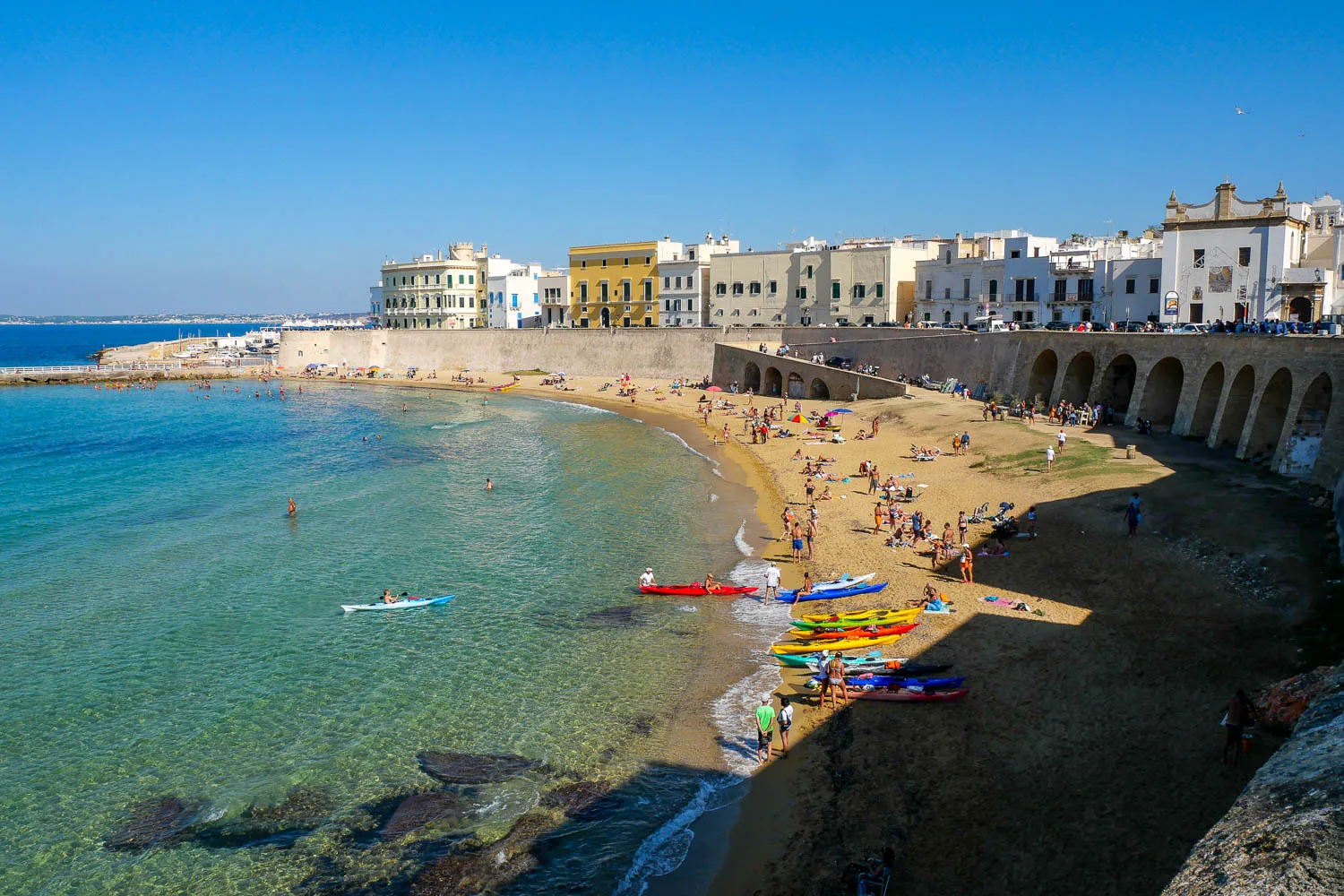
Like Otranto on the eastern coast, Gallipoli is the most beautiful city on the western coast of Salento. It’s even one of our favorites in Puglia. The historic center, located on an island connected to the mainland by a bridge, boasts a rich historical heritage. Gallipoli was one of the region’s wealthiest cities in the 16th century thanks to olive oil exports. The center features several charming churches, a cathedral, an imposing fortress, and underground olive oil mills. The sandy beach at the foot of the ramparts lets you enjoy the sea between visits.
I invite you to read my article what to do in Gallipoli to discover the must-see sights in the old town and surrounding area.
Where to stay in Lecce
Thanks to its very central location, Lecce is an excellent base for exploring Salento (the southern part of Puglia). You’ll have easy access to towns and beaches on both coasts, as well as the southern tip. If you like being in the heart of the action and close to everything, accommodation in the old town will immerse you in local life. But if you prefer to get around easily by car, I recommend staying slightly outside the historic center and choosing accommodation with parking. You’ll find some beautiful masseria (traditional Puglian farmhouses) a bit outside the cities.
Here are a few places I recommend for staying in Lecce and the surrounding area. Prices vary depending on the season, peaking in July and August. Some accommodations, especially apartments, impose a minimum number of nights.
- 46 € : B&B Verdi, one of the cheapest well-rated accommodations in Lecce. It also offers rooms for 2 to 4 people, perfect for large families. It’s well located near the city center, and breakfast is included for Genius clients.
- 53 € : Li Cumpari salentini, this 50 m² apartment in the historic center can accommodate up to 4 people. There’s also another studio for rent with a balcony. A 5-minute walk from the train station.
- 64 € : Masseria Petra, this is the accommodation we chose to explore Salento for four days, and we 100% recommend it. Very friendly welcome (in French, too), a charming room, and breakfast with local products. Located in the countryside of Martano, 24 km from Lecce.
- 79 € : Masseria Rifisa AgriResort, located 15 km from Lecce. It offers modern double rooms around a garden and a beautiful swimming pool—ideal for relaxing after a day of sightseeing in Lecce. Free private parking.
- 96 € : Il Garbino Suite and Apartment, offering a superb duplex studio with a terrace—perfect for enjoying the sun and breakfast (included) outdoors. Also has an apartment for 5 people.
- 100 € : Signuria Dimora Esclusiva, this bed and breakfast located 250 meters from Piazza Sant’Oronzo offers beautiful rooms, as well as a garden, terrace, and bar. Breakfast is included in the price.
- 130 € : Dimora Charleston Lecce, for a splurge, this central address is ideal for staying in Lecce. Rooms have balconies with views, and amenities include a pool, breakfast included, and free private parking.
Where to eat in Lecce
You’ll have no trouble finding a good restaurant in Lecce, especially in the historic center. We generally rely on Google and TripAdvisor ratings if a restaurant hasn’t been specifically recommended to us. In Italy, it’s rare to fall into a tourist trap (except in very touristy cities), and that’s not the case in Lecce.
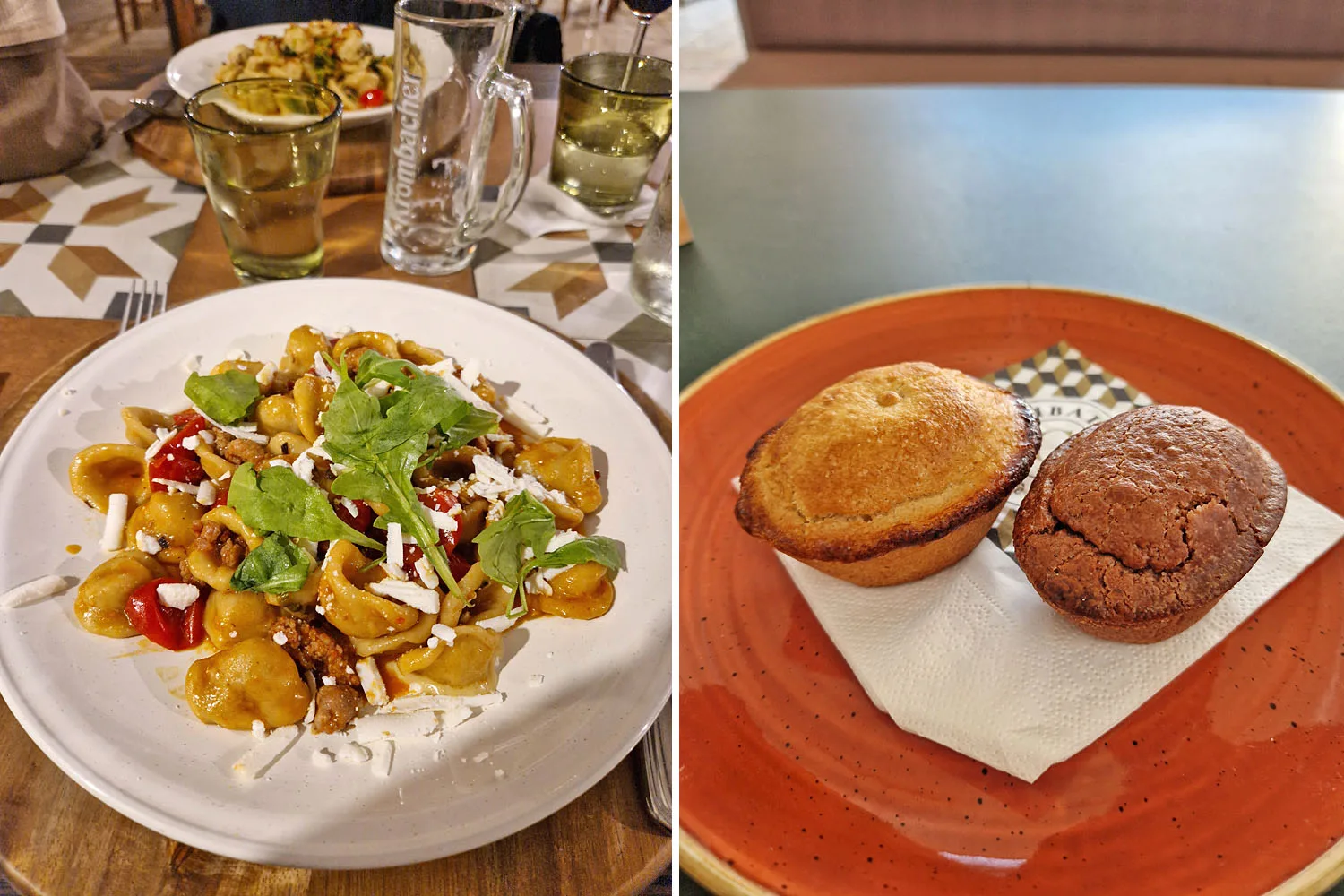
Among the specialties, orecchiette (ear-shaped pasta) are served everywhere. The most popular recipe is orecchiette alla cime di rapa (with broccoli rabe), but I prefer them with ragù (left photo). We had them at Osteria Il Banco, an address we recommend. For a lighter lunch, we enjoyed Enoteca Mamma Elvira with its outdoor terrace.
If you just want a snack, you’ll find panzerotti (pizza-dough turnovers with fillings) and focacce. We didn’t try Puglian pizza, Daniela is Neapolitan, so she doesn’t eat just any pizza.
On the sweet side, we enjoyed all kinds of biscuits. We also tried the pasticciotto (right photo), a shortcrust pastry filled with custard. In Lecce, I recommend Caffè Alvino on Piazza Sant’Oronzo for buying them.
Prices are not high in Puglia. At restaurants, we paid €11 for orecchiette alla cime di rapa (€13 with ragù), beer is €5, and a bottle of water is €1.50. You also need to add the cover charge (coperto), which is usually €2 per person.
Travel guide and tips for visiting Lecce
How to get to Lecce
To get to Lecce, you need to fly into one of Puglia’s two airports. Brindisi is the closest, otherwise there’s Bari airport further north. To find the cheapest flights, I recommend first comparing prices on Skyscanner.
Lecce is located 40 km south of Brindisi. Via the strada statale (equivalent to national roads), it takes about 30 minutes by car. A vehicle is essential for visiting Puglia, especially to reach the beaches. To find the best rates among all rental companies, I always use this comparison site, it guarantees the lowest prices.
You can also reach Lecce from Brindisi Airport with the Puglia Airbus shuttle (€6.50, 40 minutes). From Bari Airport, you need to take this bus transfer (€9, 1 hour 40 minutes).
Where to park in Lecce
A car isn’t necessary for visiting Lecce, as the entire historic center can be explored on foot. But if you’re on a road trip, you’ll need to leave it in a parking area. Be aware that Lecce’s city center is a limited traffic zone (ZTL). I recommend reading my article on ZTLs in Italy if you’re not familiar with the regulations.
We used the parking lot located at Lecce train station (coordinates). It’s well located at the very south of the old town, and the rate is affordable at €1 per hour. For dinner in the evening, we used parking spaces around Piazza Mazzini (map). It’s closer to the center and restaurants. Parking is paid from 9 a.m. to 2 p.m. and from 4 p.m. to 9 p.m. at a rate of €1.30 per hour.
How much time to spend in Lecce
The center has many buildings and a few museums, and you should plan one full day to visit Lecce without rushing. That’s enough to cover the must-see sights presented in this guide, with a few breaks to sample local specialties. If you have two days to visit Lecce, I recommend leaving the city to head to a Salento beach. Unless you’re an art and history lover, there’s no need to stay more than one day in Lecce.
What to do in Lecce : the map
I’ve marked the sights to see in Lecce mentioned in this guide on the Google Map below.
You now have all the information for things to do in Lecce in Puglia. If you have any questions, feel free to ask them in the blog’s comment section.