

Are you heading to the Puglia region in Italy and looking for the best things to do in Gallipoli ? Excellent idea. The historic center, located on an island connected by a bridge, boasts a rich cultural heritage and beautiful beaches. Founded by the Greeks around 1000 BC and later occupied by the Romans, Byzantines, and Normans, the city experienced significant growth from the 16th century onward (notably through olive oil exports), becoming one of the wealthiest cities in the Salento region. Today, Gallipoli is mainly known among young people who come to party on its beaches during the summer. As for us, we chose to visit in October to enjoy the calm of the region.
So what to do in Gallipoli ? Which are the must-see sights ? Where are the most beautiful beaches ? Where to stay in Gallipoli ? I share all my tips in this travel guide.
What to do in Gallipoli : the old town
All the must-see sights in Gallipoli are located in the historic center. There is even a beautiful sandy beach right at the foot of the city walls. It is therefore easy to visit Gallipoli on foot. The sites presented in this travel guide are listed in order starting from the port parking area and following a counterclockwise route. This is the itinerary we followed to visit Gallipoli.
Santa Maria della Purità Church
Built between 1662 and 1665 by the Bastasi brotherhood (the workers who unloaded the boats), the chiesa di Santa Maria della Purità is one of the must-see sights in Gallipoli. The very simple facade of the building gives no indication of what lies inside. If your eyes are fixed on the beach just opposite, you might walk right past it without noticing.
Yet the interior of the single rectangular nave is stunning. It is a typical example of Gallipoli baroque. The nave is entirely covered with 18th-century paintings, magnificent stucco work, and polychrome marble. The floor is paved with 19th-century majolica tiles featuring floral motifs, and the wooden choir stalls are decorated with polychrome finishes. On the vault, the paintings depict scenes from the Apocalypse.
Opening hours : 10:00 am–12:00 pm and 5:00 pm–7:30 pm.


Museo Civico
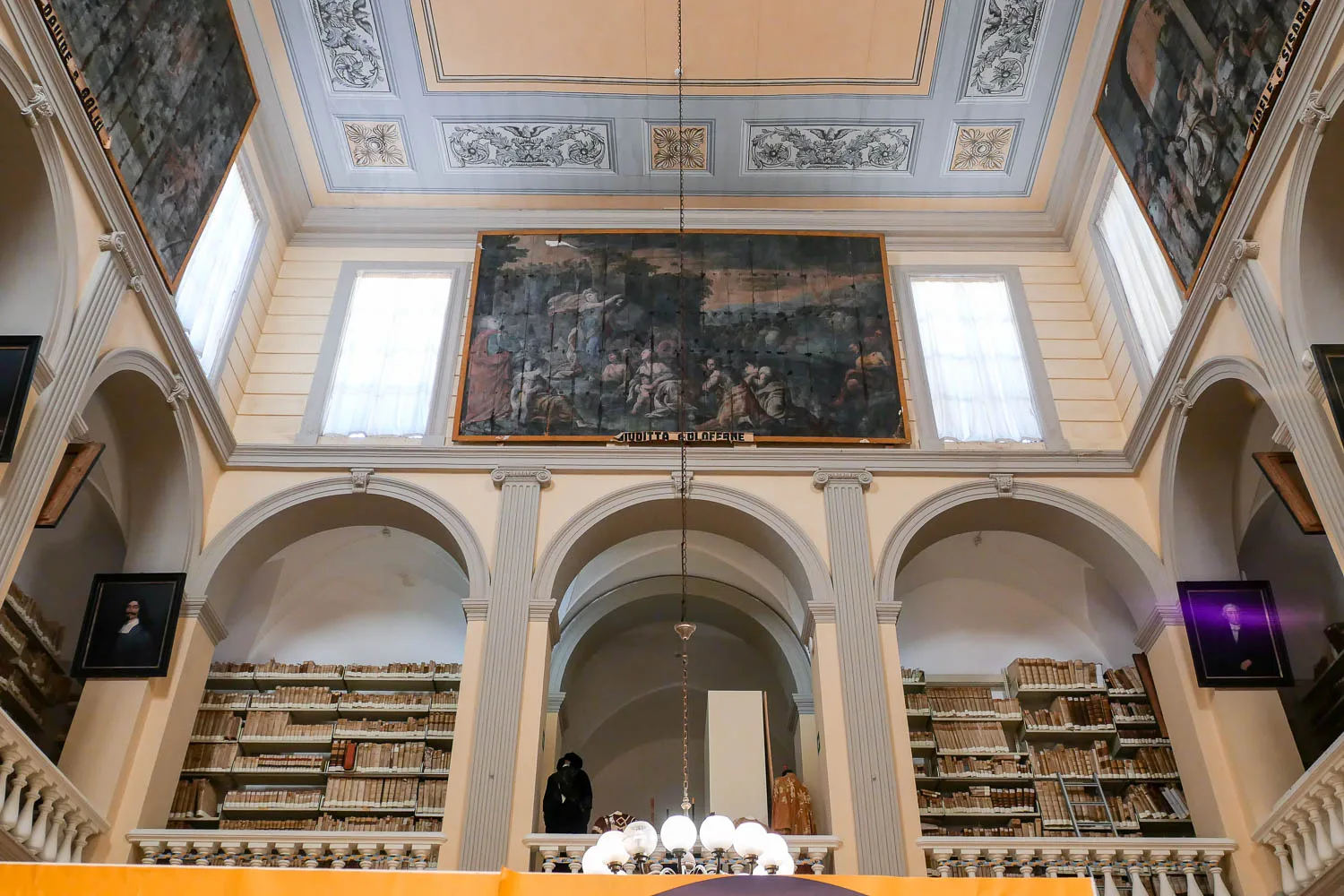
Leaving the city walls, you head deeper into the old town. The main street crossing the historic center is via Antonietta de Pace. This is where you will find the Museo Civico “Emanuele Barda,” a small museum created in 1823 in a former library. It houses a heterogeneous collection ranging from archaeology to works of art, including a whale skeleton, Renaissance weapons, and even a section displaying human and animal fetuses affected by pathologies.
We did not visit it because we were not particularly drawn to what the museum had to offer. But if you have already covered all the main things to di in Gallipoli and still have some time, you can take a look (be aware that the fetus section is quite unsettling).
Admission : €3
Opening hours : 10:00 am–1:00 pm and 5:00 pm–12:00 am in July–August | 10:00 am–1:00 pm and 5:00 pm–9:00 pm in June and September | 10:00 am–1:00 pm and 3:30 pm–6:00 pm from October to April.
Gallipoli Cathedral
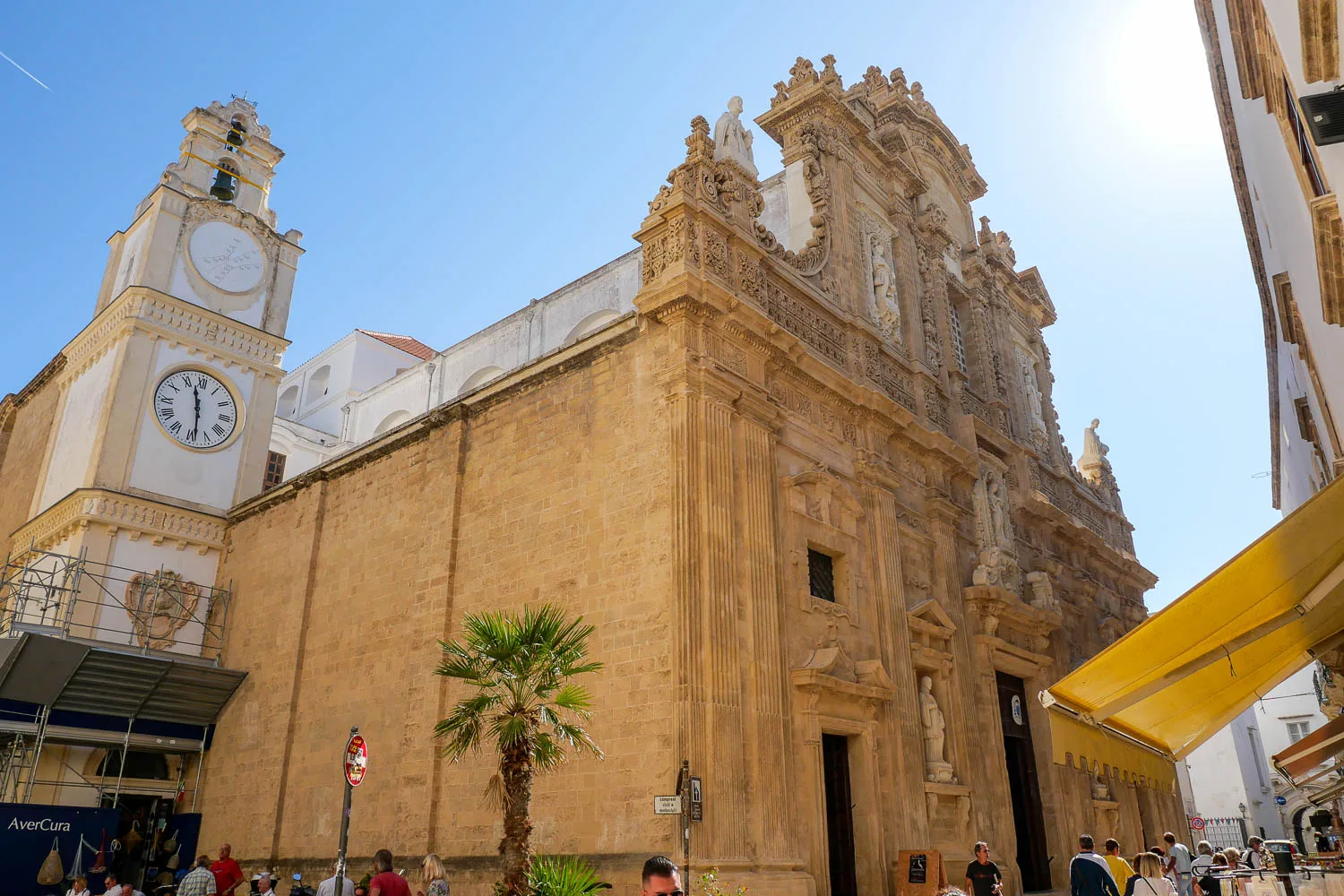
The basilica concattedrale di Sant’Agata is the most important religious building in Gallipoli. It is dedicated to Saint Agatha, the patron saint of the city. It was built in the 17th century at the highest point of the island, in an area considered sacred since Antiquity. A Romanesque church from the 12th century was destroyed to make way for the cathedral.
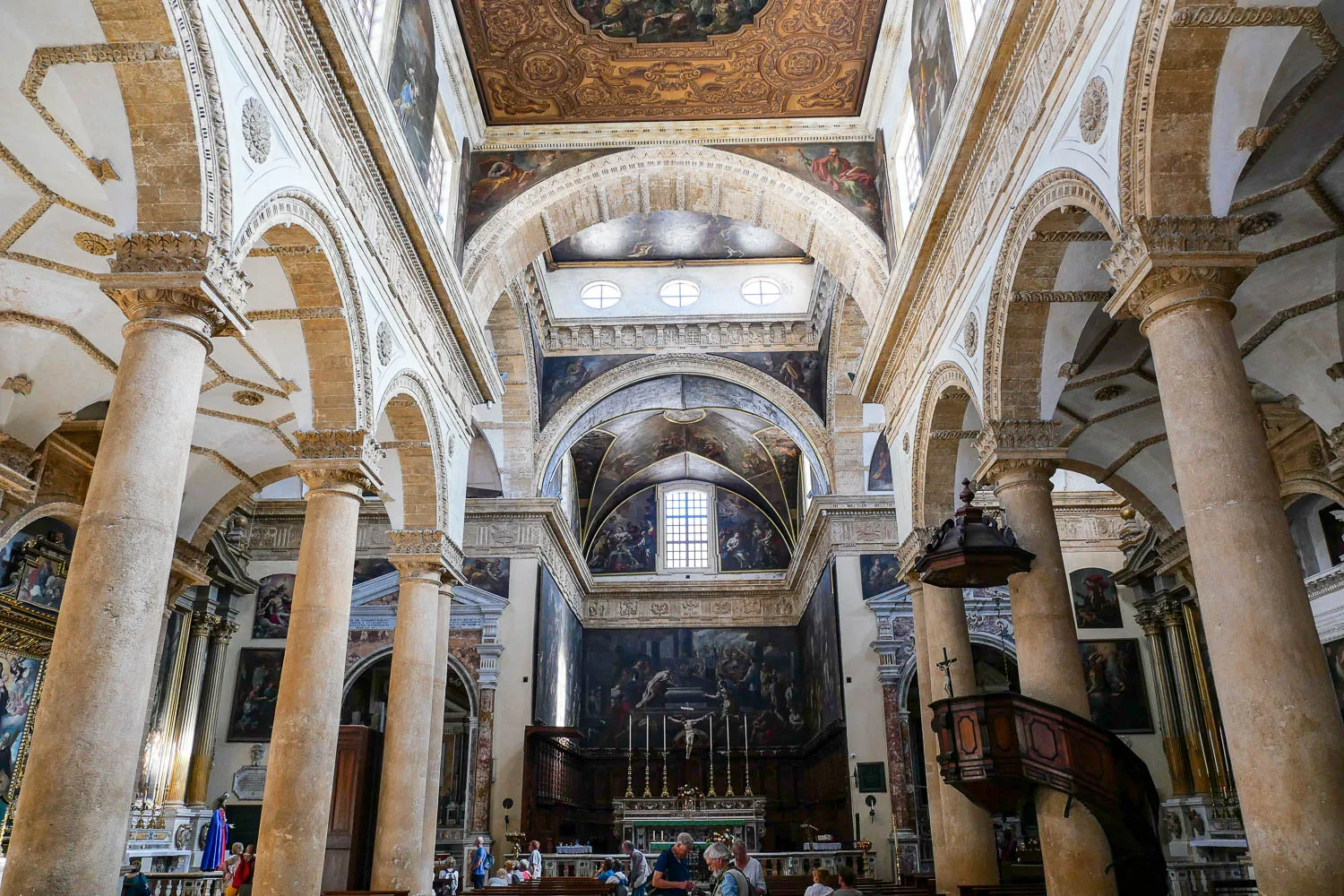
The limestone façade is carved with numerous friezes and statues. The Baroque-style interior consists of three naves separated by twelve columns and twelve altars. Inside, you will find many oil paintings, many of them by a Neapolitan master. The altar is covered with polychrome marble, and the ceiling is equally magnificent. Take your time to admire all the small details.
The cathedral is located in the heart of the old town on via Antonietta de Pace. Visiting it is one of the unmissable stops among the things to do in Gallipoli.
Opening hours : 7:30 am–12:30 pm and 3:45 pm–9:00 pm.


Old fishing port
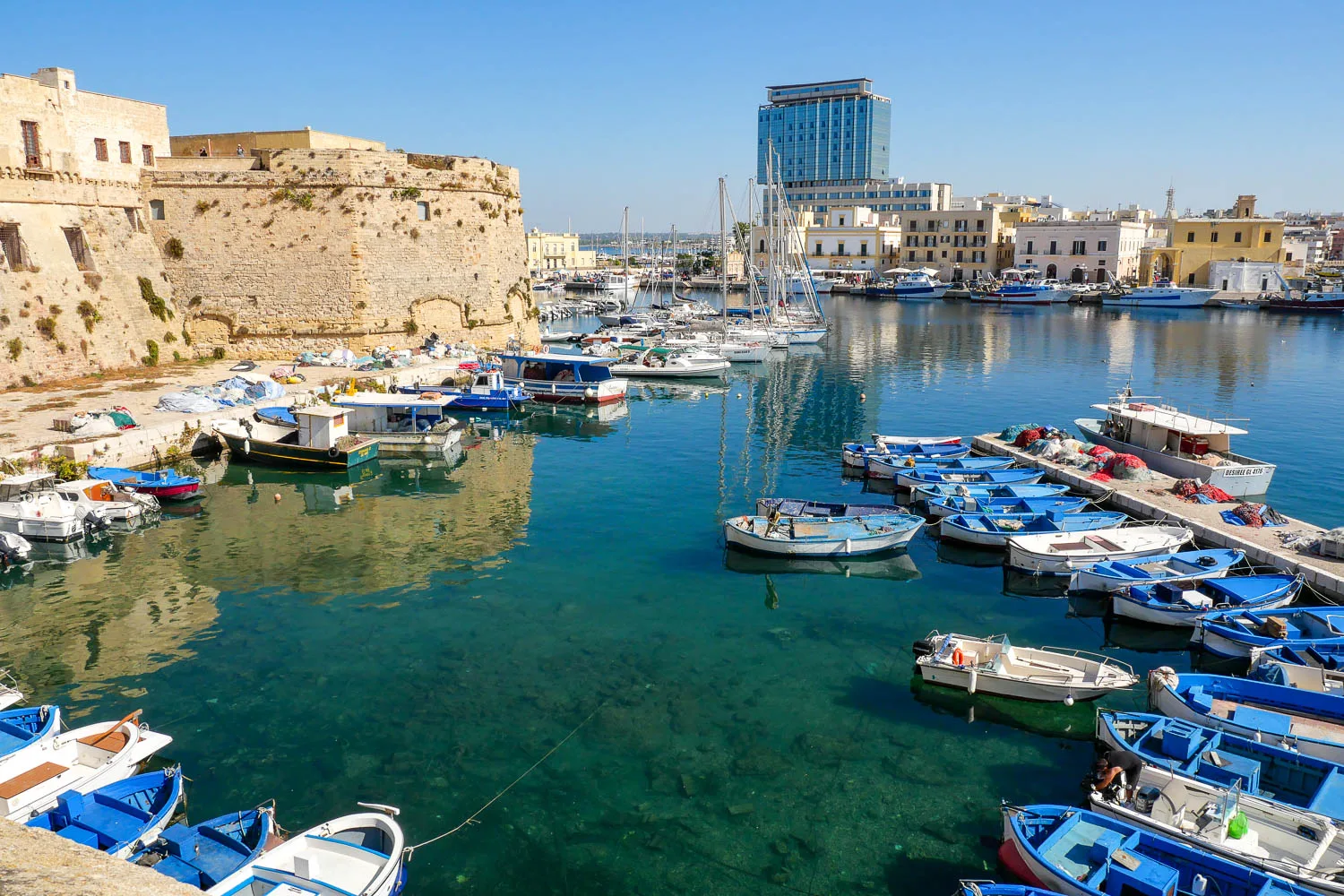
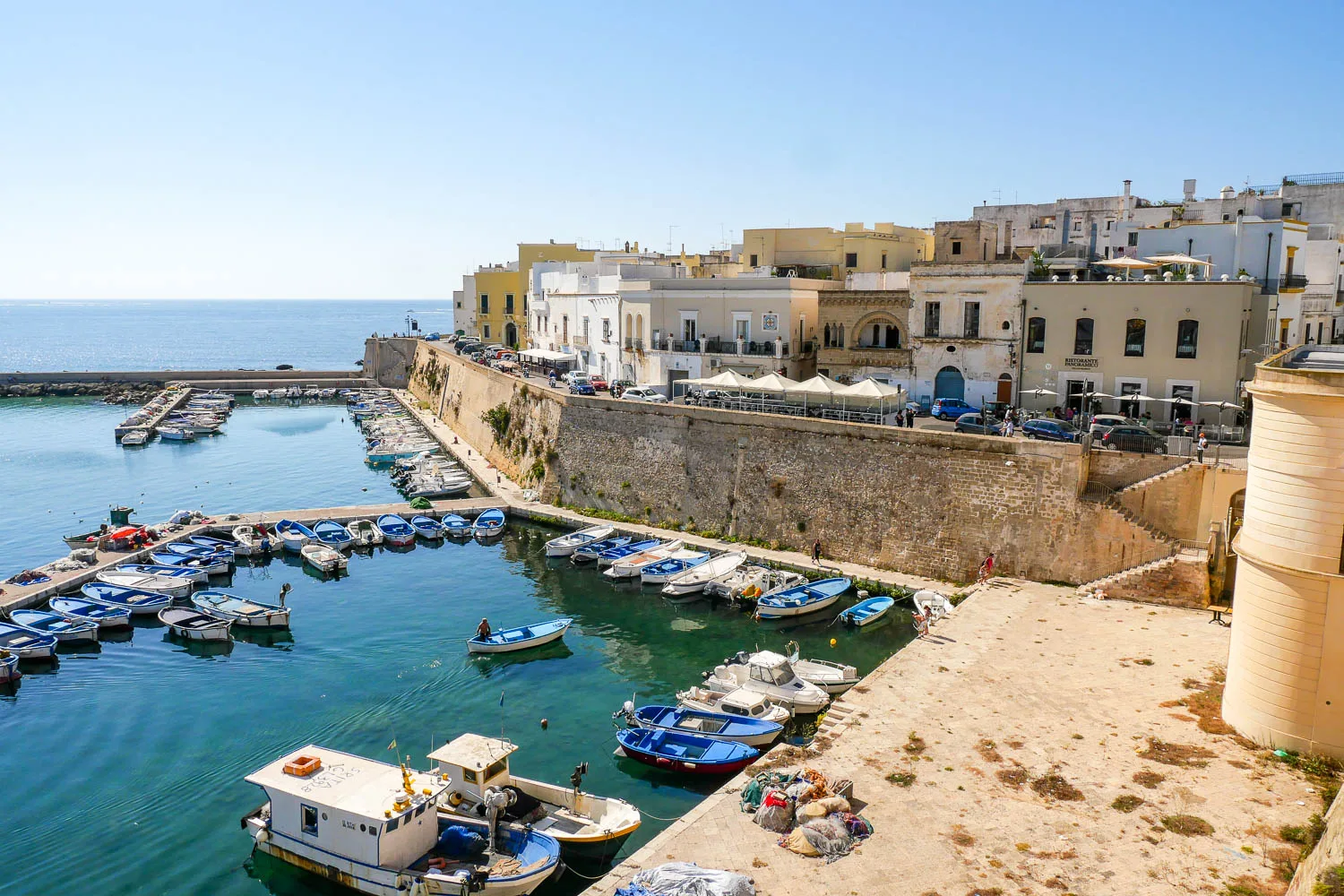
Following via Antonietta de Pace from the cathedral toward the city walls, you reach the old fishing port of Gallipoli (Porto Antico). It occupies the entire space between the fortress and the Santa Maria del Canneto sanctuary located on the other side of the bridge. From this side, you actually get one of the most beautiful views of Gallipoli. The small blue fishing boats create a perfect setting for photos. It reminded me of Essaouira in Morocco (with a bit less blue, though).
To experience the port at its liveliest, come early in the morning when the fish auction takes place. The fish market is held every day (except Sunday) at the foot of the castle. It is a great opportunity to mingle with locals who come to buy fresh fish.
Gallipoli Castle
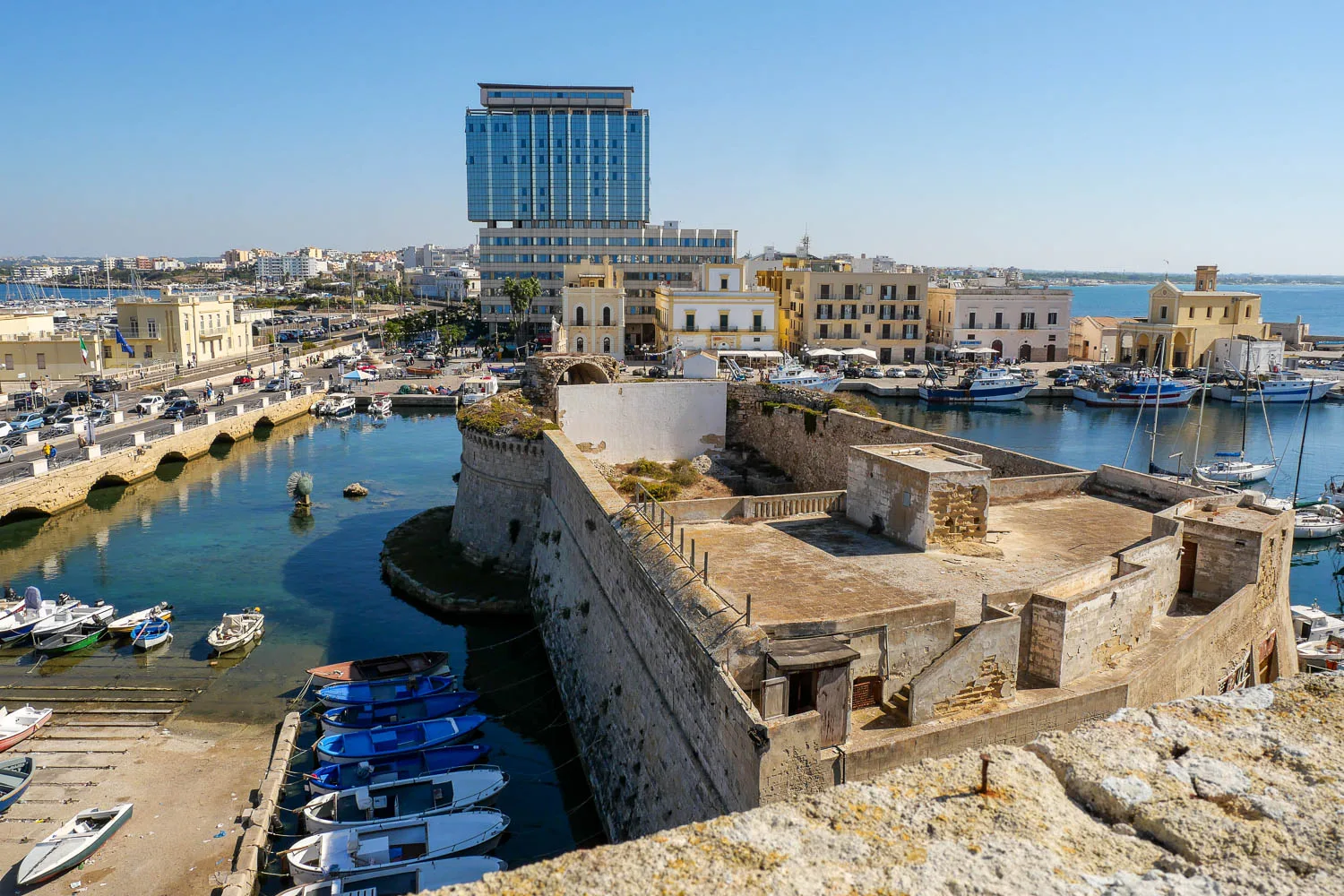
The imposing castle guarding the entrance to the island and the port was built in the 11th century on existing Roman fortifications. It was later modified by the Byzantines in the 13th century, then by the Angevins and Aragonese in the 15th and 16th centuries. It is locally known as the Castello Angioino (like the one in Naples).
The interior of the castle, built on three levels, can be visited. However, do not expect to find much inside. In the basement, there is a nonagonal room (with nine angles) measuring 20 meters in diameter and 10 meters high, a fine example of military architecture. On the ground floor, you will find several rooms to visit, such as the warehouse where salt was stored along with its weighing scale. Inscriptions on the walls likely indicate the weight of the sacks that were weighed there. On the first floor, you can enjoy panoramic views over the city, along the ramparts, or toward the towers.
If you have not yet visited a castle during your road trip in Puglia, it can be worth a visit. Otherwise, it is fairly similar to fortresses found in many other towns. The view alone does not really justify the entrance fee, so it is up to you.
The admission price for the Castello Angioino may be higher depending on temporary exhibitions. During our visit to Gallipoli, there was a discount, and entry cost €5 for everyone (without knowing the reason). The opening hours were also 10:00 am–7:00 pm, whereas normally there is a midday closure in October. Perhaps the good weather extended the summer even at the castle.
Admission : €7 (€6 for students and €5 for ages 6–14 and over 65). Audio guide €3.
Opening hours : 10:00 am–12:00 am in July–August | 10:00 am–8:00 pm in June and September | 10:00 am–1:00 pm and 3:00 pm–6:00 pm the rest of the year, closed on Mondays.


Church of Saint Francis of Assisi
The chiesa di San Francesco d’Assisi is not what I would call a must-see attraction in Gallipoli. We visited it because it was mentioned in our travel guide, the Lonely Planet Puglia (very well done, by the way, and highly recommended). The Church of Saint Francis of Assisi is the oldest church in the city. According to legend, it was founded in 1217 by Saint Francis himself.
Although rather ordinary, the church is known for its two wooden sculptures located in the Chapel of the Crucifixes (third photo). They depict the two thieves crucified alongside Christ. These are the most notable works by Vespasiano Genuino, a sculptor born in Gallipoli in 1552. Dressed like dolls, it is somewhat difficult to fully appreciate the woodcarving work.
The church is located on the city walls at the western end of the town. If you walk around the historic center along the ramparts, you will inevitably pass by it, so you might as well step inside if it is open (I could not find the opening hours anywhere).


Borgo antico
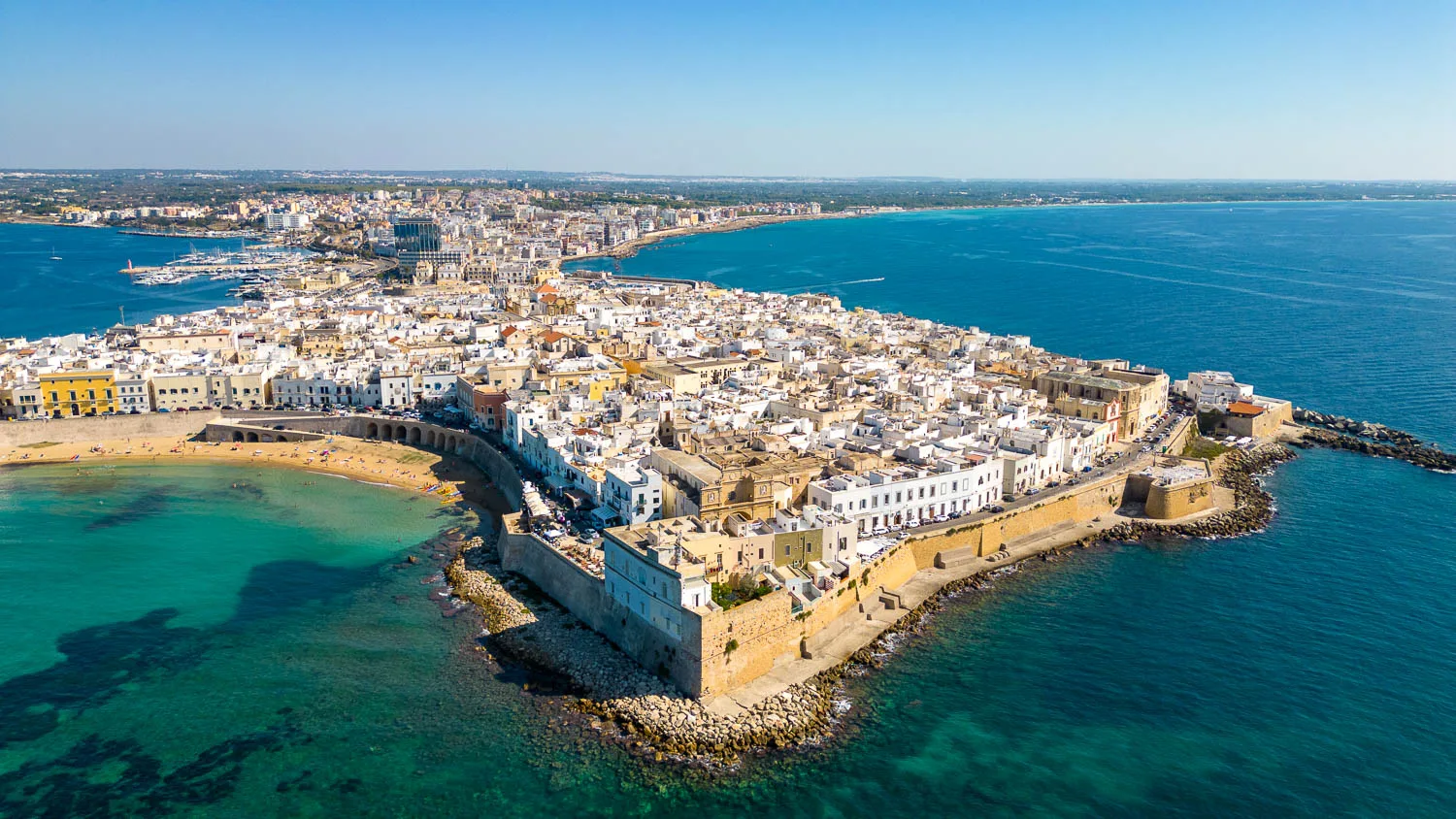
The historic center (borgo antico in Italian) stands on a limestone island connected to the mainland by a 17th-century bridge. Built around the 15th century, the powerful bastions defended the city against numerous attacks, particularly from Saracen pirates who spread terror throughout the Salento from 1480 onward. The ramparts were remodeled in the 19th century and now offer magnificent panoramic views as well as a pleasant walk.
Via Antonietta de Pace is the main street that runs through Gallipoli’s historic center. Most of the shops are located along this street. From here, many narrow, winding alleys branch off, hiding architectural masterpieces that reflect the wealth of the port city. Do not hesitate to wander aimlessly through the alleys to explore Gallipoli. You will always end up coming across a beautiful palace façade, a majestic doorway, or authentic scenes of daily life in Puglia.


Underground olive oil mills
Gallipoli’s history is closely linked to olive oil. Grown throughout Puglia, it was exported by sea to all of Europe. This is what allowed the city to prosper and become one of the wealthiest in the Salento from the end of the 16th century. At the time, however, olive oil was not used to dress a pan bagnat (a small nod to my origins) ; it was used to fuel the lighting of major European capitals.
The city once had many underground olive oil mills carved into the carparo, the limestone rock typical of the region. Some have been restored and can be visited. The most famous is the mill located in the basement of a 15th-century palace (Palazzo Granafei) at No. 87 Via Antonietta de Pace. Now a museum, the visit (continuous in July and August, otherwise 10:00 am–1:00 pm and 3:00 pm–7:00 pm) is managed by the Gallipoli Nostra association. Admission costs €2 per person.
Another underground olive oil mill can be found at No. 6 Via Santa Maria (Frantoio Oleario Ipogeo del Viceré). It is open from 10:00 am–1:00 pm and 3:00 pm–6:00 pm. Admission is also €2 per person. However, it is a bit less interesting than the first one, so I recommend visiting the Palazzo Granafei mill instead. You may come across other mills around town—look for the inscription “Frantoi Ipogei.”
The most beautiful beaches in Gallipoli
Spiaggia della Purità
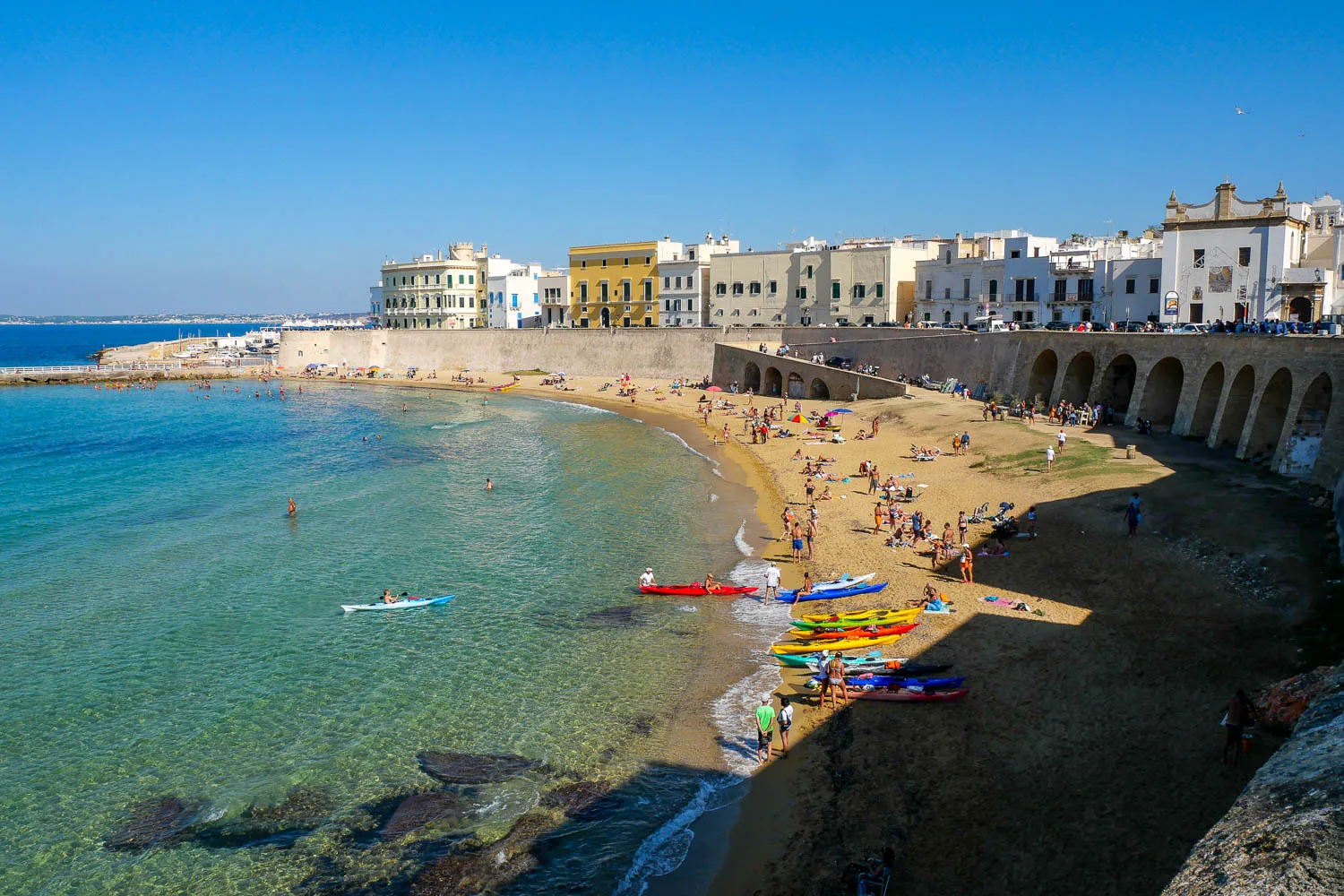
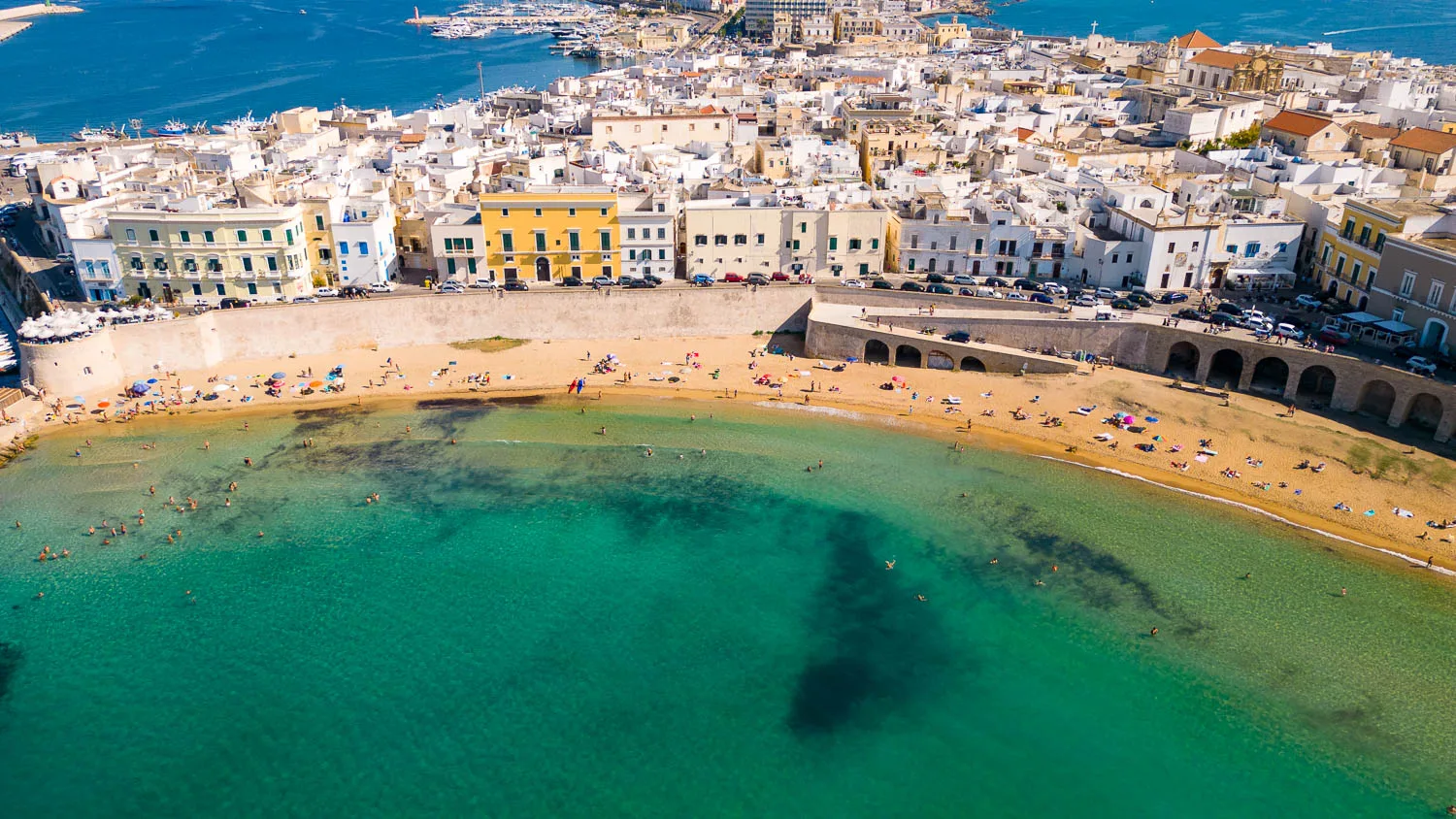
Spiaggia della Purità is the beach located at the foot of the old town walls in Gallipoli. It is a beautiful stretch of sand with shallow waters, ideal for young children. It is also easily accessible with a stroller thanks to its ramp. The beach is free, with no private beach concessions even in summer, which is quite rare in Italy and worth noting.
The water, like everywhere in Puglia, is stunning. However, there may be slightly more seaweed washed up on the sand than on other beaches. Still, for enjoying a picnic bought in the historic center or having an aperitif at sunset (it faces perfectly west), this is a spot not to be missed in Gallipoli.
Baia Verde beach
Just 3 km south of Gallipoli lies a large, beautiful sandy beach (map). Along its 3 km stretch, numerous private beach clubs with sun loungers and umbrellas are set up in summer (from June to September). However, there are free public beach areas between them. During our stay in Gallipoli in October, Baia Verde Beach was almost deserted. But this was not where we chose to stop, as we were looking for the perfect beach.
To park at spiaggia di Baia Verde, you will find parking spaces along the road. Parking is paid from June 1 to September 30 from 9:00 am–1:00 pm and 3:00 pm–8:00 pm. From April 1 to May 31 and from October 1 to October 31, parking is paid only on weekends and public holidays. In summer, especially in August, parking can be difficult.
Posto Vecchio Beach
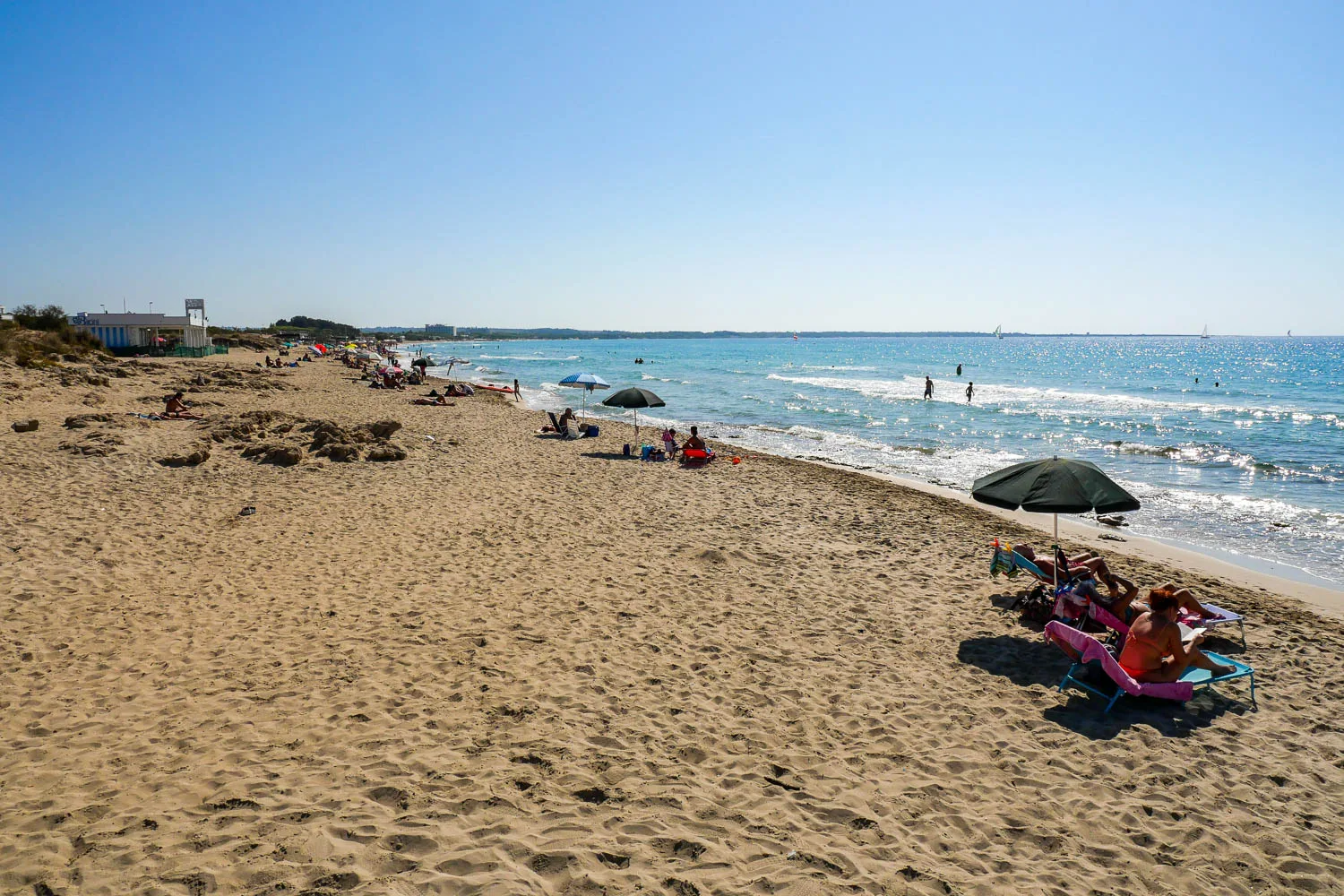
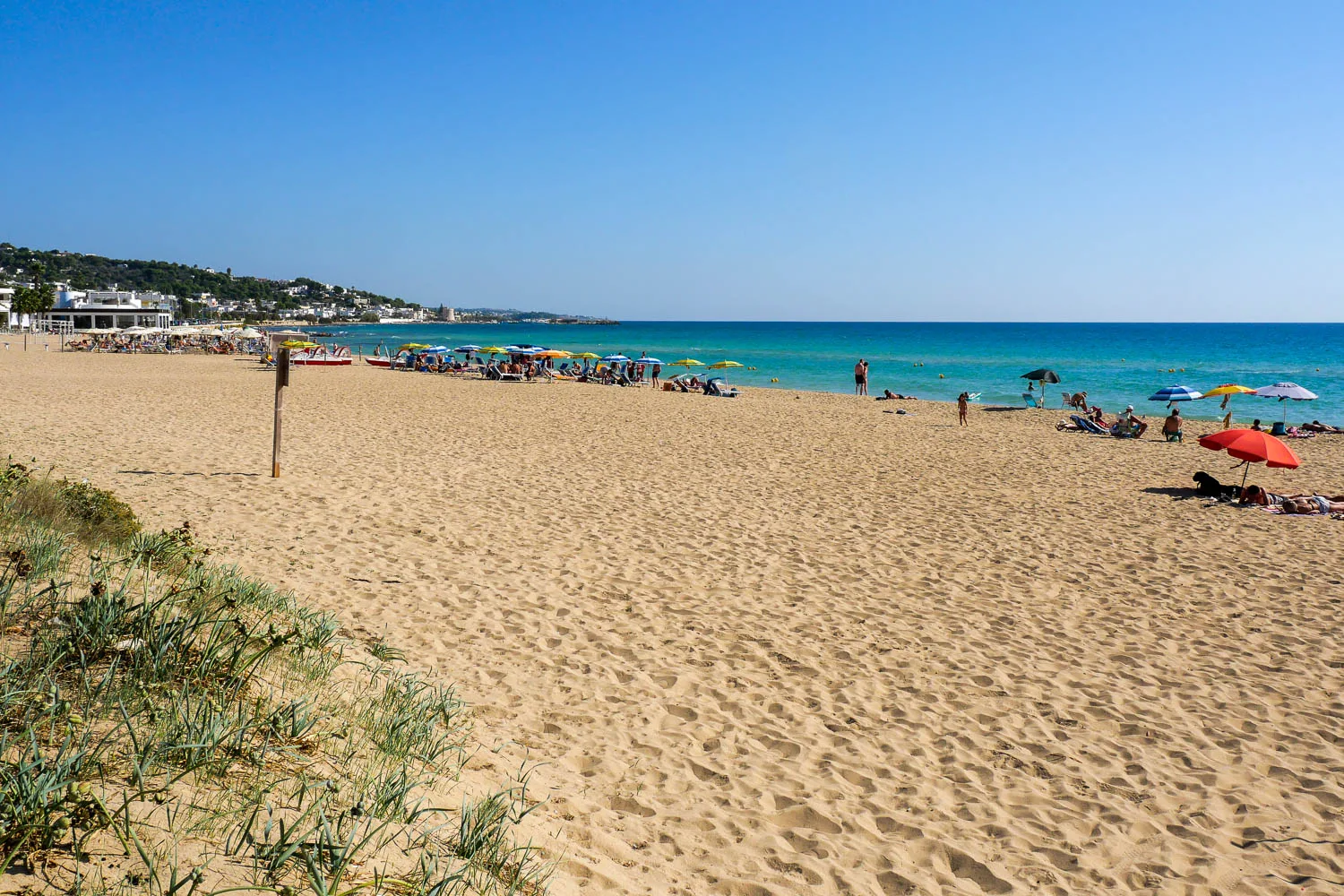
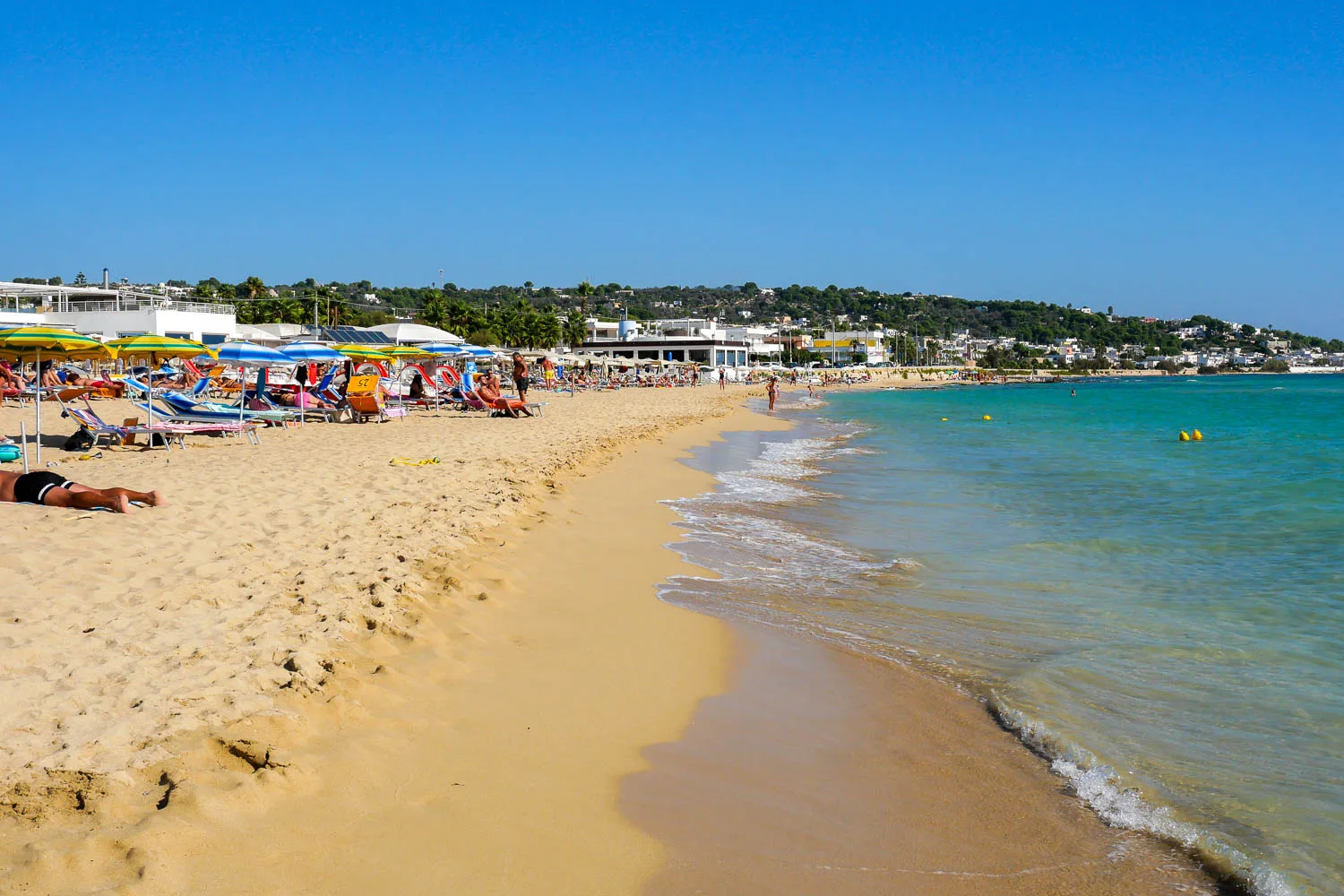
We drove a bit farther from Gallipoli to find the beach we liked the most. Spiaggia di Posto Vecchio (map) is located 41 km (35 minutes by car) south of Gallipoli and 15 minutes north of Santa Maria di Leuca, the southern tip of Puglia. It is not exactly nearby, but we chose to come here because this beach is nicknamed the Maldives of the Salento. If you overlook the seabed and marine life that I have seen in the Maldives, the nickname is well deserved. The fine golden sand and turquoise water are magnificent. Unfortunately, it was windy that day, and the photos do not do it justice.
This is where we enjoyed our picnic—focaccia bought in Gallipoli. I even went swimming (Daniela found the water too cold). For October 15, the water was still fairly warm (I would say around 21–22°C). Part of the beach is occupied by a private beach club, but there is still plenty of space to lay down your towel for free.
For parking, there are marked blue parking spaces (paid via parking meter) along the road that runs by the beach. While we easily found parking in October, it must be a different story in July and August. During our stay in Gallipoli, parking at Spiaggia di Posto Vecchio was free. There are also private parking lots charging €3 per day (check if the price is the same in summer). Be careful not to park in yellow-lined spaces, as they are reserved for residents.
What to do around Gallipoli
Nardò
Originally, this was not a visit we had planned in our itinerary. But during our stay in the Salento, we had a rainy day and had to improvise an alternative to the beach. We went to the town of Nardò, 17 km north of Gallipoli, and it turned out to be a very pleasant surprise. I would have loved to discover it in sunny weather.
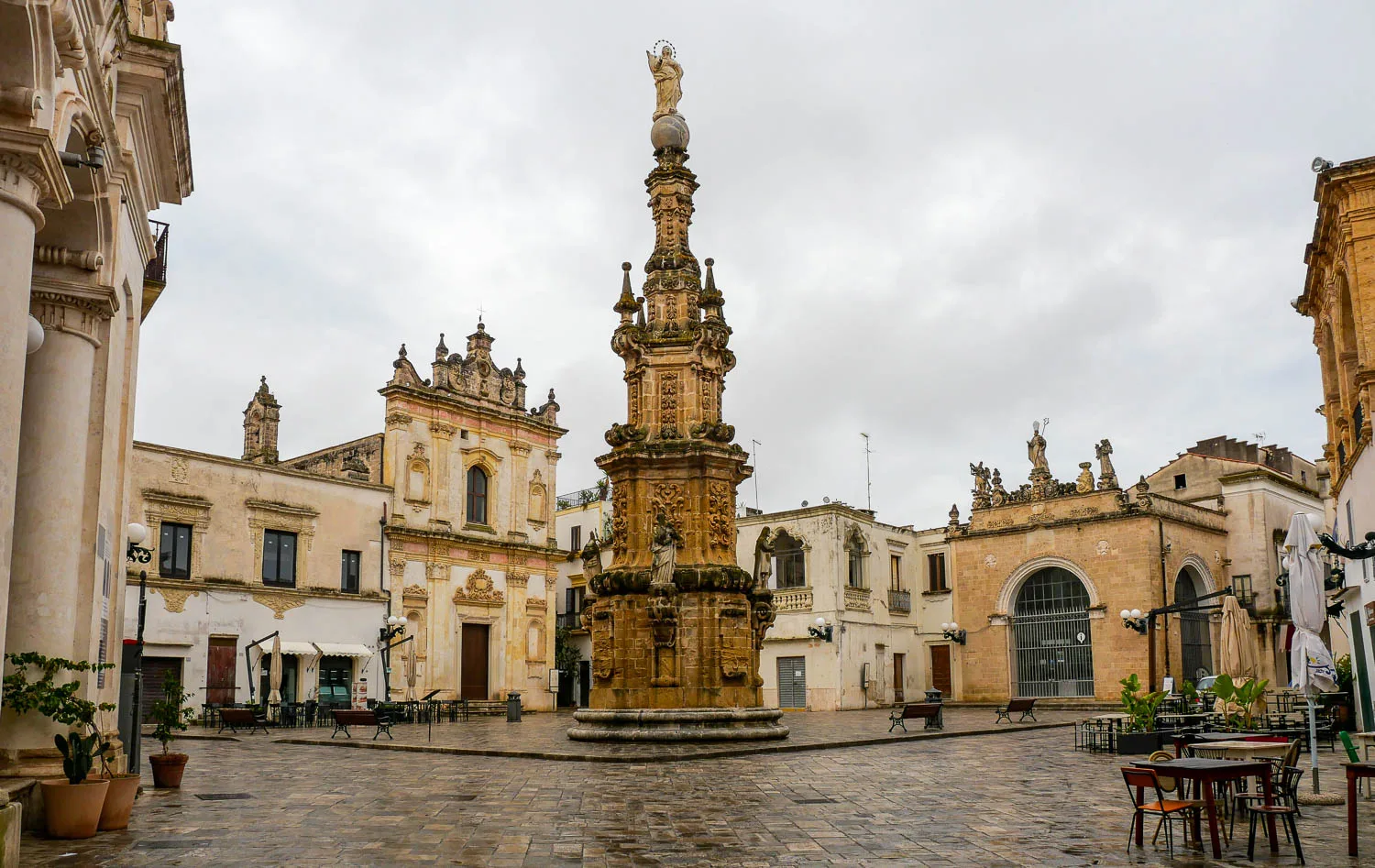
The historic center of Nardò features beautiful 17th- and 18th-century buildings, including churches, a theater, a cathedral, an Aragonese castle, and a few small museums. Piazza Salandra, surrounded by many fine buildings, is the heart of the old town (shown in the photo below).
If you are not particularly drawn to beaches or are visiting outside the seaside season, I recommend heading to Nardò after visiting Gallipoli. You will not regret it.
For parking, we easily found a free spot in the small streets northeast of the old town (map). Be aware that the historic center of Nardò is a ZTL (limited traffic zone) where vehicles are not allowed when active.
Galatina
As with Nardò, we made a detour to Galatina on that rainy day. It is located 20 minutes by car from Nardò and can also be reached from Lecce. Galatina has few noteworthy sights (compared to its neighbors), but it is absolutely worth stopping to see the stunning basilica di Santa Caterina d’Alessandria.
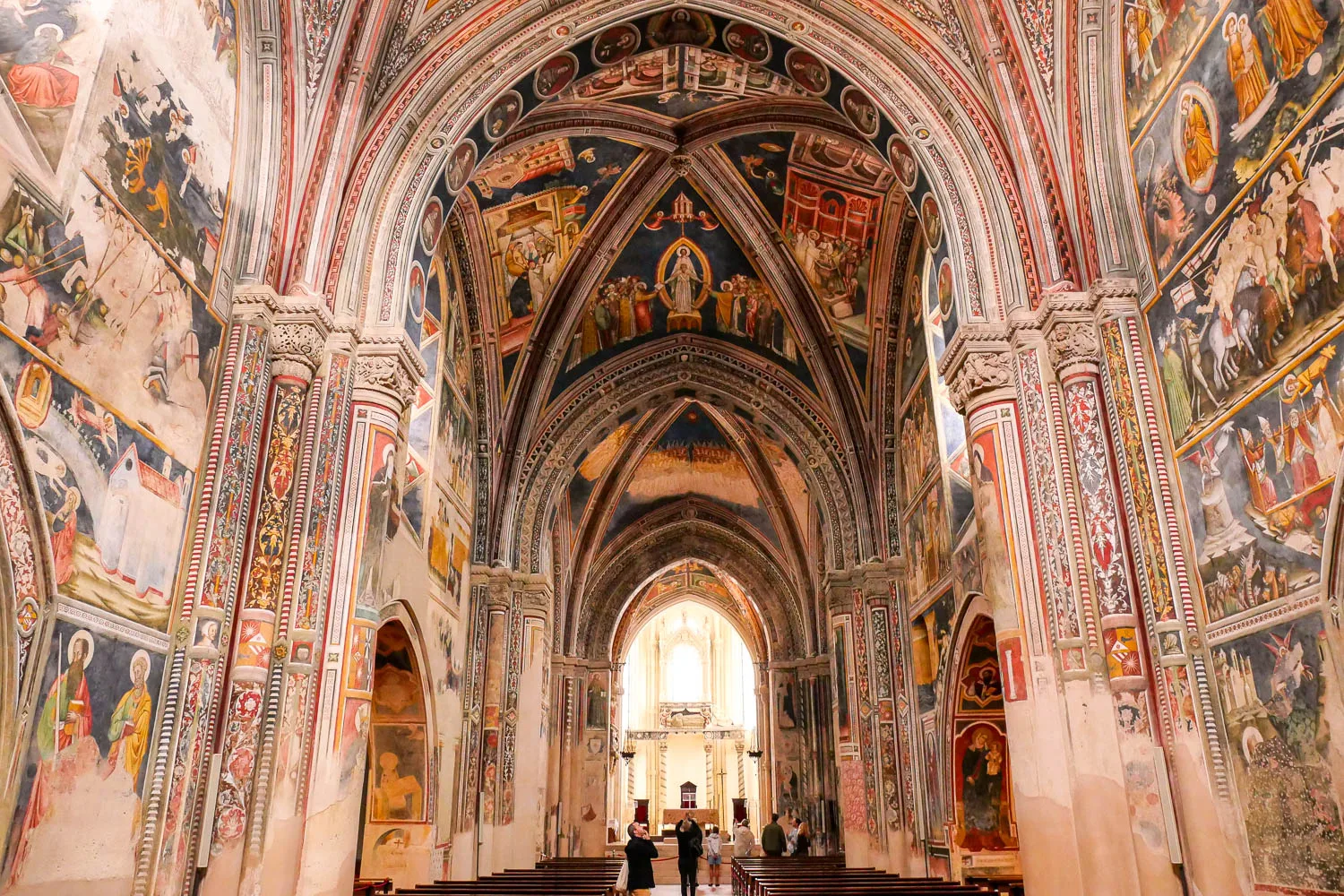
This 14th-century basilica, blending Romanesque and Gothic styles typical of Puglia, houses magnificent frescoes. It was built on the foundations of a 9th-century Byzantine church, traces of which are visible in the outer wall of the right aisle. Before entering, take a moment to admire the finely sculpted portal and the bas-relief on the lintel depicting Christ among the twelve apostles.
Inside, the five naves (the central nave is 50 meters long) are entirely covered with frescoes painted in the early 15th century. Take your time to admire them and follow the narrative cycles from left to right. The visit continues through a small museum and then the cloister.
The historic center of Galatina is also a ZTL. It is active in the evening and on weekends. You can enter from 7:00 am to 7:00 pm on weekdays, but parking is not always convenient due to narrow one-way streets.
Admission : free
Opening hours : 8:30 am–12:30 pm and 3:30 pm–5:30 pm | Sundays and public holidays: 8:30 am–9:30 am and 3:30 pm–5:15 pm.


Where to stay in Gallipoli
You do not necessarily have to stay overnight in Gallipoli to visit it, but it can make a good base for exploring the Salento (see my guide on where to stay in Puglia). Like Otranto on the east coast, Gallipoli has a central position on the west coast and remains within easy reach of Lecce, the regional capital. Moreover, Gallipoli is charming enough, with its beaches and restaurants, to justify spending a few days there.
Here are some accommodation options I recommend for staying in Gallipoli. Prices vary depending on the booking period, with a peak in summer. Some apartments require a minimum number of nights.
- 40 € : Bed&Breakfast La Cornucopia, a great budget option for families. It offers a quadruple room with breakfast included and free parking. Located 1.5 km from the old town.
- 47 € : B&B Vittoria, located in the newer part of town, 900 m from Gallipoli Castle. It offers modern rooms for 1 to 4 people, with breakfast optional. Free street parking.
- 54 € : Camera vista mare Holidayz, for those who prefer to stay in the historic center, this accommodation offers spacious, charming rooms with sea views.
- 61 € : Palazzo Zacà, double rooms in this palace immerse you in the past with lovely retro décor. Breakfast is included and served on the terrace. Very well located in the old town.
- 85 € : Agriturismo Calamate, countryside accommodation with breakfast, located 3 km from Gallipoli. It offers apartments for 2 to 4 people and is ideally located for exploring Gallipoli and southern Puglia from a single base.
- 91 € : Il Torrino B&B, this well-located agriturismo for exploring the Salento offers beautiful rooms for 2 or 3 people with breakfast included. The main highlight is its outdoor swimming pool, perfect for relaxing after a day of sightseeing.
Travel guide and tips for visiting Gallipoli
How to get to Gallipoli ?
Gallipoli is located 38 km from Lecce (30 minutes by car) and about one hour from Brindisi, the nearest airport. The best way to get there is by car, which will also be essential for reaching the beautiful beaches further south. To find the best rental car rates, I recommend using this comparison tool, which I use every time I need to rent a car.
If you prefer public transport to visit Gallipoli, buses connect Lecce’s bus station (coordinates) to Gallipoli in about one hour. There is also a direct train line taking around 1 hour and 20 minutes. For schedules, check the website of Ferrovie del Sud Est, the local train company.
Another option for visiting Gallipoli if you do not have a vehicle and do not wish to use public transport is to join an organized excursion. I recommend this tour departing from Lecce, which includes Gallipoli, Galatina, Santa Maria di Leuca, and Otranto.
Where to park in Gallipoli ?
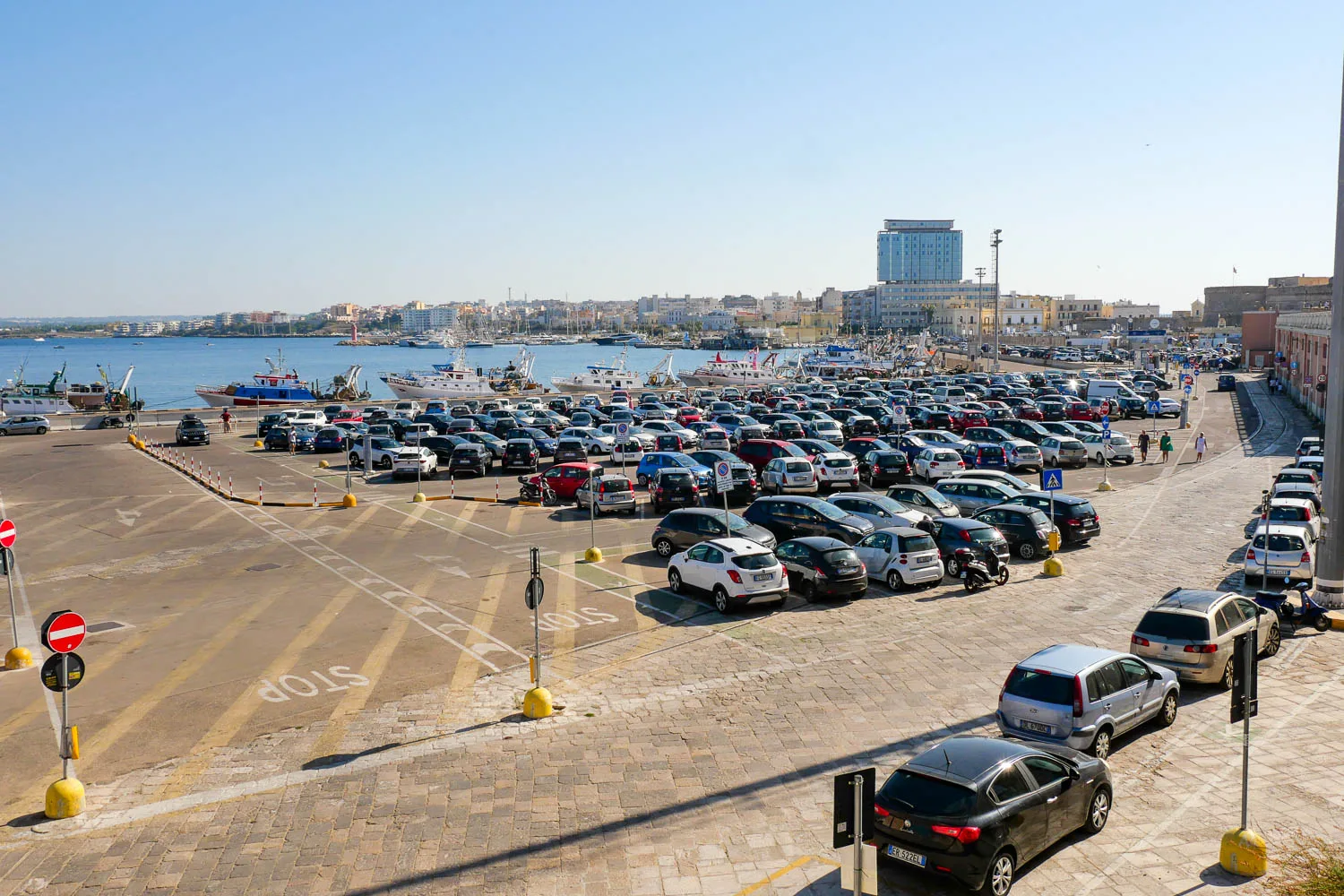
There is a large parking lot at the port, right at the foot of the city walls, and it is free for most of the day (GPS coordinates). This is the most convenient option for visiting Gallipoli by car. The port parking lot is paid only from 6:00 pm to midnight (every day). The rate is reasonable, at €0.50 per hour (payment by coins or credit card). This allows you to dine or go out in the old town without spending more than €3 for the entire evening. The parking lot is often full in summer and on weekends, so do not arrive too late. We visited Gallipoli on a Sunday and there were very few spaces left.
You can also try to find parking along the road that runs around the city walls. It is accessible to all vehicles and is not a ZTL. However, you need to visit outside the high season, as all spaces are reserved for authorized vehicles from April 22 to September 30 (from 10:00 am to 2:00 am).
How much time to spend in Gallipoli ?
Gallipoli can be visited year-round, with summer obviously being the busiest period. During this time, parking in town or near the beaches can be difficult, and there are crowds everywhere, with frequent traffic jams. The city really comes alive from late afternoon onward. However, if you want to visit the monuments of the old town, it is essential to explore Gallipoli in the morning. In the afternoon, between 1:00 pm and 5:00 pm, most buildings are closed (only a few remain open continuously in summer).
In terms of time, allow half a day to visit Gallipoli and see the main sights of the historic center. Adding the surrounding sites mentioned in this travel guide, you will need a full day.
You know now the best things to do in Gallipoli. The city is one of the must-see destinations in Puglia and was one of our favorites. If you have any questions, feel free to ask them in the blog comments.