

Among the destinations not to be missed in Italy, I recommend visiting the Amalfi Coast south of Naples. This coastline, wedged between cliffs and the turquoise waters of the Mediterranean, is listed as a UNESCO World Heritage Site for its landscapes. It is dotted with several iconic villages such as Positano, Amalfi and Ravello. While these attract most tourists, I also recommend discovering the lesser-known villages, which are a bit quieter, especially during peak season when all the beaches and villages are crowded.
What are the best things to do on the Amalfi Coast ? What itinerary should you follow for a road trip ? How many days should you plan ? How can you get around without a car ? I answer all your questions in this travel guide following our stay there in April.
Map of the Amalfi Coast and itinerary
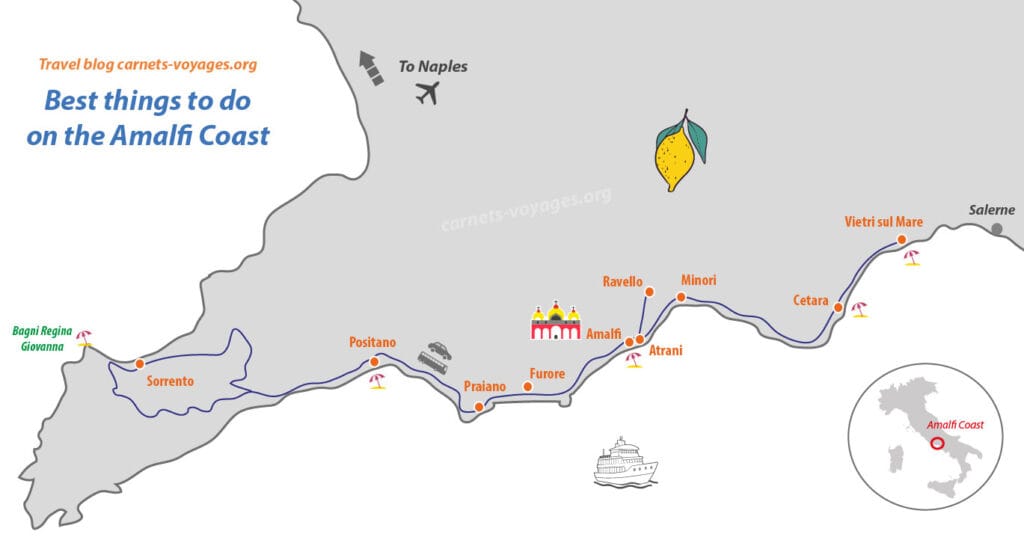
The Amalfi Coast stretches from the southern part of the Sorrentine Peninsula (Sorrento is not part of it) to Vietri sul Mare just before reaching Salerno. This represents about 70 km of coastline that can be explored via the road running along the entire coast. We chose to follow this itinerary by car to enjoy maximum freedom. In early April, traffic is still light and parking areas are not overcrowded. It’s a great time to take a road trip on the Amalfi Coast.
I’ve shown our itinerary and the must-see towns on the map below.
Travel guide and tips for visiting the Amalfi Coast
Best time to visit
The Amalfi Coast is a very popular summer destination for its beaches, not only among tourists from around the world but also among residents of Naples and the surrounding area. If you don’t want to find yourself in the middle of the crowds, stuck in traffic on the single coastal road, or queuing to board buses or boats, I recommend avoiding July and August.
The Amalfi Coast is busy from April (starting at Easter) through October. If your goal is to enjoy the beach and the sea, it’s best to visit in June or September. Otherwise, April and October allow you to avoid the crowds. Avoid winter, as from November until the end of March most hotels and restaurants are closed.
How to get to the Amalfi Coast without a car ?
The easiest way is via Naples Airport, which is served by many low-cost airlines. You can check flights and ticket prices on a comparison website. Once in Naples, several options are available to visit the Amalfi Coast without a car.
Getting to the Amalfi Coast from Naples airport : there are direct buses to Sorrento with the company Curreri Viaggi (about 1 hour 15 minutes). Departures take place every two hours between 9 a.m. and 7:30 p.m., and the fare is €13 one way. You’ll find all the information on the company’s website. Once in Sorrento, you can reach the various villages by bus or boat.
Getting to the Amalfi Coast from central Naples: you can reach Sorrento by Circumvesuviana train (EAV company). The train departs from Napoli Centrale station (level -1), and the ticket costs €4. The journey takes about one hour, check the company’s website for exact schedules. Alternatively, the ferry departing from Molo Beverello port allows you to cross to Sorrento or Positano. You can compare ferry companies and prices online.
How to get around ?
Car : this is the option we chose to be as independent as possible and save time. We rented a car at Naples Airport. To find the best rates, I used my favorite car rental comparison site. We paid €76 for 4 days with the company Sicily by Car.
Bus : the SITA Sud network allows travel between all towns. You’ll find schedules on the company’s official website. Select the departure and arrival cities and open the PDF file. It’s the cheapest way to get around the Amalfi Coast, but buses are not always on time and can be full in summer.
Boat : boat connections operate from several coastal villages: Sorrento, Positano, Amalfi, Maiori, Minori, Cetara, Vietri, and Salerno. You’ll find ticket kiosks at the port, or you can book online.
How many days to spend on the Amalfi Coast ?
This depends on your itinerary and what you want to do, but I suggest at least 3 days to visit the Amalfi Coast. The villages are not very large, but getting around and finding parking takes time. It’s best to plan visits to two villages per day to avoid overloading your schedule.
It’s possible to visit the Amalfi Coast in 1 day on an excursion departing from Sorrento or Naples. Travel is by boat, and you only visit Positano, Amalfi, and Ravello. If this interests you, you can check available excursions online.
Driving the Amalfi Coast
This is one of the most frequently asked questions on discussion groups and forums, some people think driving on the Amalfi Coast is difficult. After 4 days driving the roads, I can confirm that there is no particular difficulty driving on the Amalfi Coast. Perhaps only for drivers who have never driven on mountain roads. The roads are narrow and winding, and sometimes it’s difficult for vehicles to pass each other (the worst is when you encounter a bus), but at no point did I find it complicated.

Where to park on the Amalfi Coast ?
If driving isn’t difficult, parking on the Amalfi Coast is a completely different challenge. During our stay in early April, we had no trouble parking our car. There was always space in the village parking areas we visited. But in peak season it can be a real headache. Villages have few parking spaces, and some like Positano only have private parking lots. And don’t expect to park along the road to take photos, there are no stopping areas.
In July and August, I don’t recommend renting a car to visit the Amalfi Coast. Not only will you constantly be stuck in traffic, but you’ll also have great difficulty finding parking. Enough to turn your stay into a nightmare. During this period, I clearly recommend using boats to travel between villages (because buses are also stuck in traffic and struggle to pass other vehicles).
What budget should you plan ?
The Amalfi Coast is not a cheap destination. Accommodation prices are very high and make up a large part of the budget. For lodging with parking, it’s difficult to find anything under €150 per night. If you’re traveling by public transport, apartments can be rented from €100 per night in the off-season in more remote villages (around Minori or Maiori).
As an example, here is our budget for a 4-day stay in April 2025 :
- Flight : €202 per person (EasyJet)
- Accommodation : €600 for 4 nights at Il Limoneto (apartment with parking in Furore)
- Car rental : €76 for 4 days
- Fuel : €53
- Parking : €56
- Visits : €22 per person
- Restaurants : €176
Total : €1409 for 2 people
Best things to do on the Amalfi Coast
The towns and villages in this guide are presented from west (Sorrento) to east (Salerno). This is not necessarily the order you should follow, as it depends on your accommodation. We stayed in Furore (in the middle of the coast) and explored from there. The visit times indicated are the minimum needed to see the main sights.
Sorrento
Even though it is not part of the Amalfi Coast, you will probably pass through Sorrento during your stay. Especially if you use public transport to get around. This seaside resort enjoys a prime location for discovering the entire region, facing the island of Capri and close to Pompeii and Mount Vesuvius. Sorrento’s historic center has several buildings worth seeing and many cafés and restaurants where you can enjoy the Italian dolce vita. For beaches, I recommend heading to the tip of the peninsula, especially Bagni Regina Giovanna.
To explore the destination further and discover everything there is to do, I invite you to read my article what to do in Sorrento.
Visit time : half a day


Positano
This is the postcard-perfect village seen everywhere in photos and one of the must-visit places on the Amalfi Coast. It’s also the village I liked most, with its colorful houses clinging to the cliff. Positano is a chic and expensive seaside resort, but that doesn’t take away from its charm, especially when visiting off-season. During our stay, the private beaches with their rows of sunbeds and umbrellas were not yet installed, and a peaceful atmosphere prevailed.
In terms of activities, you can stroll through the historic streets to enjoy viewpoints and browse the shops, visit the cathedral, and relax on the beach. Positano is also a departure point for boat trips along the Amalfi Coast, including excursions such as this one.
To learn more about this beautiful village and find the best photo spots, you can read my guide best things to do in Positano.
Visit time : half a day


Praiano
Praiano’s understated charm could easily go unnoticed, as you quickly pass through the village along the coastal road. Still, you’ll notice the dome of the San Gennaro church, which closely resembles the one in Positano. The only problem is that it’s impossible to stop there by car, as there is no parking nearby. You must take the road that climbs up to the village to park. While there, you can also visit the second church, Chiesa di San Luca Evangelista.
We were lucky to have a beautiful panorama of Praiano from our accommodation terrace. We also stopped along the road at this location to enjoy the view of the church’s dome. Spots where you can park to take photos are very rare, don’t miss them.
There is no beach in Praiano except for a concrete platform belonging to a private establishment, which is not particularly interesting. If you’re short on time visiting the Amalfi Coast, you can pass through the village without regret.
Visit time : 1 hour


Furore
Furore, whose village is located in the hills, has two interesting sites along the coastal road. The first is a small beach wedged between two cliffs, Marina di Praia (coordinates), half occupied by a private establishment. To access it, there is paid parking along the road leading down to the marina (€3 per hour from 3 a.m. to 9 p.m. and €4 from 9 p.m. to 3 a.m.).
Continuing east, you reach the Fiordo di Furore (coordinates), a small fjord with a beach. I’ll tell you right away, it’s impossible to stop there by car. You can only take a quick look while crossing the bridge. The only way to reach it is by scooter (you can park along the road) or on foot from the village of Furore, but beware of the many steps. Some Amalfi Coast boat excursions stop at the Furore fjord, including this boat trip from Positano or this one from Amalfi.
The only drawback of these two beaches is that they only get sunshine around midday. The rest of the time they are in the shade due to the high cliffs.
Continuing toward Conca dei Marini, you’ll see a sign along the road for the Grotta dello Smeraldo. It’s a small cave with stalactites and blue-green water. The visit is by boat (€10). There is a tiny parking area on site, so it’s better to arrive by boat from Amalfi (an additional €15 ferry). We didn’t go, but reviews are not very enthusiastic, it feels more like a tourist trap.


Amalfi
This is the village that gave its name to this entire UNESCO-listed stretch of coastline. Amalfi is known for its 13th-century cathedral (the most beautiful on the Amalfi Coast), its sandy beach, and its lively center perfect for strolling. Of course, for the most pleasant experience, it’s best to avoid visiting in the height of summer. During this period, it’s very difficult to find parking, the beach is packed, and crowds fill the narrow streets of the historic center.
Amalfi is the best base for visiting the Amalfi Coast without a car. From here, you can reach all other villages by bus or boat (including Ravello in the hills). Find more details in my travel guide what to do in Amalfi.
Visit time : half a day


Atrani
Located a 10-minute walk from Amalfi, the village of Atrani transports you to another world, far from mass tourism (we were almost alone). The village has preserved its authenticity, with quiet streets and a beach where fishing boats linger—the kind of village we love to wander through. It reminded me a little our trip in Puglia with its white-fronted houses.
At the exit of the village, you can visit the church of Santa Maria Maddalena Penitente (it was closed during our visit). Its forecourt offers a beautiful view of the sea. There are two beaches in Atrani, one next to the old town and another toward Minori. As is often the case in Italy, they mainly consist of private establishments (€60 for two sunbeds and an umbrella) with a small public section.
There is a parking lot at Atrani’s port where parking is allowed even though it is in the ZTL (active Monday to Friday from 10 a.m. to 12 p.m. and from 4 p.m. to 7 p.m.). But honestly, it’s easier to come on foot from Amalfi, especially if you park at Luna Rossa parking.
Visit time : 1 hour


Ravello
Ravello is the only must-see site on the Amalfi Coast not located by the sea. If you don’t have a car, you can take a direct bus (Amico Shuttle or SITA Sud bus) from Amalfi port. Ravello is famous for its luxury villas, the best known being Villa Rufolo and Villa Cimbrone. Their gardens offer the most iconic panoramas of the Amalfi Coast.
It’s best to visit Ravello in May or June when the flower beds are in full bloom, as during our early April stay we were a bit disappointed. For more details and photos of the villas, you can consult my guide best things to do in Ravello.
Visit time : half a day


Minori
Most tourists visiting the Amalfi Coast only see Positano, Amalfi, and Ravello. From Minori onward, you’ll encounter fewer crowds, except in summer, as Neapolitans know the region’s beaches well.
Minori is a charming seaside resort with a small historic center (don’t miss the Basilica of Santa Trofimena) and a pleasant beach. We stopped there because of the famous pastry shop Sal de Riso (coordinates), which we know well since we eat their panettone every year (one of the best). It’s a very famous pastry chef in Italy who comes from Minori. Expect to pay €8 for a cake served with a scoop of ice cream. Among the region’s typical pastries, I love caprese (a chocolate and almond cake from Capri) and il dolce di Amalfi (a lemon and almond cake). The latter can even be brought back to home, which we didn’t fail to do 🙂
To park in Minori, there is a small parking lot at Piazzale Marinai d’Italia at the entrance to the village. The rate is €2 per hour (€4 from July to September). Minori is well connected by boat from the other Amalfi Coast villages, with 8 crossings per day, so don’t hesitate to visit.
Just after Minori lies Maiori, a more modern and less charming town. However, it has the advantage of having the largest beach on the Amalfi Coast (almost entirely private).
Visit time : 2 hours


Cetara
You need to go as far as Cetara (15 km from Amalfi) to discover an authentic fishing village on the Amalfi Coast. This activity, dating back to the 11th century, is still practiced on small boats to catch anchovies. It has given rise to a local specialty, colatura di alici, an anchovy sauce very similar to Roman garum. You need to like this fish because the taste is very strong. We ate spaghetti con la colatura di alici (€18) at Ristorante Acquapazza Cetara, a great place we recommend (if you don’t like anchovies, there are plenty of other good dishes). They produce their own sauce using locally caught anchovies.
In terms of sightseeing, there is not much to see apart from the church of San Pietro Apostolo (the patron saint of Cetara), whose current Baroque style dates from the 18th century. Unfortunately, it was closed during our visit. Cetara’s main attraction, aside from its gastronomy, is its palm-lined beach ending at the Torre di Cetara, a 17th-century defensive tower. For the best viewpoint, take the staircase leading up to the main road (at this location).
Parking in Cetara is fairly easy, with a large parking lot at the port (€4 per hour).
Visit time : 2 hours


Vietri sul Mare
The final stop of our Amalfi Coast road trip, Vietri sul Mare is the capital of ceramics in Campania. All the pieces you’ll find in other villages (especially Positano, Amalfi, and Ravello) come from workshops in Vietri (it’s marked on the back). Painted ceramic production dates back to the Roman Empire but became industrialized in the 16th century. Vietri’s historic center has many ceramic shops where you can sometimes see artisans at work (we couldn’t resist buying a beautiful plate).
Even if you don’t want to buy ceramics, Vietri sul Mare’s historic center invites you to enjoy a pleasant and more authentic walk than in the tourist villages. The town has several beaches for those who enjoy relaxing by the sea. Private beaches are cheaper than on the other side, ranging from €20 to €25 for two sunbeds and an umbrella.
For parking, we used the Piazza Matteotti parking lot located at the entrance to the historic center (coordinates). The rate is €3 per hour.
Visit time : 2 hours


Where to stay to visit the Amalfi Coast ?
[This is an excerpt from my guide where to stay on the Amalfi Coast]
Several options are available depending on your plans. If you intend to visit the Amalfi Coast and the surrounding area (Capri, Pompeii, Mount Vesuvius, and even Naples) from a single base, it’s best to stay in Sorrento. The town is well connected to all sites by public transport (bus, boat, and ferry) or by car.
However, if you plan to visit only the coastal villages over several days, I don’t recommend staying in Sorrento unless you plan to travel only by boat (but that becomes expensive). By road, you’ll lose quite a bit of time, especially if you want to explore more distant villages such as Cetara and Vietri. In this case, it’s better to choose a base between Praiano and Amalfi to stay close to everything. As for travelers on an Amalfi Coast road trip, you must choose accommodation with private parking.
Be aware that prices vary greatly throughout the season, peaking in July and August. During this period, book well in advance. We rented an apartment in Furore, Il Limoneto, with a superb sea view and private parking.
- 106 € : Blurooms, budget travelers who want to stay close to everything in the region will appreciate this B&B located in Sorrento. Some rooms can accommodate up to 4 people. Breakfast extra.
- 116 € : Il Vicoletto, this accommodation located in the upper part of Amalfi’s old town offers excellent value for money. It can accommodate up to 4 people for larger families. Private parking available at an additional cost.
- 130 € : Casa Stella Marina, located in Praiano, this guesthouse offers rooms, with the most expensive ones featuring sea views. The nearby bus stop makes it easy to get around, and private parking is also available (extra charge).
- 141 € : La Residenza del Saraceno, rooms for 2 or 4 people in this accommodation are well located in Amalfi’s historic center. The beach is only 250 meters away, and public transport is nearby.
- 148 € : Agriturismo Primaluce, this agriturismo accommodation in the Sorrento countryside is convenient for road trip travelers. It offers rooms with a terrace (superb view) and breakfast included. Private parking included.
- 190 € : Il Corallo, double rooms with terraces at this accommodation in Praiano offer a lovely sea view. Private parking available at an additional cost if traveling by car.
- 221 € : Sweet Home Positano, this 55 m² apartment accommodating up to 3 people is located in Positano. The big advantage is the included private indoor parking, which is rare in the area.
- 285 € : La Borragine Rooms, this double room with sea view located in Positano is perfect for a romantic stay. The terrace with sun loungers offers a charming setting to enjoy the breakfast included in the price.

What to do in the surroundings ?
Many travelers combine their visit to the Amalfi Coast with nearby destinations. In this case, it’s best to plan a week on site, as there is so much to do in the Bay of Naples. Conversely, it’s also possible to visit the Amalfi Coast from Naples if you only have one day. With just 1 day, I recommend taking this excursion, which includes visits to Sorrento, Positano, and Amalfi, or this one with Ravello instead of Sorrento.
Naples
The capital of Campania is one of Italy’s must-visit cities. I often hear concerns that it’s dirty and not very safe. That’s not true (okay, it’s a bit dirtier than Rome, but it’s the south). Naples is a city that deserves time to be discovered. You can’t form an opinion or absorb its unique atmosphere by staying only two hours. I recommend spending at least one day there. In 2 days, you’ll have time to see most of the city’s main attractions.
I wrote a very comprehensive article on visiting Naples, as we go there regularly (Daniela is Neapolitan). You’ll find a complete itinerary for spending 1, 2, or 3 days there.

Pompeii
Pompeii is an ancient city buried in 79 AD during the eruption of Mount Vesuvius. A thick layer of ash and eruptive materials (small stones) covered the entire city, allowing it to remain in an exceptional state of preservation.
You can visit Pompeii independently or through an organized excursion. Depending on where you stay on the Amalfi Coast, it may be easier to join an excursion. Pompeii is easily accessible by public transport from Naples and Sorrento but more complicated to reach from the Amalfi Coast villages.
- From Sorrento : Full-Day Pompeii and Mt. Vesuvius Tour
- From Positano : Pompeii Ruins Guided Tour
- From Amalfi : Pompeii Guided Tour with Skip-the-Line Entry
Capri
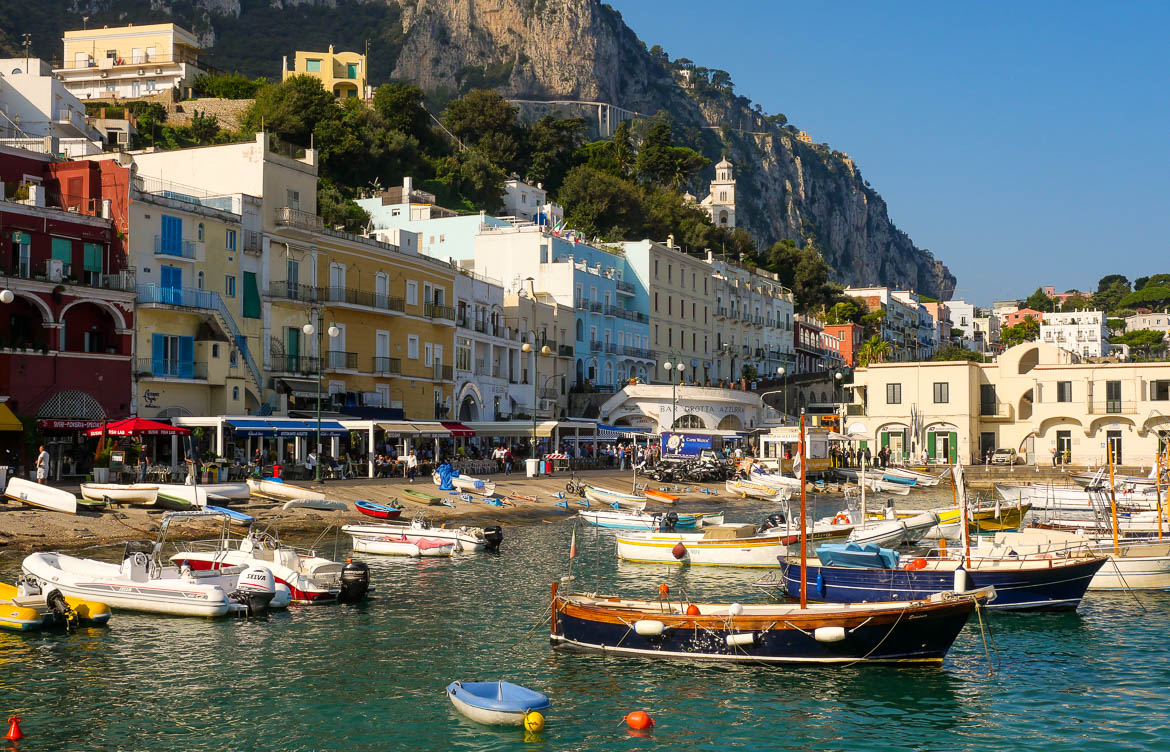
It’s the best-known and most popular island in the Bay of Naples (personally, I prefer the peaceful Procida). It is located directly opposite Sorrento and can easily be reached by passenger ferry. Once there, you can use my guide to visiting Capri for all the things to do. You can also join a cruise with a visit to the island, which is especially convenient if departing from Positano or Amalfi. This avoids traveling to Sorrento by bus or boat.
- From Sorrento : Capri Island Boat Day Trip With Transfer
- From Positano, Praiano, or Amalfi : Capri Full-Day Boat Tour
You now know the best things to do on the Amalfi Coast and in the surrounding area. If you have any questions, you can ask them in the blog comments.