
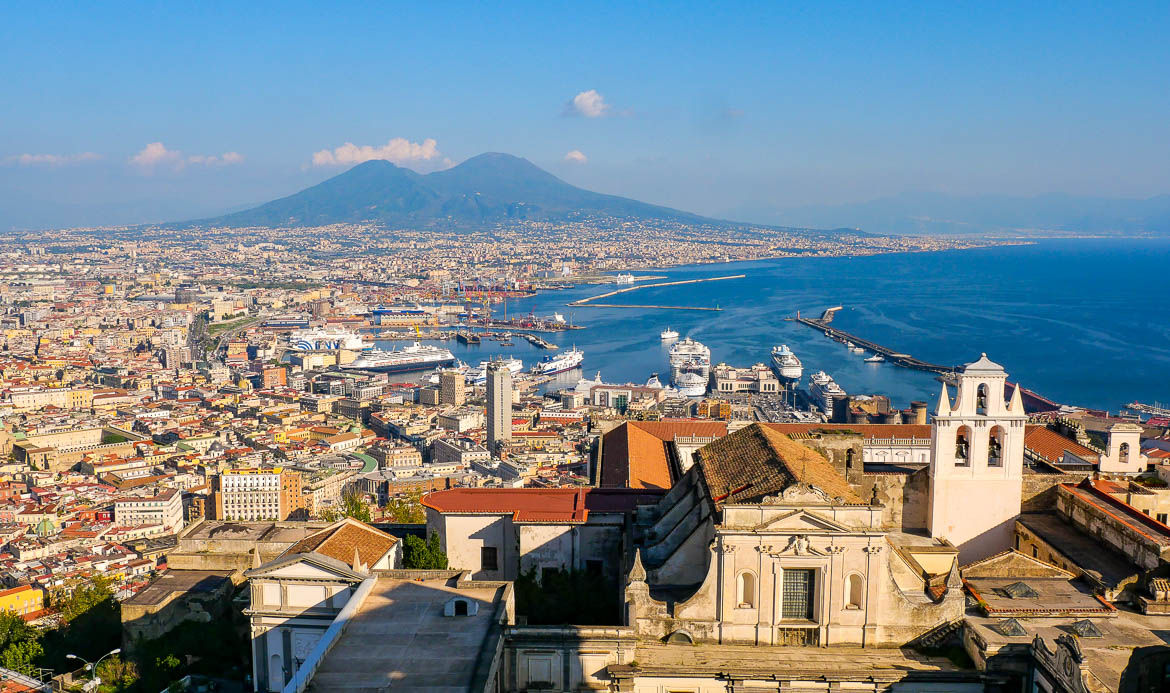
No city in Italy sparks as much passion as the capital of Campania. Visiting Naples will not leave you indifferent, you will either love it or hate it. But we can at least agree on one thing : Neapolitan cuisine, with pizza as its most iconic dish, is among the best in Italy. Architecture and art lovers will also be delighted to discover its twenty-eight centuries of history and its many treasures scattered throughout the historic center. And Naples is also the gateway to a magnificent region that includes Pompeii, Mount Vesuvius, the islands of the bay (Capri, Ischia, Procida), and the Amalfi Coast.
So what to do in Naples in 1, 2, 3, or 4 days ? What are the must-see sights and activities ? What is there to see nearby ? I share all my tips in this Naples travel guide.
Things to do in Naples : the map
This trip to Naples had a special meaning for me. If you follow my blog, you know that my girlfriend Daniela is Italian, but above all Neapolitan. She was therefore eager to show me her city and find out whether I would like it. I’ll spoil it a bit, I loved Naples (her family had put the pressure on me, I had no choice haha). Since then we’ve returned several times, and I update the blog each time.
Before starting this guide to Naples, it’s important to note that the city is not approached like other Italian cities. This isn’t Rome or Florence, with spectacular monuments on every corner. In vibrant Naples, especially its historic center, the sights are not immediately obvious. You need to take the time to discover its riches, because if you rush through the city you risk missing out on your visit.
On the map below, you’ll find the main must-see places to visit in Naples. All the tourist attractions are organized by district to help you optimize your itinerary. For those who prefer suggestions on what to do in Naples in 1, 2, 3, or 4 days, I provide sample itineraries at the end of the article.
Guided tours in English
If you don’t have much time to visit Naples or don’t know where to start (despite this excellent blog guide), joining a guided tour may be worthwhile. I’ve selected activities with English-speaking guides so you can understand everything if you don’t speak Italian.
- Downtown Tour with Veiled Christ & St Clare Tickets
- Naples Underground Entry Ticket and Guided Tour
- Free Walking Tour of Naples Old Town
- Street Food Walking Tour with Local Guide
- Hop-on Hop-off Bus Tour 24-Hour Ticket
Historic center
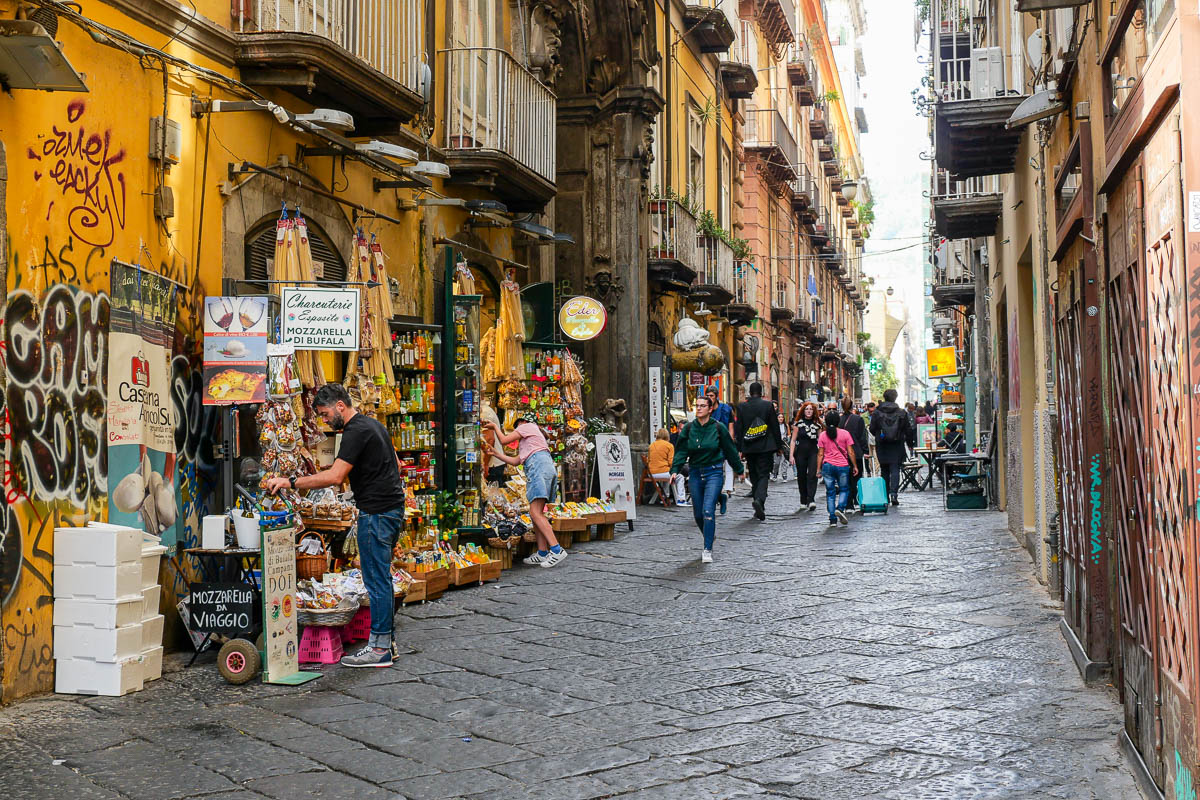
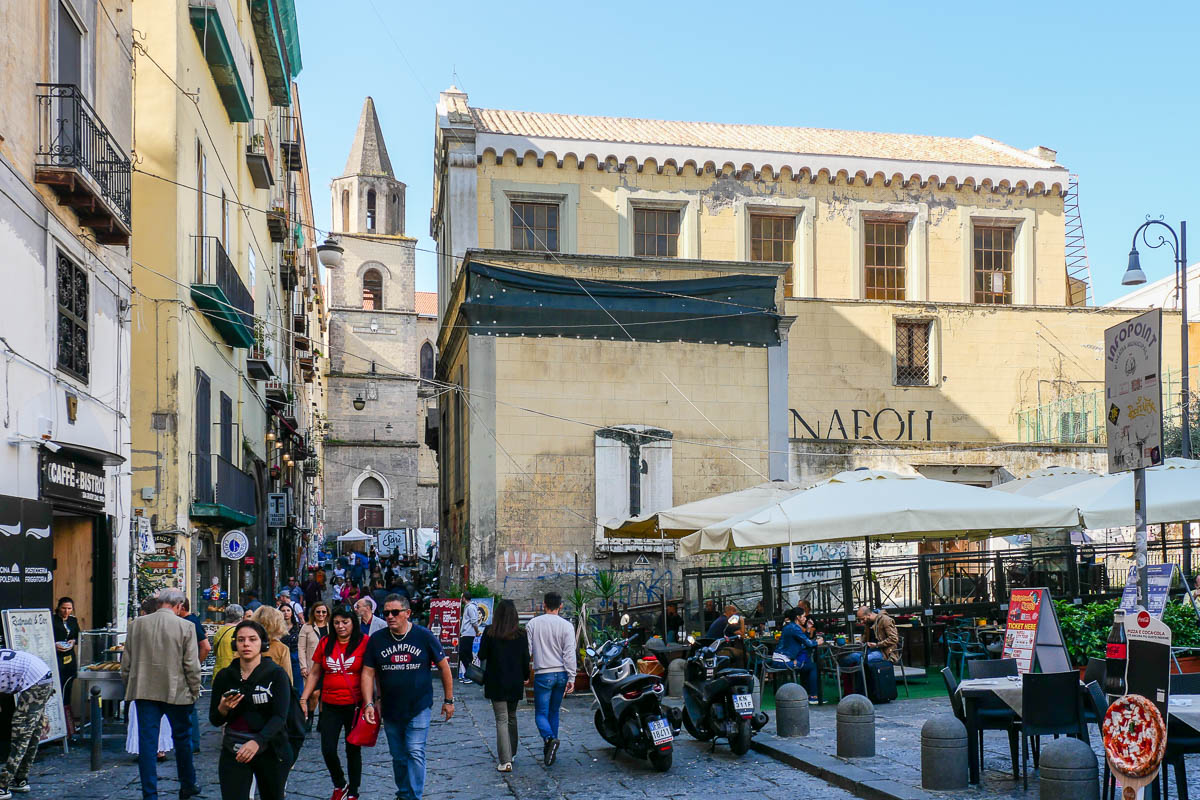
The centro storico is the heart and soul of Naples, nowhere else will you find such a typical atmosphere. The historic center is the best area to focus on if you have little time to visit Naples. Its maze of narrow streets contains many churches and palaces, as well as some of the city’s best restaurants and pizzerias.
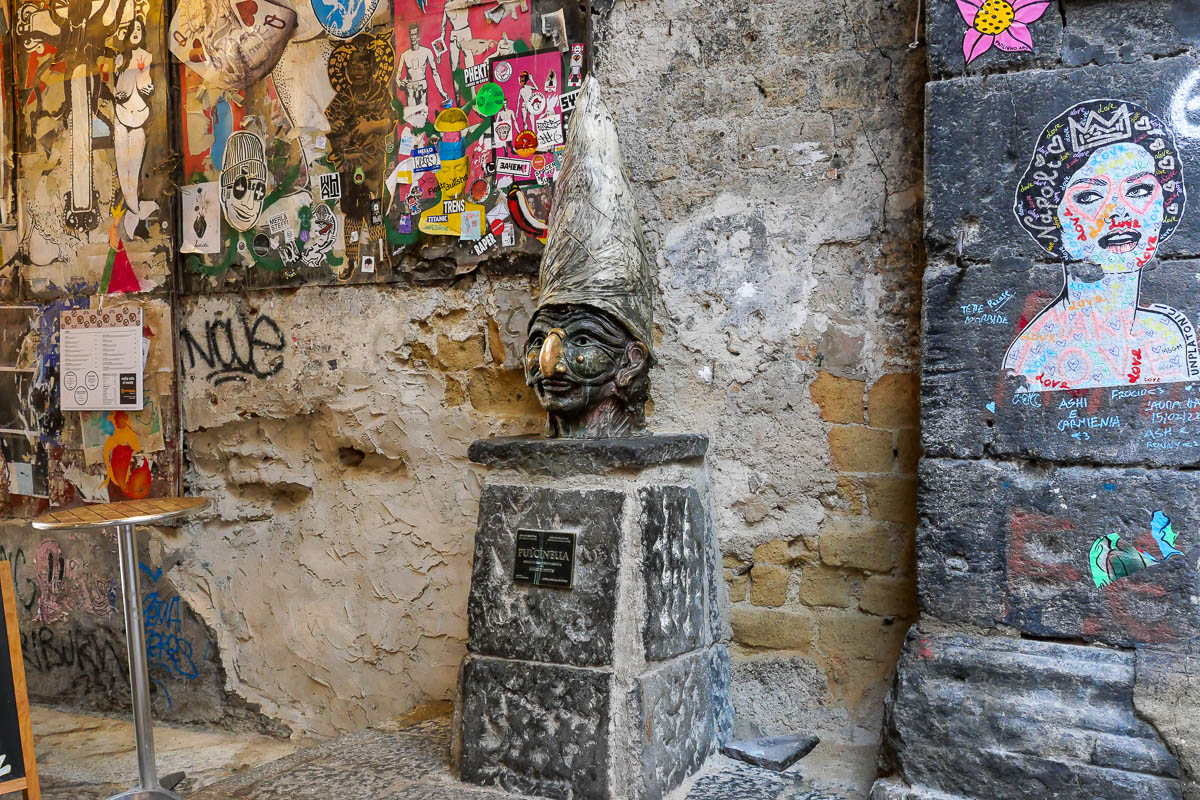
Despite its UNESCO World Heritage status and its 3,000 years of history, Naples’ historic center cannot be described as particularly well maintained or showcased. I was surprised to see that many palaces and churches were hidden behind scaffolding that seemed likely to remain for quite some time. You’ll also notice graffiti everywhere on building facades and garbage scattered here and there. And if you were planning to stroll with your head tilted upward watching laundry hanging from the windows, watch out for scooters speeding through pedestrian streets while honking. But that’s also part of Naples’ charm 🙂
Don’t hesitate to wander through the historic center’s streets to soak up the atmosphere and discover tourist attractions as you go. Those in a hurry can visit it methodically by starting at Piazza Dante, where there is a metro stop, then following Via Tribunali to the Duomo. Most of the historic center’s churches are located on this street or just a few steps away.


Church of the Gesù Nuovo
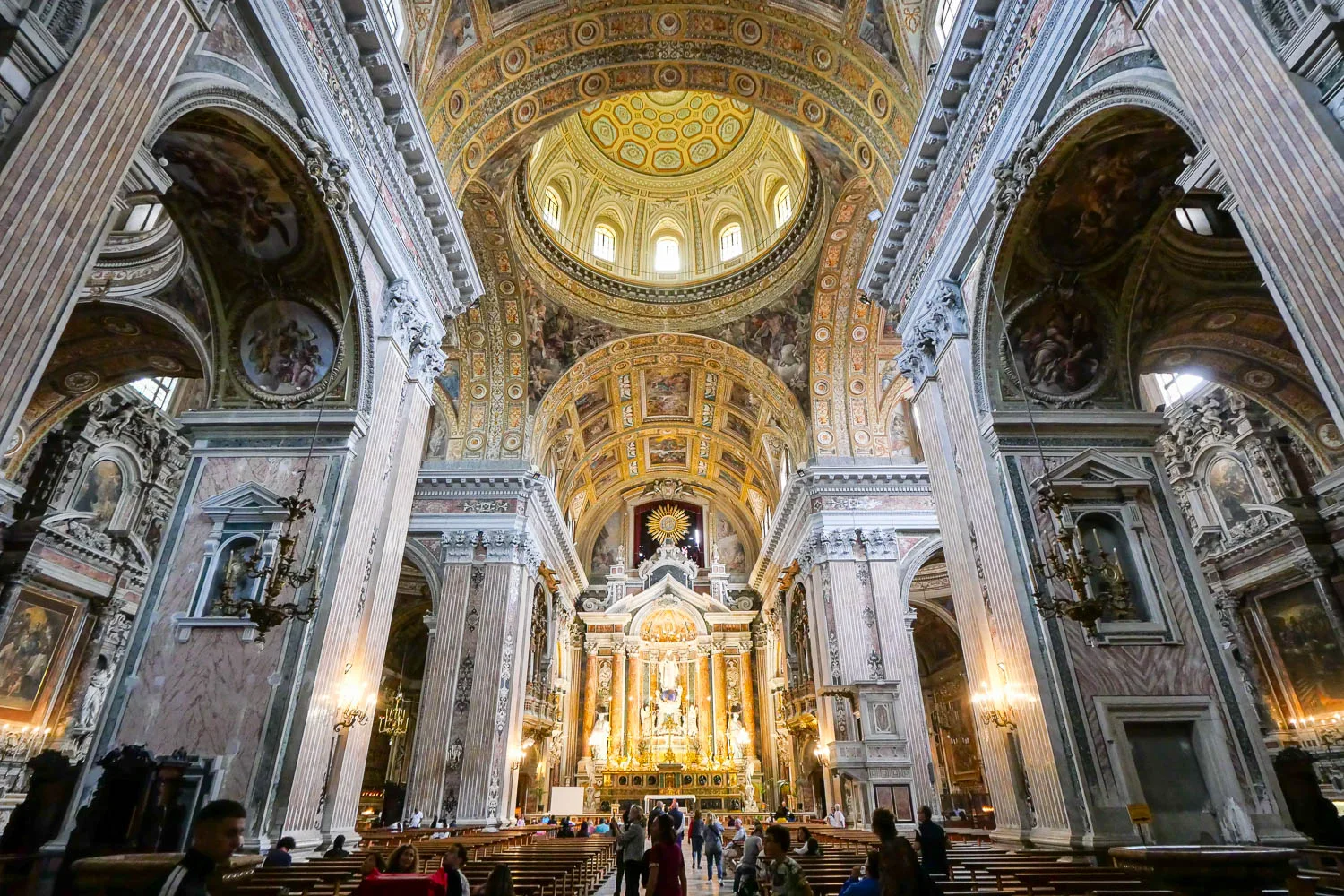
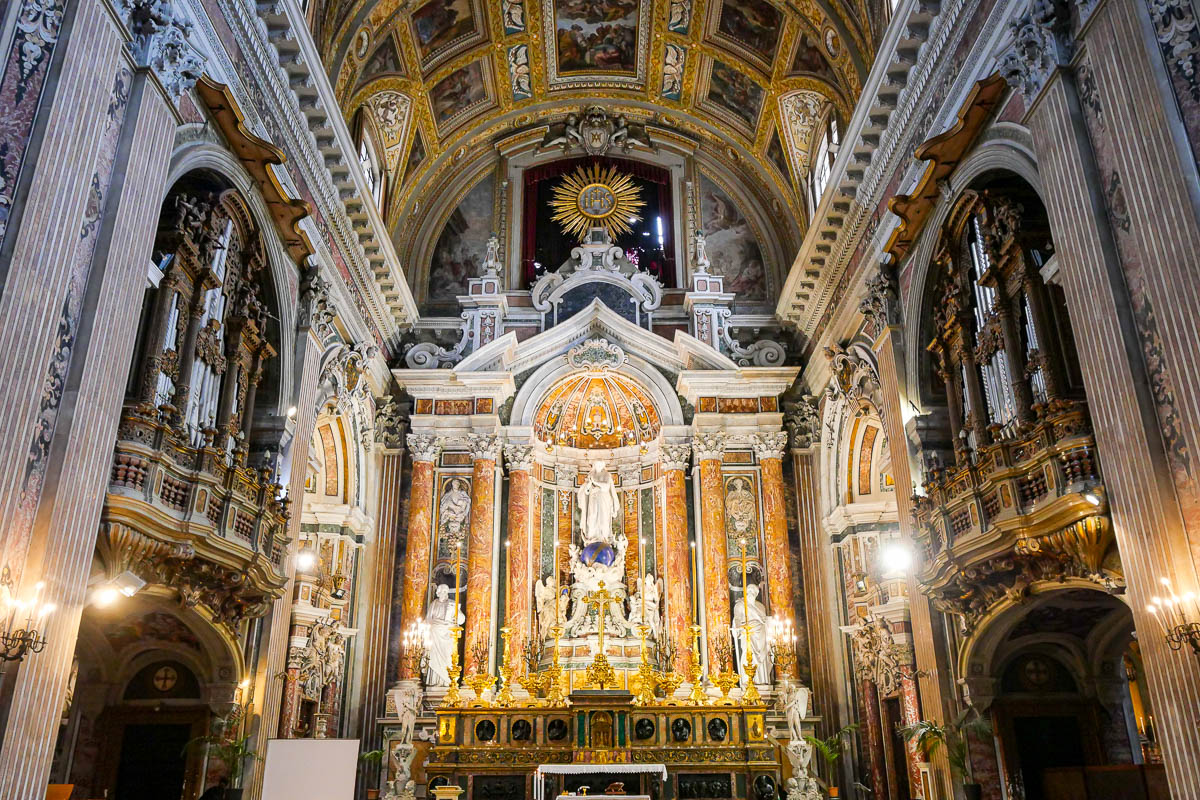
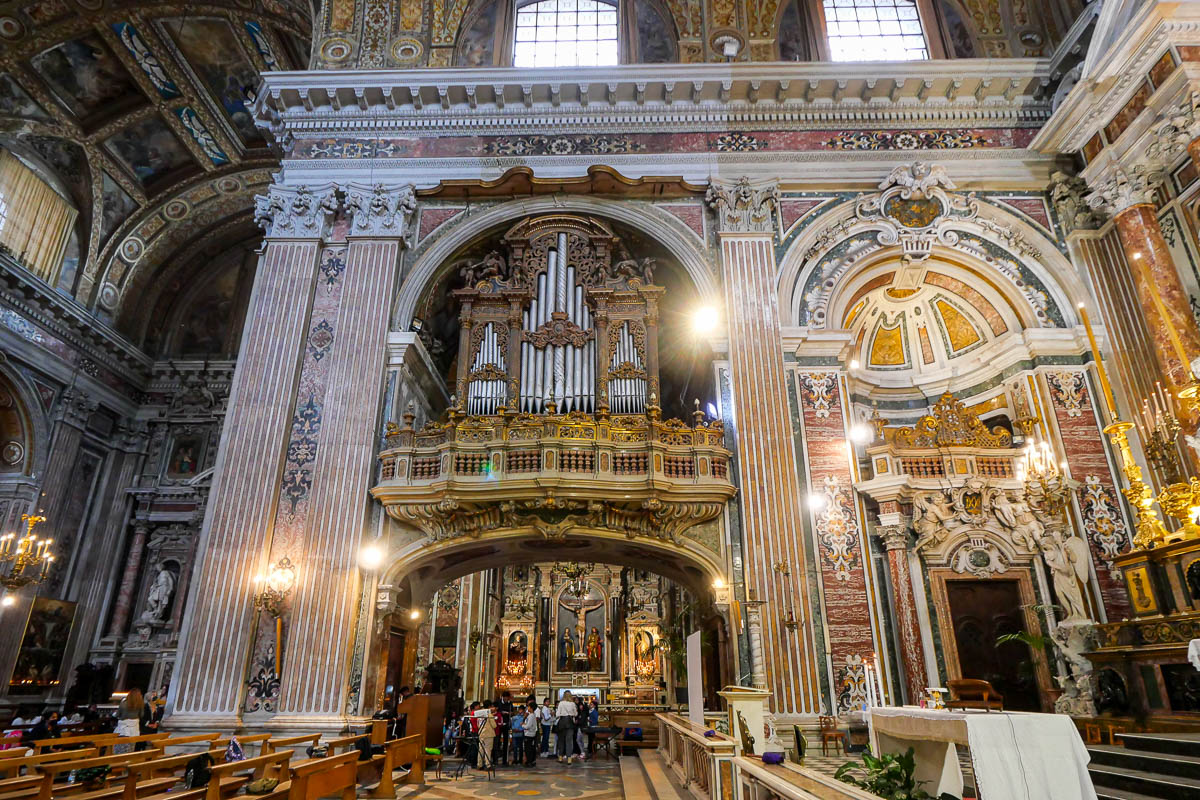
This magnificent church located on Piazza Gesù Nuovo is one of the most beautiful and important in Naples. It features a façade made of black volcanic stone shaped like diamond points. This rather unusual feature comes from the fact that the Church of Gesù Nuovo was built from the former Sanseverino Palace dating back to the Renaissance.
The interior is splendid. Admire the frescoes in the nave and choir, the polychrome marble, the height of the vaulted ceiling, and the paintings by famous artists. It’s one of the churches you absolutely must visit in Naples, and my favorite.
Piazza Gesù Nuovo is located along the street known as Spaccanapoli. Its name comes from the fact that it divides Naples’ historic center in two, following the ancient route of the Roman decumanus. Spaccanapoli can be clearly seen from Castel Sant’Elmo on the Vomero hill (see below).
Opening hours : 9am–12:30pm and 5pm–7:15pm Monday to Saturday | 8:30am–1:30pm and 4:30pm–7:30pm Sunday. Free entry.


Basilica and monastery of Santa Chiara
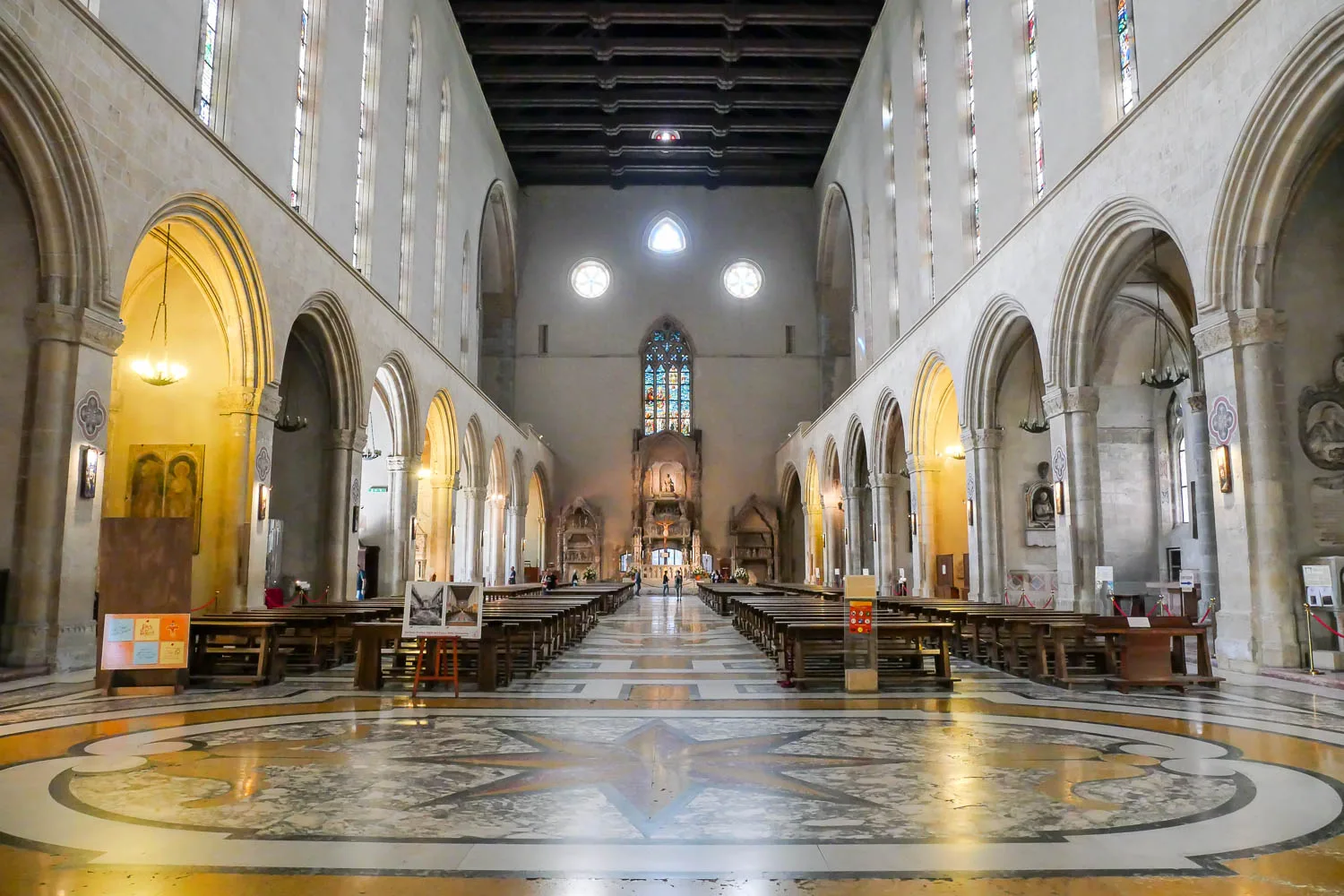
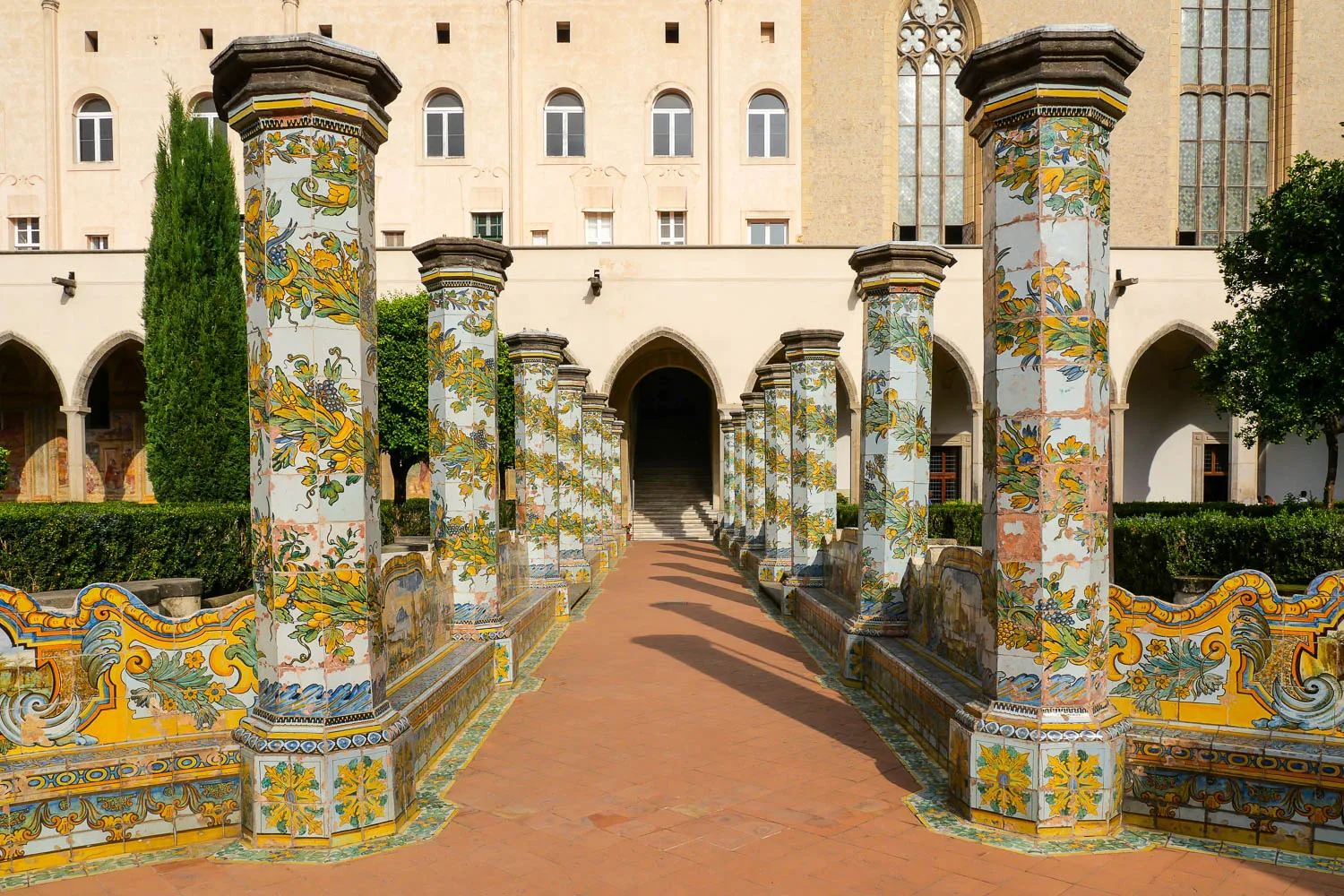
Located right next to the Church of Gesù Nuovo, the Basilica and Monastery of Santa Chiara are among Naples’ must-see landmarks. The large Gothic-style basilica is quite austere, like its exterior. You need to enter the cloister (paid access) to discover what lies within this superb 14th-century monastery.
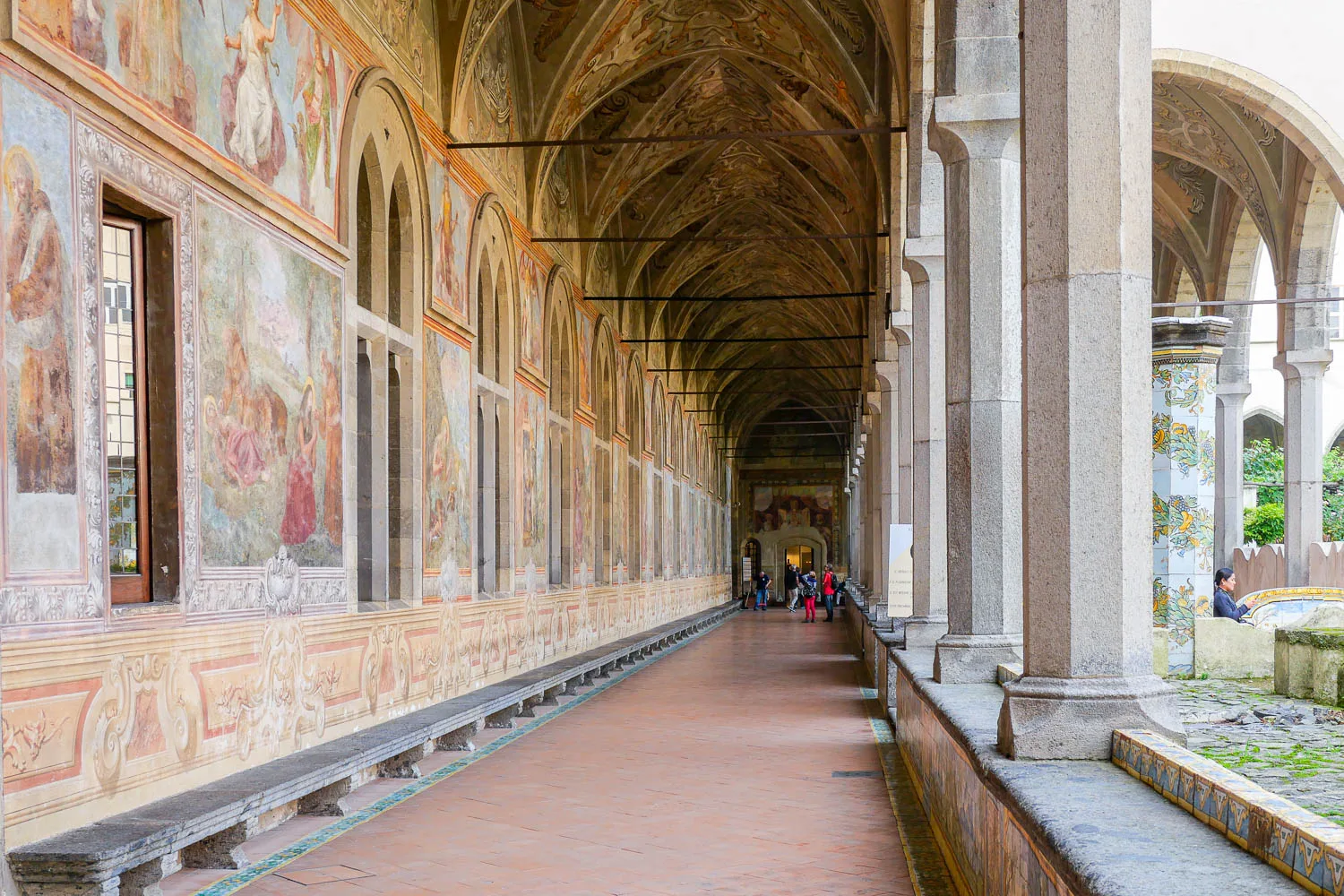
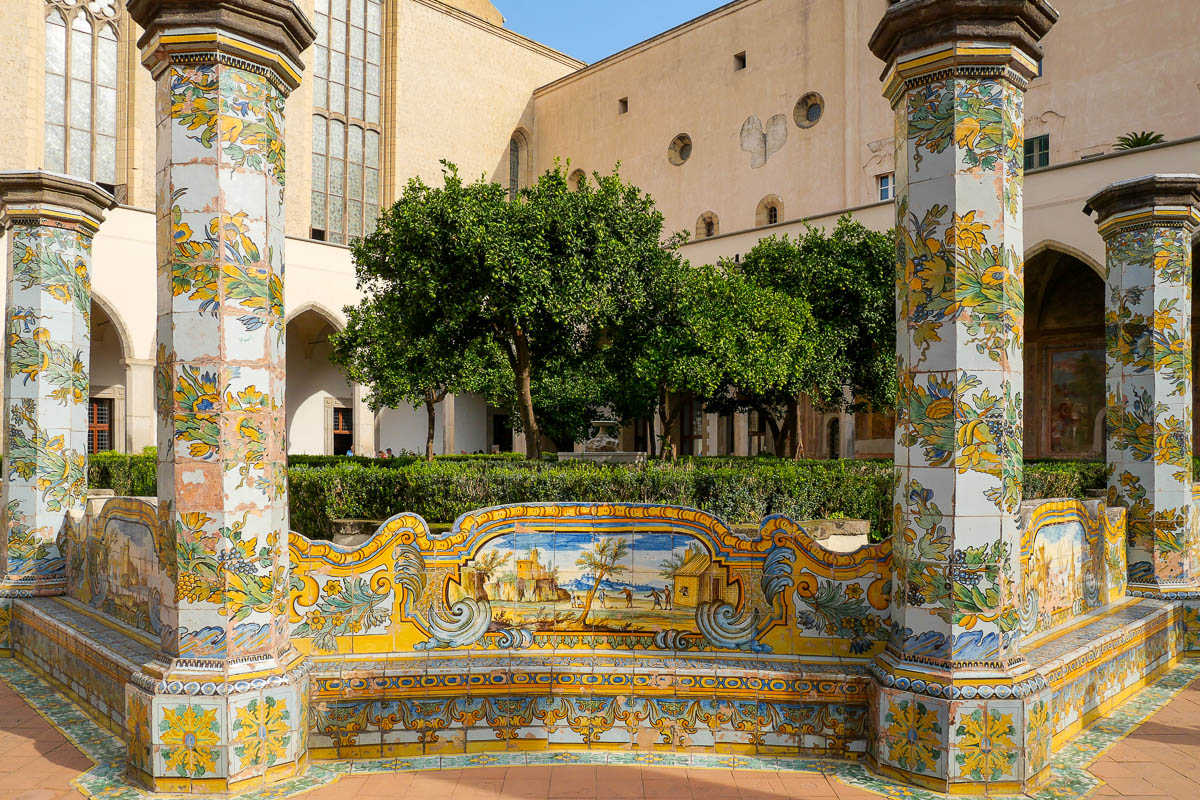
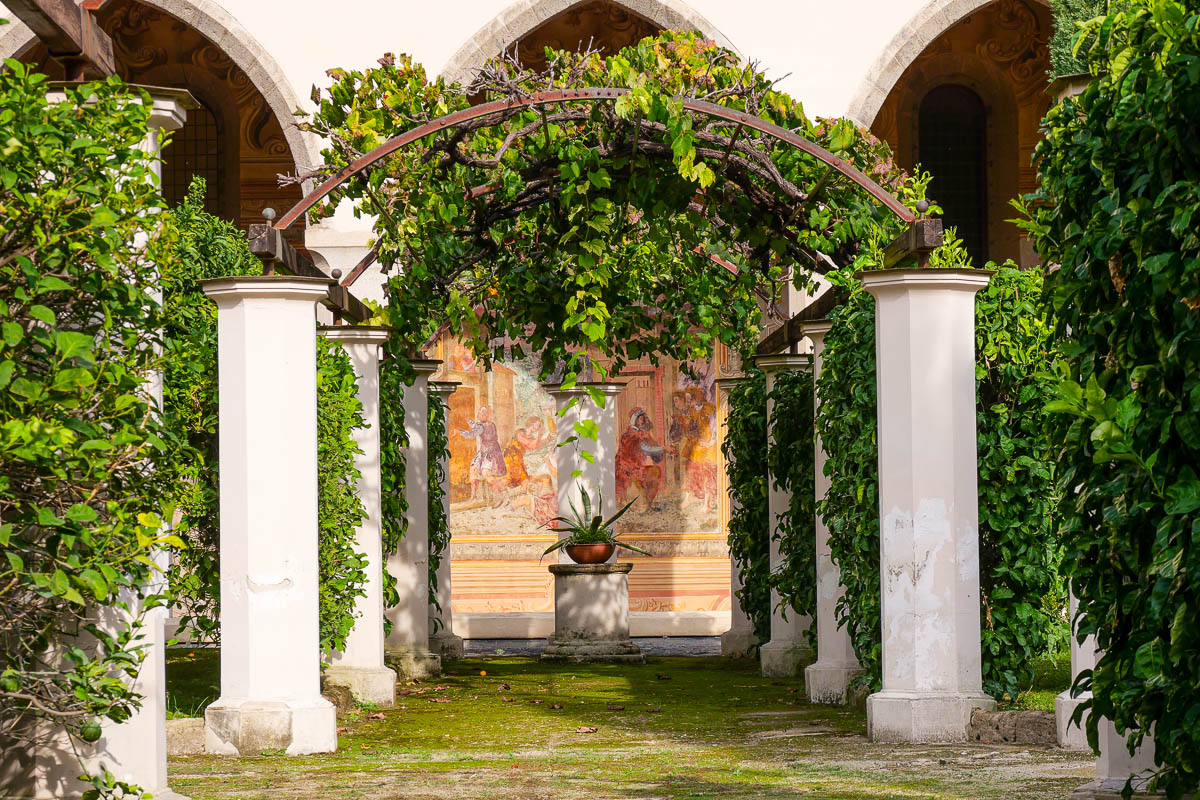
The cloister, renovated in the 18th century, features a garden crossed by two walkways lined with 72 octagonal pillars covered in majolica tiles. Between each pillar are benches also covered in ceramic tiles (it is forbidden to sit on them for photos). The corridors on each side of the cloister are covered with frescoes.
Inside, there is a small museum displaying liturgical objects and items from excavations of Roman remains. But since the museum is not as Instagrammable as the garden, it attracts fewer visitors ! Before leaving, don’t miss the large 18th-century Neapolitan nativity scene created during the reign of Ferdinand VI of Bourbon. The King of Spain and Naples was a great admirer of such scenes.
Visiting the Church of Santa Chiara is free, but access to the monastery is paid. The price is €6 per adult (€4.5 for students under 30 and visitors over 65, and €3.5 for ages 7–17).
Opening hours of Santa Chiara Monastery : 9:30am–5:30pm Monday to Saturday | 10am–2:30pm Sunday (last entry 30 minutes before closing).
Opening hours of Santa Chiara Basilica : 8am–12:45pm and 4:30pm–8pm.
Sansevero chapel
The Sansevero Chapel and its Veiled Christ is the only visit you need to plan ahead, as there is a maximum number of visitors per 30-minute time slot. Otherwise, you risk being left outside, especially if you plan to visit Naples in just 1 or 2 days. The ticket office next to the chapel only sells last-minute tickets, which sell out within a few hours each morning. The best option is to book at least 3 days in advance on the official website.
As for us, since there were no online tickets available for the next three days and we had other plans for the end of the week, we arrived one hour before opening to buy a last-minute ticket. We thought we’d be alone, but there was already a long line. We still managed to get tickets for the 9:15am visit.
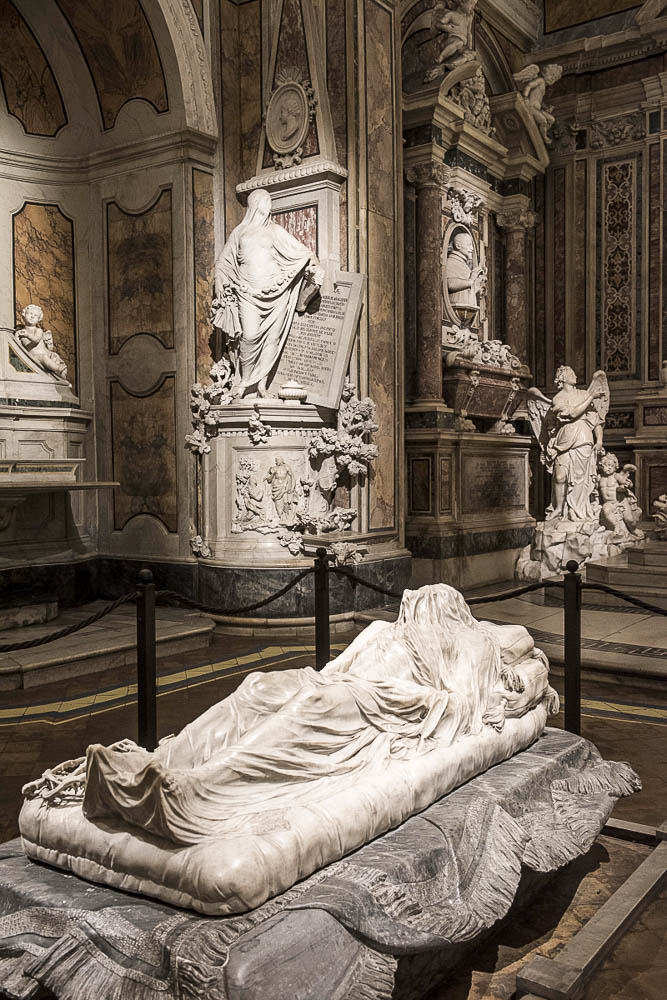
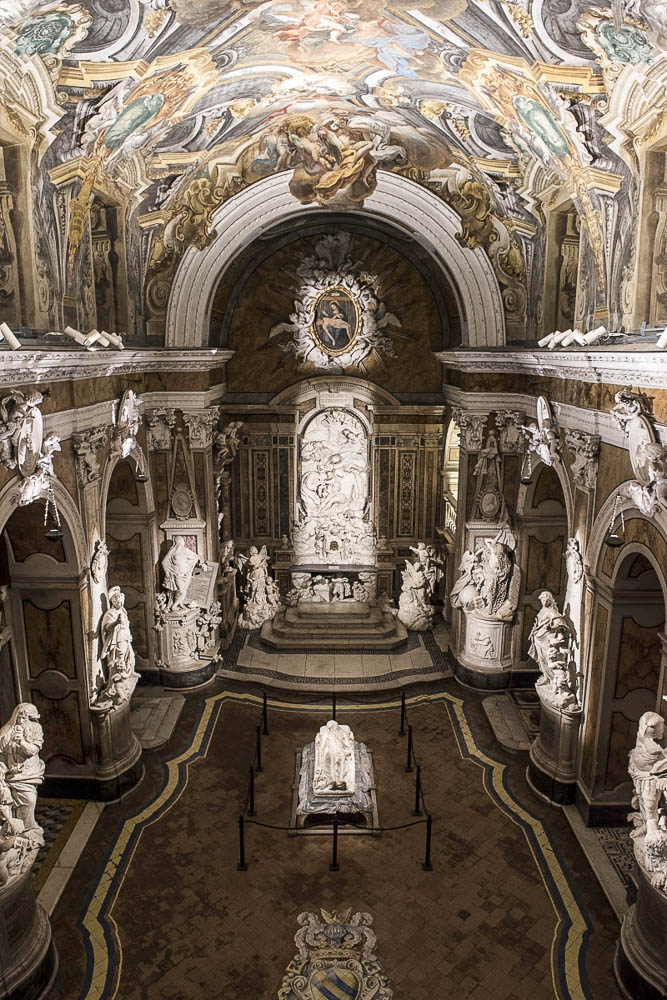
There are two lines in front of the chapel entrance: on the right, the red line for last-minute tickets, and on the left, the blue line for those who booked online. Once inside, you discover a vaulted ceiling covered with frescoes and, in the center of the room, the Veiled Christ, a marble sculpture created in 1753 by Giuseppe Sanmartino depicting Christ under a veil. The sculpture is simply astonishing when you see the finesse of the details and the shroud, especially knowing it is made of marble.
Photography of the chapel and the Veiled Christ is prohibited (and strictly monitored). I have therefore exceptionally included photos from the museum’s official website. In the basement of the Sansevero Chapel is a secret chamber where the cardiovascular systems of a man and a woman are preserved (strange !).
Opening hours of the Sansevero Chapel : 9am–7pm | Closed Tuesday.
Prices : €8 on-site last minute | €10 online reservation | Audioguide €3.5 (€5 for two).
Church of San Domenico Maggiore
Piazza San Domenico Maggiore, where the church of the same name stands, is right next to the Sansevero Chapel. It is one of the few open squares in the historic center, which mainly consists of a maze of narrow streets. Photographers will quickly realize that it is quite difficult to photograph the façades of churches and palaces.
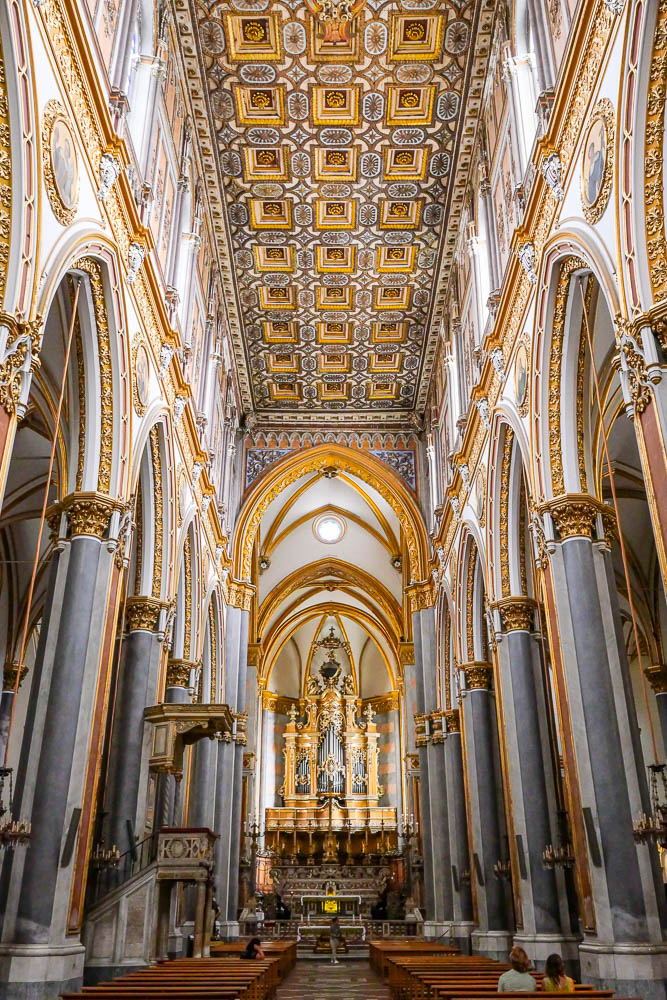
The Church of San Domenico Maggiore was completed in 1324 under the reign of Charles II of Anjou. It is Gothic in style, although several Baroque elements were added in the 17th century. Inside, you can admire a magnificent coffered ceiling, frescoes, and several works of art. It is possible to see Saint Thomas’ cell, the crypt, and the treasure room during a guided tour in Italian or English. Tickets and information are available on the museum’s official website.
Visiting the Church of San Domenico Maggiore is free, but there is a small scam if you use the entrance on Piazza San Domenico Maggiore. A woman with a badge insists you make a donation to enter. By using the main entrance at number 4 Vico San Domenico Maggiore, you won’t have to pay anything.
Opening hours : open daily from 10am to 6pm.

Church of Santa Maria delle Anime
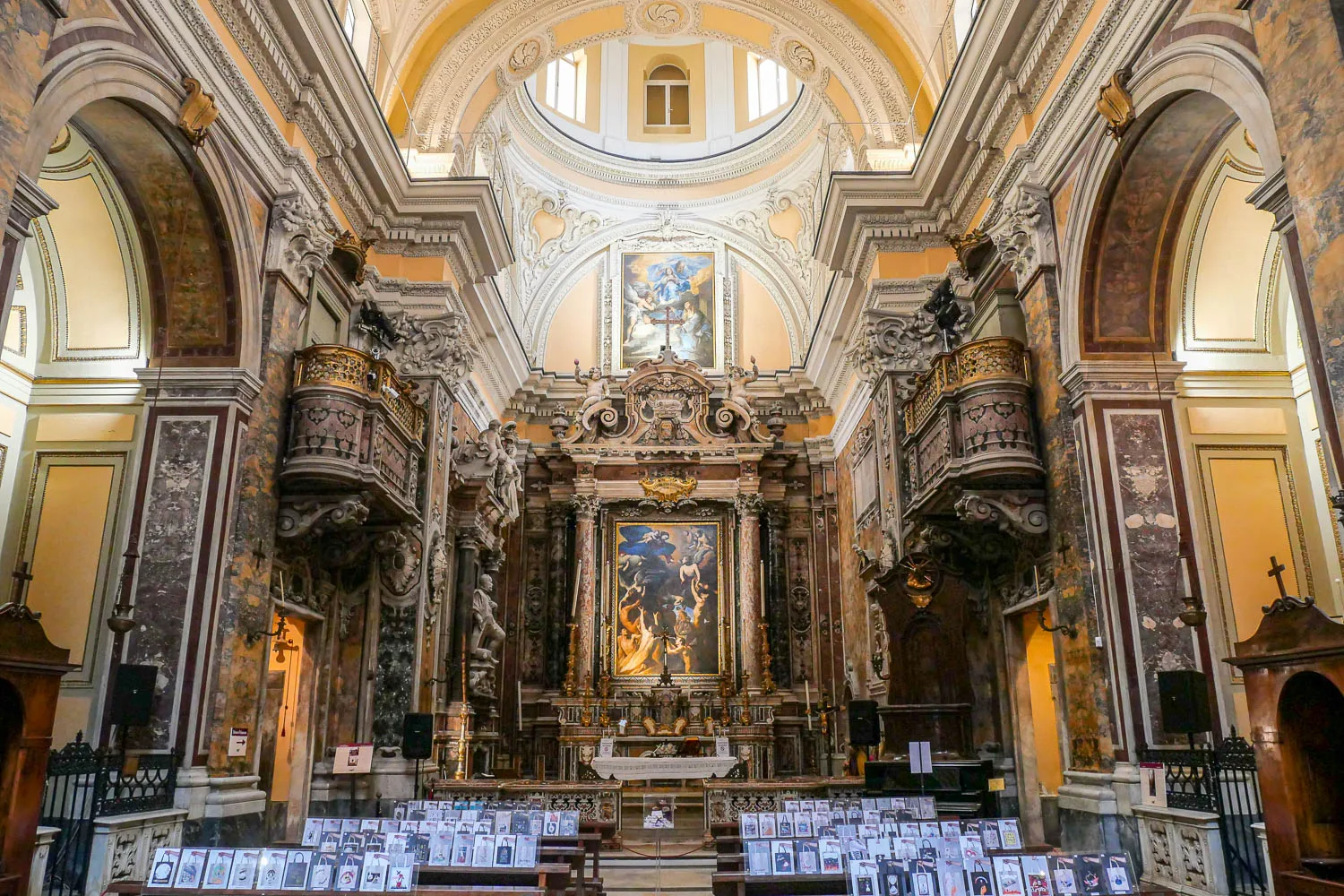
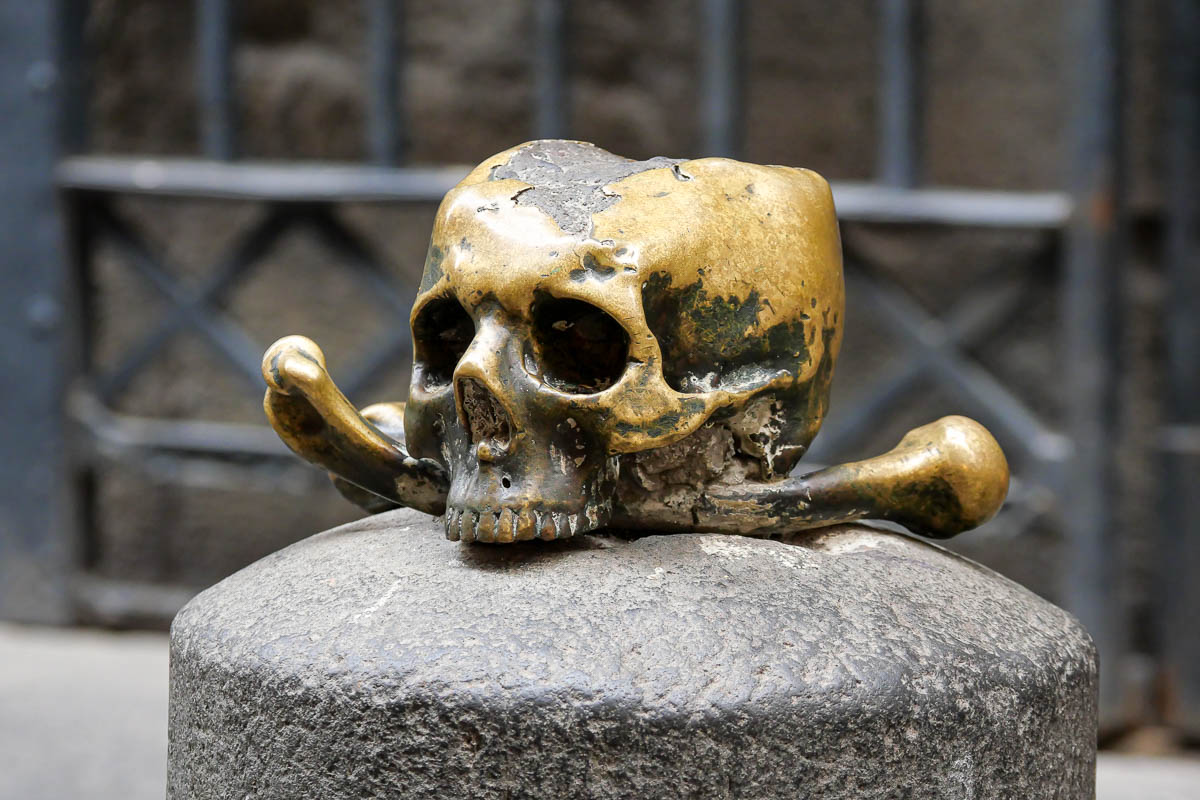
The full name of this church is the Chiesa di Santa Maria delle Anime del Purgatorio ad Arco (Church of Saint Mary of the Souls of Purgatory). It is located on Via Tribunali, the most typical street in the historic center. It is easily recognizable thanks to the bronze skulls placed just outside. You will inevitably pass by here when visiting Naples, as many restaurants, shops, and buildings are located along this urban axis dating back to Roman times (decumanus maximus).
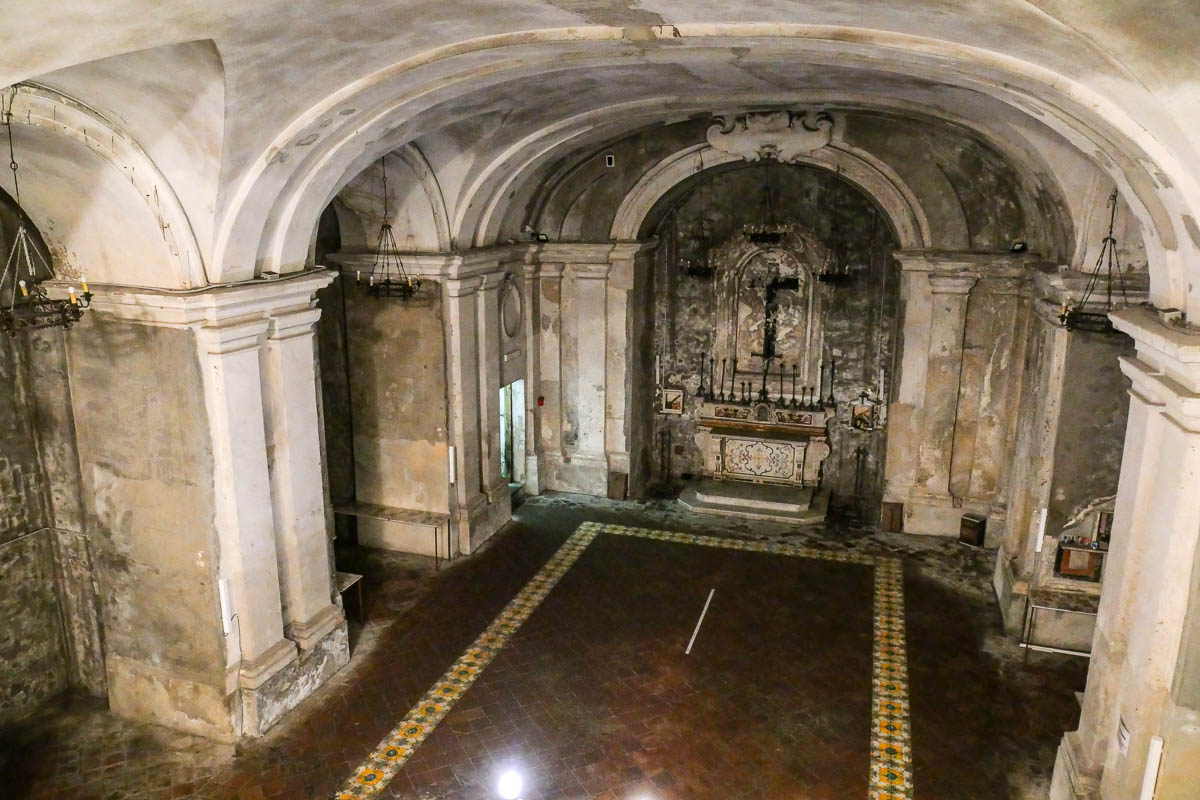
The Church of Maria delle Anime del Purgatorio ad Arco, built in Baroque style, dates from the 17th century. The project was to create a burial place for poor families and those who had none. Indeed, the church’s basement houses a cemetery where human remains can still be seen. These remains have even given rise to a true cult.
Visiting the church is free, but the rest is paid (hypogeum, sacristy, oratory, and altar). The self-guided tour begins in the hypogeum (underground cemetery), a large room surrounded by chapels with a trapdoor in the middle (photo 2). This trapdoor leads to a large vault that housed, from the 17th to the 19th century, the bodies of those who could not afford burial in the church. A corridor then leads to a smaller room containing tombs and skulls placed in niches (photos prohibited). The most famous is the skull of Lucia, which wears a bridal veil and a diadem.
It was the presence of these remains that gave rise, at the end of the 17th century, to the cult of the anime pezzentelle (begging souls). Women would choose a skull to care for (cherishing and polishing it), praying that the soul of these remains could leave purgatory. In return, they asked that the soul, once in heaven, would intervene to grant them a favor.
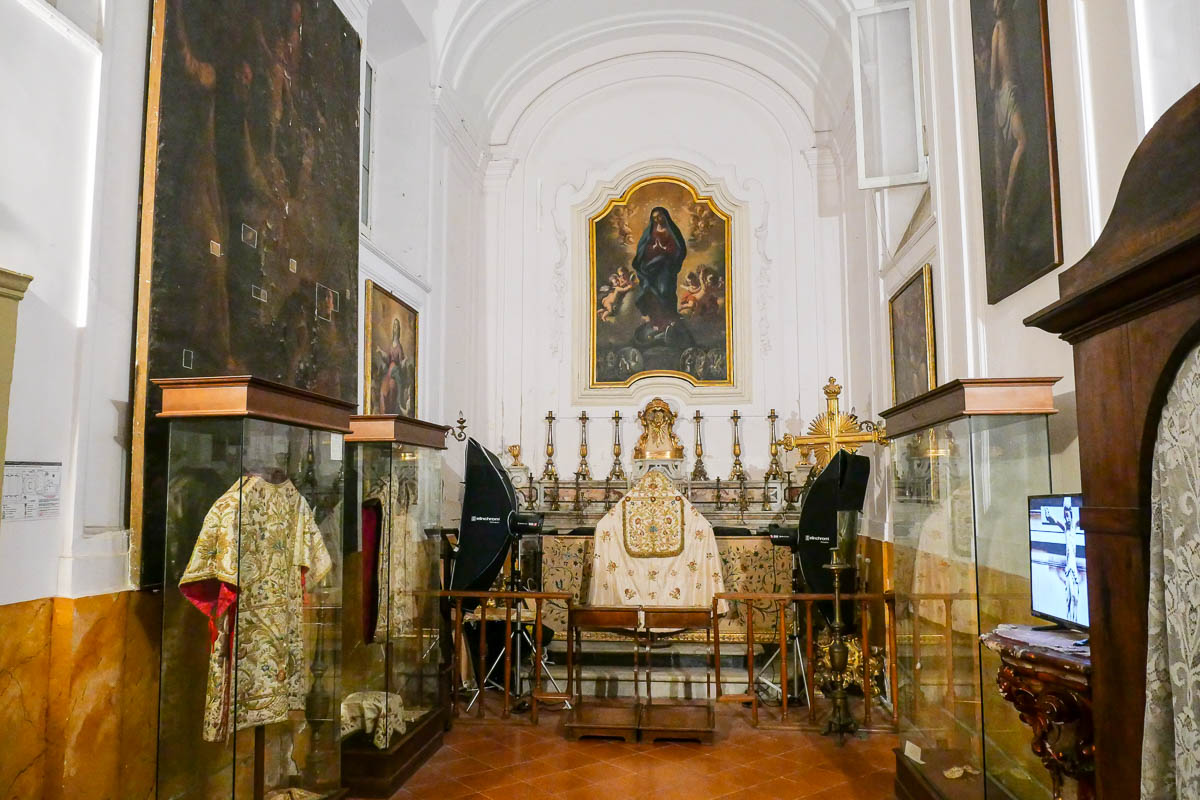
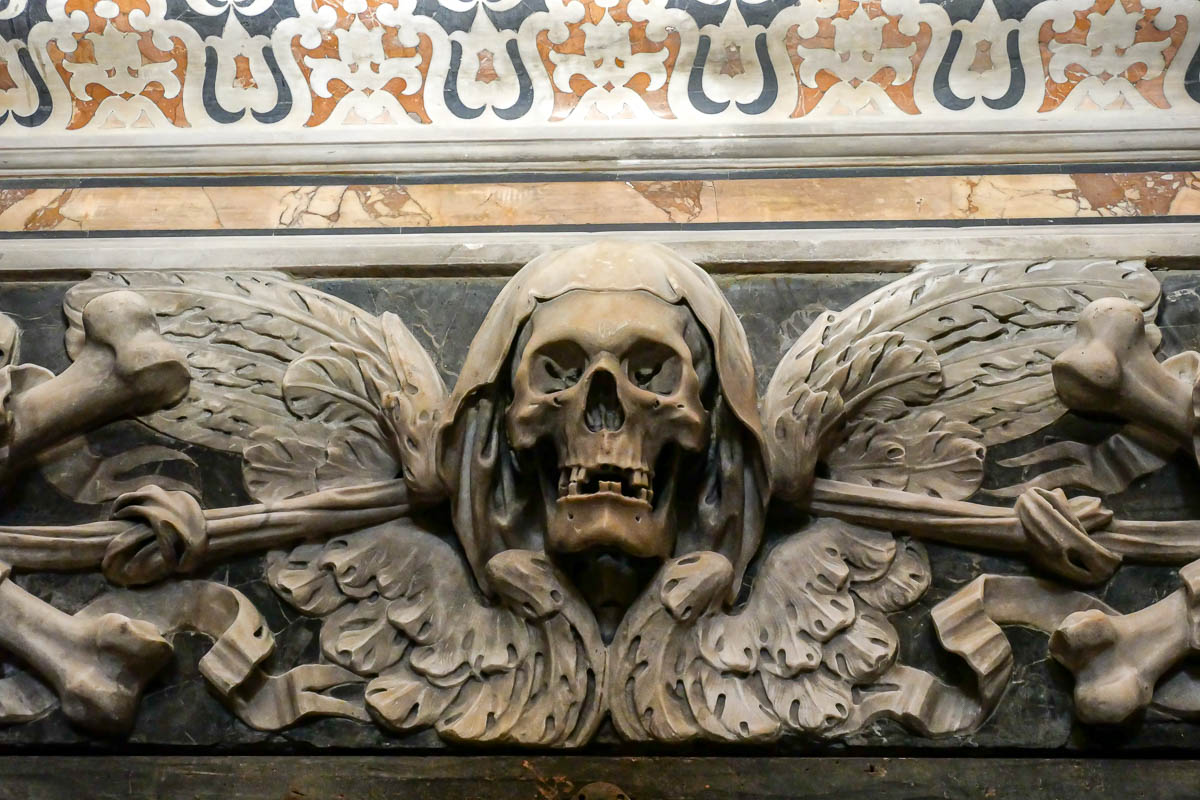
The visit then continues at the church level to discover a small museum of sacred art and ecclesiastical costumes, as well as a collection of paintings in the oratory. The presbytery is typical of Neapolitan Baroque, with death as the dominant theme.
Opening hours : 10am–2pm (last entry at 1:15pm) | Closed Sunday.
Price : €7 per adult (€6 for ages 14–25 and €3 for ages 7–13). Guided tour included daily at 12pm.
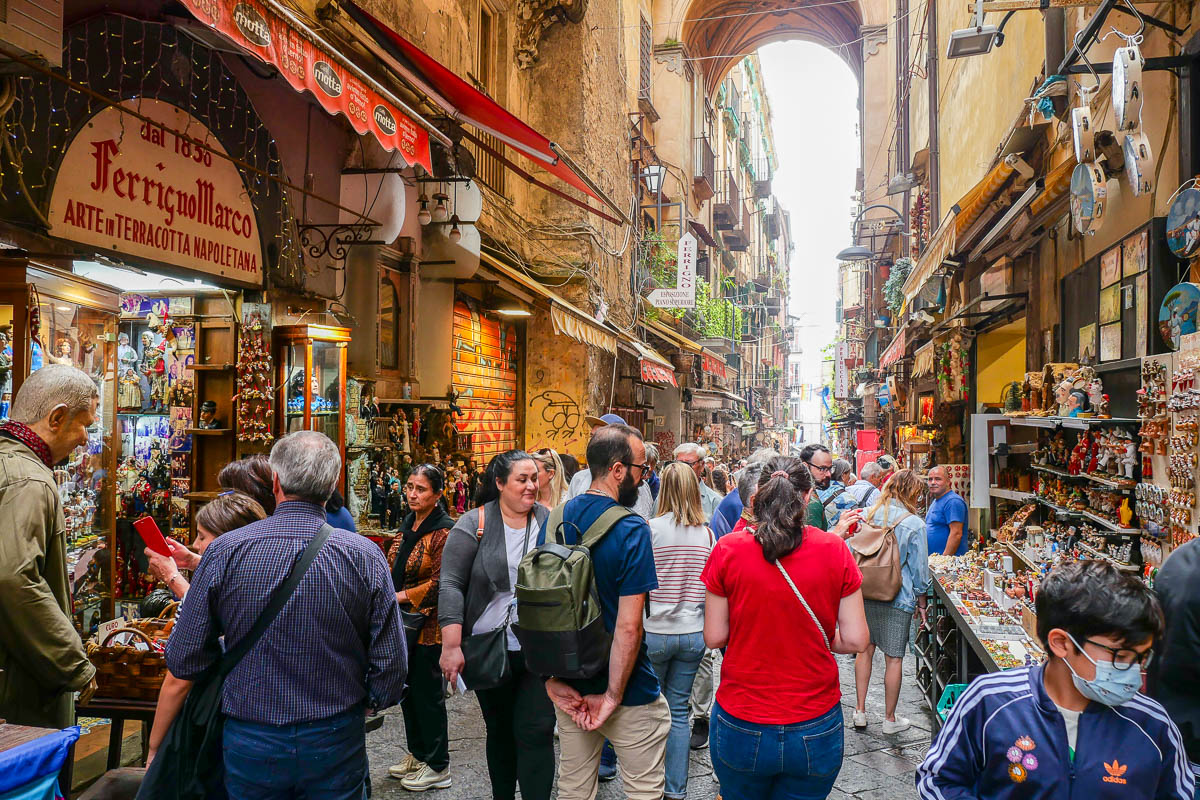
Via San Gregorio Armeno
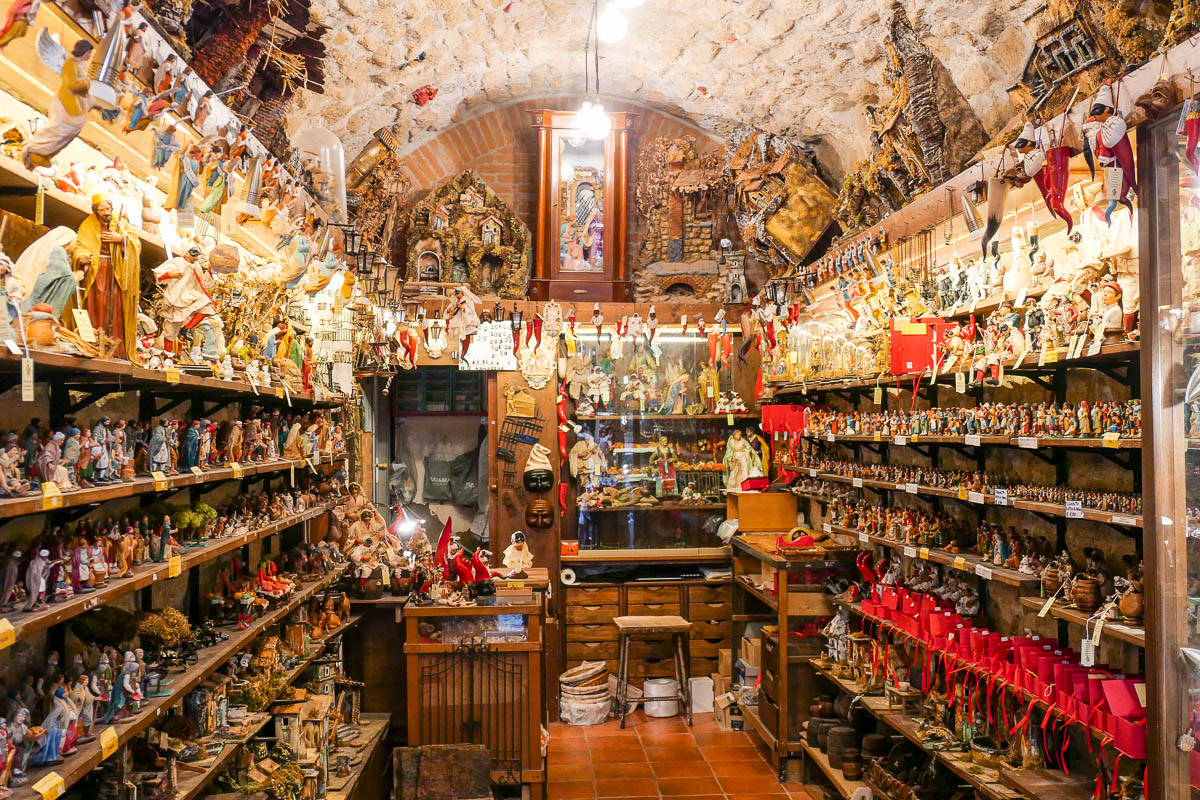
This is the most famous street in the historic center. It is lined with workshops and shops selling figurines for nativity scenes (presepe) as well as all kinds of statues. Neapolitan nativity scenes are renowned for their attention to detail and remain very popular today. Unfortunately, most shops sell mass-produced reproductions, and few figurines are still handmade.
Via San Gregorio Armeno connects Via Tribunali and Via San Biagio dei Librai (Spaccanapoli). The narrow street is always crowded with tourists, so it is not the fastest route. But you will pass through it at least once when visiting Naples and heading to the Church of San Gregorio Armeno.
Church and Cloister of San Gregorio Armeno
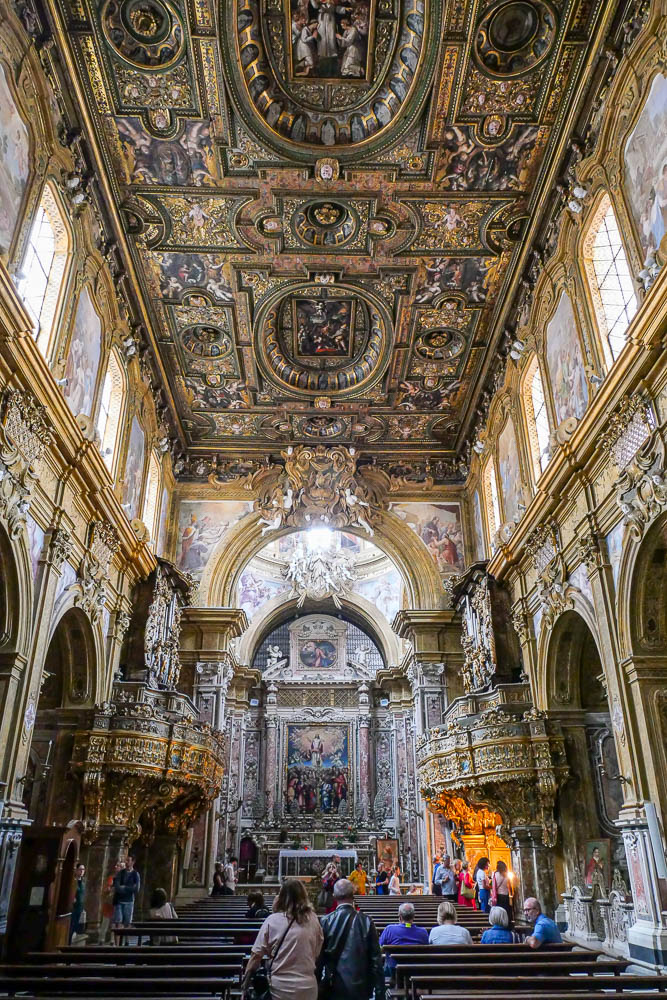
This small church located on the street of nativity scenes is only open in the morning or late afternoon. You’ll need to take this into account when planning your itinerary in Naples. The Church of San Gregorio Armeno is certainly the most richly decorated Baroque church, one might even say “overloaded.” It is an avalanche of gilding, frescoes, stucco, and multicolored marble.
Visiting the church is free, but to access the monastery and the 1580 cloister you must pay an entrance fee (€7). The garden, featuring a Baroque fountain at its center, is surrounded by several rooms open to visitors (a salon decorated in 1773, the nuns’ choir, a chapel, and the refectory). The entrance to the San Gregorio Armeno monastery is located slightly higher than the church toward Via Tribunali.
Church opening hours : 9:30am–1pm and 4pm–6pm Monday to Friday | 10am–1pm and 3pm–7pm Saturday and Sunday.
Cloister opening hours : 10am–1pm and 3pm–6pm | 10am–1pm Saturday and Sunday. Closed Monday afternoon.
Monastery price : €7 per adult (€5 for under 18s and free for under 5s). Church visit is free.
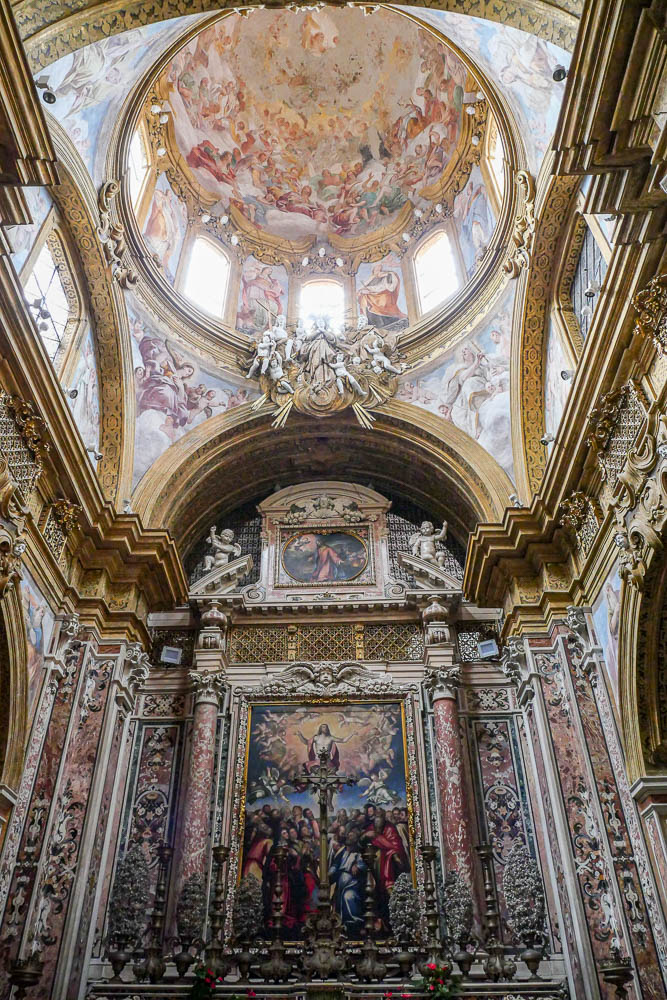


Basilica San Lorenzo Maggiore
Located on Piazza San Gaetano just above the San Gregorio Armeno monastery, this basilica is one of the oldest in Naples. After the sumptuous decorations seen in the Church of San Gregorio Armeno, the Gothic-style Basilica of San Lorenzo Maggiore appears much more austere. It was built in the 13th century by order of Charles I of Anjou on the site of the former Roman forum. The yellow façade (completely covered in scaffolding during our visit) is Baroque in style.
It is possible to visit the basilica’s underground ruins to immerse yourself in Naples during the Greco-Roman period (daily from 9:30am to 5:30pm — €9 ticket — duration 50 minutes). Reservations and information are available on the official website.
Basilica opening hours : 7:30am–8pm Monday to Saturday | 9:30am–1pm and 4pm–8pm Sunday | Basilica visit is free.
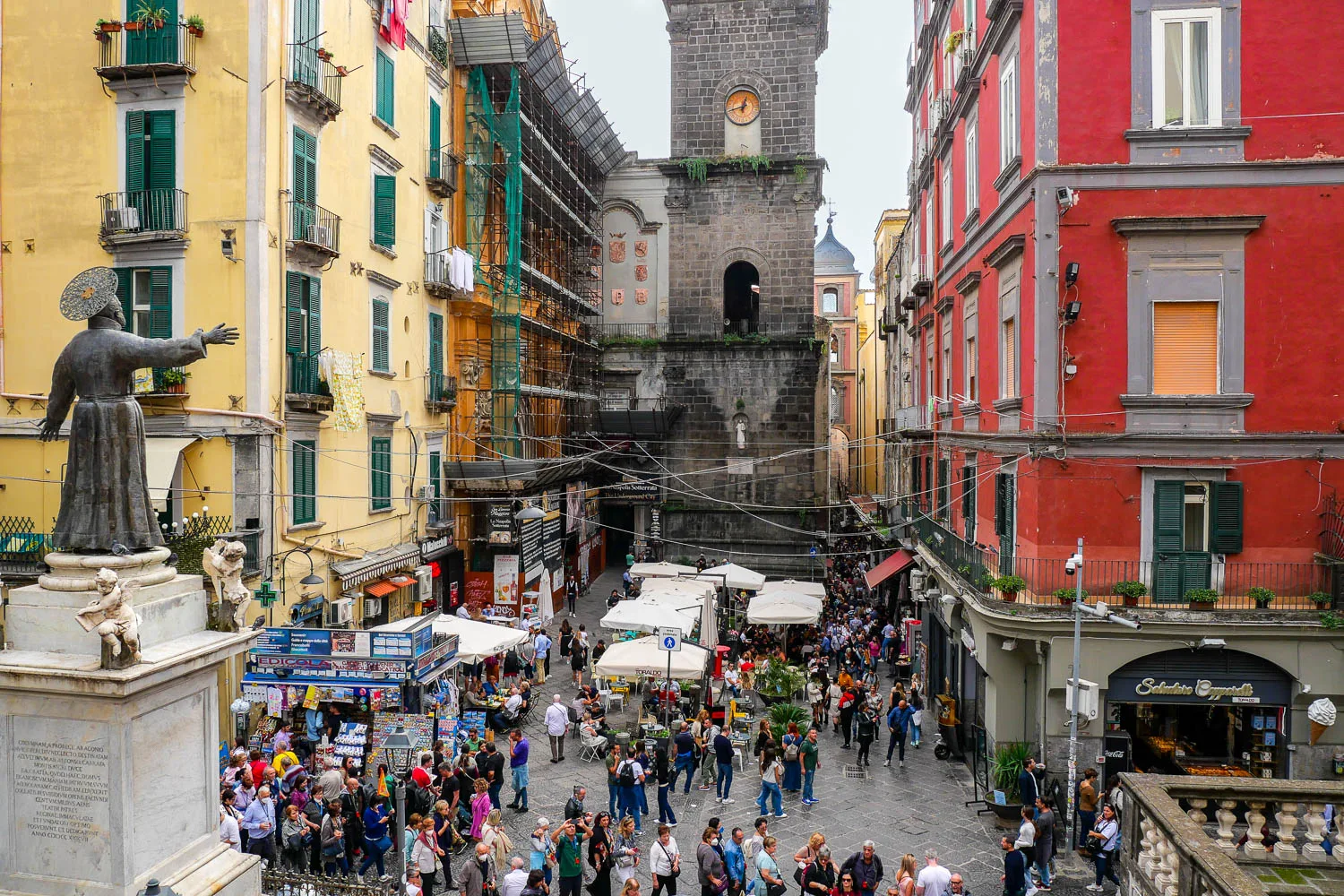
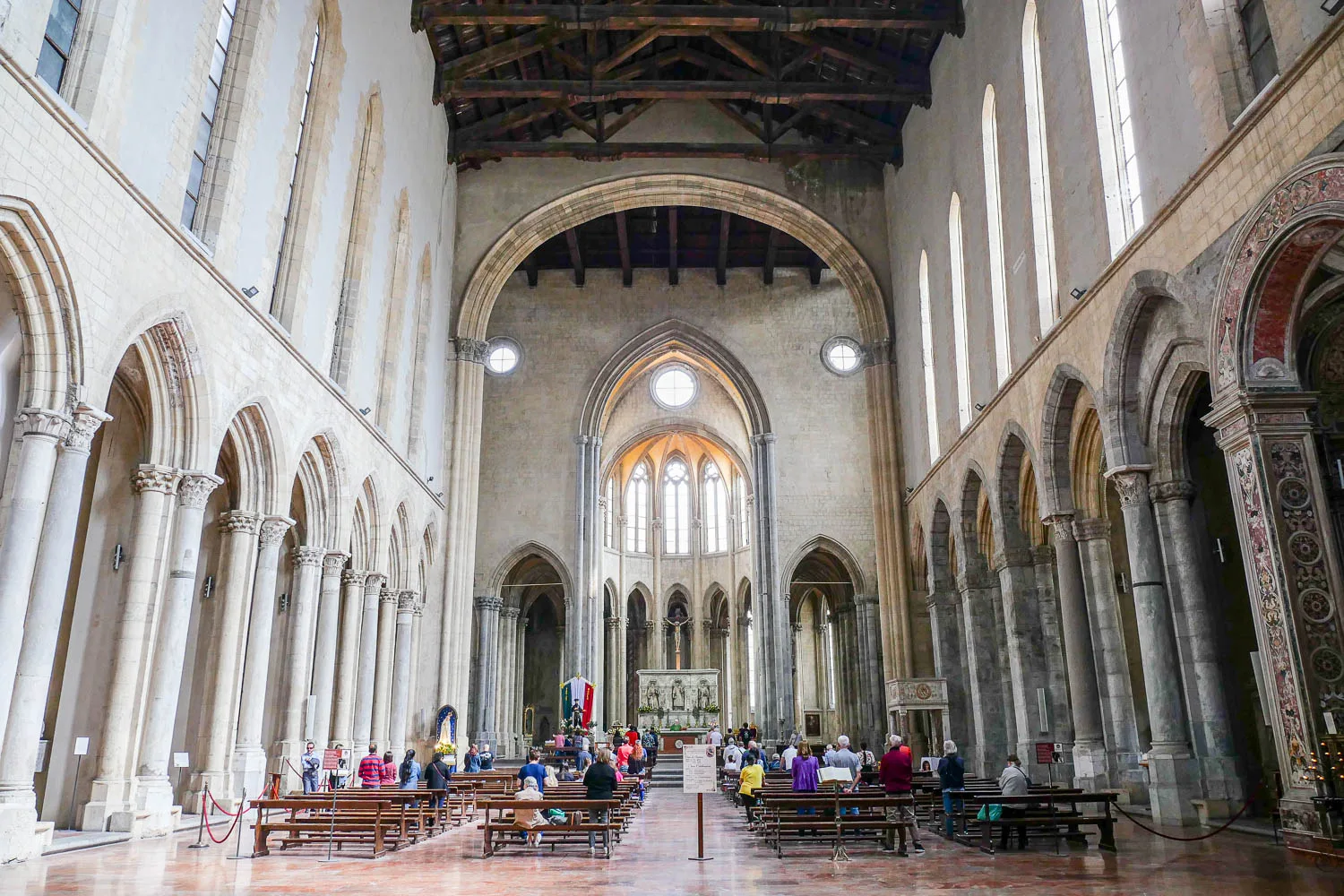
Basilica San Paolo Maggiore
Just above the Basilica of San Lorenzo Maggiore stands the Basilica of San Paolo Maggiore (yes, there are many in Naples). This 16th-century Baroque building was constructed on a 1st-century Greek temple. Inside, you’ll find, as usual, polychrome marble, gilded stucco, and frescoes. The visit takes only a few minutes, so you might as well take advantage if you’re nearby. You just need to be lucky enough to find it open, which is not often the case.
Opening hours : 10am to 5pm Thursday to Saturday.


Church of the Girolamini
Continuing along Via Tribunali, you reach the Chiesa dei Girolamini. During our last stay, it was closed for renovation with large scaffolding, but in 2025 it features a beautifully restored façade. It was built in 1592, but the façade adorned with sculptures and covered in white and blue marble dates from 1780. The interior is quite vast — it is one of the largest churches in Naples (68 meters long). The three naves are separated by granite columns and contain numerous works of art. The coffered ceiling was decorated in 1627 by Neapolitan artists.
Opening hours : 9am–5:30pm Tuesday to Friday | 8:30am–1:30pm Saturday and Sunday. Closed Monday.
Price : €5 (€2 for ages 18–25, free for under 18s and with the Artecard).


Duomo (Naples cathedral)
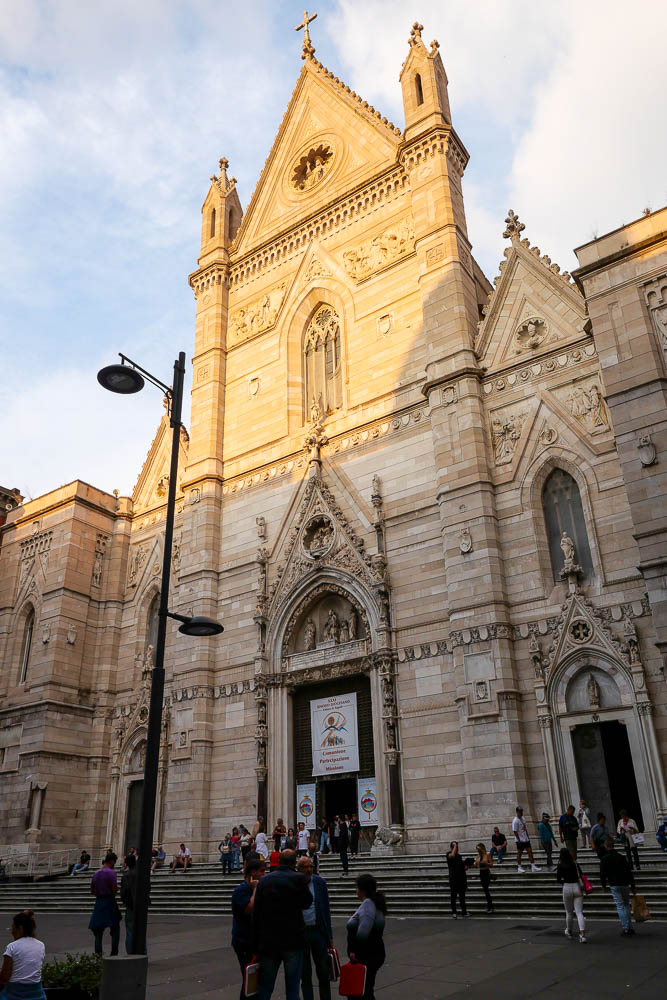
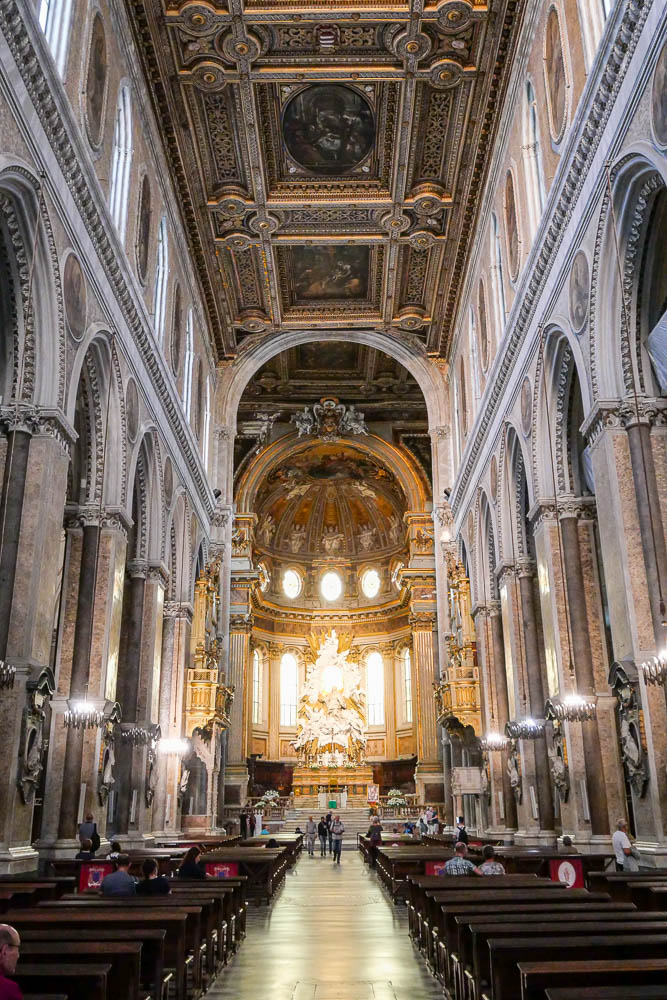
This is the religious building you absolutely must not miss, even if you have only one day to visit Naples. The Naples Cathedral is magnificent. Entry is free, but if you wish to visit the baptistery (which I highly recommend), you must pay €2.5. The cathedral is located on Via Duomo at the end of Via Tribunali.
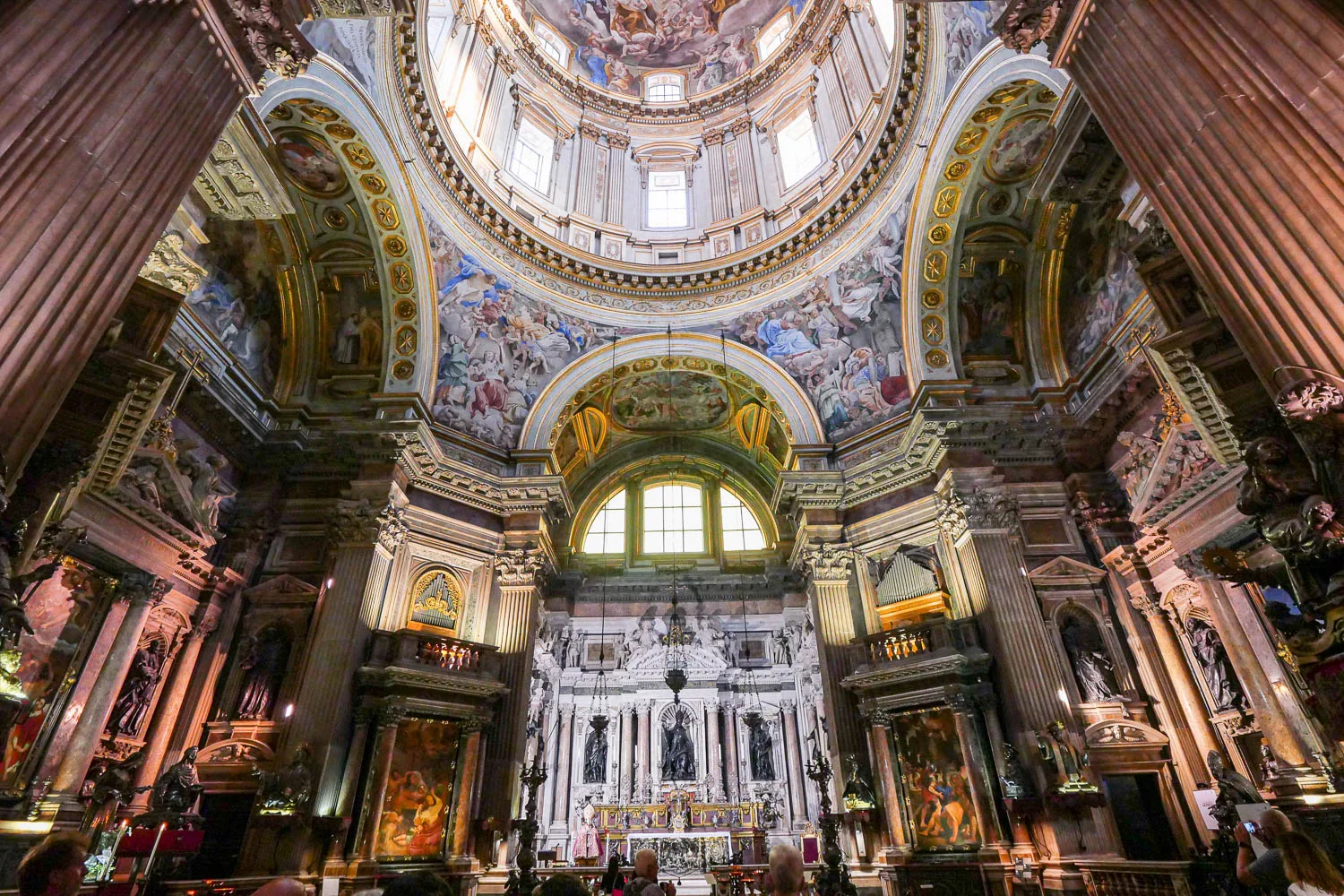
Built between 1272 and 1315 by Charles I of Anjou, it is especially famous for housing the relics of San Gennaro, the city’s patron saint. Its façade, damaged by an earthquake, was rebuilt in 1876 in a Neo-Gothic style. The Gothic interior features a superb coffered ceiling. The Chapel of the Treasure of San Gennaro, built in gratitude for his protection during the plague epidemic, is a jewel of Neapolitan Baroque art. The early Christian Basilica of Santa Restituta, accessible from the nave, contains beautiful medieval mosaics. As for the Baptistery of San Giovanni in Fonte, it is considered the oldest in the Western world.
Duomo opening hours : 8am–12:30pm and 4:30pm–6:30pm Monday to Saturday | 8:30am–1pm Sunday | Basilica visit is free (except baptistery).
Pio Monte della Misericordia
I do not consider a visit to the Pio Monte della Misericordia to be one of the best things to do in Naples. However, since this church-museum is located right next to the Duomo, you can easily make a quick stop.
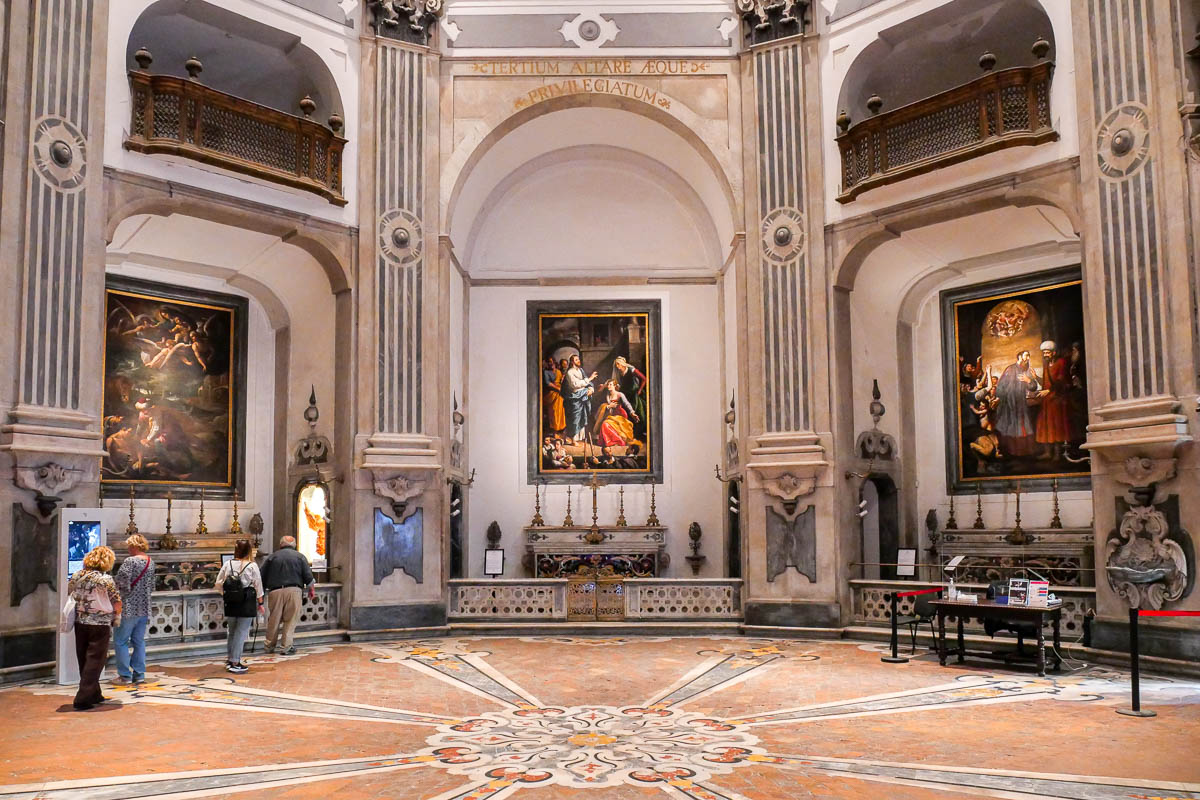
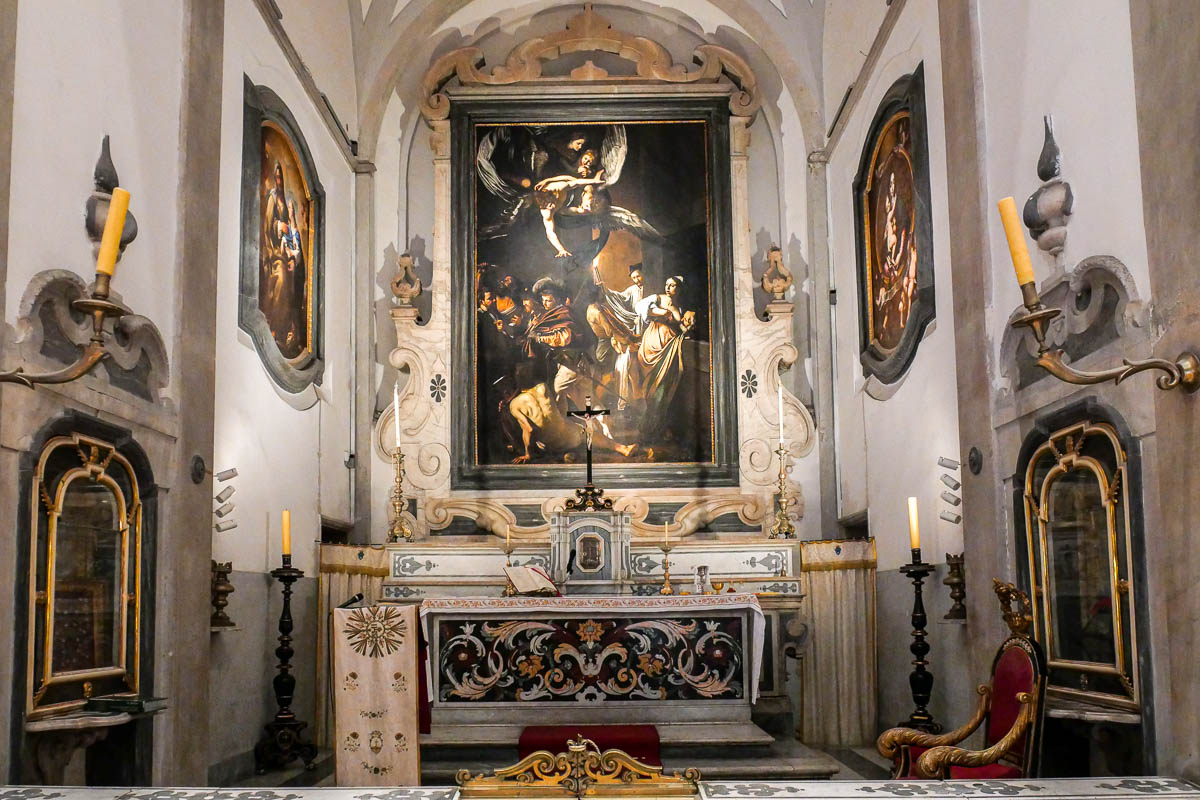
During our visit, the painting gallery on the first floor was closed. Only the 17th-century octagonal chapel was open to visitors, which may explain why entry to the Pio Monte della Misericordia was free (normally €8). The chapel is mainly famous for the painting by Caravaggio above the high altar (second photo). Our visit lasted exactly five minutes.
Opening hours : 10am–6pm Monday to Saturday | 9am–2:30pm Sunday.
Piazza Dante
This square dedicated to the poet Dante Alighieri is a good starting point for visiting Naples and the historic center. Indeed, beneath the square is the “Dante” metro station on Line 1. It is the closest station, just a few minutes walk from Via Tribunali, quite convenient if you are staying in another part of the city.
Originally it was a market square, but King Charles III of Spain wanted to transform it into a square dedicated to himself by building a large hemicycle with statues. The project was never completed, and today Dante has taken his place.
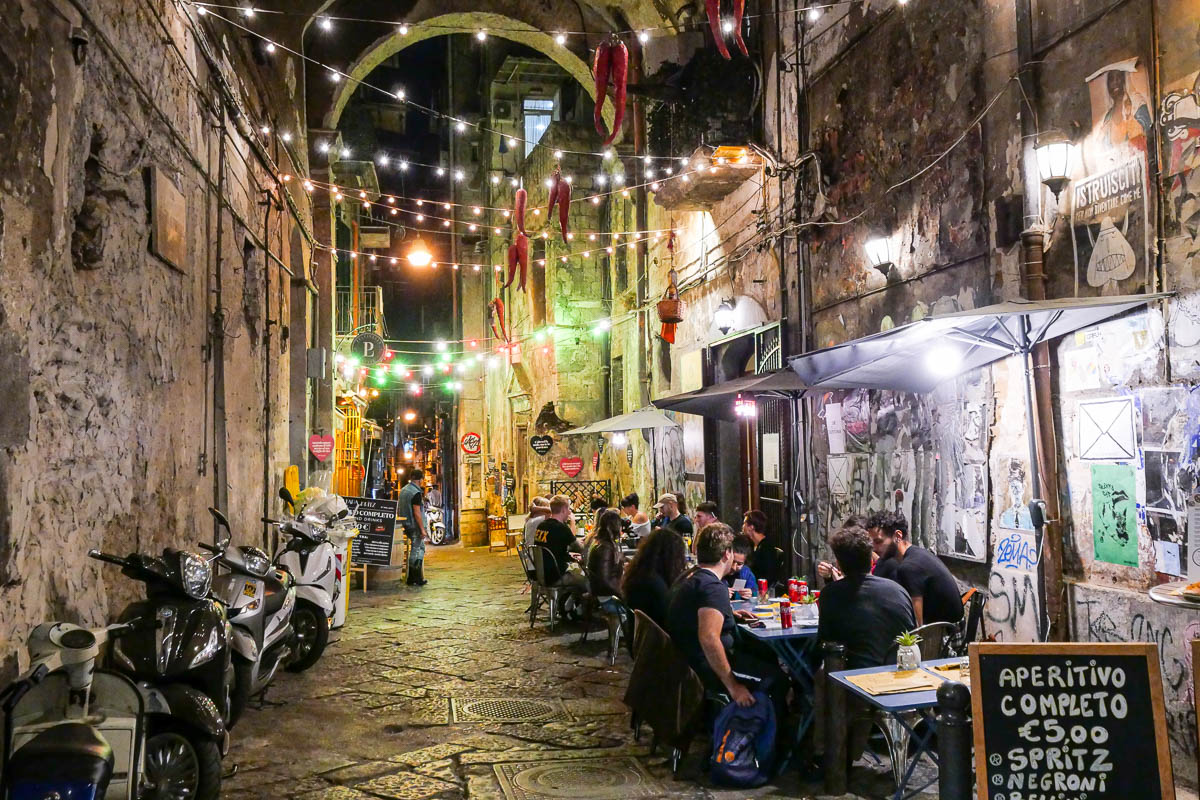
Passing under the arch of Port’Alba, a former city gate, you reach Piazza Bellini, mainly known for its café terraces. It is a popular meeting place for Neapolitans to have a drink or enjoy an aperitivo. The square is largely occupied by the excavated remains of an ancient Greek villa.
Some stations on Naples metro lines have been transformed into art galleries. The most famous is the “Toledo” station, located one stop after Dante toward Garibaldi. It was even voted Europe’s most beautiful metro station by an English newspaper. The “Università” station is another not to be missed, although it was closed until February 2023 (with a bit of luck, the work will be finished when you read this blog).


Street Art in Naples
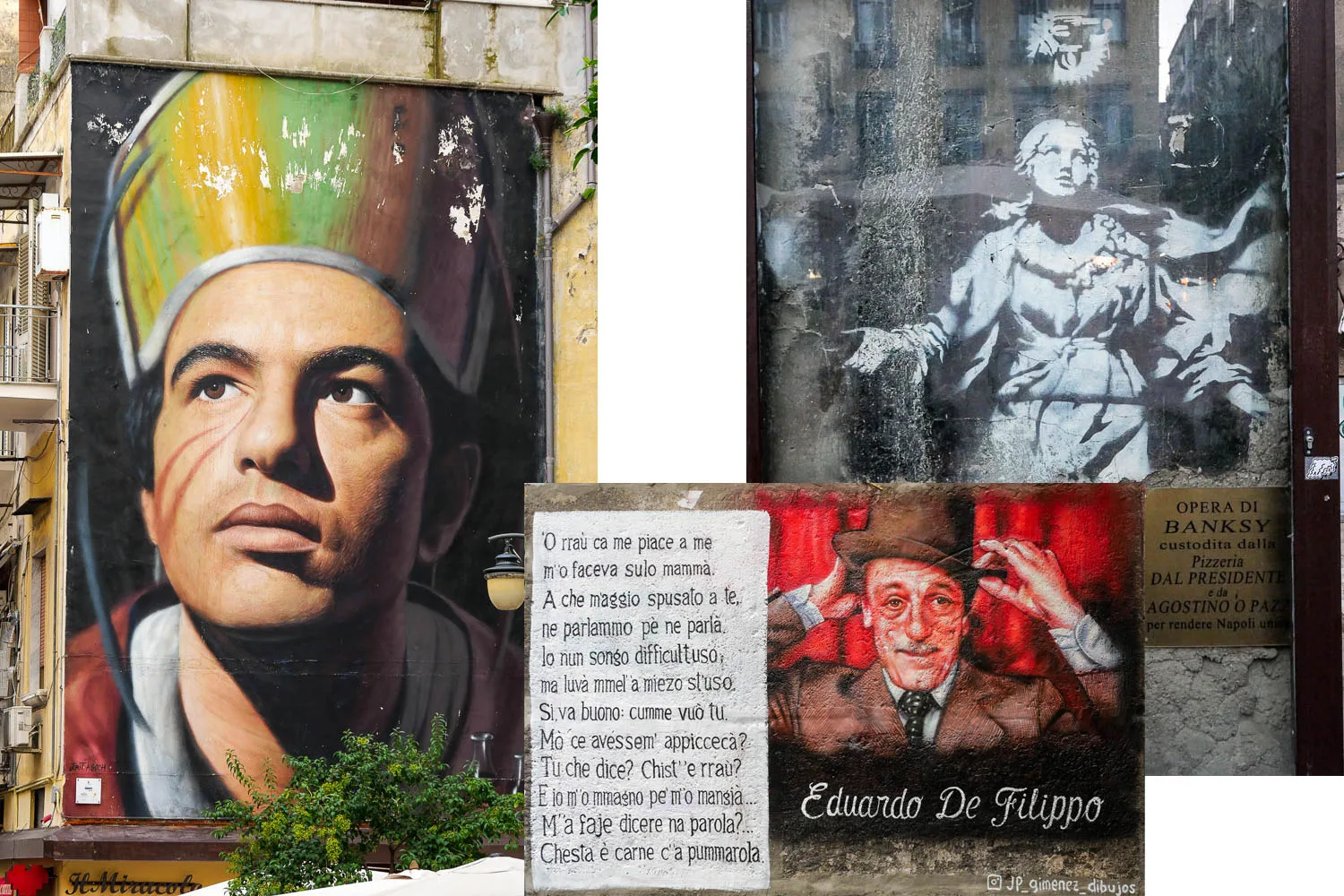
Naples is not particularly known for its street art, but enthusiasts will find a few interesting works. The city can boast the only work by Banksy in Italy : Madonna con la pistola. The painting depicts a Madonna with a pistol in the halo above her head. The artwork, which has been partially damaged, is now protected by glass. To see it, head to Via Tribunali at the corner of Piazza Gerolomini (coordinates).
The second mural not to miss is located one street lower on Piazza Crocelle ai Mannesi at the corner of Via Vicaria Vecchia (coordinates). If you pass through Via Duomo, you can’t miss it, it is visible from afar. The mural, created by Agoch in 2015, depicts San Gennaro (Naples’ patron saint) as a young worker.
There are other examples of street art in the streets of the historic center and in the Spanish Quarter. I’ll let you discover them as you wander around. Otherwise, you can join this 2-hour street art tour. It’s an original way to visit Naples that will appeal to urban art lovers.
Vomero district
Vomero Hill is one of Naples’ upscale neighborhoods and has little to do with the historic center. Here you won’t find graffiti on the façades of elegant buildings, nor garbage lying in the streets. Calm and tree-lined parks replace the bustle and noise of the center. As the streets are quite steep, the easiest way to reach Vomero is by taking one of the three funiculars.
We used the funicolare centrale located on Via Toledo just above the Galleria Umberto I (coordinates). The funicular ticket can be purchased on-site for €1.20 one way.
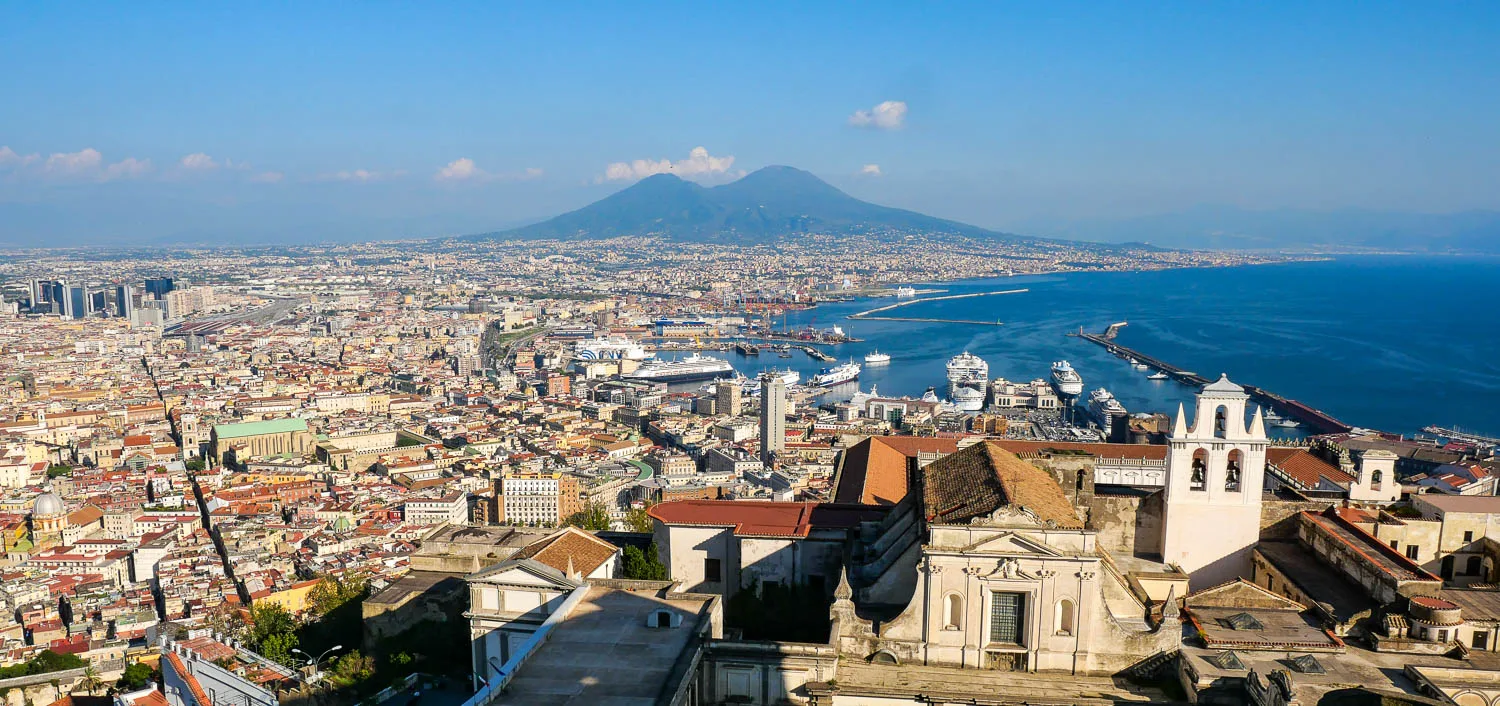
For me, the Vomero district offers the most beautiful view of Naples, with Mount Vesuvius as a backdrop (Daniela prefers the panorama from Posillipo). It is therefore a must-see and one of your priorities if you only have one day to visit Naples.
Castel Sant’Elmo
The medieval Castel Sant’Elmo stands at the top of Vomero Hill, 250 meters above the sea. It was completed in 1348, but the current star-shaped fortifications date from the period 1537–1547. Castel Sant’Elmo houses two small museums (Polo museale della Campania and museum Novecento a Napoli) and several temporary exhibitions. But most people come here to enjoy the magnificent panorama over the Bay of Naples.
For me, it’s the best photo spot in the city ! If the weather is cloudy, there’s no point in going up, as you might not even see Mount Vesuvius in the distance. The afternoon is also preferable for taking beautiful photos since the sun won’t be directly in front of you. You can walk all the way around the castle, offering a 360° view of Naples. If it’s not too hazy, you can even see the islands of Procida, Ischia, and Capri. On the side of the historic center, you can clearly see the route of Spaccanapoli, the street that divides the old town in two.
Opening hours : open daily from 8:30am to 7:30pm (last entry 6:30pm).
Price : €5 (€2 for ages 18–24, free for under 18s).
Charterhouse and Museum of San Martino
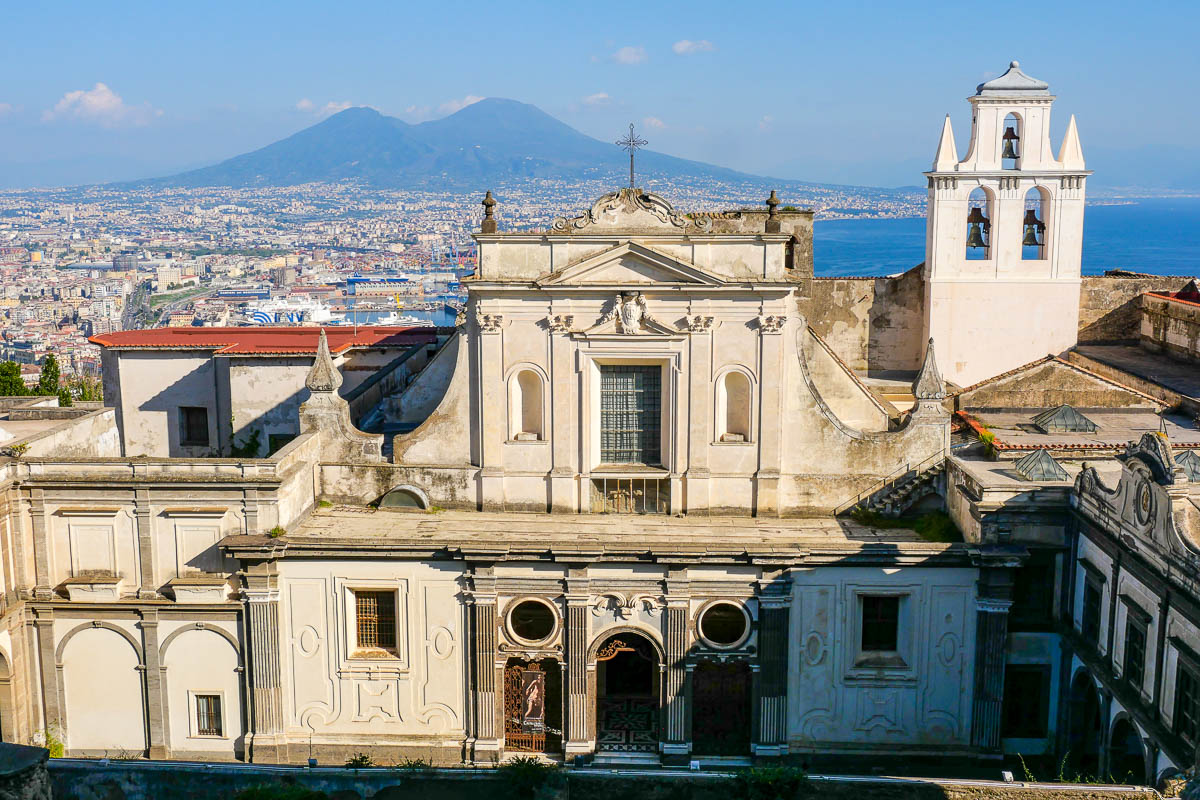
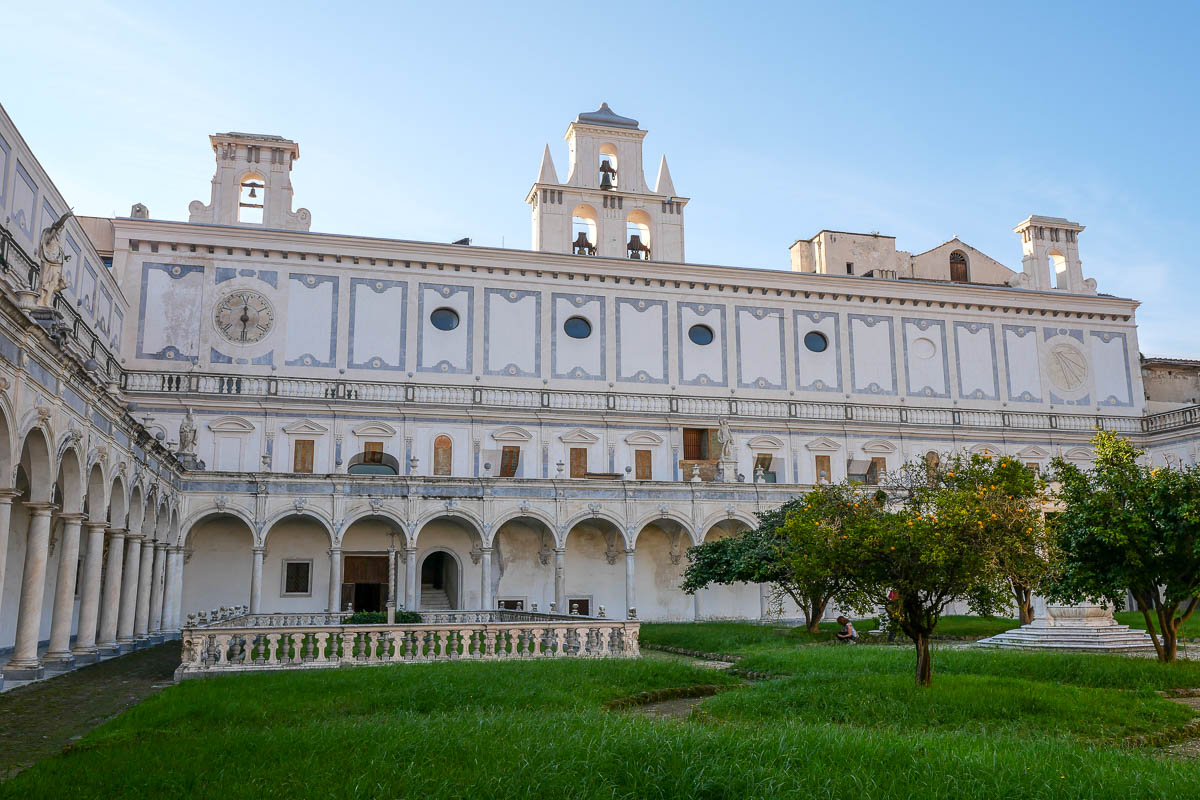
The Certosa di San Martino is the second tourist attraction not to be missed on Vomero Hill. It is located just below Castel Sant’Elmo. This charterhouse, founded in 1325, is one of the largest religious complexes in the city and perfectly represents Neapolitan Baroque architecture and art.
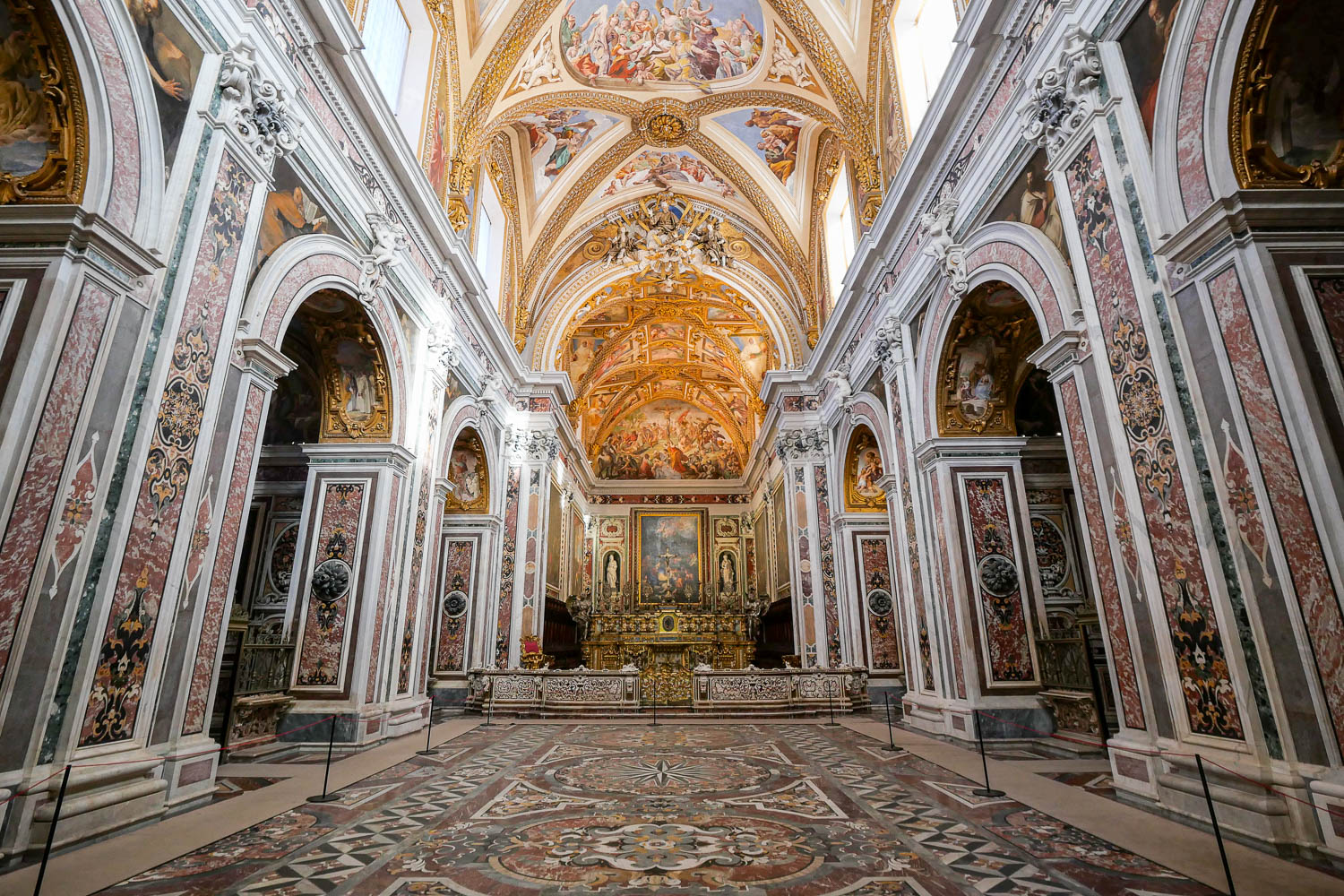
Entrance to the San Martino monastery is through the main church (photo 2), beautifully decorated with frescoes, inlays, marble, and paintings by major Neapolitan artists. The various rooms lead to the large cloister (photo 3), designed in Renaissance style at the end of the 16th century by the Tuscan architect Giovanni Antonio Dosio. It was later enriched with decoration a century later by his successors. The Procurators’ Cloister is smaller and features only a well at its center (no orange trees here). The visit then continues through the San Martino Museum, which presents the history of Naples from the Bourbon era to Italian unification in 1861. Notably, you can see a beautiful nativity scene with angels suspended in midair as well as a royal carriage.
Instagram enthusiasts should not miss the terrace next to the hanging gardens, which offers a panoramic view of the Bay of Naples and Mount Vesuvius from an arch-shaped niche (photo 4).
Opening hours : 8:30am to 7pm | Closed Wednesday.
Price : €6 (€2 for ages 18–25, free for under 18s).

San Ferdinando district
This seaside district is located south of the historic center and the upscale Chiaia district. It contains many must-see attractions in Naples and ranks second in the number of monuments and tourist sites. To get there, you can walk down Via Toledo or take the metro. The closest station for visiting Naples and the San Ferdinando district is Municipio, next to Castel Nuovo.
Castel Nuovo (Maschio Angioino)
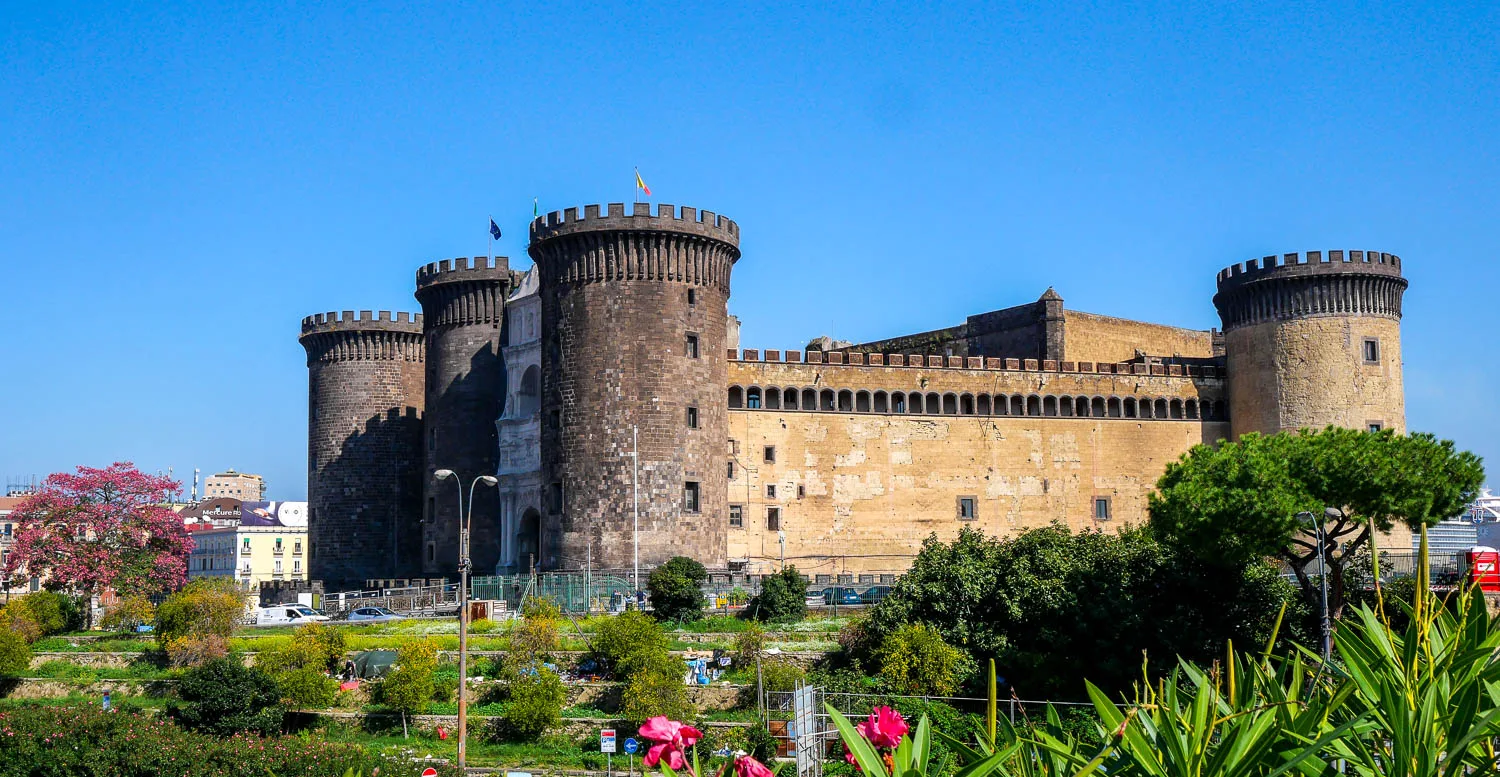
Castel Nuovo is located right next to the port from which ferries depart for Capri, Ischia, and Procida. But in Naples, no one knows it as Castel Nuovo, everyone calls it Maschio Angioino (Angevin Keep). The Gothic-style castle was built in 1279 by Charles I of Anjou, who wanted a more central position to control his lands stretching from Tuscany to Sicily. The fortress’s current appearance no longer dates from the Middle Ages, as it was modified by the Aragonese and during later restorations.
There isn’t much to see inside Castel Nuovo apart from the Palatine Chapel and the city’s civic museum. However, the latter is relatively uninteresting compared to Naples’ other art museums. If you wish to visit the Museo Civico, the entrance fee is €6 (open Monday to Saturday from 8:30am to 6:30pm).
For a nice view of Maschio Angioino, head to the gardens of the Royal Palace (free access).
Galleria Umberto I
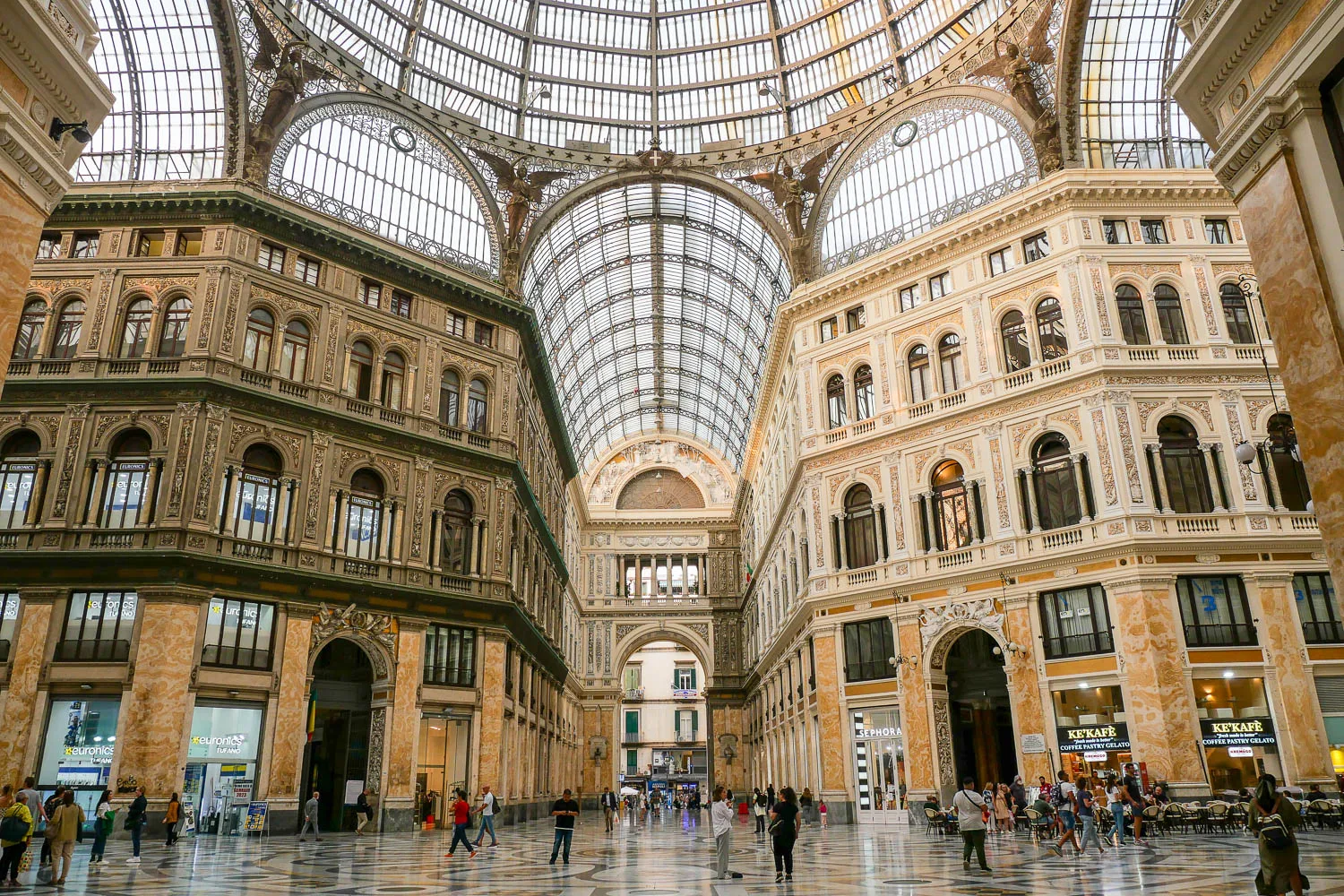
If you’ve already been to Milan, you’ll notice some resemblance to the Galleria Vittorio Emanuele II. Naples’ gallery was built a few years later. The Umberto I shopping gallery houses shops and cafés, but it is less upscale than Milan’s. However, you can still admire its superb architecture, with a glass and metal dome and marble floors.
One of the four entrances to Galleria Umberto I opens onto Via Toledo, where you’ll find one of the best sfogliatella shops in Naples (La Sfogliatella Mary). This typically Neapolitan pastry, shaped like a shell, is made from flaky pastry filled with ricotta and flavored with vanilla or cinnamon and candied orange peel.
San Carlo theatre
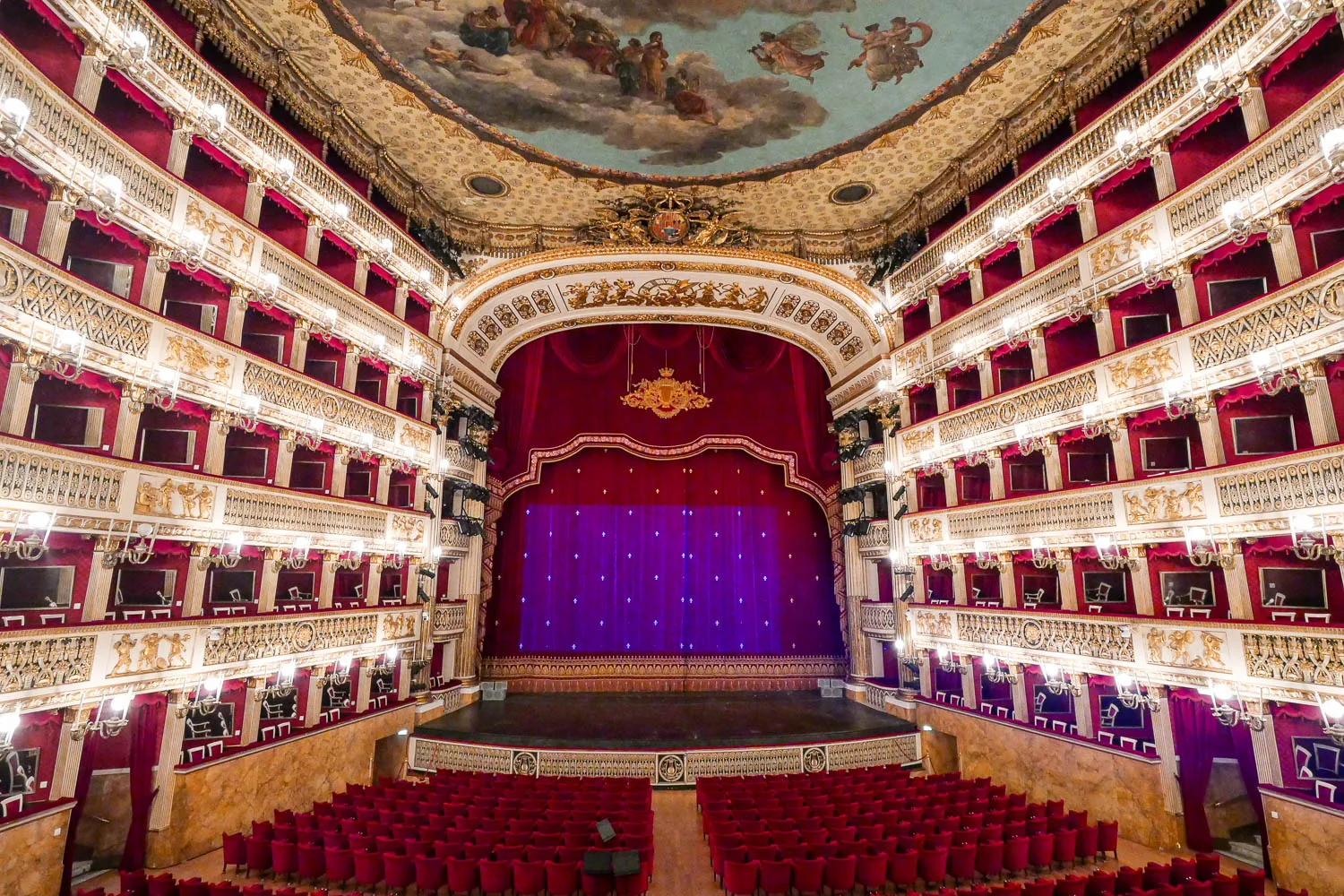
The Teatro di San Carlo is one of the oldest theaters in Europe, built in 1737 during the reign of Charles of Bourbon. Like the one in Venice, it suffered a fire and was rebuilt in 1816 by the same architect. While the neoclassical façade is rather plain, the interior, which can accommodate 1,300 people, is grandiose.
To visit the San Carlo Theatre, you can either attend an evening performance or choose one of the guided tours offered daily. We chose the second option. Guided tours in Italian take place at 10:30am, 12:30pm, 2:30pm, and 4:30pm, and guided tours in English/Italian take place at 11:30am and 3:30pm. The ticket costs €9 (€7 for under 30s and over 60s).
The visit, which lasts about 40 minutes, begins in the main hall. It’s an opportunity to admire the beautiful ceiling fresco and listen to explanations about the theater’s history. It continues with the second balcony, the King’s box, and ends in the foyer. As a small anecdote, the mirrors seen in all the boxes allowed spectators to see the King in his box located opposite the stage (today the control room). Since he was the one who initiated the applause, this allowed spectators to avoid making a mistake.
Piazza del Plebiscito
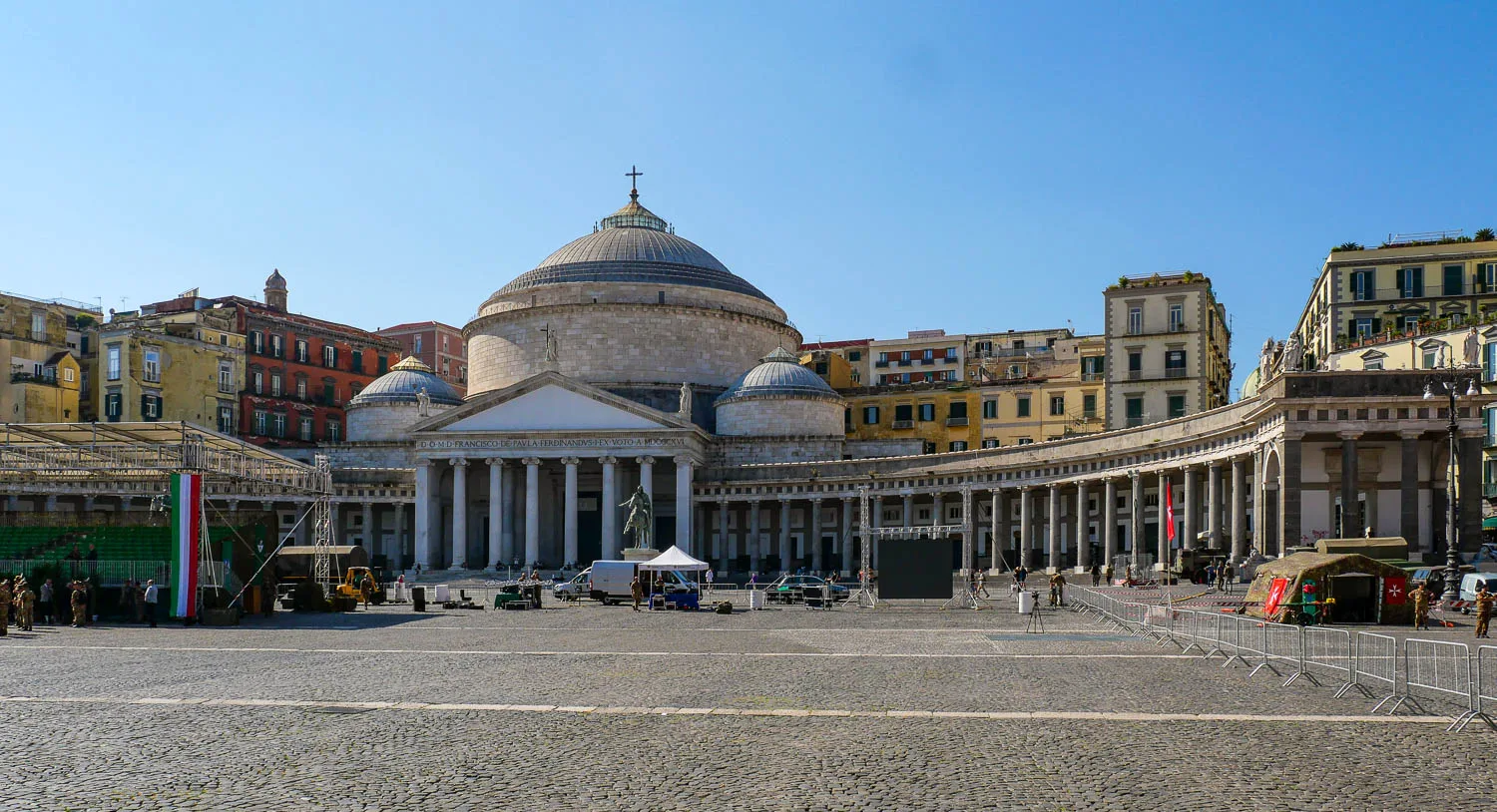
This immense 25,000 m² square facing the Royal Palace is located right next to the San Carlo Theatre and Galleria Umberto I. You will inevitably pass by it when visiting one of these monuments, so it’s hard to miss. There’s nothing in particular to do on-site other than admire the many neoclassical columns (1846) inspired by the Roman Pantheon.
As it is the city’s largest square, events and demonstrations are regularly held on Piazza del Plebiscito. During our vacation in Naples, there was an anniversary ceremony for the Alpini (Italy’s alpine troops). Photography enthusiasts may prefer to come in the morning to avoid facing the sun.
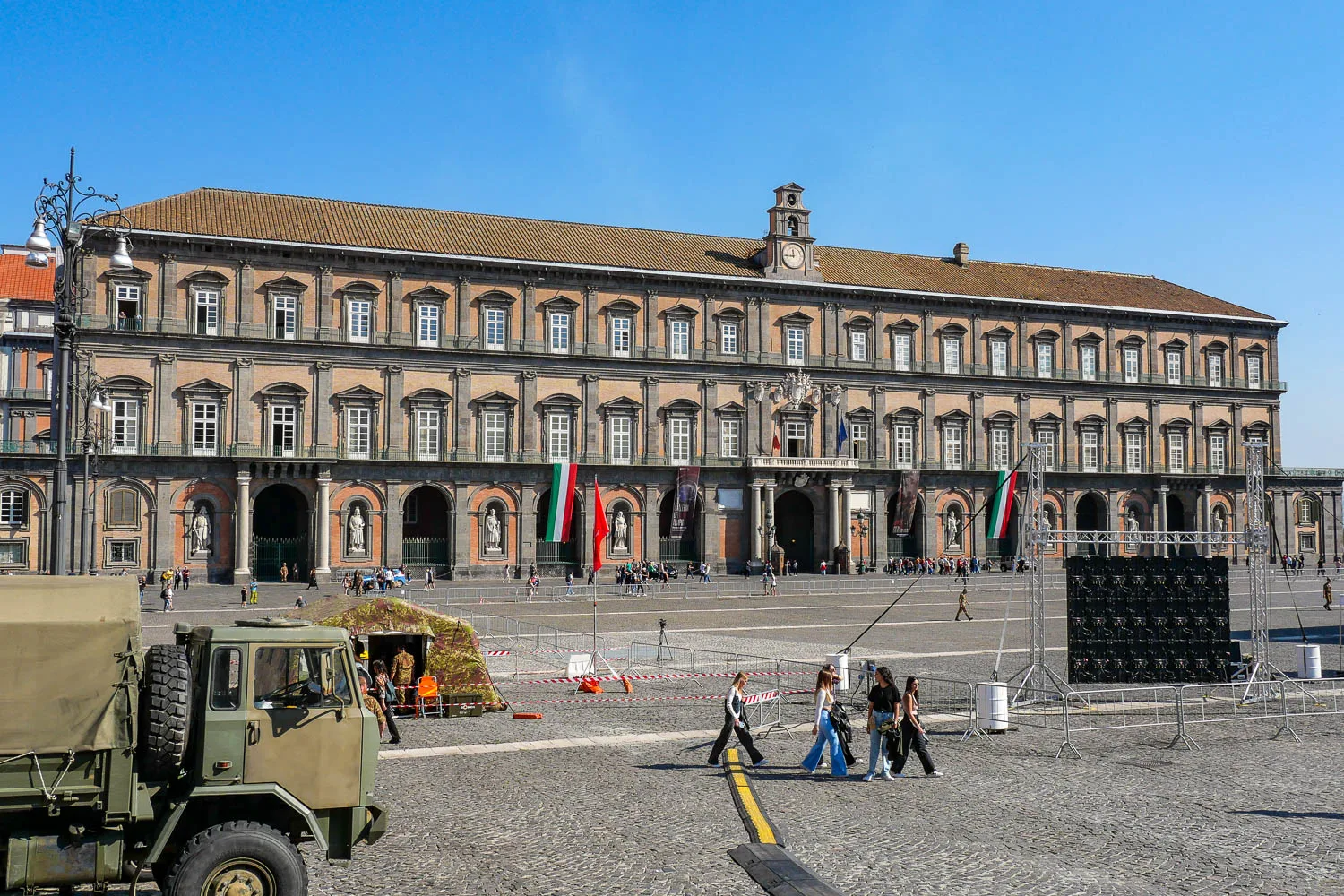
Palazzo Reale
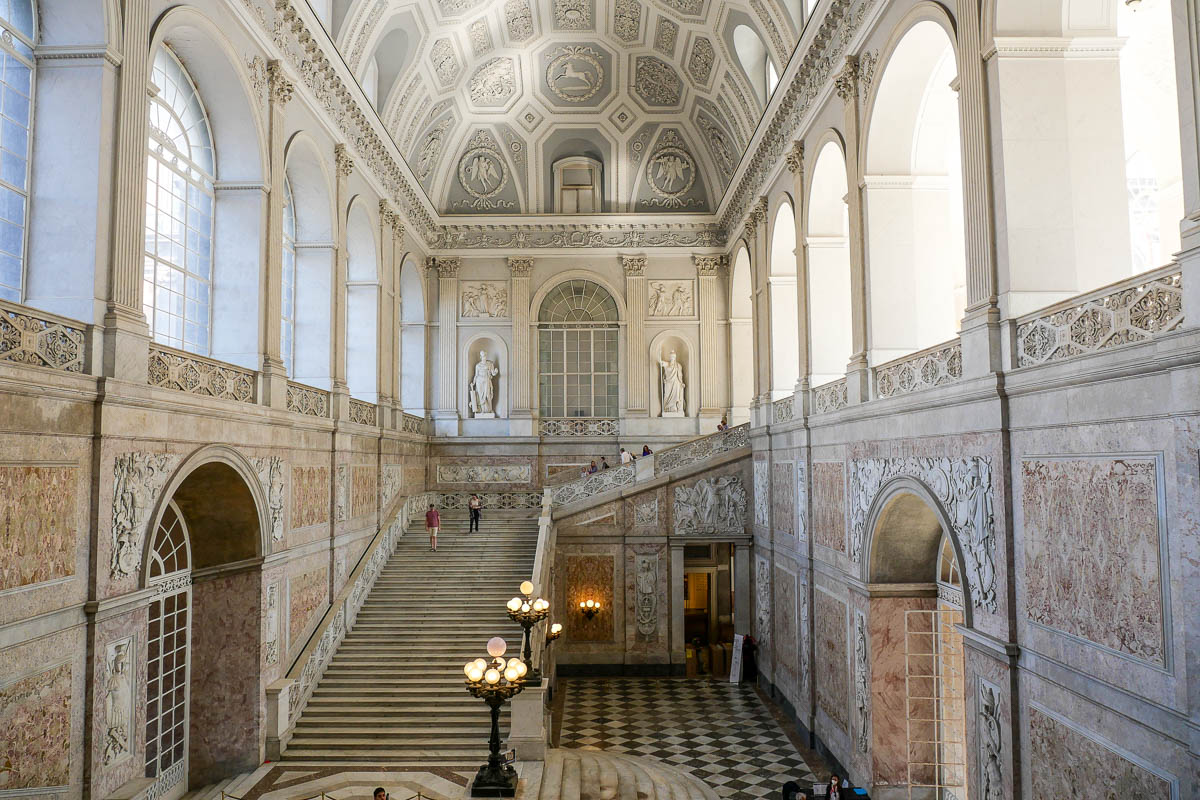
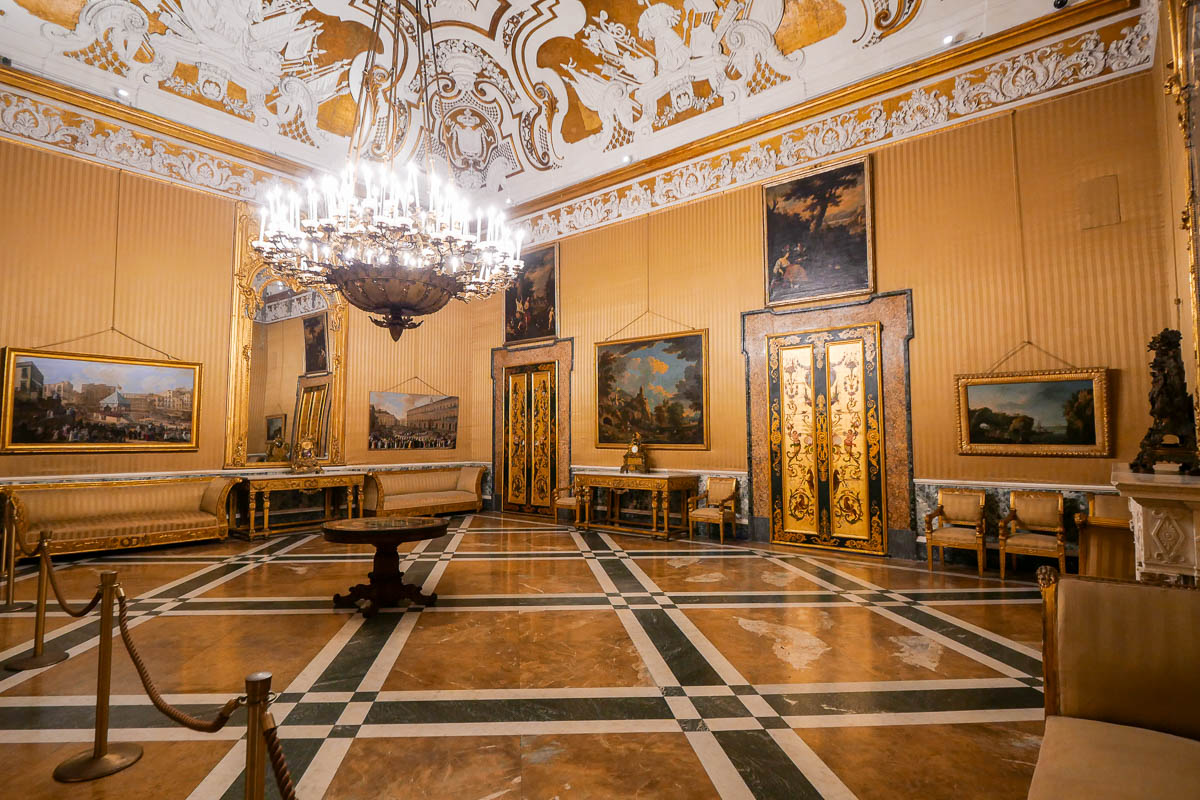
Symbol of Spanish rule in Naples in the 16th century, the Royal Palace is located opposite Piazza del Plebiscito. It houses the Museo del Palazzo Reale, which features a rich collection of objects displayed throughout the 30 rooms of the royal apartments. There is even a small theater intended for the royal family. The palace entrance has a superb marble staircase. A wonderful visit in Naples for history and art lovers.
Opening hours : 9 a.m. to 8 p.m. | Closed on Wednesdays.
Price : €10 (€2 for ages 18–25, free for under 18s).


Galleria Borbonica
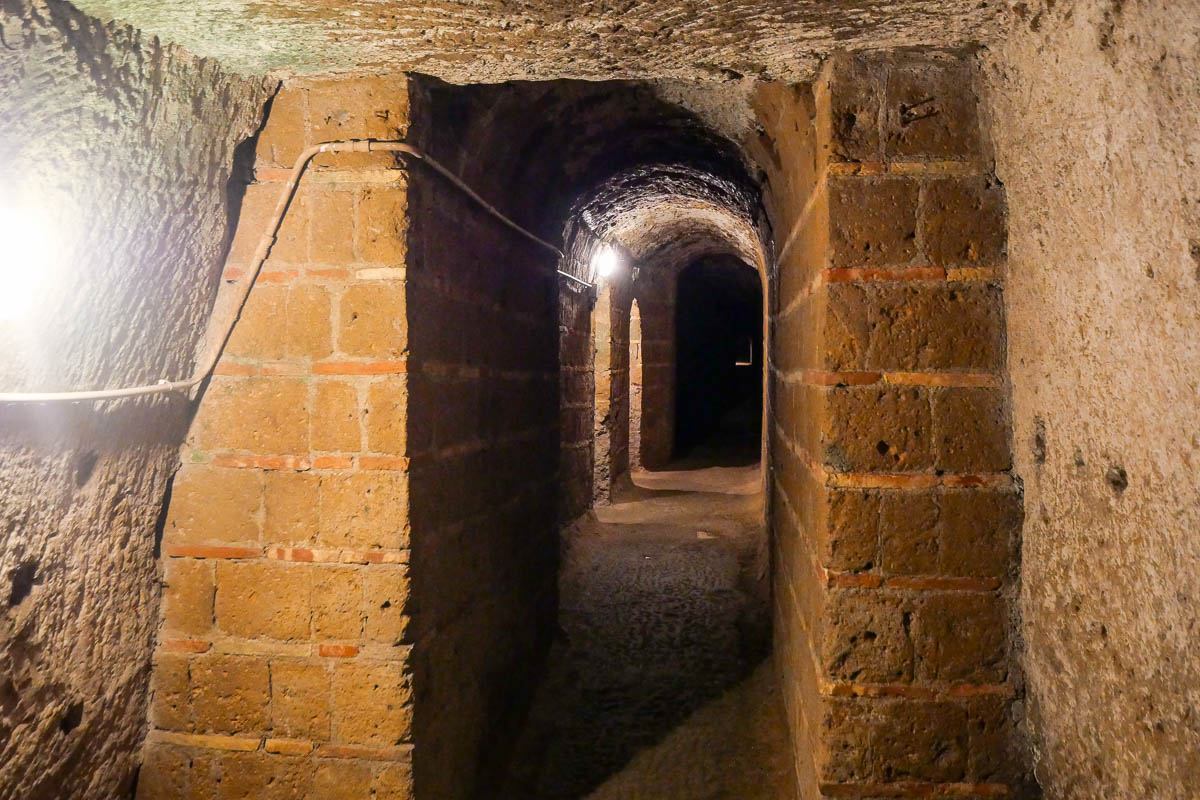
Naples has a huge underground network of man-made galleries excavated at different periods. Indeed, the fairly soft tuff ground has been used for construction from Roman times until World War II. It is possible to visit these various galleries, grouped under the name Napoli Sotterranea.
The Galleria Borbonica (Bourbon Tunnel) is a gallery built by Ferdinand II of Bourbon in 1853 to connect the Royal Palace with Piazza Vittoria, near the sea and the barracks. This military passage was intended to defend the Royal Palace in case of attack or riots. The gallery partly follows the route of the 16th-century Bolla aqueduct.
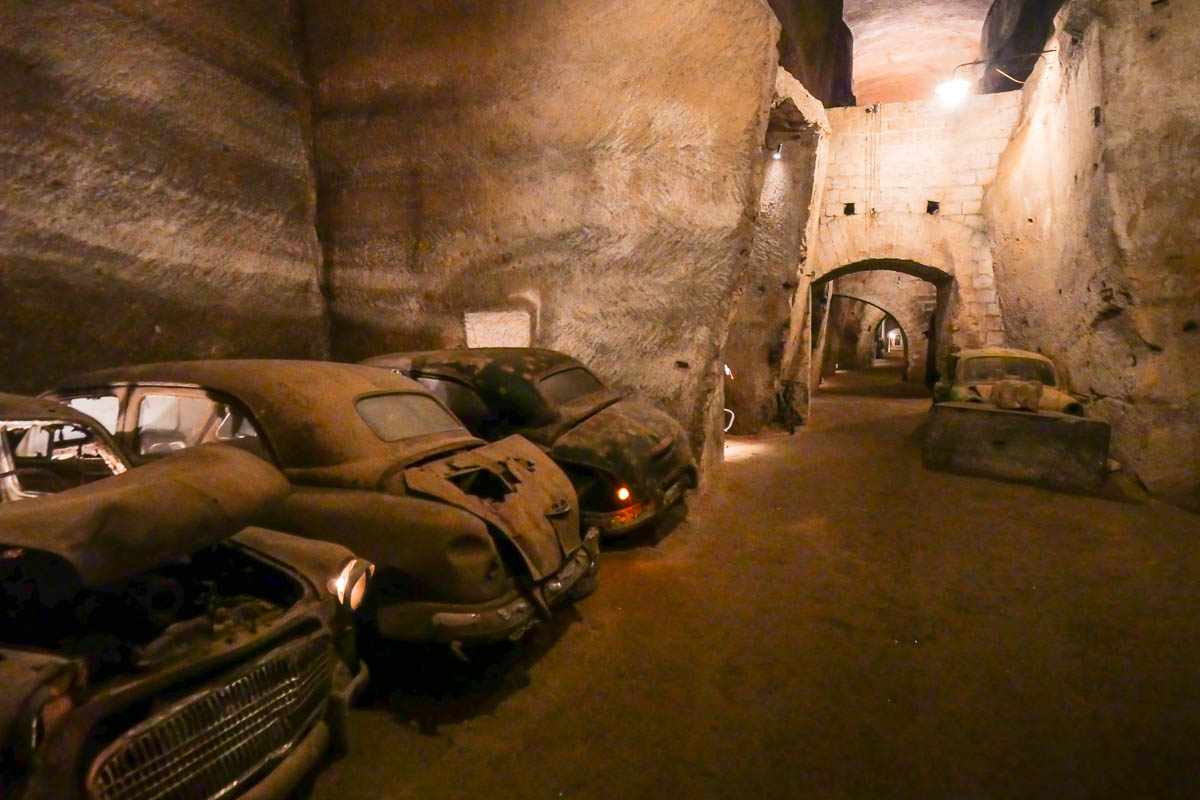
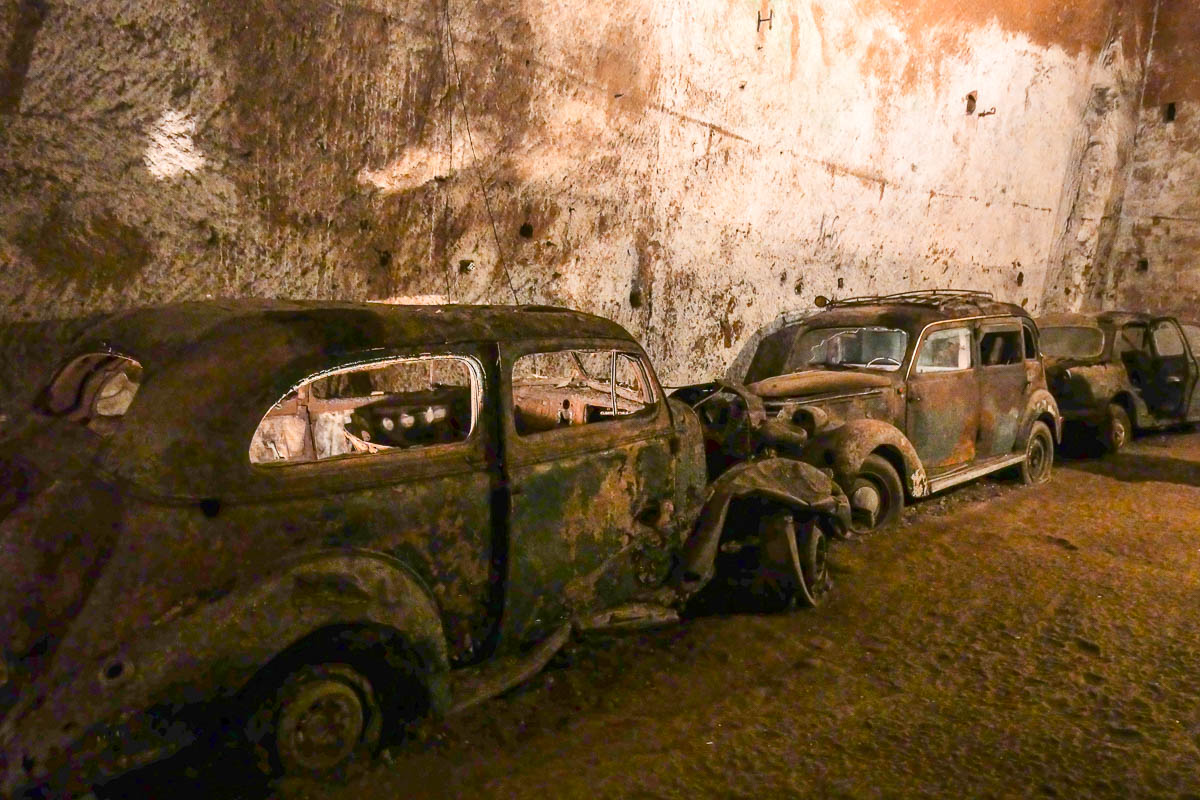
This tunnel served as a shelter for residents during the war between 1939 and 1945. Between 5,000 and 10,000 Neapolitans took refuge here to escape the bombings. The guided tour actually begins with this period, where you can see the difficult living conditions of residents during the war. Later, and until 1970, the Galleria Borbonica was used as a vehicle impound lot for cars and motorcycles, which explains the remains of old vehicles. The exit is on Via Domenico Morelli at the underground parking lot (entry is via Vico Grottone).
There are four different tours : the standard tour (the one we took), the Via delle Memorie, the adventure tour, and the speleology route. You will find all the information on the official website. Tickets can be purchased on site or online for an additional €1 (also available on GetYourGuide). Guided tours are in Italian or English.
The visit was interesting, but if you have limited time to explore Naples (less than 3 days), it is not a priority. Moreover, you must come on Friday or the weekend to enter the Galleria Borbonica.
Opening hours : Friday to Sunday and public holidays only. Standard tour at 10 a.m., 12 p.m., 3 p.m., and 5 p.m.
Price : €10 for the standard tour (€5 for ages 11–13 and over 75s, free for under 10s).

Castel dell’Ovo
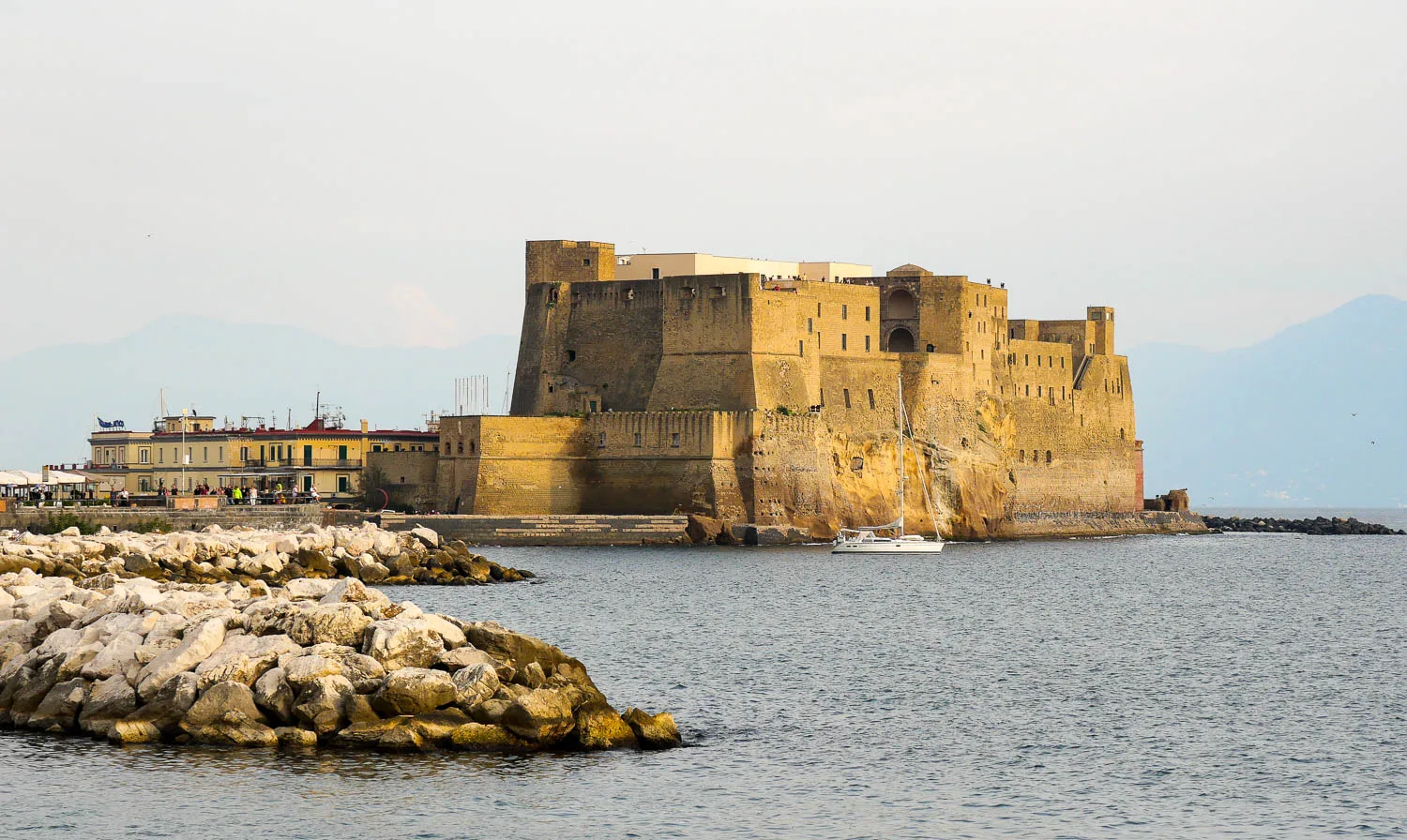
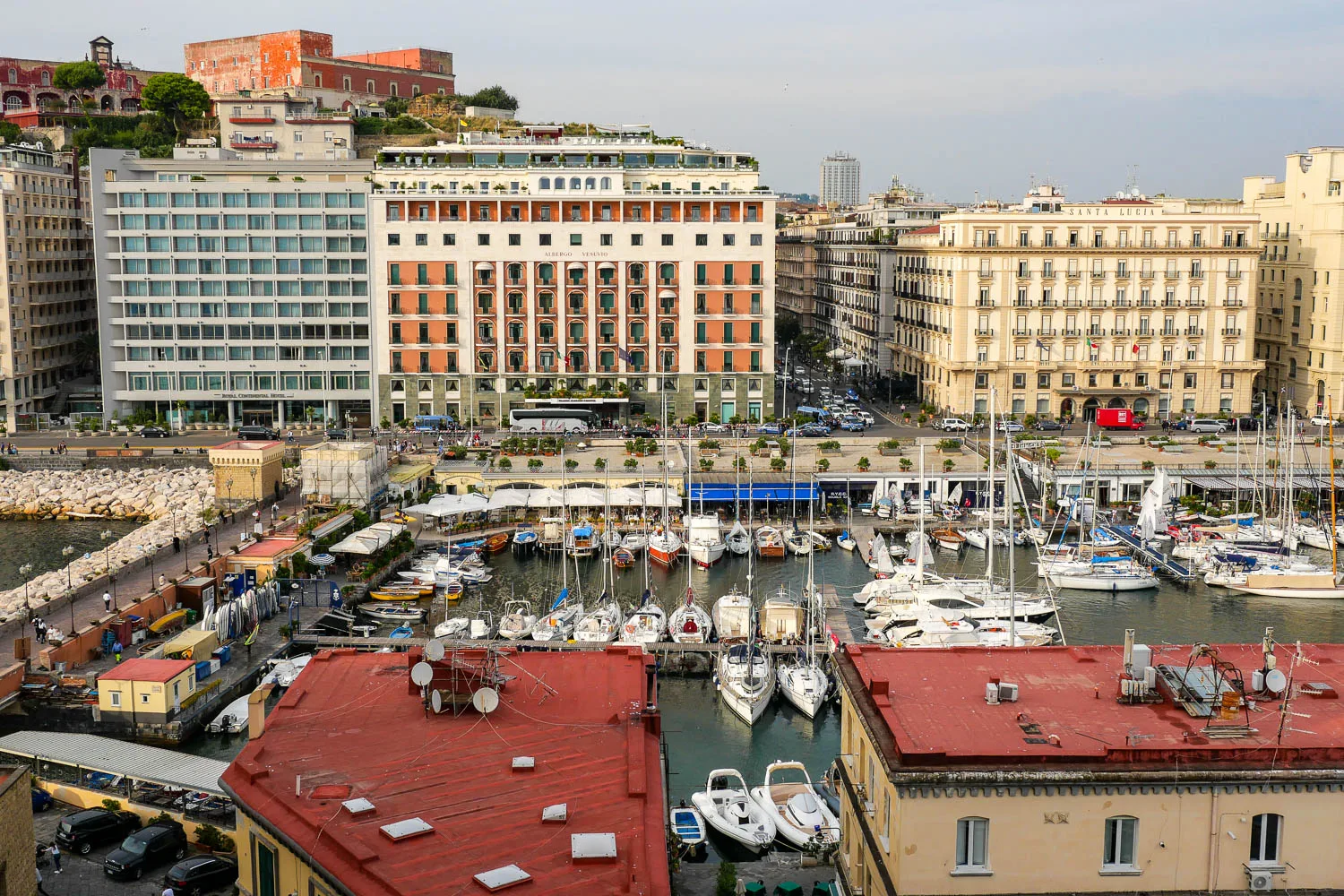
After visiting the San Ferdinando district, continue toward Lungomare to discover Borgo Marinaro and Castel dell’Ovo. The “Egg Castle” (in French) is the oldest in Naples; it was built by the Normans in the 12th century. Legend has it that a sorcerer placed a magical egg beneath the castle’s foundations. If the egg were to break, the fortress would collapse, bringing about the ruin of Naples.
The interior of Castel dell’Ovo is empty, there is nothing to visit. However, you should climb to the top of the castle to enjoy a beautiful panorama of the city. Unfortunately, the day we visited the weather was foggy.
At the foot of the fortress lies Borgo Marinaro, a former fishing village that now houses pleasure boats. There are many restaurants here, the most famous being Zi Teresa. The specialties naturally focus on fish and seafood.
Spanish Quarters and Via Toledo
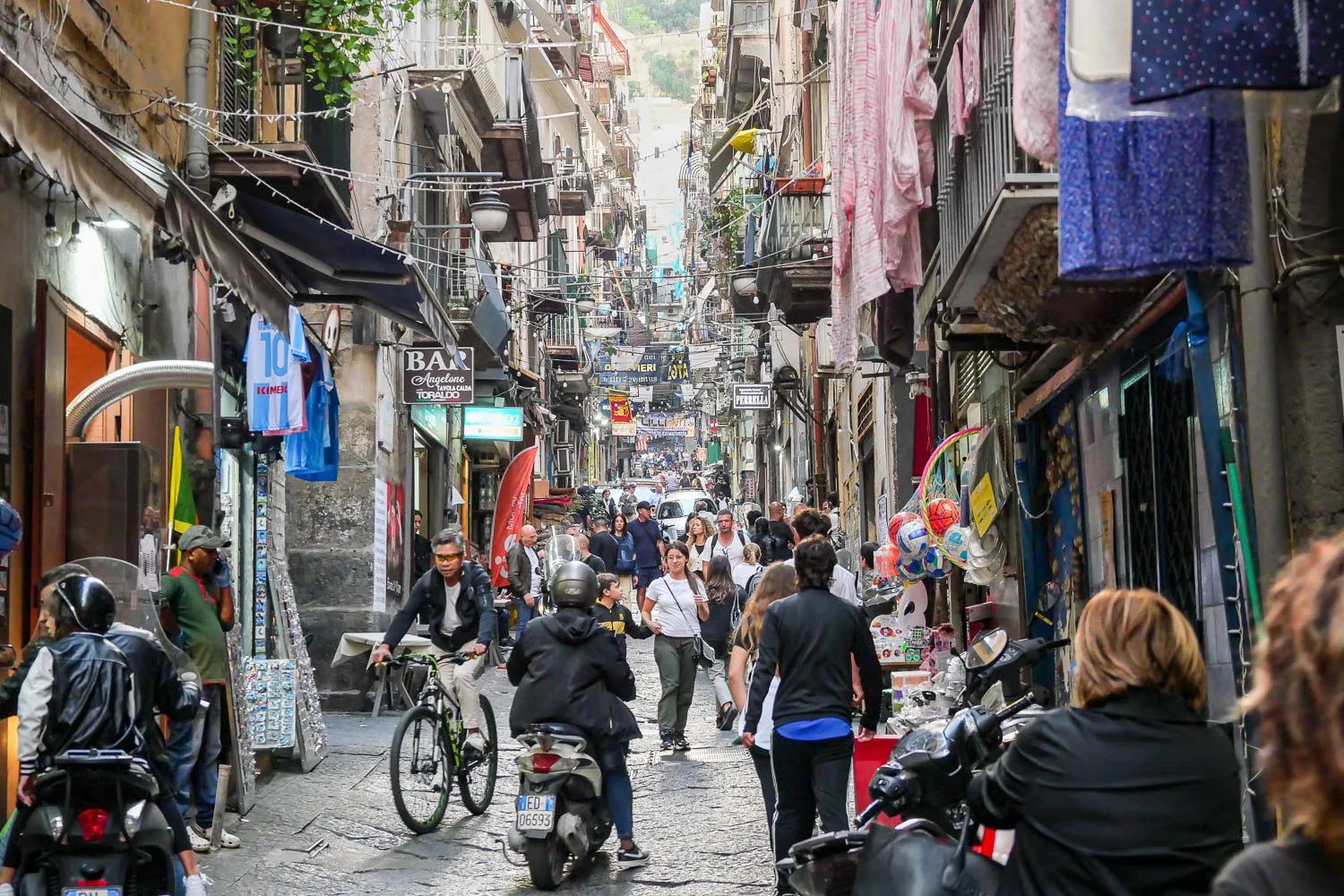
During Spanish rule in Naples in the 16th century, it was necessary to accommodate and house Don Pedro’s troops, who were tasked with monitoring and defending the population. This is how the Spanish Quarters in Naples were created. For tourists, the Quartieri Spagnoli are a lively area with a typical atmosphere where laundry hangs from the windows and scooters speed through the streets. There are a few street art works, and many restaurants are located near Via Toledo. However, there is not much to see in terms of monuments.
Via Toledo, which runs alongside the Spanish Quarters, is worlds apart from this atmosphere. It is a major shopping street, partly pedestrianized, lined with palaces and shops. You will also find many vendors selling counterfeit handbags on the sidewalk. Via Toledo connects Piazza del Plebiscito to Piazza Dante. You will inevitably pass through here during your stay in Naples.
Piazzetta Maradona
Neapolitans are passionate about football and devoted supporters of Napoli, the city’s club. Since Diego Maradona, the famous Argentine player, played for Napoli between 1984 and 1991, he has become a true legend for Neapolitans. A small square is dedicated to him in the Spanish Quarters at the end of Via Emanuele de Deo (Murales Maradona). Even though Piazzetta Maradona is not yet its official name, that is what people already call it here. In addition to seeing a mural, you can buy all sorts of items related to the star. Fans will appreciate it. There is a much larger and more beautiful fresco than the one in the Spanish Quarters, but it is located on the façade of a building in San Giovanni a Teduccio, quite far from the center (coordinates).

Church Sant’Anna dei Lombardi
The Church of Saint Anne of the Lombards (15th century) is located on Piazza Monteoliveto between Via Toledo and the historic center. Visiting the church is free, but what is interesting here is the museum and the chapels (€6), which house numerous works of art. If you do not plan to pay the entrance fee, you can skip the Church of Sant’Anna dei Lombardi.
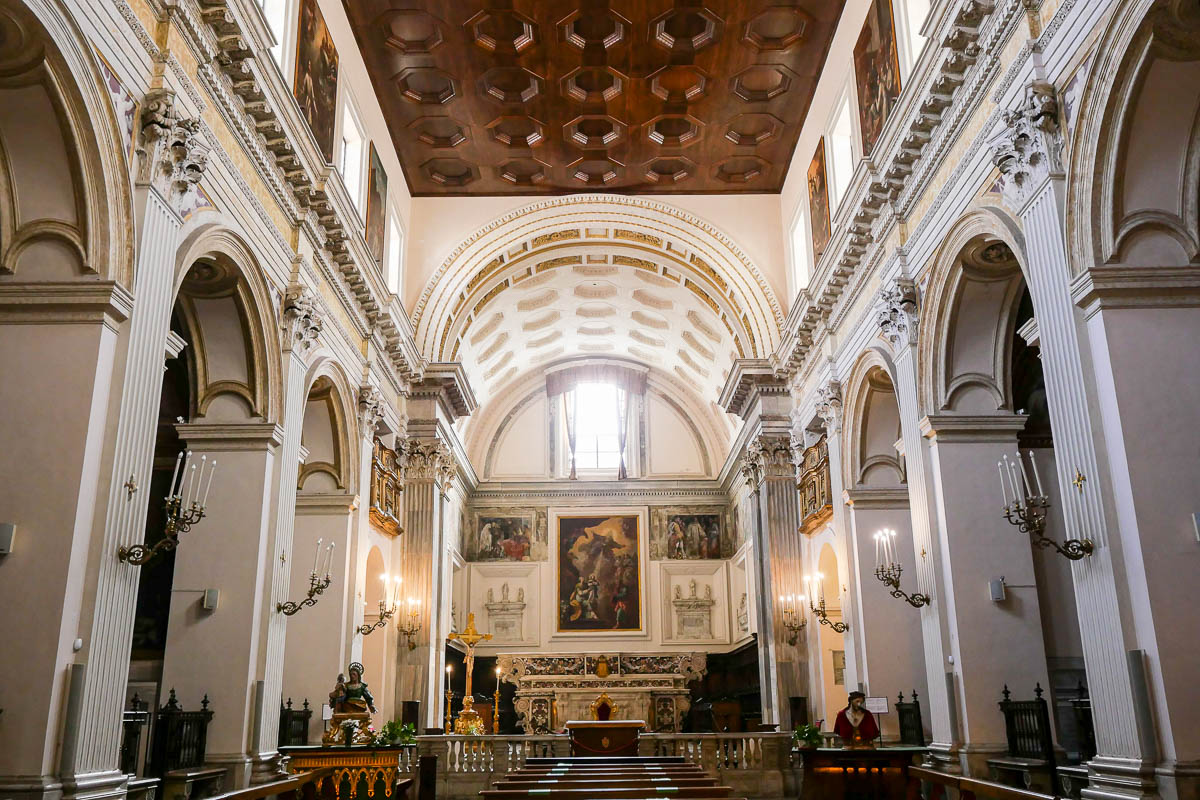
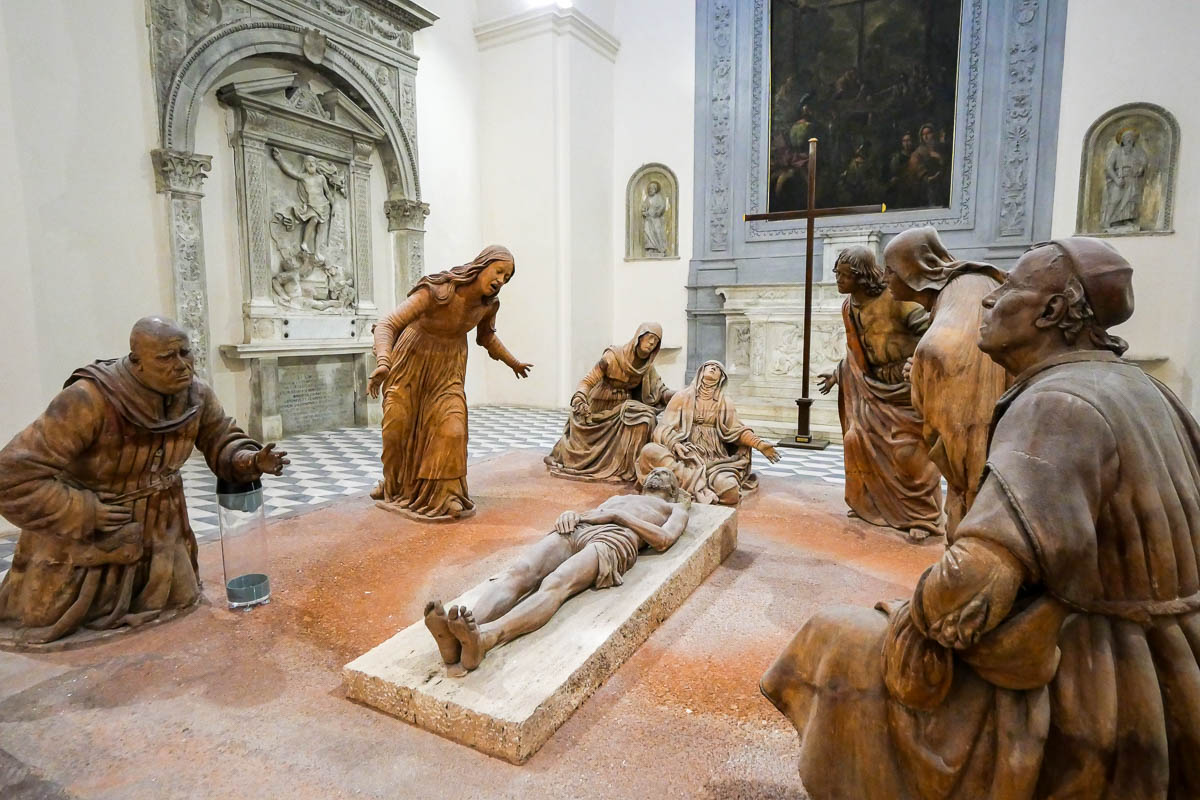
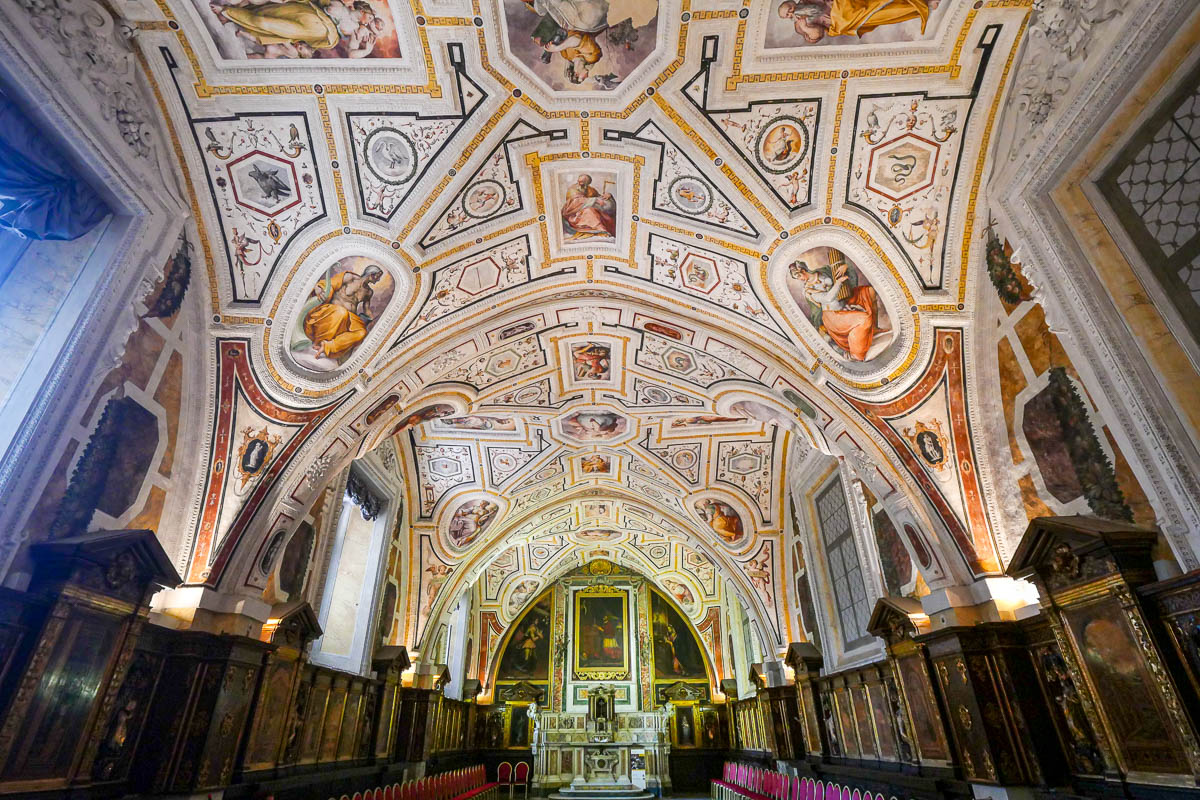
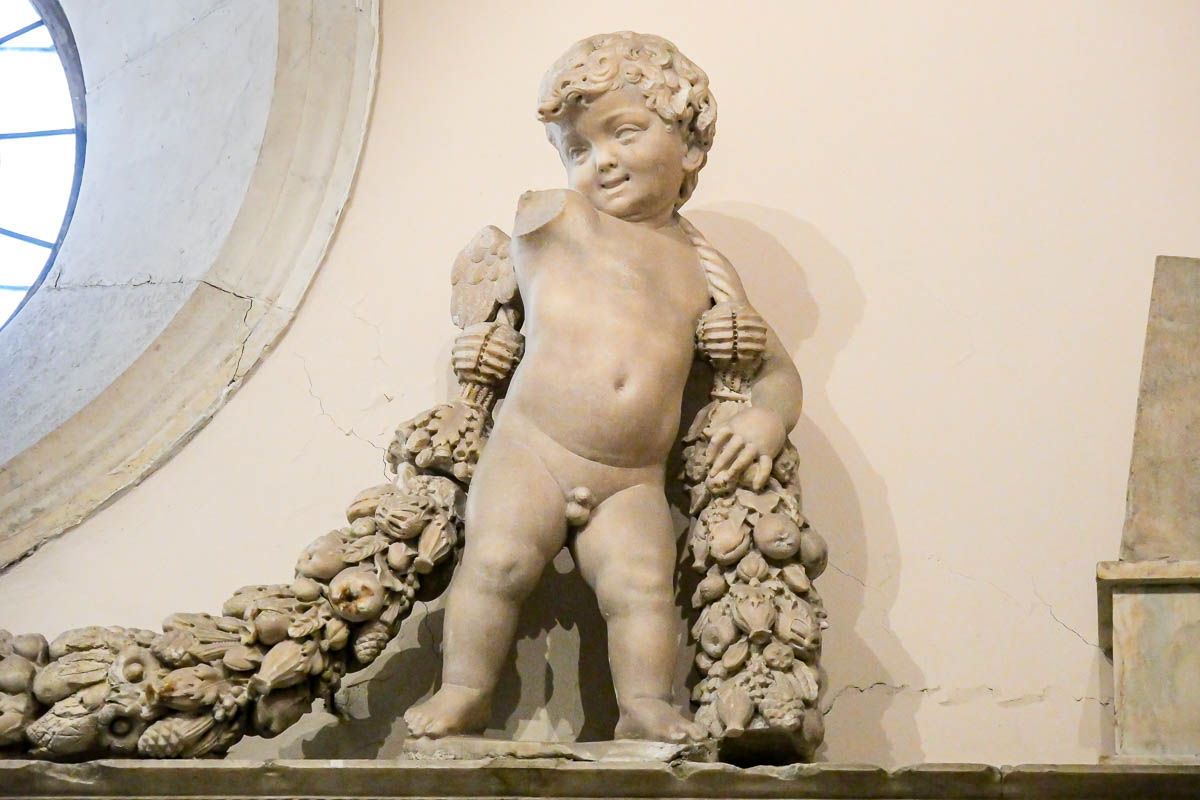
Entering through the museum, the first chapel on the right contains one of the most important works, the Compianto sul Cristo morto (Lamentation over the Dead Christ). This terracotta sculpture from 1492, whose colors have faded over time, depicts a life-size scene of figures surrounding Christ’s body (photo 2). The sacristy further on features a magnificent ceiling covered with Tuscan Renaissance-style frescoes by Giorgio Vasari (photo 3). You then enter the church (photo 1), which contains several beautiful chapels accessible only with the museum ticket. In the Cappella Correale there is a sculpture by Michelangelo (photo 4).
Museum opening hours : 9:30 a.m. – 6:30 p.m. Monday to Saturday | 12:30 p.m. – 5:30 p.m. Sunday.
Price : €6 (€4 for under 26s, free for under 12s). Church entry free.
Chiaia district
This is one of Naples’ upscale neighborhoods. It begins at Piazza del Plebiscito and runs along the sea to Posillipo. There are few tourist sites to see, but it is a pleasant place for a walk and for shopping. It is also a popular spot among the chiattilli for its restaurants and bars. This somewhat pejorative Neapolitan term refers to wealthy residents who do not mix with the popular masses.
Lungomare
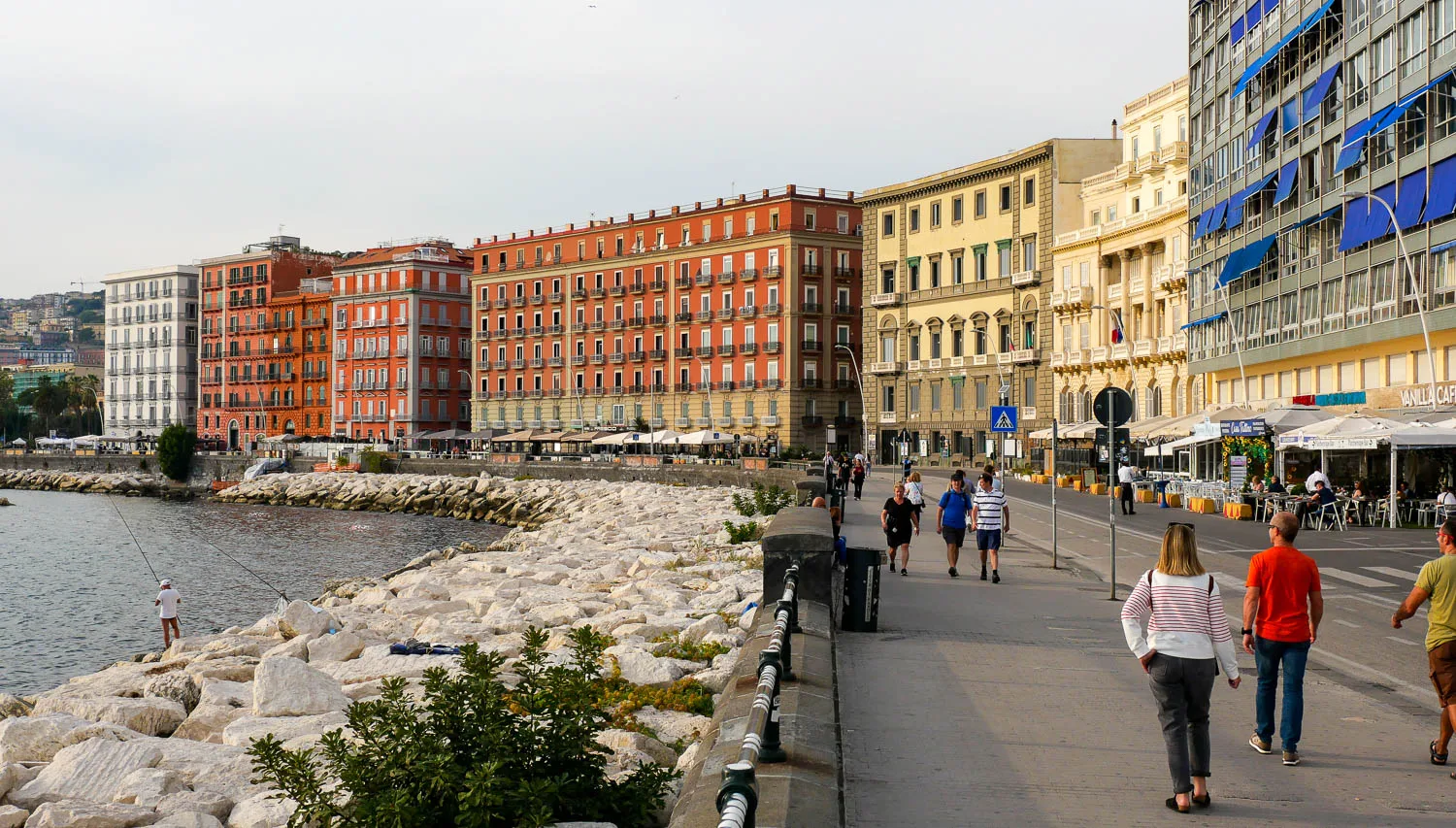
This 2.5 km pedestrian promenade runs along the sea between Castel dell’Ovo and the port of Mergellina. It is a pleasant place for a walk while enjoying the sea air and admiring the panorama of the castle and the islands of the Bay of Naples (if the weather is nice, unlike in my photo). However, there is no beach here along the sea, only a rocky breakwater. Daniela does not like when I say this, but I prefer my Promenade des Anglais in Nice 🙂
Via Chiaia and via Filangieri
As mentioned earlier, Chiaia is one of Naples’ wealthiest neighborhoods. It therefore naturally features luxury boutiques, particularly on Via Chiaia, Via Filangieri, and Via dei Mille. Shopping enthusiasts will find plenty to enjoy. Those who prefer architecture will linger over the Belle Époque or Art Nouveau-style buildings.
Palazzo Mannajuolo
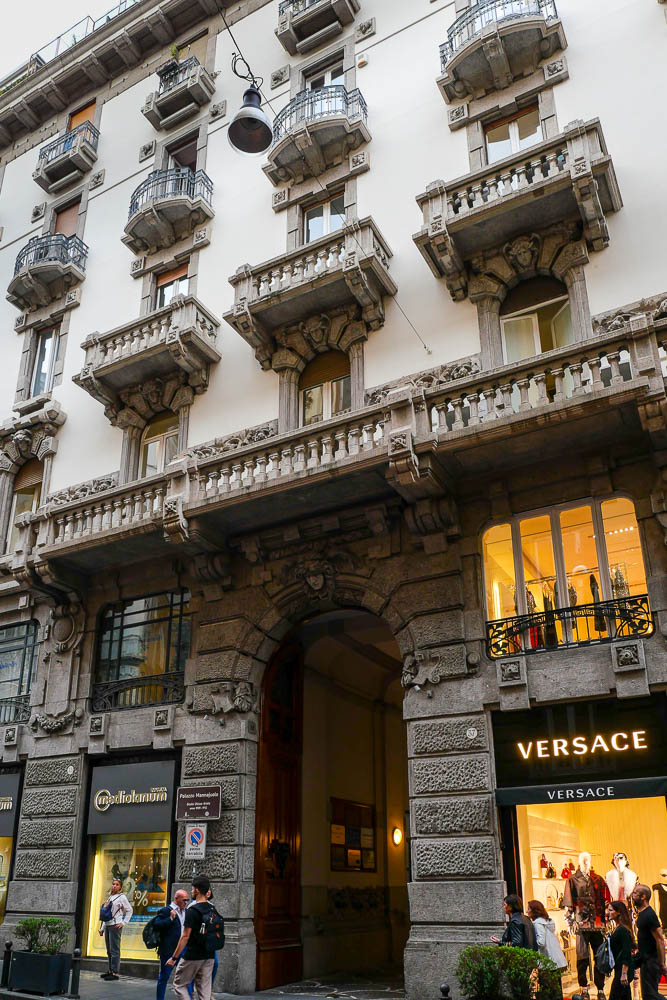
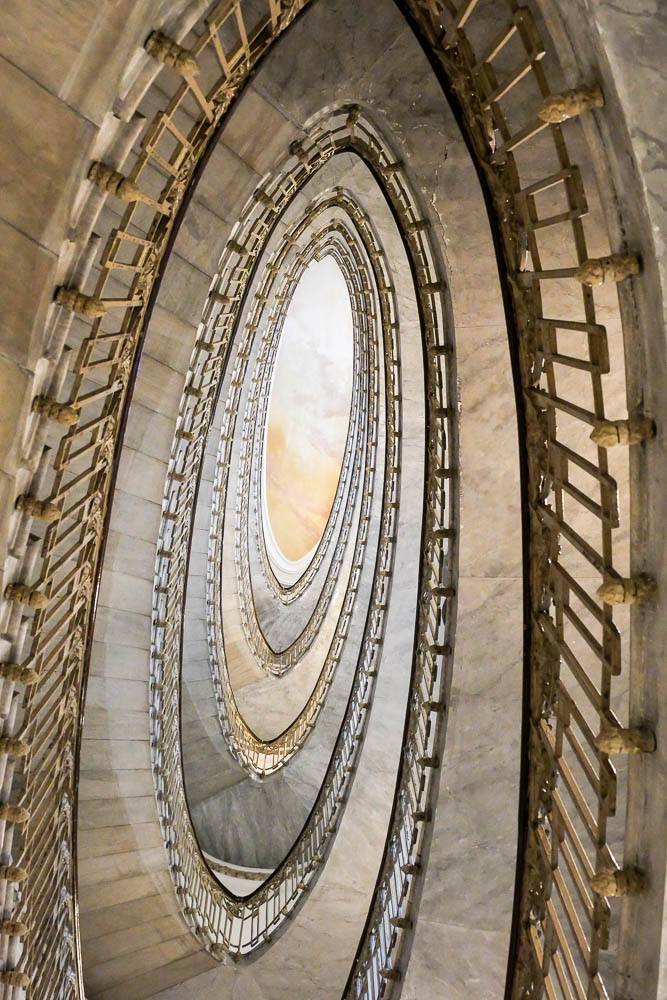
Speaking of architecture, at No. 37 Via Filangieri you will find a palace typical of the Liberty style (Neapolitan Art Nouveau). This is Palazzo Mannajuolo, built between 1909 and 1912 by Giulio Ulisse Arata. You must go inside to see its superb ellipsoidal marble staircase. As it is a residential building and not a museum, entry is only possible from 10 a.m. to 12 p.m. and from 5 p.m. to 7 p.m. (there is a concierge). Climbing the stairs is not allowed.
La Sanita district
This working-class neighborhood located north of the historic center is full of small street markets. It is the ideal area to meet locals, as it is not touristy like the old town.
At the northern end of La Sanità lies Capodimonte Hill, which houses one of Italy’s richest art museums and the Catacombs of San Gennaro.
Naples Archaeological Museum
If you love archaeology, especially the Greco-Roman period, you absolutely must visit this museum. It is considered the most important in the world for Roman history. With two ancient Roman cities located right next door, that is hardly surprising. Many objects come from excavations at Pompeii and Herculaneum, as well as from the Farnese collection initiated by Charles III of Bourbon.
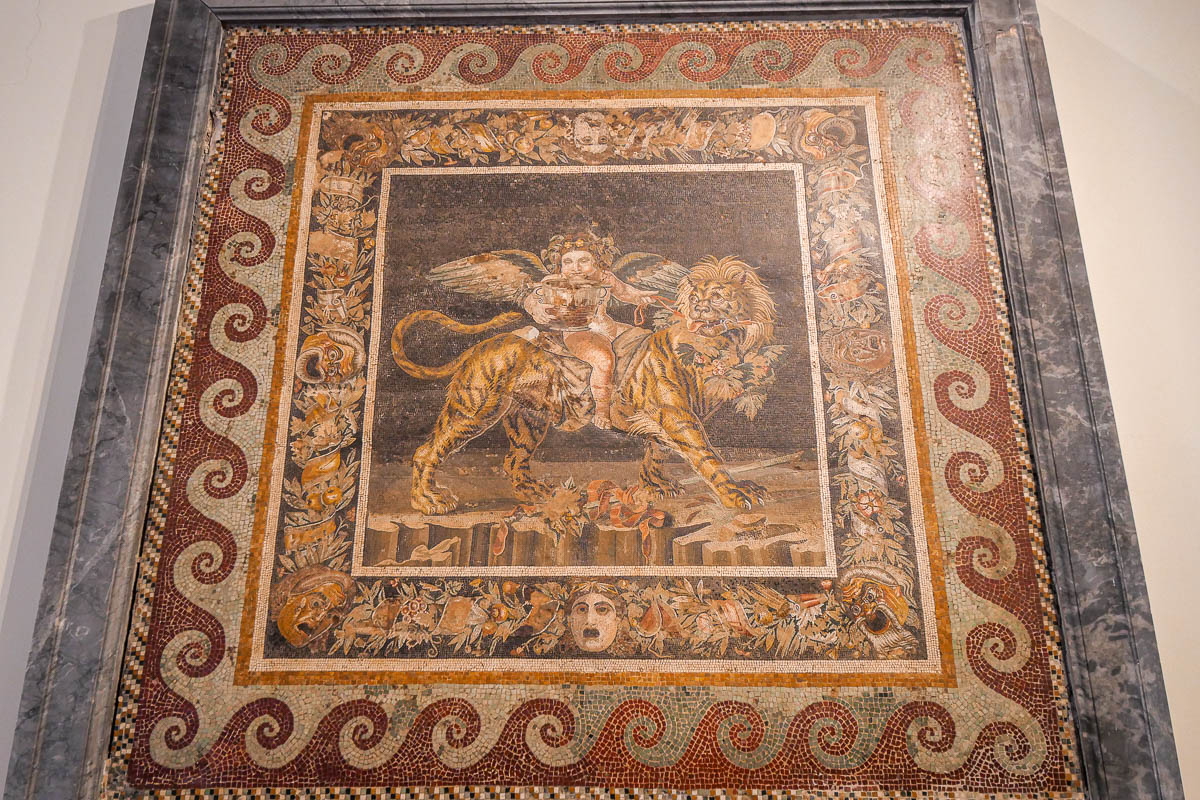
The Naples Archaeological Museum is quite large, if you spend time on each object, it takes several hours to explore. I particularly enjoyed the section on mosaics from Pompeii and Herculaneum. The originals are in the museum and no longer in Pompeii (only reproductions remain there). Thanks to preservation by the ashes of Vesuvius, painted frescoes from wealthy villas have also been recovered. There is also an original section on ancient erotic works that were long censored and only opened to the public in 2000.
For more explanations, you can join a guided tour of the National Archaeological Museum of Naples (also includes skip-the-line entry).
Opening hours : 9 a.m. – 7:30 p.m. | Closed Tuesdays.
Price : €18 (€2 for ages 18–24, free for under 18s). Add €1.5 to visit the “Magna Grecia” section (which I recommend for its mosaics).

Palazzo dello Spagnolo
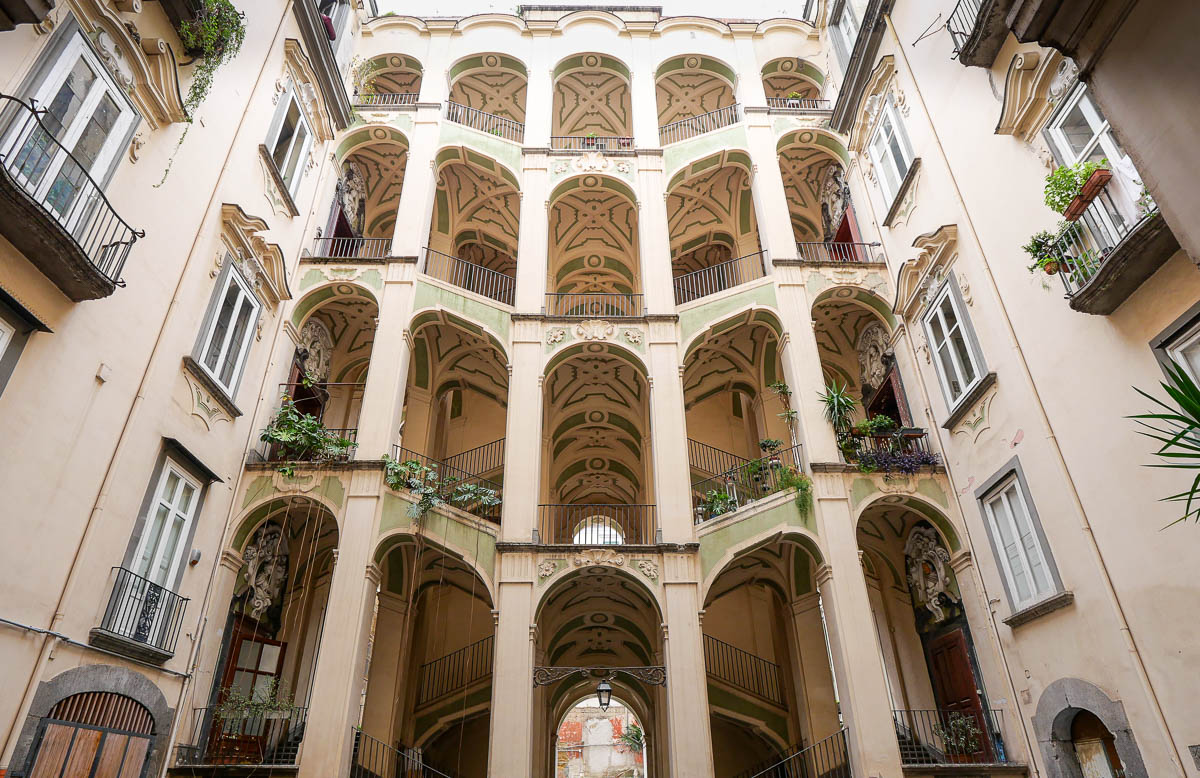
This palace, built in 1738 by architect Ferdinando Sanfelice, is located on Via Vergini just above Piazza Cavour. From the historic center, it requires a detour of about ten minutes. Declared a national monument in 1925, its internal hawk-wing staircase in Neapolitan Baroque style is a masterpiece.
Today it is a residential building, and watching an elderly lady climb to her apartment made me think that is quite a lot of stairs to go up and down each time. Of course, there is no elevator. If you like Palazzo dello Spagnolo, you can even stay in this apartment with a terrace. It is quite close to the center for visiting Naples.

Basilica Santa Maria della Sanita
The building was constructed between 1602 and 1613 above the Catacombs of San Gaudioso. The façade and the majolica clock date from the 18th century. Inside, you immediately notice the double staircase leading to the choir and the main altar in polychrome marble. Access to the catacombs is from the crypt.
While visiting the church is free (9 a.m.–1 p.m.), access to the catacombs is only possible on a guided tour (€13, every day except Wednesday). You discover a Paleochristian cemetery dating from the 5th century, combining frescoes and skeletons. It is best to buy your tickets in advance on the official website.


Palazzo Reale di Capodimonte
This former summer residence of the rulers of the Two Sicilies houses one of Italy’s richest art collections (entry €15). Even if you do not wish to visit the museum, you can come here to enjoy the gardens of the Capodimonte Park (a former 134-hectare hunting reserve), which offers many views of the city. To get there, you need to take the bus (we took it from Piazza Dante).

What to do in Naples in 1 day : must-sees
One day to visit Naples is really too short. If you do not have more time to dedicate to the city because you are heading to the islands or the Amalfi Coast, you will need to make wise choices based on your interests. Here is a program I suggest for what to do in Naples in 1 day with the must-see sites.
- Start the day in the historic center and visit the Church of Gesù Nuovo, one of the most beautiful.
- A few meters away, enter the basilica and monastery of Santa Chiara.
- Go see the magnificent Cristo Velato in the Sansevero Chapel (reservation essential). Closed Tuesdays.
- Lunch in the historic center at Antica Trattoria Da Carmine.
- In the afternoon, head to Vomero Hill (funicular) to admire the city’s most beautiful view from Castel Sant’Elmo.
- Right next door, visit the Charterhouse of San Martino, a jewel of Neapolitan Baroque.
- Return to the historic center to visit the Duomo (open 4:30 p.m. to 6:30 p.m. in the afternoon).
- In the evening, go eat the best Neapolitan pizza at Gino e Toto Sorbillo.
What to do in Naples in 2 days : the essentials
With 2 days to visit Naples, you will have a bit more time to explore the city and the pace will be less rushed. Follow the must-see itinerary from the previous day (lightening it if you could not do everything). For the second day, here is an itinerary idea.
- If your accommodation is in the historic center, start by visiting the churches you did not see yesterday. While wandering through the alleys, stop by Santa Maria delle Anime, San Gregorio Armeno, San Paolo Maggiore, and San Domenico Maggiore.
- Or, if you prefer archaeology, spend the morning at the Naples Archaeological Museum.
- At lunchtime, you will easily find somewhere to eat in the historic center.
- In the afternoon, walk down Via Toledo or take the metro to Municipio.
- Once in the Ferdinando district, take a walk to see the architecture of Galleria Umberto I and Castel Nuovo.
- Enjoy tea or coffee with a pastry at Gran Caffè Gambrinus.
- When you leave, you should be on time for the guided tour (3:30 p.m.) of Teatro San Carlo.
- Then head to Piazza del Plebiscito to visit the Royal Palace opposite.
- Continue toward Castel dell’Ovo and Lungomare to admire the sunset.
- In the evening, have a fish or seafood dinner at Borgo Marinaro (at the foot of Castel dell’Ovo).
What to do in Naples in 3 days : the complete tour
In 3 days you can cover all the things to do in Naples. You can follow the previous 2-day itinerary and add the following tourist sites.
- Take the bus up to Capodimonte Hill.
- Visit Palazzo Reale di Capodimonte, which displays an exceptional collection of artworks, one of the richest in Italy.
- On your way out, enjoy some fresh air in Parco di Capodimonte, a Baroque garden.
- Nearby, the Catacombs of San Gennaro (guided tour) are the oldest in Naples.
- Return to the historic center to visit Napoli Sotterranea, the underground galleries. There are several, including Galleria Borbonica.
- Then stroll through the Spanish Quarters to Piazzetta Maradona.
If you are tired of the city, you can just as easily go to the islands of Capri or Procida in the Bay of Naples. Climbing Mount Vesuvius and visiting the ancient cities of Pompeii and Herculaneum are also options. Otherwise, include them in your itinerary for visiting Naples in 4 days.
What to see around Naples ?
The islands of Capri, Procida and Ischia
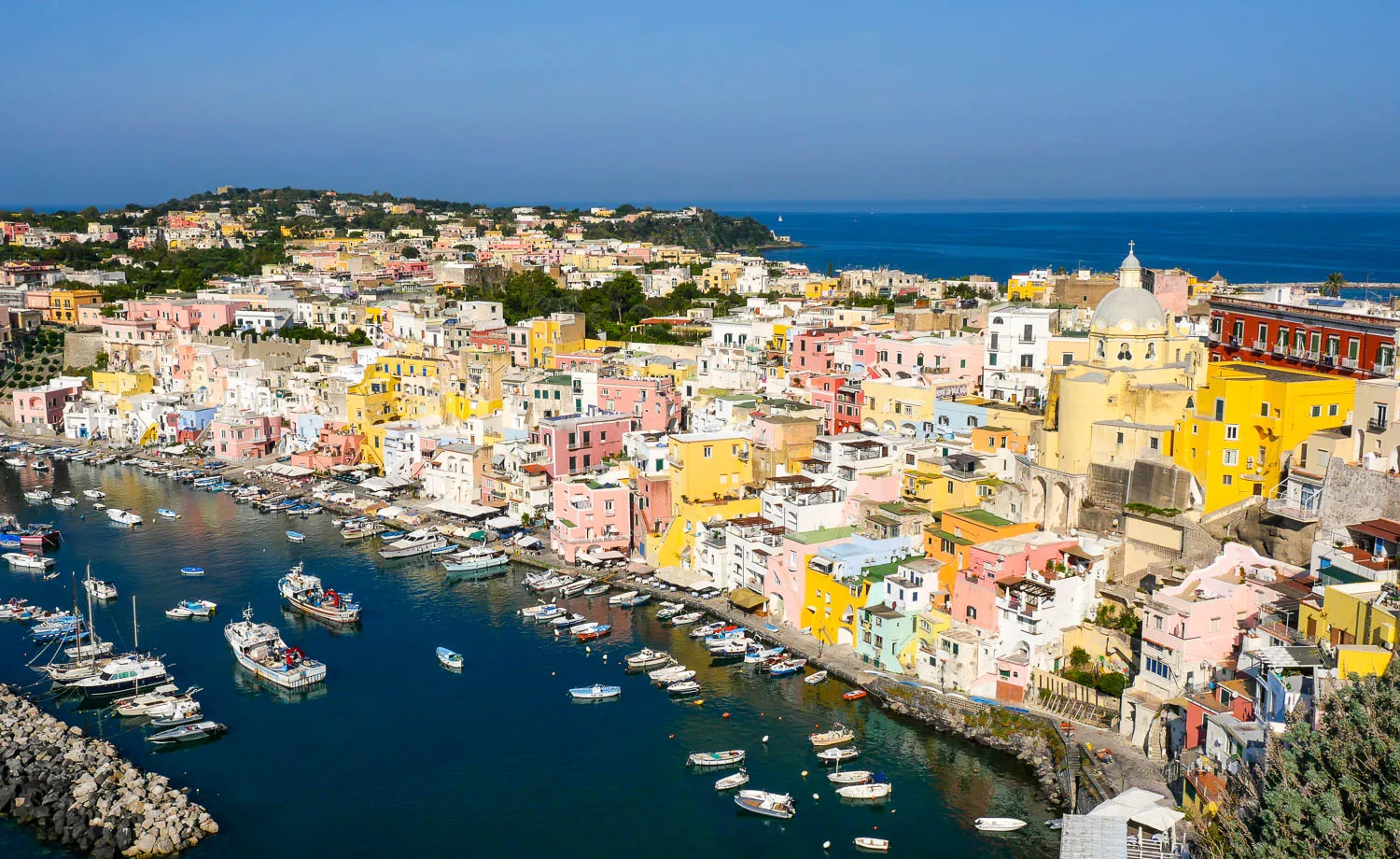
The three tourist islands in the Bay of Naples are Capri, Procida, and Ischia. Each has a different character and atmosphere, you can visit all three (if you have plenty of time) or choose the one that best matches your expectations. Capri is the chic island favored by the jet set and home to many luxury boutiques (like Portofino or Porto Cervo). The smallest of the three islands, Procida is the most authentic. Its fishing village atmosphere has been preserved from mass tourism. Ischia, the largest, is famous for its gardens and thermal springs. All of them have beaches for swimming in summer.
It is easy to reach Capri, Procida, and Ischia from Naples. From the port of Molo Beverello (next to Castel Nuovo), ferries from several companies provide connections. Alternatively, you can choose an organized excursion that will take you on a cruise to discover all the wonders of the Bay of Naples.
- Gulf of Naples & Capri Sightseeing Boat Tour
- Capri & Anacapri ferry included – Small Group Tour
- Ischia & Procida Day Trip
Pompeii and Herculanum
The surroundings of Naples include two major archaeological sites, the famous Pompeii and the lesser-known Herculaneum. These two cities, buried in 79 by the ashes and mud of Mount Vesuvius, were frozen in time as in the Roman era. The ruins of the towns are extremely well preserved. If you are hesitating between the two, note that Herculaneum is smaller than Pompeii and therefore requires less time to visit.
Pompeii and Herculaneum are easily accessible from Naples by the Circumvesuviana train, which departs from the central station (Piazza Garibaldi in the historic center). Alternatively, you can opt for an organized excursion from Naples. You can also take the shuttle to Pompeii.
- Pompei Half-Day Tour
- Pompeii and Herculaneum Tour with Lunch
- Pompeii Ruins & Mount Vesuvius Day Tour
- Amalfi Coast and Pompeii – Small Group Tour
- Skip-the-Line Guided Tour with Archaeologist
Mount Vesuvius
The iconic feature of the Bay of Naples panorama is one of the most active volcanoes in the world. It is part of Vesuvius National Park, which offers several hiking trails. It is possible to climb to the summit (1,281 m) to see the crater. From the top, the panorama of Naples is superb.
You can reach Vesuvius by train (Circumvesuviana), bus, or car. There is a parking area near the ticket office. You then need to walk 20 to 30 minutes along a gravel path to reach the crater. If you do not want to organize anything, choose a private tour, which is more convenient.
The Amalfi Coast
This is one of the most touristy regions in southern Italy, listed as a UNESCO World Heritage Site. With its rugged coastline plunging into the sea, the Amalfi Coast is a destination in itself if you are visiting Naples. Sorrento, Positano, and Amalfi are among the villages not to be missed. As the Amalfi Coast is very crowded in summer, avoid July and August as much as possible. Allow 3 days to visit the region. If you have little time, day trips from Naples are available.

Which accommodation for visiting Naples ?
I recommend choosing the historic district for your stay, as it is the best located in terms of sights and restaurants. And contrary to what you might think, it is not necessarily noisy. We spent a week in Naples in a perfectly located apartment that was absolutely quiet right in the center!
For more advice on where to stay and the best addresses, I recommend reading my article on where to stay in Naples.
- 55 € : Casina in Centro Storico, one of the cheapest options with excellent reviews for staying in Naples’ historic center. The 25 m² apartment is modern and very well equipped (TV with Netflix, coffee machine, etc.).
- 63 € : Mimì Terrace, this accommodation offers double rooms with private bathrooms. The big advantage is the B&B’s rooftop with a 360° view of Naples. Shared kitchen. Very well located on a quiet street.
- 64 € : La Stanza a parte, in the upscale Chiaia district near Piazza del Plebiscito, this guesthouse offers rooms with breakfast included (homemade) and newly renovated bathrooms. Small balcony with a view.
- 70 € : Sleep & Zupp Casa Olimpia, this 80 m² apartment accommodates up to 4 people (living room + bedroom). It has a fully equipped kitchen and a washing machine, ideal for long stays. Very well located next to the Santa Chiara Monastery.
- 99 € : Hotel Nunù, for those who prefer hotel service, this 4-star property offers rooms with modern bathrooms and breakfast included. All have a balcony with city views. Very well located and close to the port for ferries.
- 100 € : Sellaria4 Guest House, this is the apartment we chose for our stay in Naples and we recommend it 100%! Very well located on a small square facing a fountain and very quiet. Kitchen, beautiful bedroom, and large bathroom. Everything is new.
- 200 € : Relais Della Porta, a place to treat yourself in this 4-star hotel with palace-like decor. Rooms with king-size beds and breakfast included, as well as magnificent suites. Very well located on Via Toledo.
Where to aat Neapolitan specialties ?
It is impossible to visit Naples without tasting its delicious cuisine, one of the best in Italy. While Neapolitan pizza is known worldwide, you will find a large number of dishes and desserts typical of the region. Here, tomatoes grow on the slopes of Vesuvius (which gives them a unique taste), and you will find the best mozzarella di bufala.
You certainly will not go hungry in Naples, snack bars and pastry shops selling takeaway food can be found on every corner. Temptation is everywhere. Pizza fritta (a kind of calzone fried in oil) or pizza al taglio (pizza by the slice) are very popular among Neapolitans (and tourists) for a quick lunch.
Here are the places we recommend for eating typical Neapolitan dishes :
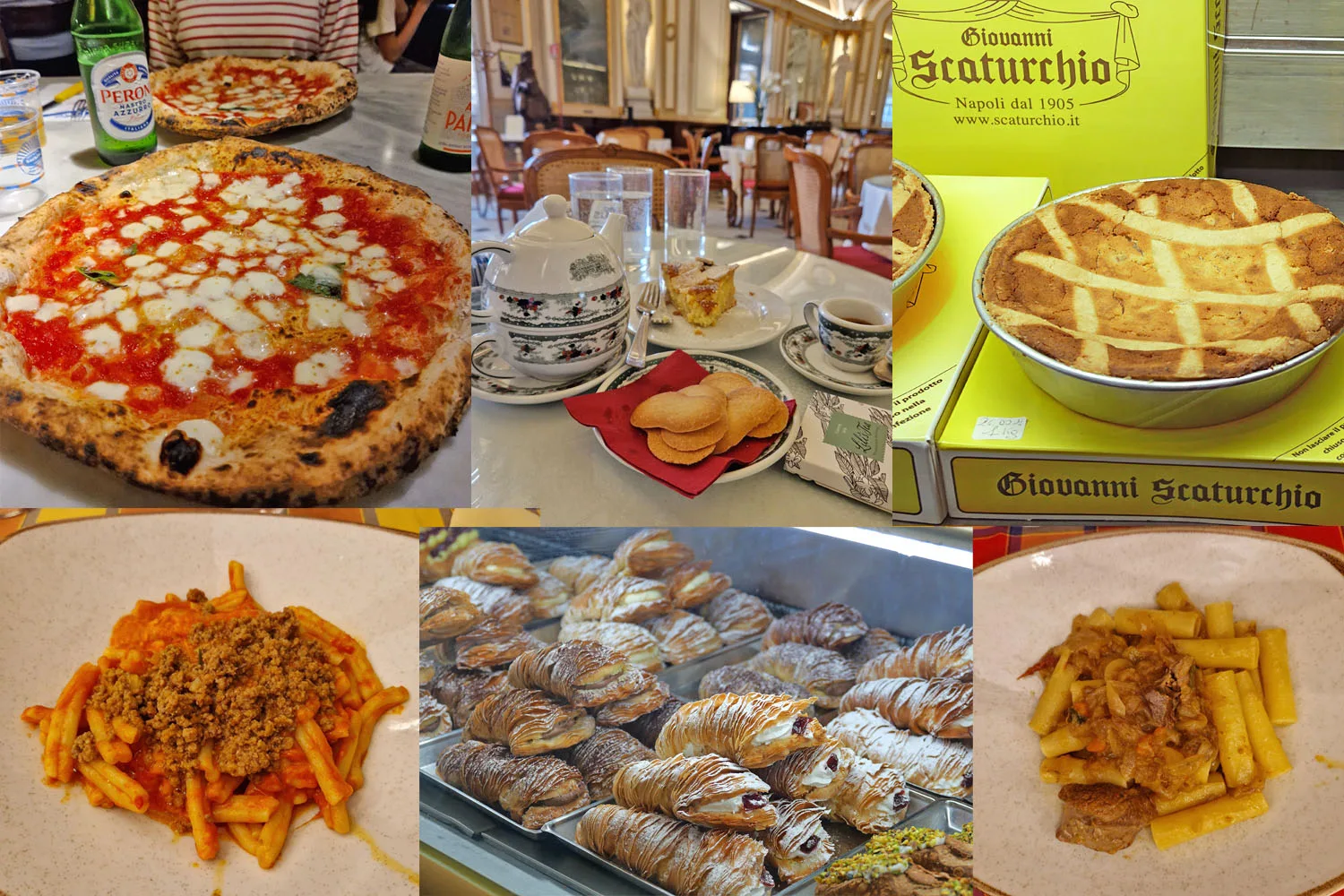
- Pizzeria Gino e Toto Sorbillo : often considered the best pizza in Naples. Sorbillo has several locations in the city (pizza and pizza fritta takeaway), but the original is in the historic center. Come early (6:30 p.m.) to avoid waiting too long. Margherita pizza costs €5.5, plus a €2 table charge for dining in.
- Pizzeria da Michele : another very famous address for eating pizza in Naples. The dining room is quite small; it mainly offers takeaway (you must take a ticket like at the fishmonger). Again, very crowded—margherita €5. Open 11 a.m. to 11 p.m.
- Teresa Iorio : if you want to try pizza fritta, I recommend this small place in the historic center (south of Università metro stop). Teresa is simply the world champion of Neapolitan fried pizza and proudly displays it in her shop.
- Antica Trattoria Da Carmine : for typical Neapolitan dishes in the historic center, we recommend this superb trattoria. Good and inexpensive (pasta dishes around €10). Closed Mondays and no reservations. In the same style, still on Via Tribunali, we also liked Trattoria Enoteca Campagnola.
- Trattoria e Pizzeria Spaccanapoli : located in the heart of the historic center on Via San Biagio Dei Librai, this authentic trattoria with a small terrace on the square opposite serves genuine Neapolitan cuisine.
- Magnolia : this chic restaurant in the Chiaia district, set in a lovely inner courtyard, serves refined fusion cuisine and excellent cocktails. Prices are rather high, but the food is very good.
- Gran Caffe Gambrinus : founded in 1860 next to Piazza del Plebiscito, is a true institution in Naples. All the city’s great names have passed through here. People mainly come for the setting, which transports you back in time, but the pastries are also excellent. Prices match the prestige of the place.
- Pasticceria Giovanni Scaturchio : this pastry shop in the historic center is known by all Neapolitans for making the best pastiera. This cake is traditionally served at Easter but is available year-round. A must try !
- La Sfogliatella Mary : as already mentioned in this Naples guide, to eat the best sfogliatella in the city, head to this small shop at the entrance of Galleria Umberto I.
Neapolitan cooking class
To try recreating at home the delicious dishes you discovered during your stay in Naples, what could be better than attending a cooking class ? It is an opportunity to learn all the secrets of making authentic Neapolitan pizza and pasta.
Travel guide and tips for visiting Naples
How to get to Naples ?
Plane : the easiest, fastest, and cheapest way to get to Naples. Several low-cost airlines offer affordable tickets all year round. To find the best fare, I recommend using a flight comparison website.
Train : Napoli Centrale railway station is located in the city center in the historic district. The train is a good option if you are coming from another Italian city, such as Rome. From France, the journey is rather long.
Car : not the most practical or fastest option, as you will not need a car to visit Naples. Moreover, Neapolitan driving is quite colorful compared to the rest of Italy, so it is best not to try the experience.
How to reach the city center from Naples airport ?
Naples airport is located 4 km from the historic center (10 to 20 minutes by car depending on traffic). To reach the center, you have several options :
Alibus airport shuttle : this special bus line runs between the airport and the railway station (Piazza Garibaldi) in the historic center. The bus then continues to the ports of Molo Beverello and Molo Mossa (also in central Naples). Tickets cost €5 and can be purchased from vending machines in the airport arrivals area or directly on the website. Frequency every 10 to 20 minutes. When leaving the airport, follow the Alibus sign to find the shuttle.
Taxi: taxis in Naples operate with a meter and charge extra for luggage. However, from the airport there is a fixed price to reach the city center. It is €21 to the central station or the historic center and €24 to Piazza Municipio. Make sure the fixed rate is confirmed before getting in; otherwise, the driver will use the meter and it will cost more.
How to get around Naples ?
It is easy to get around on foot when visiting Naples, as the main tourist sights are mostly concentrated around the historic center. However, using the metro can be convenient to save time (ticket €1.2, purchased from machines or shops). The network has several lines, but the most useful is Line 1, which crosses the center and passes near the port. The Naples metro is far from reliable—we once waited 20 minutes for a train during the morning rush hour. In addition to the metro, three funiculars (ticket €1.2) allow access to Vomero Hill.
Fans of the hop-on hop-off red bus will be pleased to know that it also exists in Naples. You can purchase a 24-hour ticket for the multi-stop bus (€24) on this website (free cancellation up to 24 hours in advance). There are two different routes; you can check the stops via the provided link. It may be convenient for those who have difficulty walking.
Where to park in Naples ?
A car is not necessary for visiting Naples. However, if you are coming for a short stay before continuing your road trip to the Amalfi Coast, you will need to find parking. Here, more than elsewhere in Italy, I recommend choosing secure paid parking. Indeed, thefts are frequent in Naples, so it is better not to take risks.
To travel with peace of mind and avoid searching for a parking space in an unfamiliar city, I recommend booking your parking with Parclick. Simply enter your travel dates and search for the parking closest to your destination or that matches your budget.
Best time to visit Naples
The capital of Campania can be visited year-round, but the best times to visit Naples are spring (April to June) and autumn (September and October). In summer it can be very hot, and in August many restaurants and shops are closed because Neapolitans take their holidays. In July and August there will also be large crowds on the islands and the Amalfi Coast. If you plan to visit Capri, Ischia, or Procida, avoid winter when everything is closed from November to April.
How many days to spend in Naples ?
As I already mentioned in this travel guide, Naples is a city unlike the rest of Italy. If you do not take the time to discover its charm beyond the first impression you may have upon arrival, you will miss out on your stay. That is why I recommend visiting Naples for at least 2 days (3 days is best). And in those two days, I do not include trips to the islands, Pompeii, or Vesuvius. Allow at least 5 days in Naples if you want to explore the surroundings, and more than a week if you add the Amalfi Coast.
Is Naples unsafe ? Is the city dangerous ?
This is the question that comes up most often on travel groups and forums. The city’s reputation follows it like a burden, and many tourists wonder whether it is safe. I will cut the debate short : the city of Naples does not have a security problem, especially for tourists who focus on the tourist areas.
However, it is true that this was not always the case. Daniela, who lived more than 30 years in Naples before moving to France, believes things have greatly improved thanks to tourism. So, as in any major city, you should be cautious, but I can tell you that I feel safer in Naples than in Paris. Some neighborhoods in the north of the city are not safe and are controlled by the mafia, but you have no chance of ending up there, as there is obviously nothing to see.
So there is no need to worry about safety in Naples. As in all large cities, beware of pickpockets and minor scams, but you can set off with peace of mind to visit Naples 🙂
This guide to Naples comes to an end. I tried to be as comprehensive as possible and present everything there is to do in Naples. Of course, we could not see everything, but we will definitely return ! If you have any questions, feel free to ask them in the blog comments.