

Puglia in southern Italy is home to many cities worth discovering, and among them I highly recommend visiting Ostuni in the Itria Valley. This hilltop town, nicknamed the White City, offers stunning views over the surrounding countryside from its ramparts. Inside its winding alleys are hidden palaces and religious buildings. Ostuni is also very popular with tourists who enjoy its bars and restaurants.
So, what the best things to do in Ostuni ? What are the must-see sights ? Where to stay in Ostuni and the surrounding area ? I’m sharing all my tips in this travel guide following our stay there in October.
What to do in Ostuni : the old town
Ostuni’s historic center brings together all the must-see sights. Only the stunning viewpoint (the cover photo of this article), which I strongly recommend not missing, is located outside the ramparts. Once you’ve parked your car, you’ll have the pleasure of visiting Ostuni by wandering through its narrow streets.
The streets of Ostuni’s old town form concentric circles within the city walls. Only one street, Via Cattedrale, leads directly up to the cathedral at the top of the hill.
To avoid too much walking, you can take a private tuk-tuk tour of Ostuni’s medieval district.
Piazza della Libertà
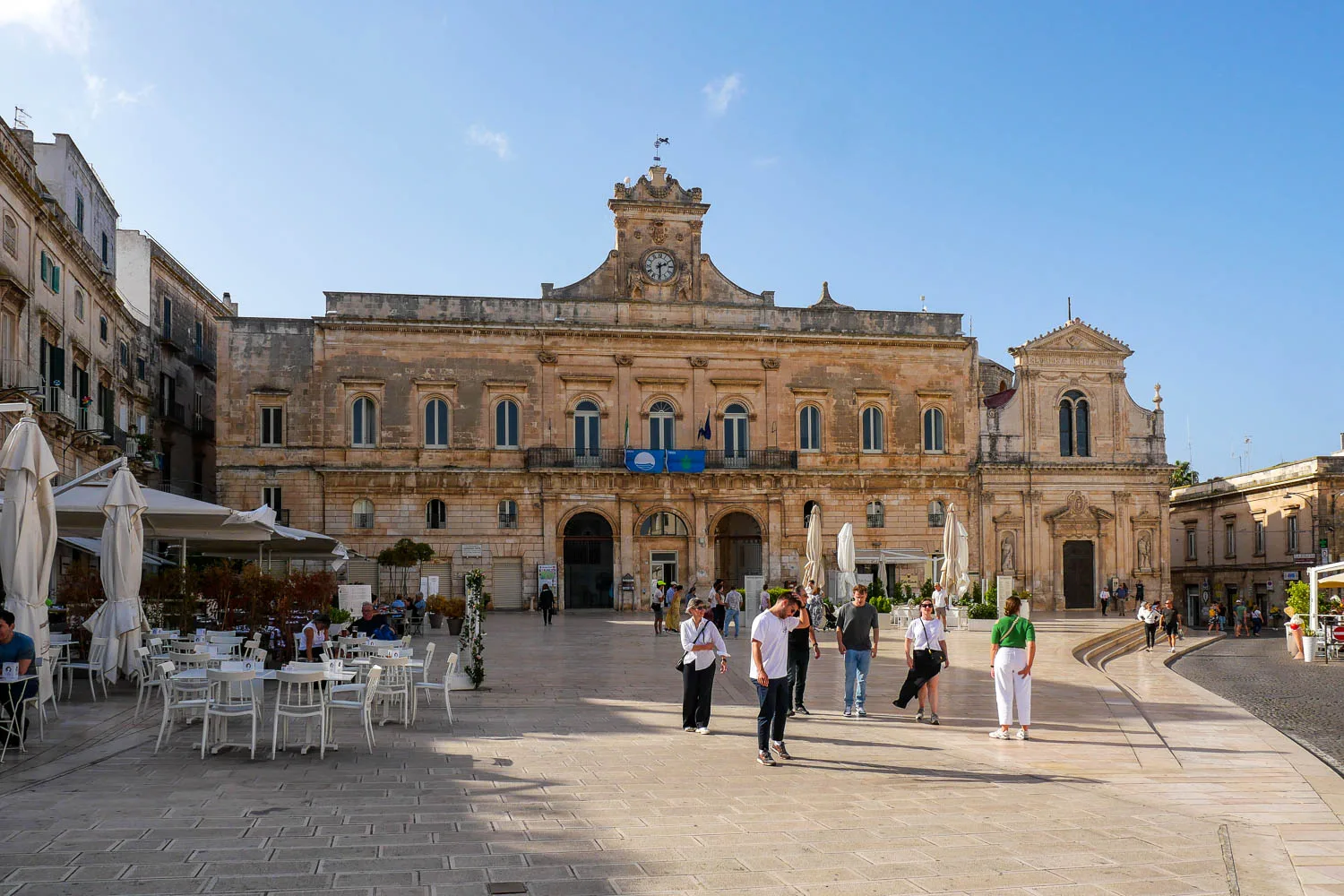
This large square is the gateway to visiting Ostuni. It is located south of the old town, just before entering the ZTL (limited traffic zone). Piazza della Libertà is lined by the Palazzo del Municipio (the town hall), housed in a former monastery, with the chiesa di San Francesco d’Assisi to its right. Built in 1304, this church has been modified several times over the centuries. Its façade dates from the 19th century. It was closed during our stay in Ostuni.
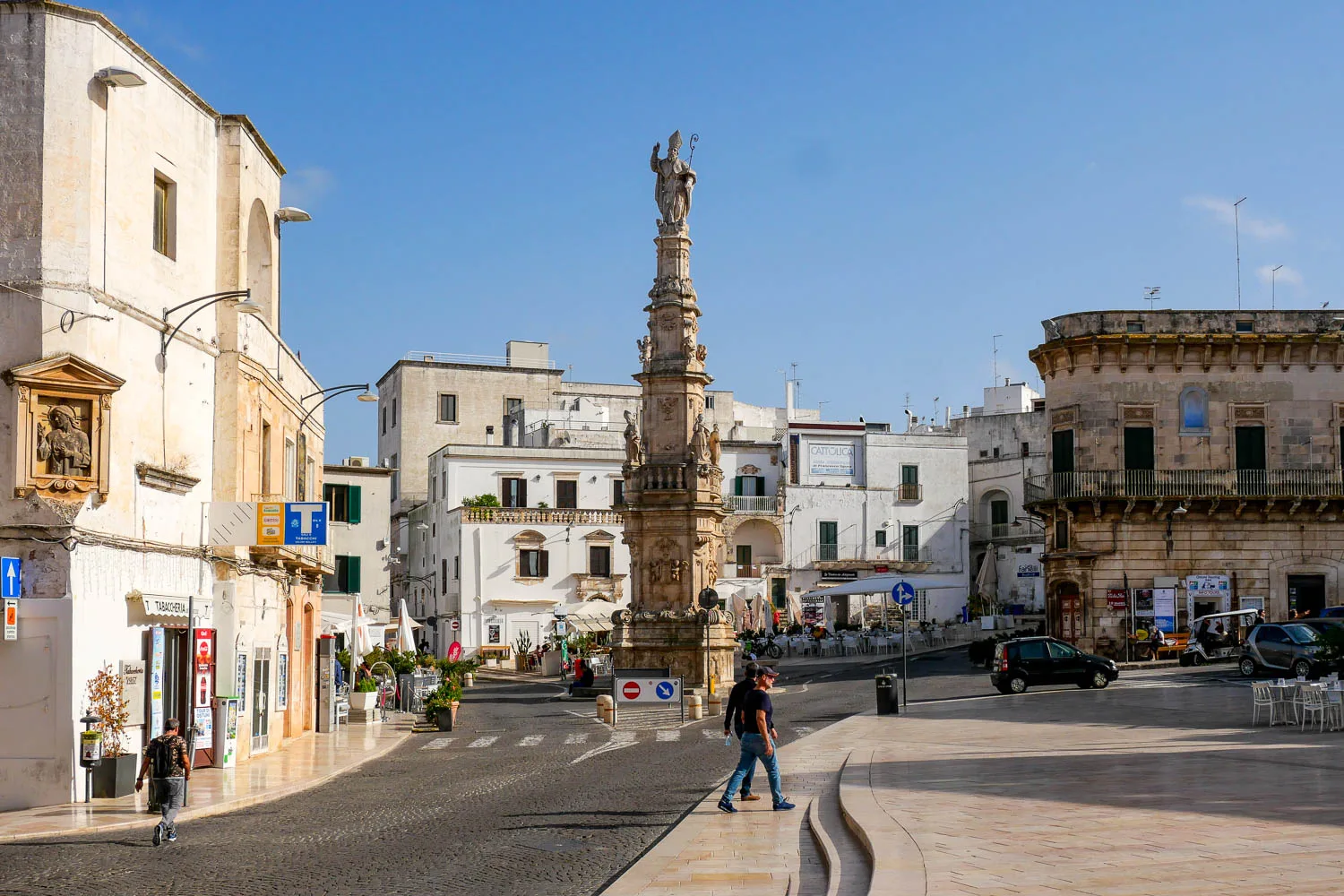
At the center of Piazza della Libertà stands a Neapolitan-style spire from 1771. If you’ve already visited Naples, it will certainly remind you of the one in Piazza Gesù Nuovo. But here, it is the patron saint Oronzo who stands at the top of the spire. From the square, take Via Cattedrale to enter the historic center.
Museo di Civiltà Preclassiche della Murgia
As you go up Via Cattedrale, you reach this prehistory museum housed in the former Carmelite monastery of Santa Maria Maddalena dei Pazzi, with the adjoining church of San Vito Martire. It presents archaeological collections from the civilizations that lived in the Murge, a region of Puglia. The objects come from excavations, notably in the Sant’Angelo cave and the Santa Maria di Agnano archaeological park. One of the museum’s most important pieces is the skeleton of a pregnant woman with a fetus dated to 26,000 BC, found in a funerary cave.
The explanations on the museum panels are only in Italian. If you don’t speak the language, you may be disappointed by the visit—especially if archaeology isn’t your passion.
Price : €5 (€3 for students, schoolchildren, and over 65s. Free for under 6s).
Opening hours : daily from 10 a.m. to 4 p.m.


Arco Scoppa
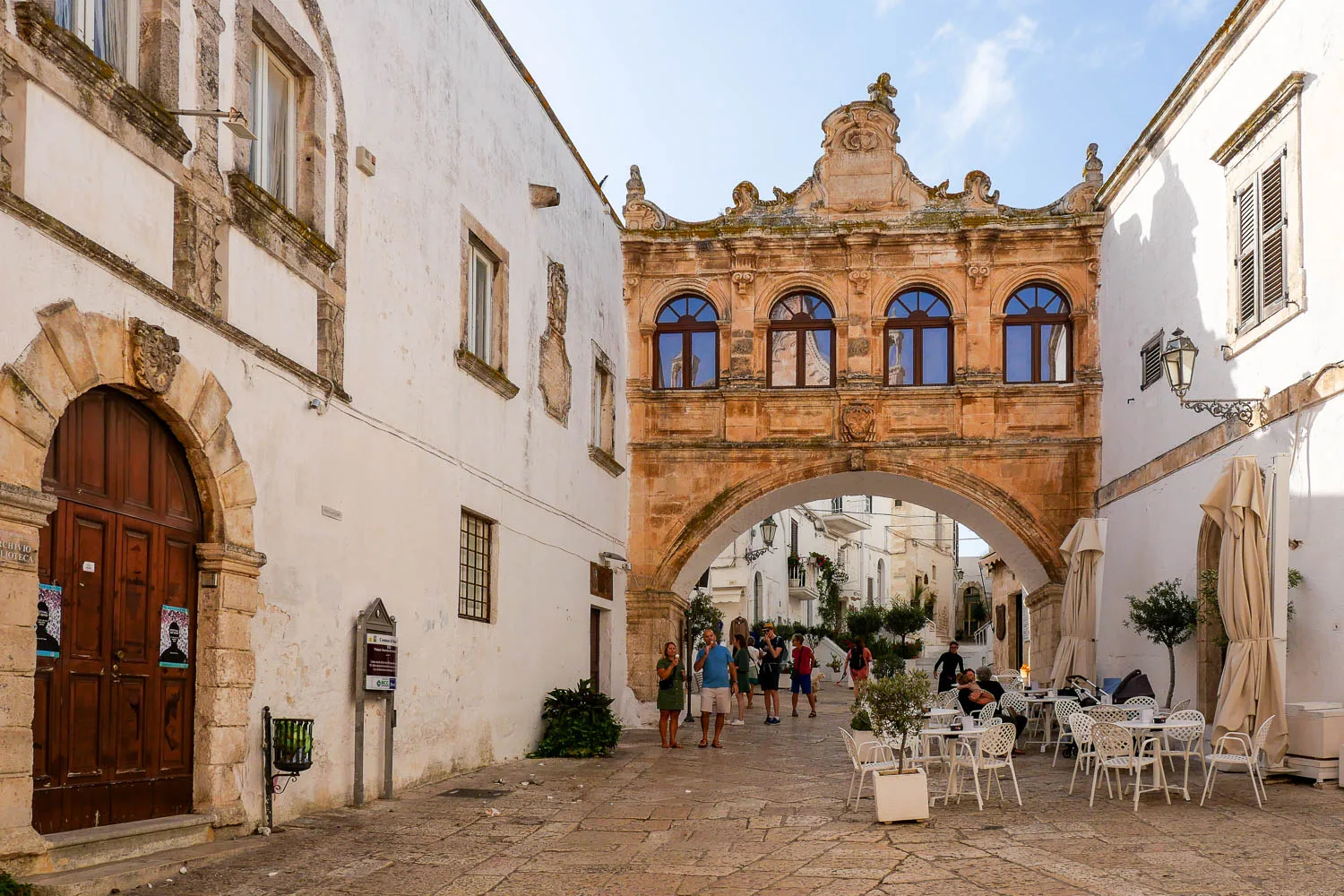
Continuing uphill, you arrive at the cathedral, located at a 90-degree street corner. Directly opposite is the Arco Scoppa, an archway that connects the episcopal palace to the Palazzo del Seminario. It was built after the 1743 earthquake by Bishop Francesco Antonio Scoppa. The original wooden structure was replaced by a stone building in 1750. Its shape is said to be inspired by the Bridge of Sighs in Venice.
The ochre color of the arch contrasts with the white façades of the two palaces. All the buildings in the city were whitewashed in the 17th century to fight the plague, as lime is a natural disinfectant—a practice found in many regions. From the arch, you get a better view of the cathedral façade. This is where we continue our visit of Ostuni.
The ground floor of the episcopal palace, located to the right of the arch, houses the diocesan museum (Museo Diocesano di Ostuni). It presents a collection of artistic treasures from local churches and monasteries. Opening hours are quite limited: it is open from 10 a.m. to 12 p.m. from June 1 to September 30, and from 10 a.m. to 1 p.m. on Wednesdays, Thursdays, and Fridays from October 1 to May 31. Ticket €6.
Cathedral of Santa Maria Assunta
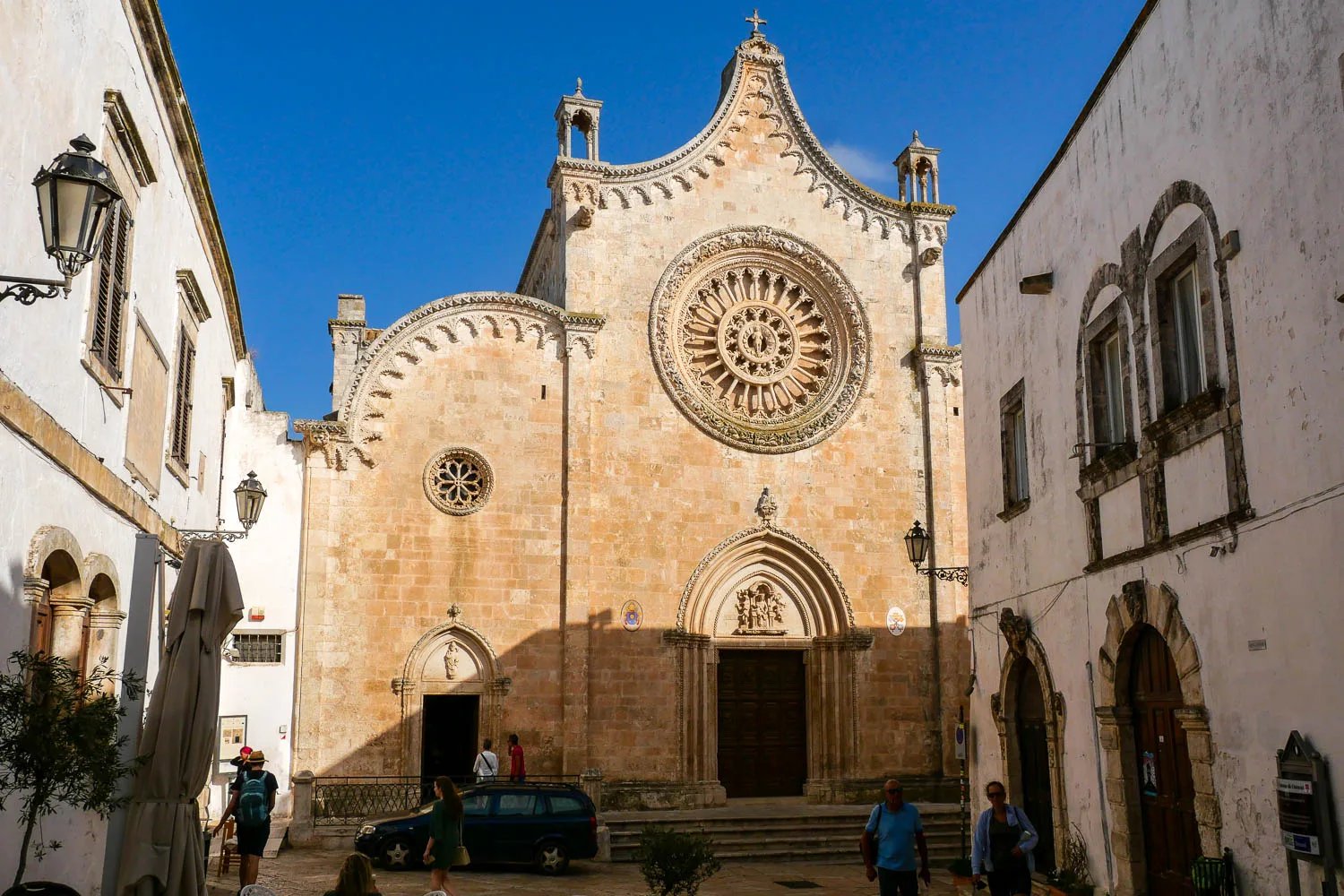
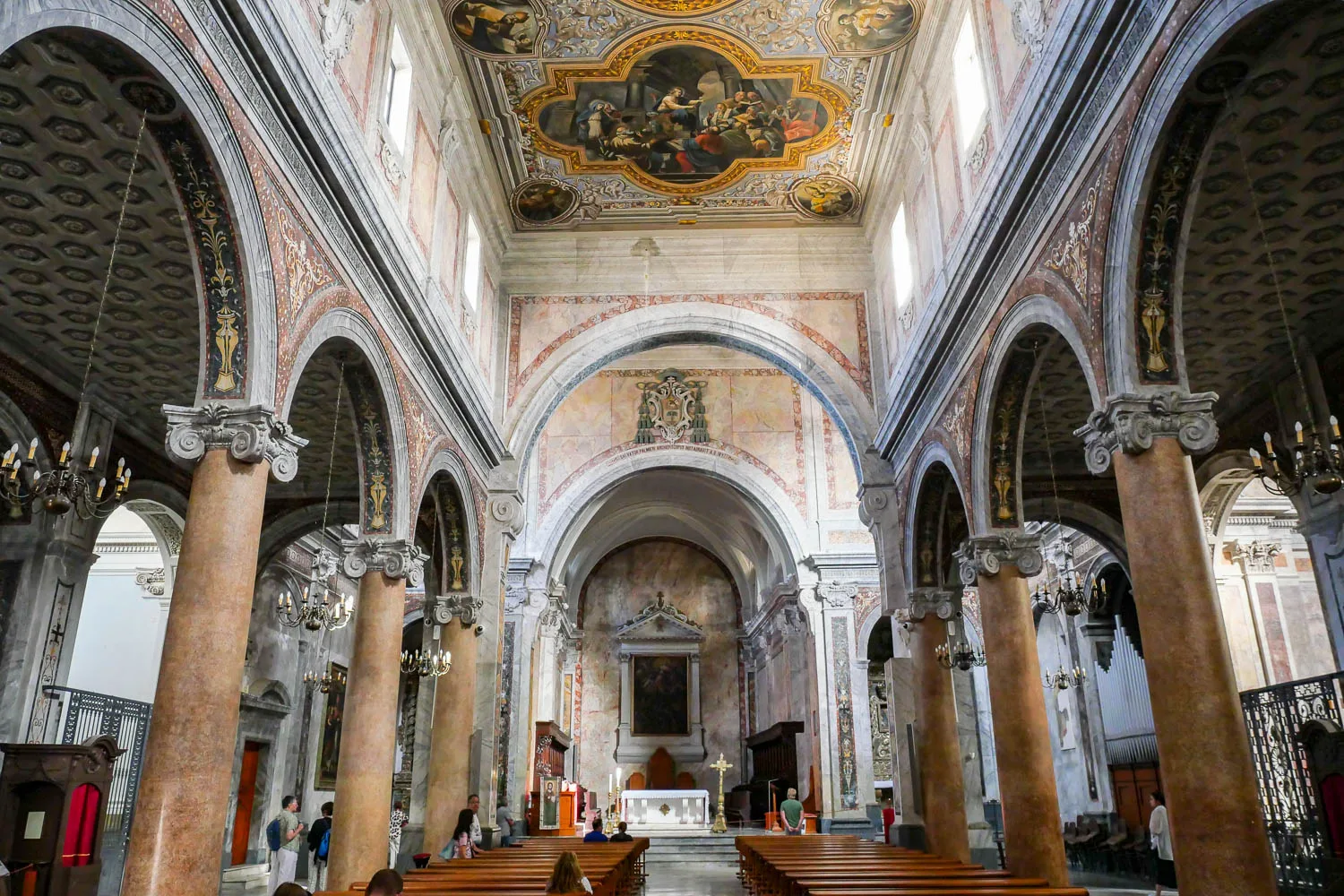
The Duomo of Santa Maria Assunta was built between 1437 and 1495 at the highest point of the hill. Its late Gothic facade, with projecting arches borrowed from 15th-century Venetian architecture, is beautifully crafted. It even served as a reference for contemporary buildings in the Adriatic region (Veneto and Dalmatia in particular). The magnificent carved rose window is the main feature of the façade. It depicts Christ and the twelve Apostles and is considered the most beautiful rose window in Puglia.
The interior underwent many transformations during the Baroque period and houses several works of art. The 18th-century fresco on the ceiling of the central nave depicts episodes from the life of Christ. In one of the side chapels is a Byzantine fresco representing Santa Maria della Sanità, highly venerated by the people of Ostuni.
Ostuni’s ramparts
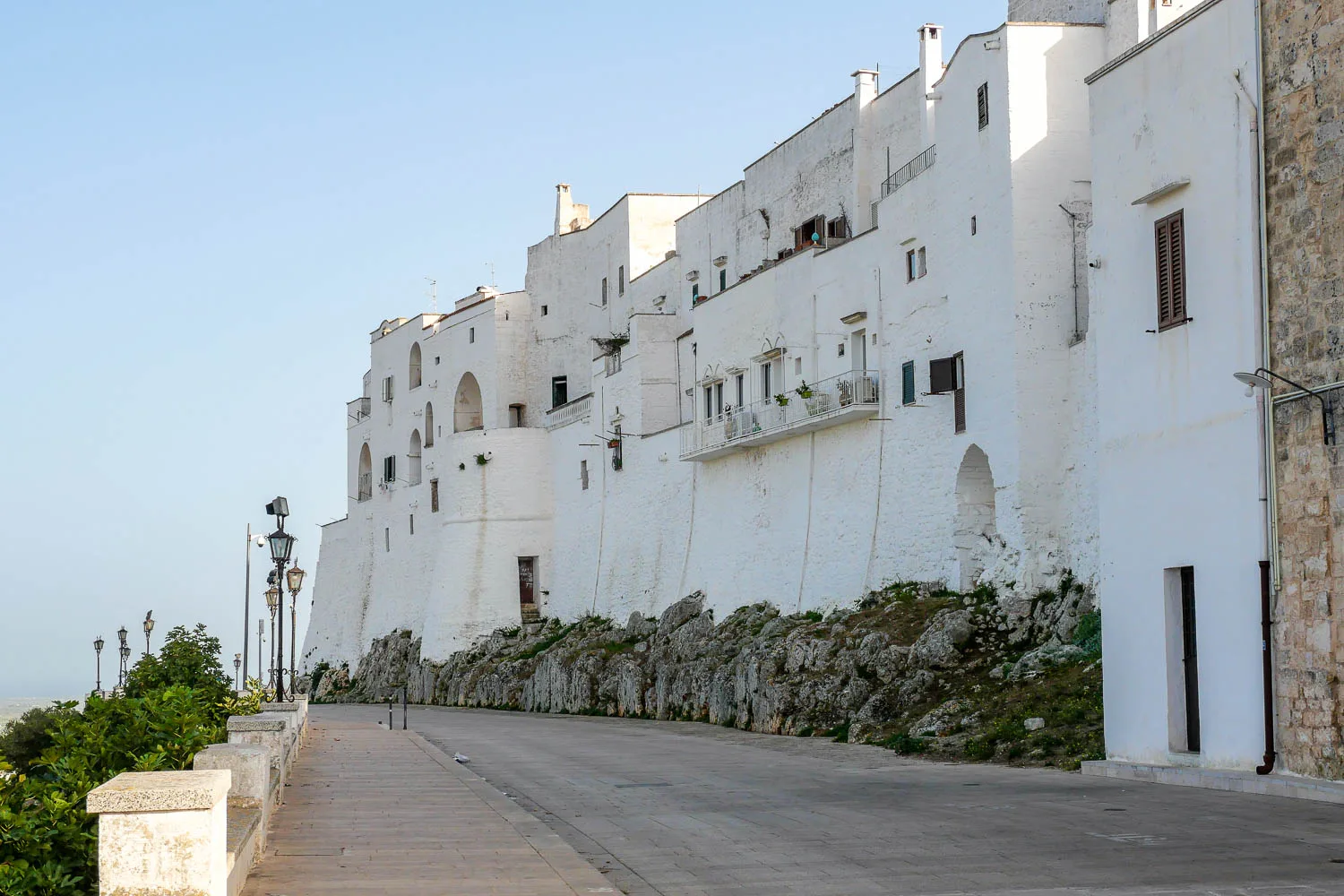
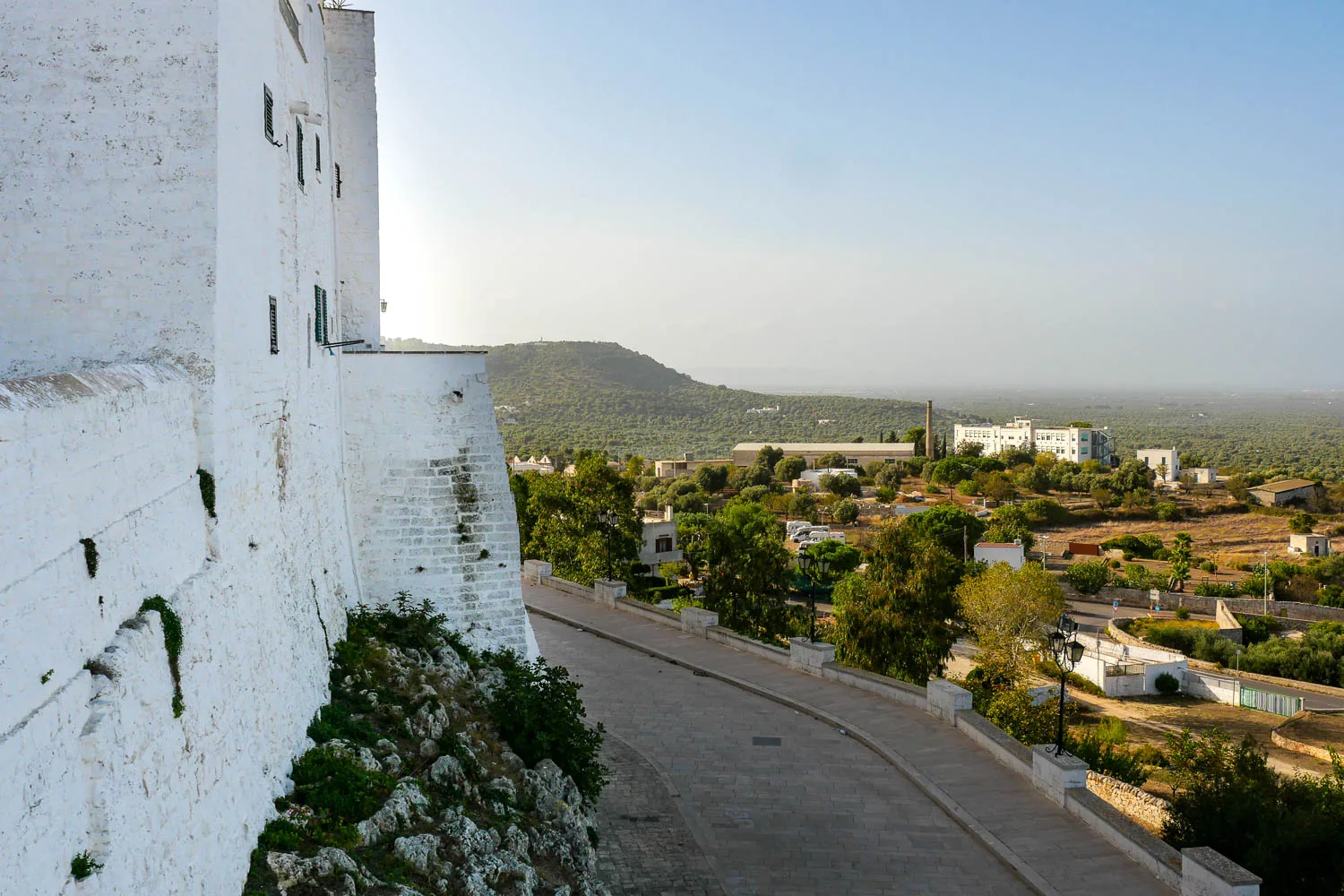
Almost the entire old town of Ostuni is surrounded by ramparts. Only the southern part, overlooking Piazza della Libertà and the modern town, is without them. These walls date back to the Aragonese period (16th century), when the region was under Spanish rule.
At the very north of the historic center, a staircase (map) allows you to descend to the road (Viale Oronzo Quaranta) that runs all the way around the ramparts. From here, you’ll enjoy a beautiful panorama over the entire Itria Valley countryside. It’s also from this road that you get the best view of these imposing walls. At the top of the staircase is the church of Santa Maria della Stella, which was closed during our visit to Ostuni.
Streets of the historic center
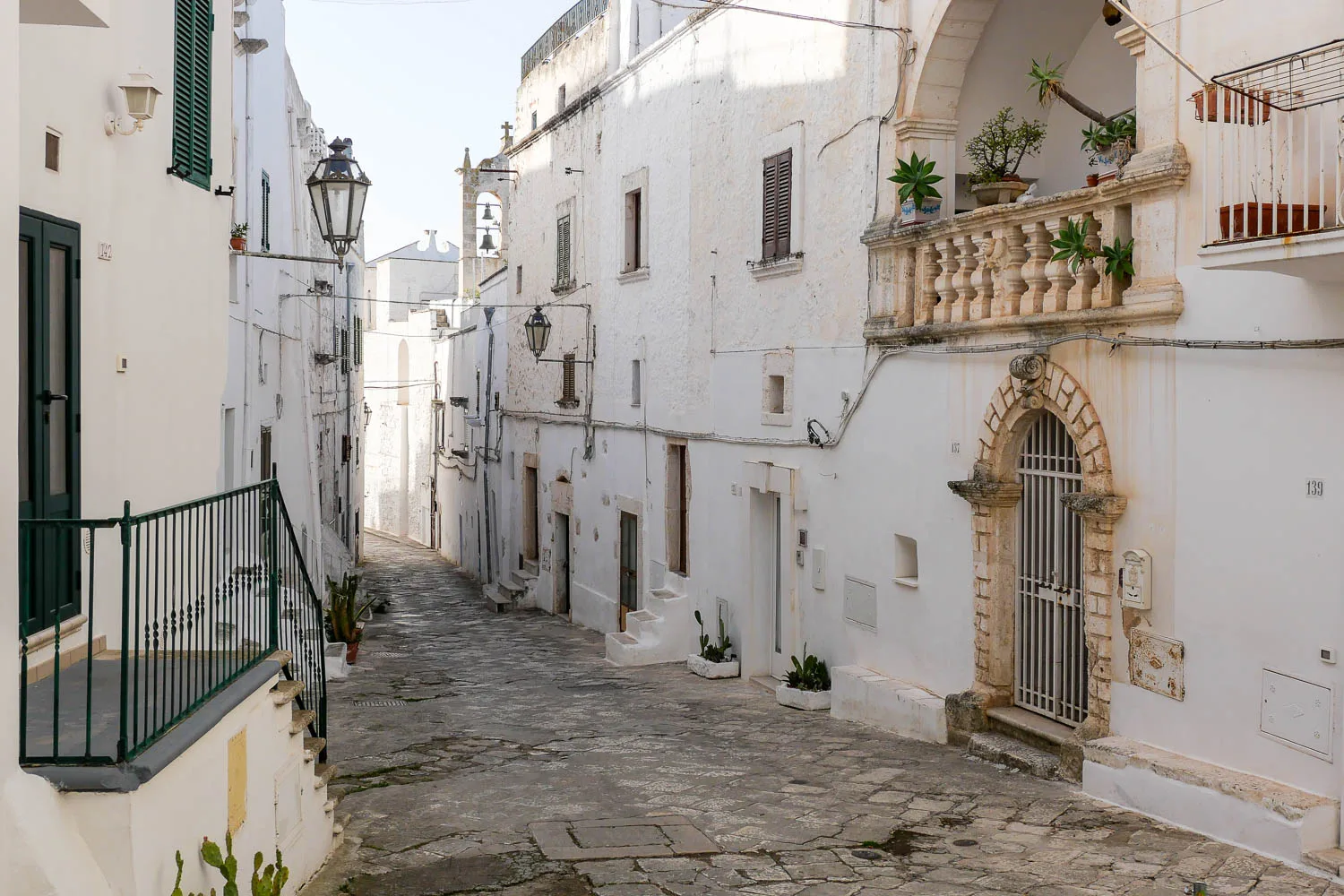
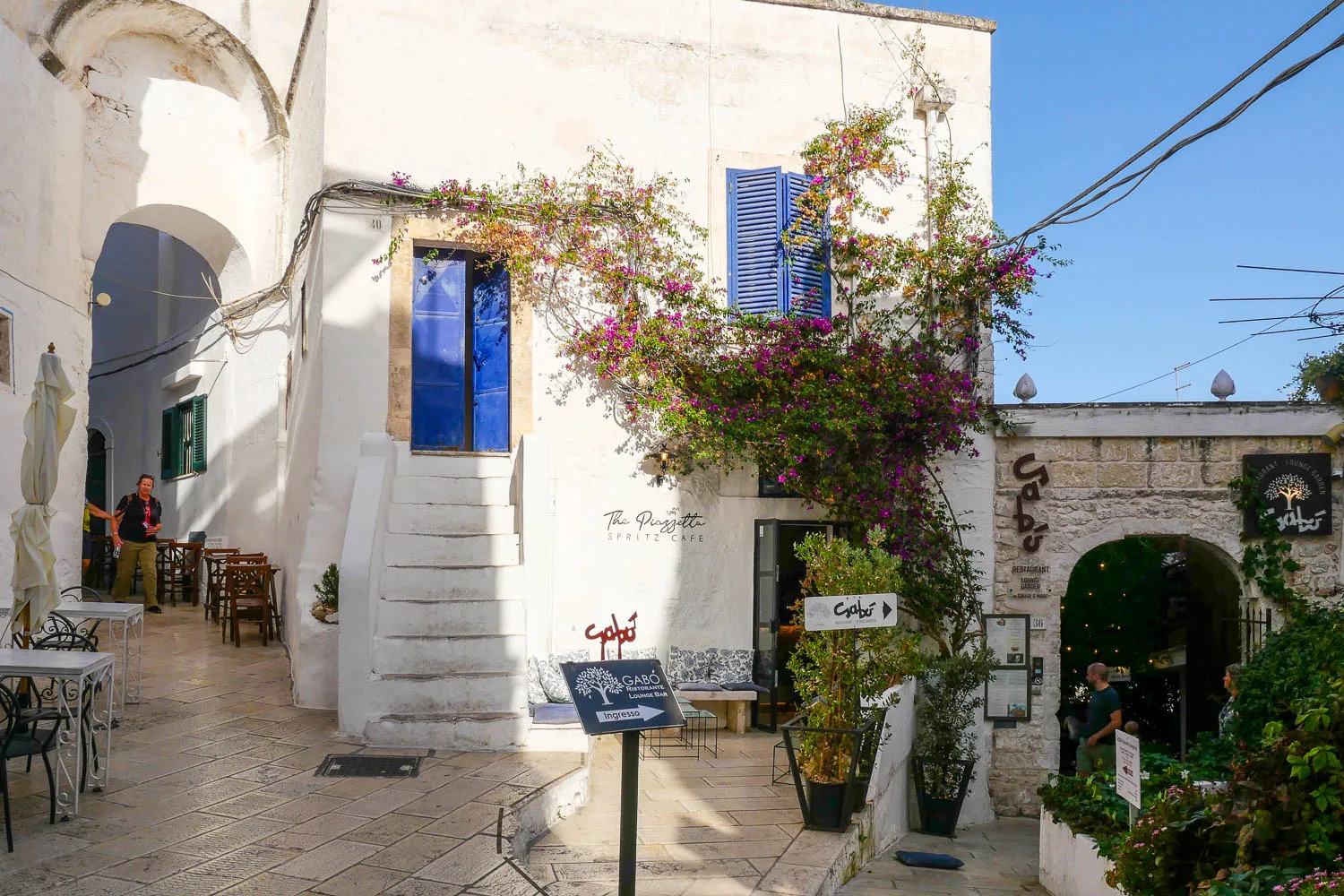
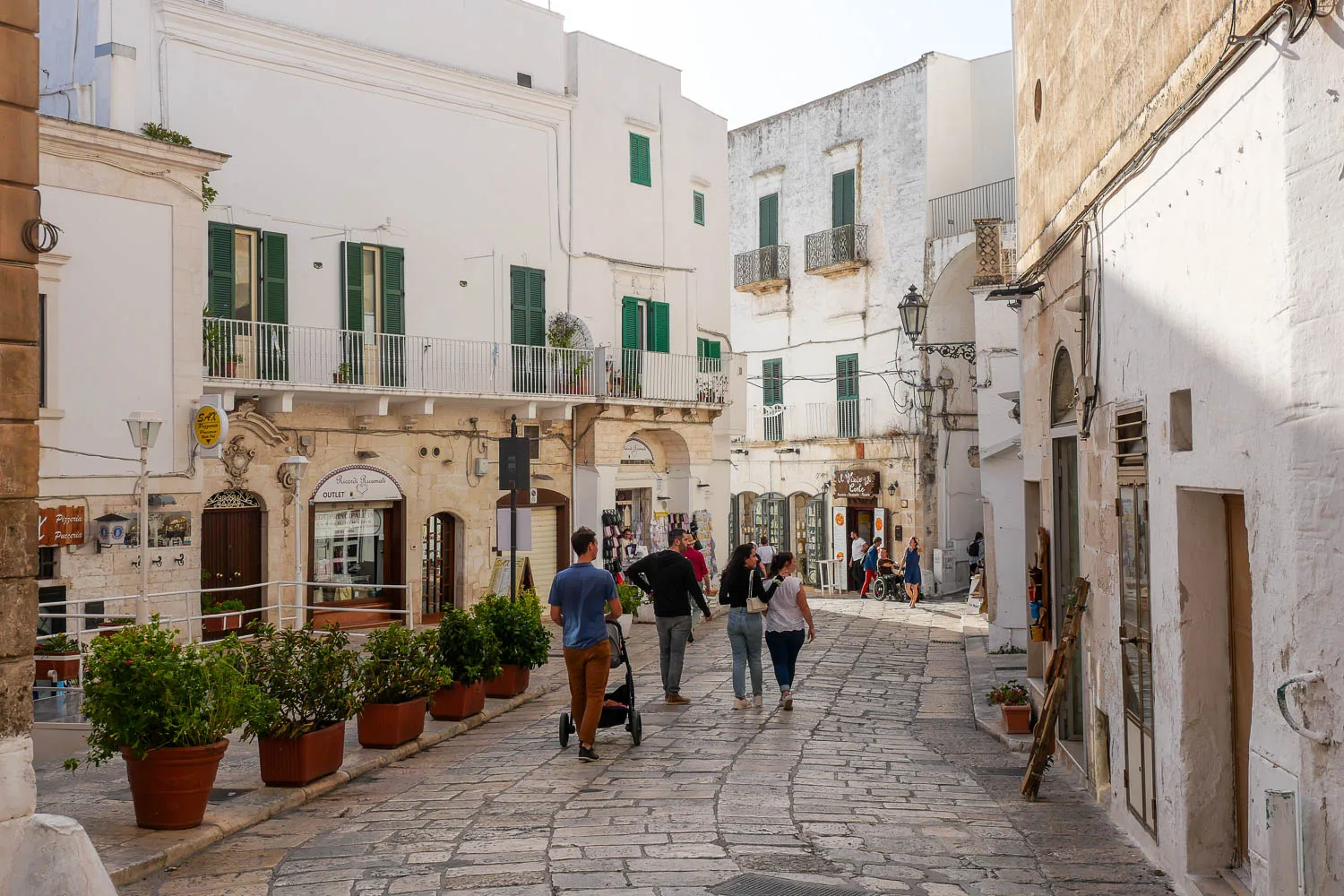
All the charm of the old town lies in its winding alleys, where it’s a pleasure to stroll. It’s an opportunity to discover a beautiful building, a viewpoint over the countryside, or a terrace to stop for a drink. In fact, there aren’t many things to do in Ostuni. You’ll spend most of your time wandering through the streets at random, enjoying the soft late-afternoon light. This is when the historic center fills with tourists coming for an aperitivo.
And don’t worry, even though the center looks like a labyrinth, it’s impossible to get lost. You always end up coming back to the same place, since all the streets form concentric circles. And that’s no coincidence: this layout was designed to disorient invaders.


Chiesa del Carmine
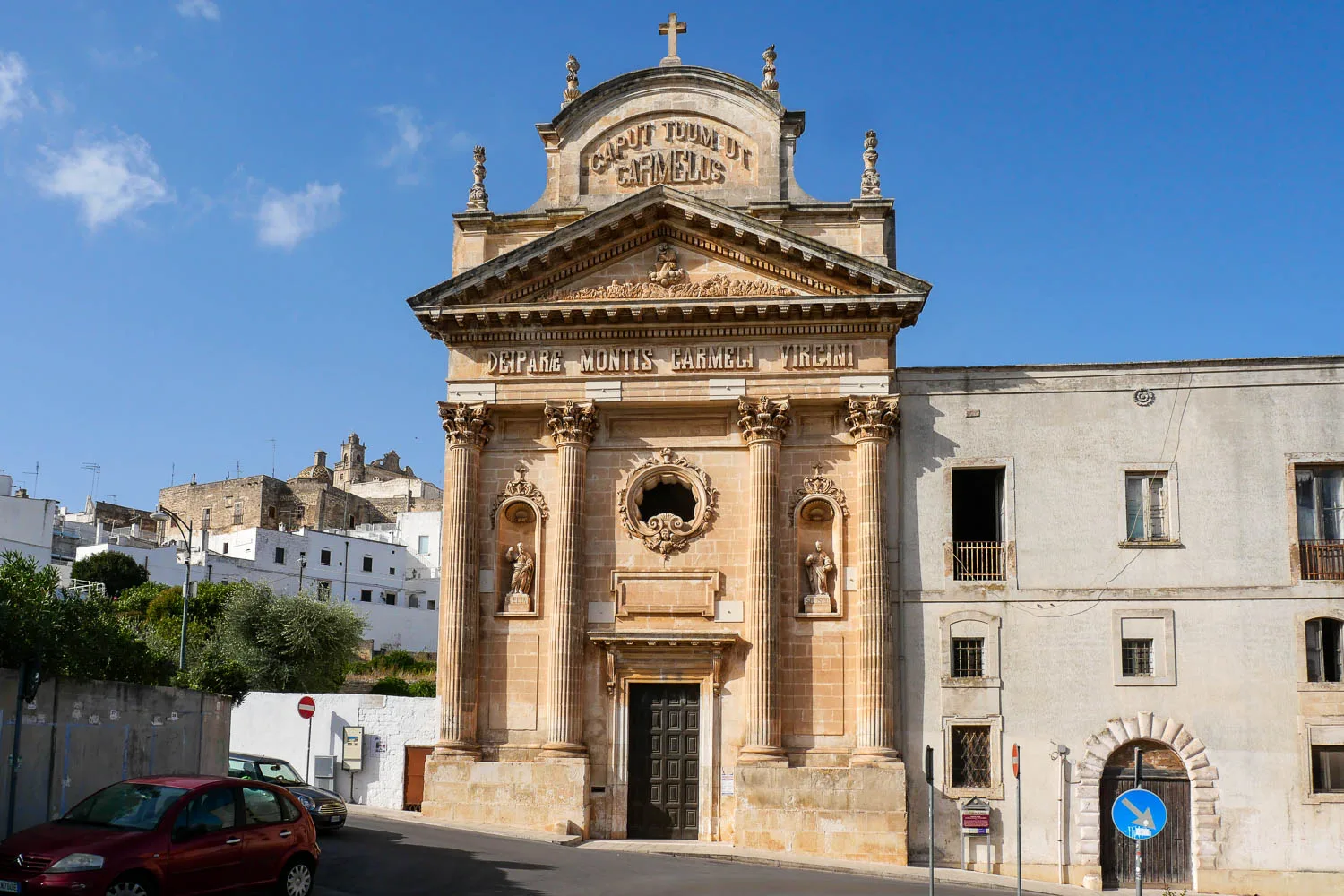
To reach the old town from the parking lot whose address I give later, you’ll pass in front of the chiesa del Carmine. Its golden ochre color stands out against the city’s white façades. There’s little chance it will be open when you pass by, but you can at least admire its 19th-century neoclassical façade. The church dates back to the 15th century and is dedicated to Our Lady of Mercy.
If you can’t go inside, you can view the interior on the church’s official website, where everything is detailed (history, artworks, decoration, statues, etc.). The façade of the Chiesa del Carmine is also clearly visible from the viewpoint I mention below.
The most beautiful viewpoint over Ostuni
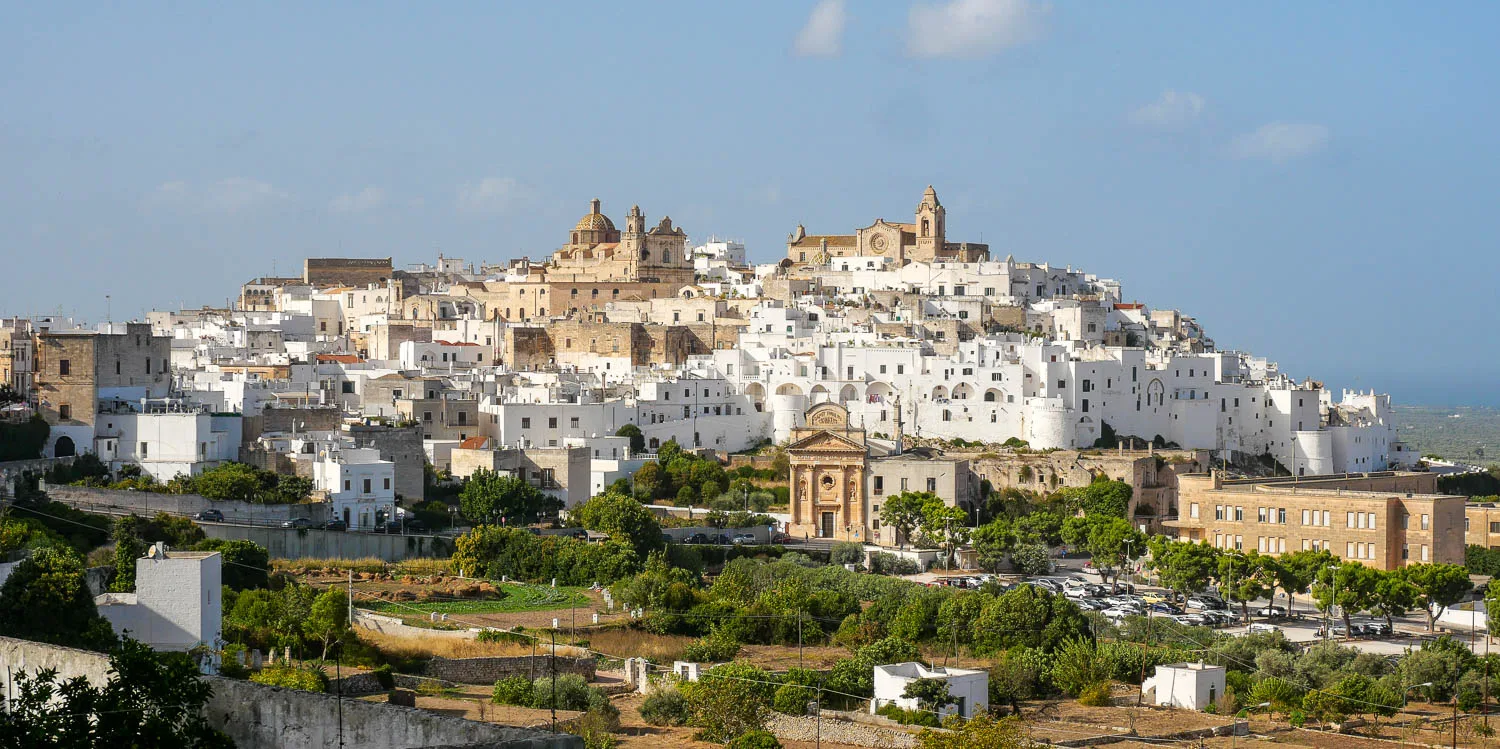
Ostuni’s historic center is very photogenic when seen from a distance. The hilltop village with its white houses offers a postcard-perfect panorama. I spent some time looking for the best photo viewpoint over Ostuni, and I’m going to share this almost secret spot with you 🙂
First, we went to the viewpoint suggested by Lonely Planet at the Auto e Camper Stella parking lot (here). Honestly, it’s not great—you get a too-close, low-angle view with trees and power lines that interfere with photos. Instead, I suggest stepping much farther back. You can reach this viewpoint on foot (600 m), but we went there by car before visiting Ostuni and heading to the parking lot.
The best viewpoint for taking photos of Ostuni is located exactly here. It’s a very small square with benches offering an unobstructed panorama over the countryside and the hill. I recommend saving it in Google Maps, you won’t find a better one !
What to do around Ostuni ?
Cisternino et Locorotondo
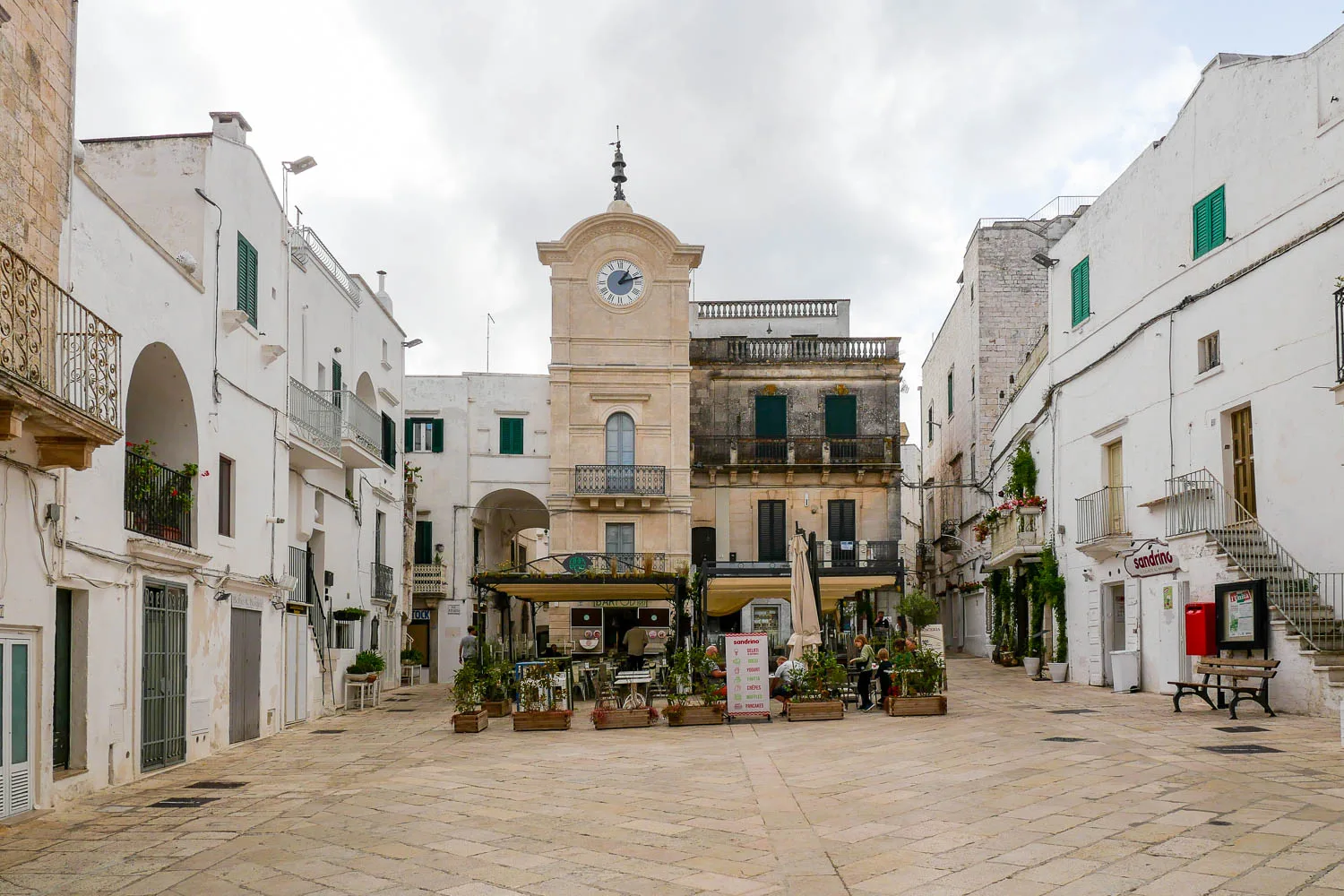
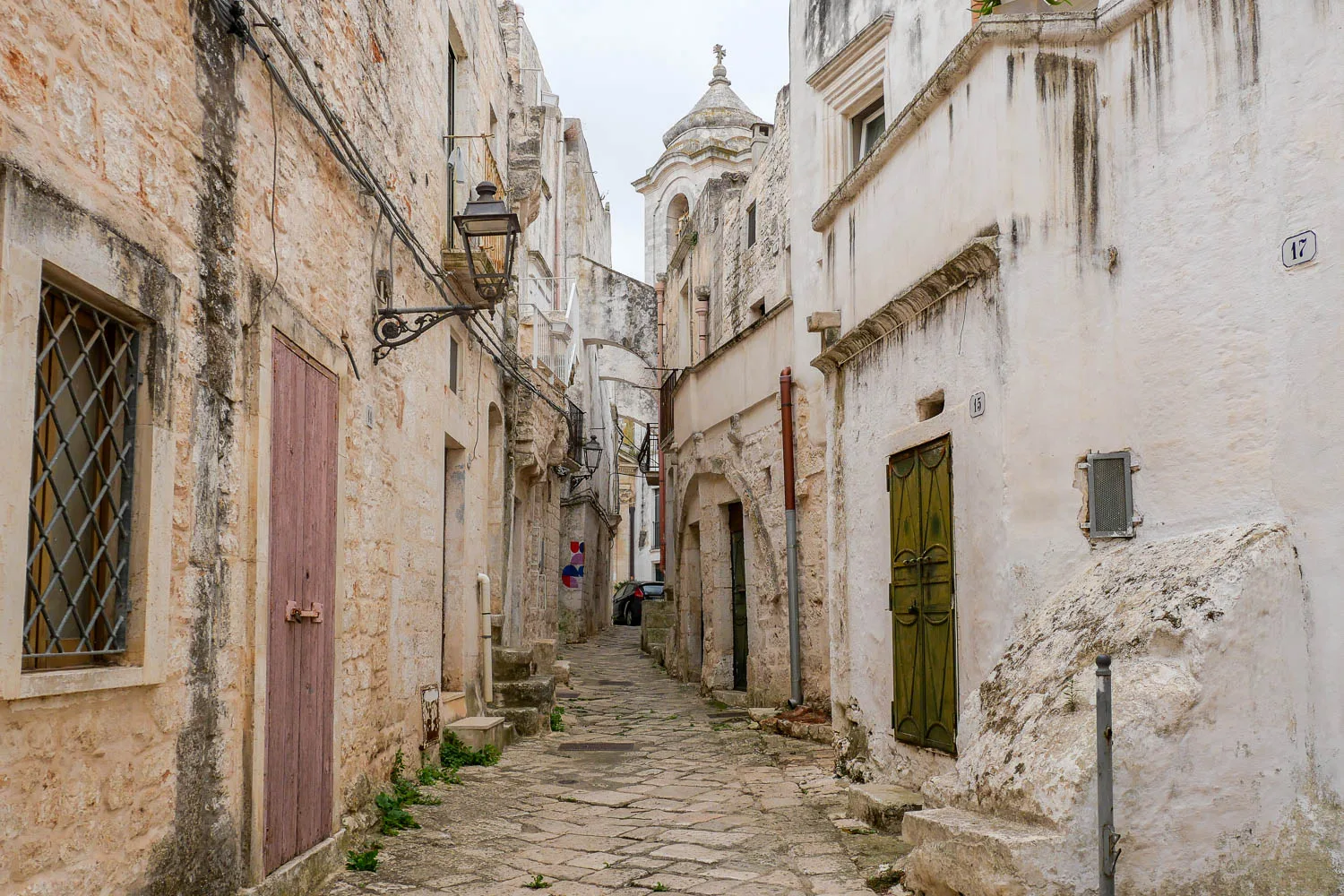
These two villages are located northeast of Ostuni, respectively 14 km and 26 km away. You can easily include them in a day exploring the Itria Valley. Smaller and less well-known, these two towns are nonetheless full of interest. They have also received the label of Italy’s Most Beautiful Villages (borghi più belli d’Italia).
Cisternino, reached in 20 minutes by car, has a pleasant historic center. And the advantage compared to Ostuni is that there are virtually no tourists (at least during our stay in October). There are no major monuments that would specifically draw you there, but if you like authentic villages slightly off the beaten tourist track, I recommend stopping by.
Locorotondo closely resembles Ostuni. You find the same layout: a hilltop village with white-faced houses. All around, the countryside stretches out with vineyards and olive groves as far as the eye can see. Strolling through the historic center is charming—don’t miss the Church of San Giorgio Martire with its beautiful dome.
Alberobello
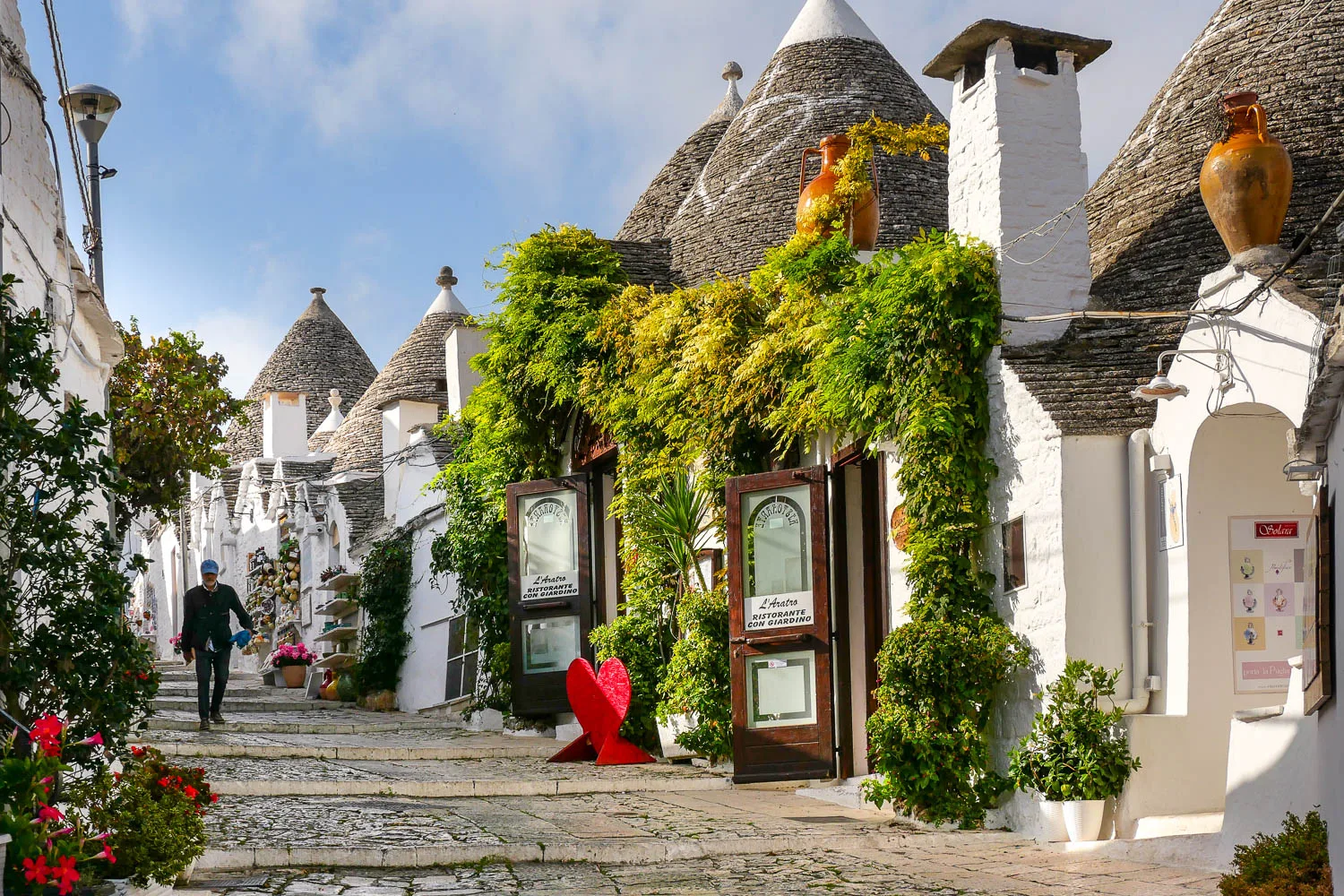
There’s no need to introduce Alberobello, the most famous village in Puglia. Thanks to its trulli—typical dwellings of the Itria Valley listed as a UNESCO World Heritage Site—it has become one of the most touristy places in the region. Even if it sometimes feels more like a theme park than an authentic historic center (most trulli have been converted into shops and accommodations), you shouldn’t miss this visit.
I’ve written a complete and detailed article on all the things to do there. For more information and tips, I suggest reading my post on what to do in Alberobello.
Torre Guaceto Nature Reserve
We didn’t visit the Torre Guaceto Nature Reserve due to the weather (and lack of time), but this destination was recommended by our Lonely Planet Puglia guidebook. It’s very well done and comprehensive, and I suggest it for organizing your stay.
The Torre Guaceto Nature Reserve is located 22 km south of Ostuni on the Adriatic coast. It’s very popular in summer, as it features sandy beaches and coves, some of which are only accessible by hiking. The 6-km-long reserve is a playground for hikers and cyclists. However, it’s best to avoid summer if you want to hike, as the sun is intense and there’s little shade. As for the sea, aside from swimming, the most famous beach is spiaggia di Torre Guaceto, where you can snorkel and dive. The reserve takes its name from the Torre Guaceto, an imposing 16th-century structure that can be reached via a 3-km trail.
Electric bike tour
Looking to discover the beautiful landscapes of the Itria Valley while leaving your car behind ? I recommend this lovely electric bike tour that requires almost no effort. Accompanied by a guide, you’ll ride through the countryside to discover local life and culture (a glass of wine and bruschetta included). The program includes a visit to a farm to learn more about olive cultivation, with a tasting of local products. You’ll then ride through the streets of the old town, retracing the most important events that shaped the life of the “White City.” Cancellation is free up to 24 hours before the activity.
Where to stay in Ostuni ?
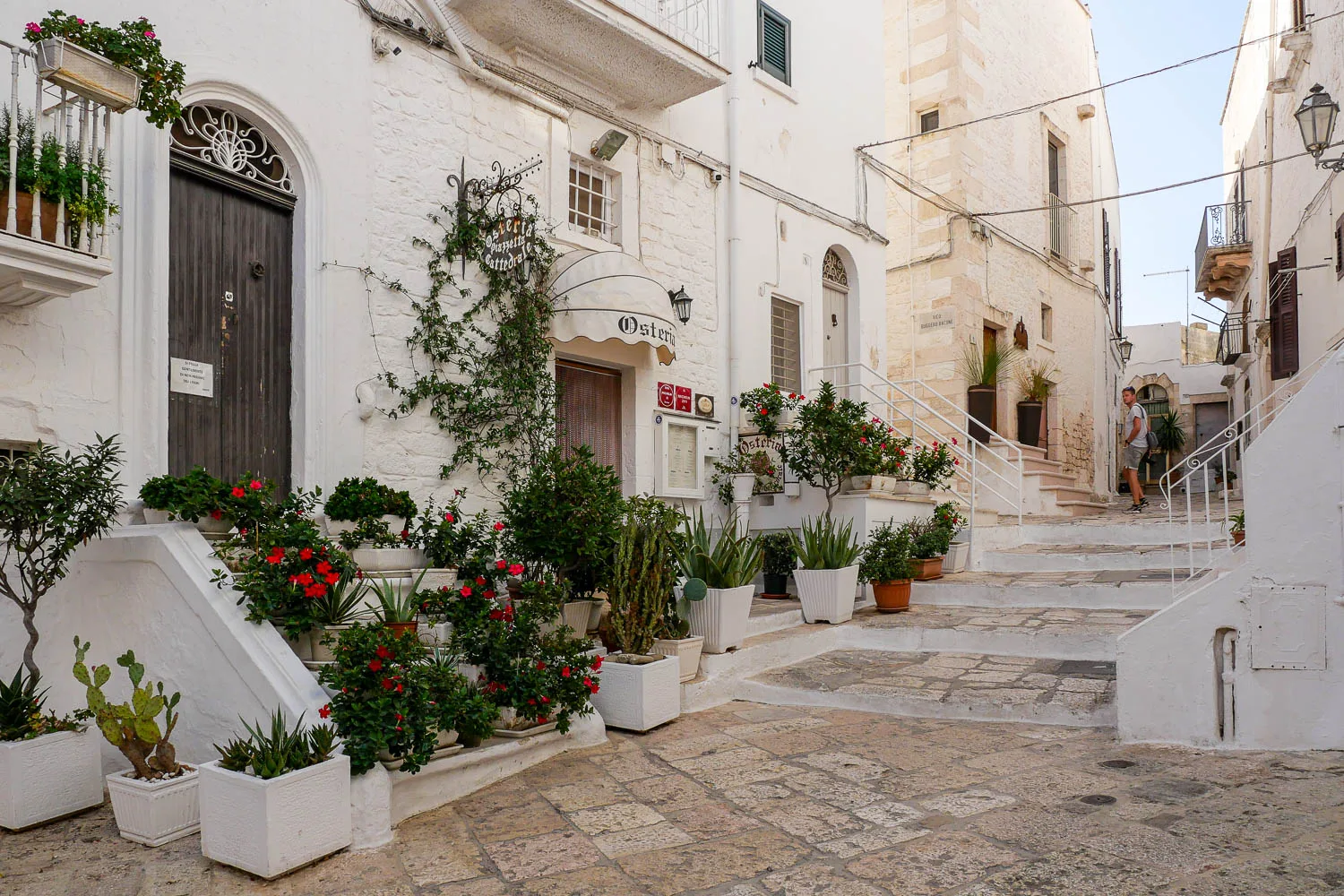
Ostuni is a good base for visiting the Itria Valley and, more broadly, the entire region between Bari and Brindisi. The advantage is that the town is lively in the evening, offers many restaurants, and is not far from the Adriatic coast beaches. If you plan to travel frequently by car, I recommend staying outside the historic center—it’s more practical (and cheaper as well).
Below, I’ve selected accommodations where to stay in Ostuni with good value for money. Prices vary depending on the season, peaking in July and August. If you’re visiting during this period, I recommend booking well in advance.
- 52 € : CASA FLAMI’ 3, one of the cheapest accommodations in Ostuni with very good reviews. This 20 m² apartment with kitchenette is located in the city center, in a quiet area just steps from the old town.
- 53 € : Liberty Bell, a great deal in Ostuni, as the listed price is for 4 people, ideal for families or couples of friends. The stone interior with vaulted ceilings is charming. Just a few minutes’ walk from the historic center.
- 74 € : B&B Giovannarolla Green House, this countryside bed and breakfast is located 8 km from Ostuni. It has a terrace, garden, swimming pool, and is surrounded by olive groves for complete peace and quiet. Breakfast and private parking included.
- 74 € : Relais Trulli Le Icone, combine a trullo stay with the charm of a bed and breakfast at this countryside address. Swimming pool, breakfast, and private parking included. Well located for visiting the Itria Valley from a single base.
- 77 € : Casetta Mare, this apartment with terrace, located in Villanova di Ostuni (7 km from the old town), is ideal for those who want to be close to the beach. It features a private kitchen and sea views.
- 89 € : Radici Ostuni, beautiful apartment for rent with stone vaulted ceilings in the heart of the historic center. Option to choose an apartment with sea views. Everything inside is stunning. Breakfast is also included.
Travel guide and tips for visiting Ostuni
How to get to Ostuni ?
Ostuni is located in the Itria Valley, in the heart of Puglia. The town is easily accessible from surrounding villages. The best option is to go by car, but it’s also possible to take a bus from Brindisi (2-hour journey). If you haven’t rented a vehicle yet, I recommend using this comparison site to find the best car rental deal. It’s the site I use every time I need a car, and it guarantees the lowest prices.
Where to park in Ostuni ?
The historic center of Ostuni is a ZTL (limited traffic zone) where cars are not allowed outside authorized hours. In Ostuni, the ZTL is active Monday to Friday from 10 a.m. to 2 p.m. and from 5 p.m. to 7 a.m.; on Saturdays from 10 a.m. to midnight. In any case, I advise against entering the ZTL by car—the streets are very narrow. The road that runs along the ramparts is also off-limits to tourists. The best option is to park in one of the parking lots on the outskirts of town.
We used this parking lot to park in Ostuni. It’s the closest to the historic center. It’s paid year-round, but hours and rates vary by season. Between June 15 and September 15, the parking lot is paid from 9 a.m. to 2 a.m. The rate is €1.20 per hour from 9 a.m. to 9 p.m. and €2.50 per hour from 9 p.m. to 2 a.m. From September 16 to June 14, the parking lot is paid from 8 a.m. to 1 p.m. and from 3 p.m. to 10 p.m. at a rate of €1.20 per hour. Payment is made at parking meters with a ticket placed in the car, which means you need to estimate how long you plan to spend visiting Ostuni.
How much time to spend in Ostuni ?
It doesn’t take much time, as there are few monuments to see or museums to visit in Ostuni. It’s more of a city where you enjoy strolling and taking your time—getting lost in the streets, enjoying the views, eating a Puglian specialty, or having a drink. That’s what gives the historic center its charm. This is also why many tourists come to Ostuni in the evening, to enjoy its many bars and restaurants.
To cover the must-see sights of the city presented in this guide, plan between 2 hours and half a day to visit Ostuni. That will give you plenty of time to see everything.
You know now the best things to do in Ostuni. If you have any questions about organizing your stay, feel free to ask them in the blog comments.