

Are you going on vacation to Italy and looking for the best things to do in Turin ? The capital of Piedmont and the fourth-largest city in Italy does not enjoy a great reputation among tourists. People often wonder whether it’s worth going to Turin during a trip to Northern Italy. So I’ll answer that question right away. In my opinion, you shouldn’t miss this essential stop, if only for its Egyptian Museum and its historic cafés.
What to do in Turin in 1 day or during a weekend ? Which monuments should you not miss ? Where can you eat Piedmontese specialties ? I answer all your questions in this travel guide following our 2-day stay there in September.
What to do in Turin : the must-see attractions
When I planned this trip to Turin, I browsed many guidebooks and websites to find the best things to do. I removed monuments that didn’t seem essential or that felt redundant with others. I therefore consider this list to be the minimum you should see when visiting Turin. Most of the sites are located in the Centro and Quadrilatero districts, which make up Turin’s city center. It took us 2 days to visit all these monuments (while also spending time in the historic cafés). They are shown on the map below.
Torino + Piemonte Card
This card, valid for 1 day, 2 days, 3 days or 5 days, allows free entry to the most important museums and exhibitions in Turin, as well as the Royal Residences, castles, and fortresses of Piedmont. It also offers discounts on tourist tickets such as the panoramic elevator of the Mole Antonelliana (National Cinema Museum) and on public transport passes.
The price of the Torino + Piemonte Card depends on the number of days : €29 for 24 hours, €39 for 48 hours, €45 for 72 hours and €50 for 5 days.
If you follow this guide to visit Turin in 2 days with all the monuments presented, I recommend buying the Torino + Piemonte Card in the 2-day version (or 3 days if you want to take your time). It will easily pay for itself because if you add up all the museum entrance fees, the total comes to €84.
Guided tours of Turin
For lovers of history, anecdotes and heritage, nothing beats the explanations of a local guide. Several themed guided tours are available, including :
- Hop-on hop-off bus tour : the famous red bus allows you to discover the city thanks to its many stops. Tickets are valid for 24 or 48 hours on 1 or 3 routes.
- Free walking tour in Turin : this free tour covering the main highlights is led by an English-speaking guide.
- Torino Magica Guided Tour : Immerse yourself in the magical and mysterious side of Turin with this original guided tour.
- Gourmet Food tour : taste local dishes in 5 different restaurants and discover the culinary history of the city.
- Underground Tunnels Guided Tour : discover underground tunnels dating from the 18th century and mysterious World War II air-raid shelters.
Cattedrale di San Giovanni Battista
The Cathedral of Saint John the Baptist in Turin is the city’s main church. It is located on the square of the same name in the Quadrilatero Romano, the oldest district of the city. It was built at the end of the 15th century on the site of a theater from the ancient Roman city. Its white marble façade is one of only two remaining examples of Renaissance art in Turin. The interior, divided into three naves, is quite austere compared with most Italian cathedrals (I loved the one in Siena, for example).
The Duomo houses the Chapel of the Holy Shroud where the Shroud of Turin is kept. According to legend (since nothing has ever been proven), it is the burial cloth that wrapped Jesus after his crucifixion. You cannot see the Holy Shroud itself, as it is locked in a silver case behind glass. A photograph provides a glimpse of the face of Christ.
Opening hours : 10 am–12:30 pm and 4 pm–7 pm.


Porta Palatina
This gate located next to the cathedral was one of the four gates of the Roman city. It dates from the 1st century for its oldest section, while the crenellated tower dates from the medieval period (1404). Its structure, made entirely of red bricks, features four arches: two for chariots and two for pedestrians. They are surrounded by two polygonal towers (only the one on the right is of Roman origin). You cannot climb the Palatine Gate, so the visit is quite quick.

Palazzo Reale
When leaving the Duomo you arrive directly in the courtyard of the Royal Palace of Turin, which is listed as a UNESCO World Heritage Site. In 1562 the capital of the States of Savoy moved from Chambéry to Turin and a new palace was built to house the royal family. The Palazzo Reale is part of the Musei Reali complex. We were lucky that our visit coincided with the first Sunday of the month, when entry is free (saving €30, which we reinvested in the historic cafés 😀).
The visit begins with the apartments (reached via a beautiful grand staircase), where you move through rooms full of gilding and painted ceilings. The throne room (photo 4) is one of the most beautiful. In the dining room (photo 3), a royal table is set with porcelain produced by the Royal Porcelain Manufactory of Berlin. You then pass through the Armoria Reale (photo 5), where around 28,000 objects are stored. The tour continues with the Chapel of the Holy Shroud (cappella della Sindone) in Baroque style, which is connected to the Duomo. The Galleria Sabauda houses paintings by great masters, and in the basement the Museo di Antichità displays Roman artifacts discovered during excavations on the site.
You exit at the back of the palace into the gardens designed by Le Nôtre. The Palazzo Reale is one of the must-see attractions in Turin. It is more impressive than the one we saw in Naples.
Price : €15 per person (€2 for ages 18–24 and free for under 18s). You can book a skip-the-line ticket with a time slot on the official website. Free with the Torino + Piemonte Card.
Opening hours : 9 am–7 pm. Closed on Monday.


Piazza Castello
The second-largest square in the city, Piazza Castello is also the heart of Turin. It is surrounded by the Royal Palace, the Real Chiesa San Lorenzo, and Palazzo Madama. Piazza Castello was designed in 1584. To the south it opens onto Via Roma, a beautiful arcaded shopping street that has been pedestrianized. On the eastern side of the square you will find two historic cafés (see below), Baratti & Milano and Caffè Mulassano.

Real Chiesa San Lorenzo
The construction of this church was decided after the Duke of Savoy Emmanuel Philibert I and his cousin Philip II of Spain won the Battle of Saint-Quentin in France on August 10, 1557, the day of Saint Lawrence (San Lorenzo). The church was built a century later between 1668 and 1687. It is characterized by the absence of a façade, but that should not discourage you from going inside because the interior is magnificent. The superb dome is one of the finest examples of Italian Baroque.


Palazzo Madama
Opposite the Church of Saint Lawrence stands Palazzo Madama, a surprising building that features two different architectural styles. On one side there is a Baroque façade (1721), and on the other a 15th-century red-brick castle with two towers. It was built on the site of an ancient Roman gate from the 1st century. The regents Christine of France and later Marie-Jeanne-Baptiste lived in this palace, which is why it is called Palazzo Madama.
The palace houses the Museo Civico d’Arte Antica, which displays collections of Gothic and Renaissance art as well as temporary exhibitions. We did not visit it, but you can find all the information on the official website (ticket €10, free with the Torino + Piemonte Card).


Galleria Subalpina
This magnificent shopping gallery is located between Piazza Castello and Piazza Carlo Alberto (the entrance is under the arcades at the corner of Via Po). It was inaugurated in 1874 and combines Baroque and Renaissance styles. Inside you will find one of the entrances to the famous Caffè-Pasticceria Baratti & Milano.

Museo del Risorgimento
When leaving the Galleria Subalpina you arrive at Piazza Carlo Alberto, one of the historic squares to visit in Turin. It is surrounded by the university library (in the Palace of the Academy of Sciences built in 1679) and Palazzo Carignano, which houses the museum of Italian reunification (Risorgimento). It retraces the entire history that led to the creation of the Kingdom of Italy in 1861, of which Turin was the capital for four years (before it was moved to Florence and then Rome).
Price : €10 (€8 for people over 65, free for children under 6, family ticket €18). Free with the Torino + Piemonte Card.
Hours : 10 am–6 pm. Closed on Monday.

Piazza Carignano
Just behind Piazza Carlo Alberto is Piazza Carignano, one of the most beautiful squares in Turin. It is bordered by Palazzo Carignano with its red-brick façade (which houses the Risorgimento Museum) and by the theater opposite it. Right next door, Ristorante Del Cambio was one of the favorites of Camillo Cavour, a statesman who contributed to Italian unification alongside Giuseppe Garibaldi and Victor Emmanuel II. The restaurant is very elegant, but you can at least take a look at the historic décor.

Chiesa San Filippo Neri
This church located one block south of Piazza Carignano is not really a must-see when visiting Turin. But since it is right next to the entrance of the Egyptian Museum, you might as well take a look. Chiesa San Filippo Neri is the largest church in Turin, measuring 69 meters in height. Construction began in 1675 but it took two centuries to complete the work. The large Baroque nave features six chapels framed by red onyx columns. The church contains several works of art that enthusiasts will appreciate. The façade with its Corinthian columns is neoclassical.
Just opposite the church stands Palazzo Asinari di San Marzano, a beautiful 17th-century Baroque palace. It is a private building, but you can admire the hall from the entrance door. On the wall of the corridor, a plaque commemorates the first vermouth factory founded here in 1786.
Opening hours : 8 am–7 pm Monday to Saturday and 10 am–6 pm on Sunday.


Piazza San Carlo
Another square (the Piedmontese capital has quite a few of them), Piazza San Carlo is one of the most important in the historic center. Inaugurated in 1638 (the arcades were built later in 1646), it is surrounded by numerous palaces and two churches. This is where Piedmontese political life once took place, particularly in the cafés located under the arcades. The most famous is Caffè San Carlo, where royalty, nobles, and writers used to gather.


Galleria San Federico
From Piazza San Carlo, instead of taking Via Roma to reach Piazza Castello, I recommend passing through the Galleria San Federico. The entrance surrounded by two columns is located just to the left on the Via Santa Teresa side. This shopping arcade, created in 1856, houses shops, a café, and a historic cinema. A lovely place to wander if you’re looking for things to do in Turin when it rains.

Museo Egizio
This is the most famous museum in Turin and one of the most beautiful Egyptian collections in the world alongside the museums of Paris and London. You cannot visit Turin without stopping by the Museo Egizio, founded in 1824. More than 12,000 artistic and cultural pieces from ancient Egypt are displayed across three floors. The museum owns 40,000 items in total, making it the largest collection after the one in the Cairo Museum.
The collections cover 5,000 years of Egyptian civilization. Among the major pieces are huge statues of pharaohs, sarcophagi with mummies (including one without bandages), frescoes, and many papyri. There is even a section with animal mummies that look like small dolls.
It is recommended to book your visit on the official website, especially on weekends (choose your date and time). For our part, we went on a Monday morning in September without booking.
Price : €18 (€15 for people over 70, €3 for ages 15–18 and students, €1 for ages 6–14). Guided tour available in English. Free with the Torino + Piemonte Card.
Hours : 9 am–6:30 pm Tuesday to Sunday. 9 am–2 pm on Monday.


Museo del Cinema (Mole Antonelliana)
For a change from museums focused on culture and art, I recommend visiting the Cinema Museum. Especially if you’re looking for things to do in Turin with children. Italian cinema was born in the Piedmont capital, so it was only fitting to pay tribute to it. And it is in this tower, which has become the symbol of the city, that this museum dedicated to the seventh art is located.
The Mole was built starting in 1863, commissioned by the Jewish community who wanted to make it a synagogue. But due to lack of funds the project changed during construction and was eventually bought by the city in 1878. The Mole Antonelliana tower was long the tallest masonry building in the world (167.5 m high). Since 2000 it has housed the National Cinema Museum.
The first floor is dedicated to the history and techniques of cinema, including the magic lantern and explanations about special effects. You then take a staircase that goes all around the building where original objects from Hollywood films sets are displayed. Fans of American cinema will particularly enjoy this section.
We were not able to go up to the roof of the Mole to admire the view. All the tickets were already sold out (there are two queues in front of the ticket office). If you want to go up I recommend booking the ticket with the panoramic elevator on the official website.
Price : €15 (€20 with the panoramic elevator). Free with the Torino + Piemonte Card.
Hours : 9 am–7 pm (8 pm on Friday and Saturday). Closed on Tuesday.


Piazza Vittorio Veneto
From the Cinema Museum we continue our visit to Turin by taking Via Po to Piazza Vittorio Veneto. Inaugurated in 1825, it is the largest square in Turin but not my favorite. Because of its size, which can accommodate up to 100,000 people (but much fewer in reality for safety reasons), it is often used for major events. Thanks to its arcades you can walk all around it while staying dry or in the shade. It’s a Turin specialty, as the city has a network of 18 km of arcades (although the champion remains Bologna with its 40 km).
The square ends at the Vittorio Emanuele I Bridge which crosses the Po River. Right opposite you cannot miss the Gran Madre di Dio church inspired by the Pantheon in Rome. If you want to take a lunch break on Piazza Vittorio Veneto, I recommend the Porto di Savona restaurant. We enjoyed homemade pasta and the terrace on the square is quite pleasant.


Chiesa Santa Maria del Monte dei Cappuccini
Once we cross the Vittorio Emanuele I Bridge, we climb via a path on the hill where the Church of Santa Maria del Monte dei Cappuccini stands. The construction of this church, entrusted to the Capuchin monks, lasted from 1584 to 1637. The interior is quite classic and typical of Baroque churches. But that’s not really why we came here.
The main interest is to enjoy the exceptional panorama from the Giusto Gervasutti balcony. You can see the whole city and the roof of the Mole. It is the most famous viewpoint in Turin. It faces due west, which makes it perfect for watching the sunset.


Santuario della Consolata
This church located on Piazza della Consolata in the Quadrilatero district is one of the oldest and most popular places of worship in Turin. It is also a true masterpiece of Piedmontese Baroque art. The red brick tower to the right of the basilica dates from the end of the 10th century. It is a remnant of the former Sant’Andrea church.
On the square in front of the church, don’t miss the Caffè Al Bicerin, open since 1763. This is where the bicerin was invented, a drink made with espresso, hot chocolate, and milk.


The historic cafés of Turin
You cannot visit Turin without experiencing its historic cafés, a true institution of Turin life since the 19th century. It was in these settings, unchanged for more than 150 years, that the intellectuals and politicians of the time used to gather. And don’t think these are touristy places, quite the opposite. Many locals come here to enjoy a bicerin, a coffee, tea, or an aperitivo. Prices are rather high, but the products are always high quality. At the very least you can simply step inside to admire the décor. We love them and didn’t hesitate to (almost) try them all! 🙂
- Caffè Baratti & Milano (1858) : my favorite, if you only choose one, I recommend this one (address).
- Caffè Mulassano (1907) : this very small café with few tables is located right next to the previous one (adress).
- Caffè San Carlo (1822) : located on the square of the same name, it is the most elegant café (adress).
- Caffè Al Bicerin (1763): the oldest café in Turin and the inventor of the bicerin, which is still the best in the city (adress).

Basilica di Superga
This basilica is located on the heights of Turin, 10 km from the city center. Although it is possible to reach it by public transport, it is easier to go by car during a Piedmont road trip for example. It is a masterpiece of Baroque architecture, although it still resembles other buildings that can be seen in the city. The trip is mainly worthwhile to admire the panorama over Turin. Unfortunately there was quite a bit of fog when we visited (I had to edit the photo to achieve this result). In bad weather I think the detour is not necessarily worth it.
The crypt of the Superga basilica is the necropolis of the House of Savoy. All the sovereigns of Savoy and Sardinia from Victor Amadeus II of Savoy to Charles Albert of Sardinia are buried there (except two). Unlike the basilica, access to the crypt is paid (guided tour €6), which we did not do. You can also climb the dome (€4).
Opening hours : 10 am–1 pm and 2:30 pm–5 pm Monday to Friday (6 pm on Saturday and Sunday).


Reggia di Venaria Reale
Around Turin several royal residences (called residenze sabaude) were built by the rulers of the House of Savoy. This is where they spent the warmest season (about six months per year) between the 17th and 18th centuries. They are all listed as UNESCO World Heritage Sites. We didn’t have time to see all the palaces with only 2 days to visit Turin. We had to choose just one and it was Venaria Reale (GPS).
The Palace of Venaria, with the Hall of Diana, the Great Gallery, the Chapel of Saint Hubert, and the huge stables, is considered one of the absolute masterpieces of Baroque architecture. The palace is surrounded by immense gardens which won the award for the most beautiful park in Italy in 2019. I particularly liked the passage through the stables where you can see the modes of transport used by the sovereigns of the time. There is even a boat, called the floating palace, which was used to travel from Venice to Turin along the Po River in 1731.
A great visit that we recommend, we don’t regret making the detour. I had hesitated with the Palazzina di Caccia di Stupinigi located south of Turin. If you have visited it, feel free to leave feedback in the blog comments.
Before leaving we had lunch at the restaurant Il Convito della Venaria right next to the entrance of Venaria Reale. The homemade Piedmontese specialties are excellent (I ordered the Agnolottini del plin for €14). It is listed in the Michelin Guide but the prices are very reasonable.
Price : €16 for the palace, stables, and gardens. Free with the Torino + Piemonte Card. Possibility of a 3-hour guided tour in English.
Opening hours : 9:30 am–5 pm (6:30 pm on Saturday and Sunday). Closed on Monday.


Accommodations for visiting Turin
To be close to all the attractions, I recommend choosing accommodation in the Quadrilatero or Centro districts, as they are the best located. However, this is also where the ZTL is located (see the explanations later in this guide). So if you arrive by car you will need to find parking outside the zone. That’s why we chose Porta Palace Apartments (€98 per night), a well-located apartment with a public parking lot right next door (€18 per day).
I wrote a complete guide on where to stay in Turin depending on the neighborhoods and your criteria. You will also find other recommended addresses there.
Here are some accommodations I recommend for visiting Turin :
- 72 € : Residenza il Nespolo – Estella Hotel Collection, this 35 m² studio is one of the cheapest options in the district.
- 78 € : Quadrato, this apartment is simple, elegant, and well equipped. Private parking available at an extra cost.
- 106 € : Oriana Homèl Torino, modern studios and suites very well located in the center that can accommodate 2 to 6 people.
- 136 € : Hotel Roma e Rocca Cavour, for those who prefer hotel services, this 3-star hotel includes breakfast and is close to the train station.
- 145 € : Palazzo Bellezia Luxury Suites, beautiful modern rooms with stylish décor and breakfast included. Many services offered.
- 220 € : Corte Realdi Luxury Rooms Torino, a great place for a special stay with historic-style rooms and breakfast included. Some have views of the Royal Palace.
What to do around Turin ?
Langhe
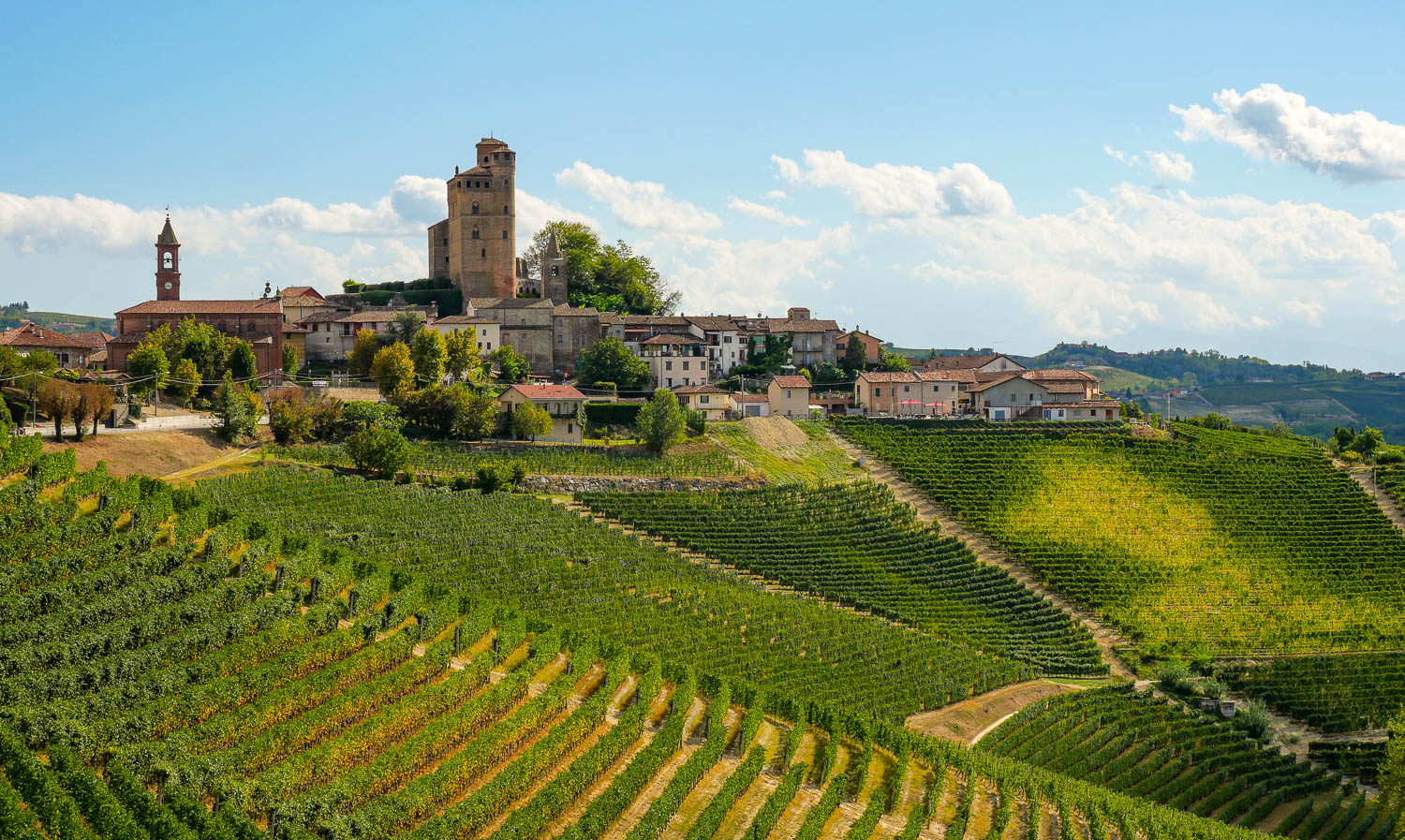
Piedmont is a region worth discovering, even if it is not as popular as Tuscany or Puglia. One of my favorite areas is the Langhe, which has magnificent vineyard landscapes. This region, listed as a UNESCO World Heritage Site, includes vineyards and medieval villages around Alba. Among the most beautiful are Barolo, La Morra, Serralunga d’Alba, Grinzane Cavour and Barbaresco.
It is easy to explore these medieval villages on a day trip from Turin (about 1 hour by car). If you don’t have a vehicle you can opt for a private tour departing from Turin with lunch.
To learn everything about the region and discover the must-see attractions, I invite you to read my article about visiting the Langhe in Piedmont.
Lake Orta
In the far north of Piedmont, about 1 hour 30 minutes from Turin, lies Lake Orta, the smallest of the Italian lakes. The main village, Orta San Giulio, is absolutely charming. It is one of my favorite places in Piedmont. The round trip can easily be done in a day.
In my opinion, Orta San Giulio is the only village on the lake that is really worth visiting. It does not have many monuments, but its architecture, colorful houses, quays, and small squares create a romantic atmosphere. Try to avoid weekends as it is a popular destination for people from Milan.
Facing the village and sitting like a small confetti on the lake, Isola San Giulio is home to a beautiful 11th-century basilica. You can walk around the island in just a few minutes. It is accessible by boat (5-minute crossing) from Orta San Giulio. To learn more I invite you to read my article about things to do in Lake Orta.

Travel guide and tips for visiting Turin
How to get to Turin ?
- Plane : the Piedmont capital has an airport but it is not a very popular terminal for low-cost airlines. You can check on this flight comparison site. From the airport you can reach the city center by bus.
- Train : the train is a good option for visiting Turin if you live not too far from the Italian border. There is no direct line, so you will need to make one or more transfers.
- Car : as part of a Northern Italy road trip, a car is essential. However, you will have to leave it in a parking lot during your entire stay in Turin.
Parking in Turin
If you visit Turin by car, you will not need it once you are there. The ideal solution is to find accommodation with free parking, but after hours of searching we did not find any. Most establishments charge for parking and it can be quite expensive.
We left our vehicle at Parcheggio Emanuele Filiberto located right next to our accommodation. It is just outside the ZTL and about a 10-minute walk from the Royal Palace. The price is €18 per day.
Limited traffic zone (ZTL)
Like all major Italian cities, Turin has a limited traffic zone where driving is prohibited under penalty of a fine. If you are not familiar with the concept I recommend reading my article about ZTL zones in Italy before leaving. The perimeter of the ZTL covers the entire city center from Piazza della Repubblica in the north to Piazza Carlo Felice in the south (see the map).
Traffic is prohibited in the central ZTL from 7:30 am to 10:30 am from Monday to Friday. The rest of the day and on weekends you can drive freely. You will find all the details on the city’s website. In any case, pay close attention to the road signs and do not rely on your GPS because it does not recognize the ZTL boundaries.
Best time to visit Turin
The capital of Piedmont can be visited all year round, but some seasons are better than others. In winter the climate is cold and humid and sometimes it snows. Fortunately the large network of arcades and numerous cafés allow you to stay dry. In summer the climate is hot and locals leave the city.
The best time to visit Turin is in May, June, and September. The weather is milder and sunnier. We chose September for our Northern Italy road trip.
How many days to spend in Turin ?
To discover all the sites presented in this guide, we needed 2 full days. If you only have one day to visit Turin, you will need to make choices because it is impossible to see everything. Museums and palaces take quite a bit of time (especially the Egyptian Museum). However, if you just want to stroll through the city center to admire the architecture, enjoy the cafés, and do a bit of shopping, you can plan a single day.
You now know what to do in Turin in Piedmont, Italy. If you have any questions you can ask them in the comments section of the blog.