
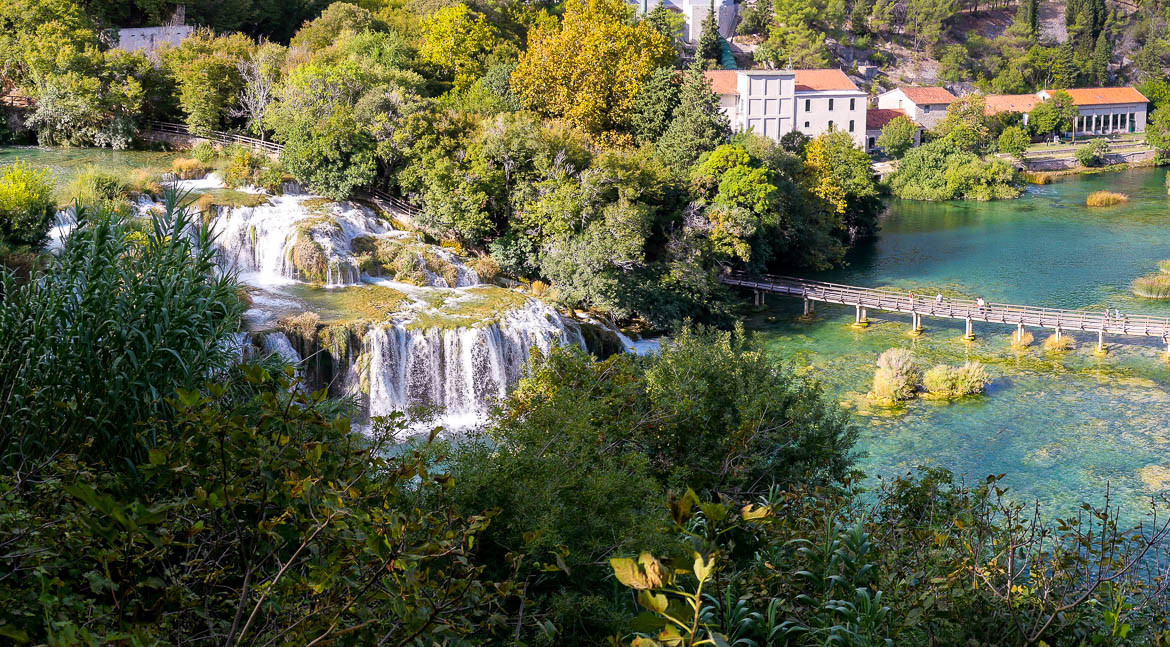
The second most visited park in the country, it’s one of the must-see highlights of any trip to Croatia. But visiting Krka National Park isn’t limited to the many waterfalls created by the river in this karst landscape. The park is also home to a stunning Serbian Orthodox monastery, a Franciscan monastery built on an island, and Roman ruins.
What to do in Krka National Park? Which entrance should you choose? Where to stay nearby? I’m sharing all my tips and practical information in this complete guide so you don’t miss anything during your visit to Krka.
Since 2021, swimming has been prohibited in Krka National Park. Some may find this unfortunate, while others will appreciate being able to take photos without crowds of tourists in the water. One last thing before diving into this guide: if you’re also planning to visit Plitvice Lakes during your trip to Croatia, I recommend visiting the Krka waterfalls first, otherwise you might be disappointed.
Practical information for visiting Krka National Park
Krka National Park map
With sites spread out across the area, it’s not always easy to find your way around Krka National Park. I’ve marked the 6 must-see spots on the map below. If you don’t have much time for your visit, after the Skradinski Buk waterfalls, try to at least stop by the viewpoint over Visovac Island and the Krka Orthodox monastery.

How to get to Krka National Park?
Krka National Park, which covers a total area of 109 km² around the river of the same name, is located just north of the city of Sibenik. It has 5 main entrances: Skradin and Lozovac (for access to the Skradinski Buk waterfalls), Roski Slap, the Krka Monastery, and Burnum.
The closest entrance (Lozovac) is 15 km from Sibenik (18 min), 62 km from Trogir (50 min), and 89 km from Split (1 hour). If you don’t have a car, a bus runs in summer from Sibenik to Lozovac and Skradin, the two entrances to the famous Skradinski Buk waterfalls. There are also boats to Skradin departing from Sibenik.
But the best way to visit Krka National Park in its entirety is to rent a car. The park isn’t limited to the Skradinski Buk waterfalls, where most tourists go. There are other waterfalls and sites further north that shouldn’t be missed, with the added bonus of far fewer crowds. If you’re not traveling with your own vehicle, I recommend using the AutoEurope comparison tool for car rental in Croatia, where prices can be up to 25% cheaper.
For backpackers traveling by public transport or those who prefer guided experiences, you can join an organized excursion from Sibenik, Zadar, Trogir, or Split (see below).
How long should you spend in the park?
If you only want to see the park’s most famous waterfalls (Skradinski Buk), allow about one hour for your visit. But unless you’re really short on time, it would be a shame not to go further and discover all the points of interest, such as the Krka Monastery or other much less crowded waterfalls (especially since all these sites are included in the entrance ticket).
You should plan a full day to visit Krka National Park in its entirety. And even then, you won’t have time to explore every site in depth. The full loop we did by car from Sibenik is 137 km along the river. During this day (8:30 am – 4:30 pm), we were able to see the Skradinski Buk waterfalls, the viewpoint over Visovac Island, the Roski Slap waterfalls, the Krka Monastery, the Manojlovački waterfalls, and the Burnum amphitheater.
Entrance ticket price
The entrance fee for visiting Krka National Park varies depending on the time of year. Tickets can be purchased directly at the various entrances and grant access to all sites. Don’t forget to pick up the brochure which includes maps and a list of places to visit in the park. You can check opening hours on the park’s official website and even buy your tickets in advance if you want to save time.
- June to September: €40 per adult and €15 per child (free for children under 7)
- April, May, and October: €20 per adult and €12 per child
- November to March: €7 per adult and €4 per child
In addition to the entrance ticket, you can purchase boat excursions to reach the following sites:
- Visovac, an islet with a Franciscan monastery (2 hours including 30 minutes on site). Price: €15 / €10
- Visovac and Roski Slap, after the Franciscan monastery the boat continues to the Roski waterfalls (4 hours including 30 minutes at each site). Price: €20 / €15
- Krka Orthodox Monastery and the remains of the Trosenj and Necven fortresses (2h30, departure from Roski Slap). Price: €15 / €10
What to wear in Krka National Park?
No need to bring full hiking gear to visit Krka National Park—simple sneakers are enough. Just look at how some Instagram influencers are dressed to be convinced 😀 The paths are well maintained; for example, at the Skradinski Buk waterfalls you’ll mostly walk on wooden boardwalks. The only risk is that it can get muddy in places if it rains. Outside the hottest months, bring a jacket or sweater as it’s cooler in the park than on the coast (especially in the morning).
Can you enter Krka National Park with a dog?
Dogs are allowed in Krka National Park only if kept on a leash, and this applies to all sites. You are not allowed to let them roam freely on the trails or swim in the rivers and waterfalls. However, dogs are not allowed on Visovac Island or inside the Krka Monastery.
Visiting Krka National Park: Lozovac or Skradin entrance?
The famous Skradinski Buk waterfalls, the best-known in the park, are accessible from both the Lozovac and Skradin entrances. This is one of the must-see sites during any visit to Krka National Park, and likely the first stop of your day if you’re coming from the coast.
Whether you enter via Skradin or Lozovac, you’ll arrive at the same place: Skradinski Buk. So why choose one entrance over the other? Here are a few points to consider:
- Lozovac entrance: this is the closest entrance to the waterfalls and it has a large free parking lot. The journey to the falls is done by shuttle bus (included in the entrance ticket) or on foot via a forest trail (875 m long, about a 10-minute walk). This is the entrance we chose.
- Skradin entrance: this entrance is via the village of Skradin, where you’ll need to find a spot in one of the paid parking lots, which fill up quickly in summer. The trip to the waterfalls is by boat (25 minutes), unless you prefer to walk the 4 km. In summer, there can be long lines for the boat, which departs every hour (included in the entrance ticket).
If the boat ride between Skradin and the Skradinski Buk waterfall isn’t essential for you and you’re traveling by car, I recommend choosing the Lozovac entrance, which is more convenient thanks to its large free parking lot. It’s also closer to the next stop, the viewpoint over Visovac Island. You’ll also save time since you won’t be dependent on boat schedules.
On the other hand, if you don’t have a car, I recommend going through the Skradin entrance and taking the boat to the waterfalls. You can even take a boat directly from Sibenik.
Note that no boats operate in Krka National Park during winter, between November and March. In that case, your only option is the Lozovac entrance. You’ll even be able to drive down to the start of the trail, as the shuttle bus does not operate during this period either.
Skradinski Buk Waterfall

This is the most visited site in Krka National Park and the waterfall you see in tourist brochures. It’s also the largest collection of waterfalls and cascades along the Krka River. If you don’t have much time, this should be your priority.
An interpretive trail of 1,900 m (about a one-hour walk) follows wooden boardwalks built on stilts above the travertine barriers. This loop trail allows you to discover the richness of the local flora and fauna, with numerous information panels about the species that inhabit this natural environment. It’s easy to follow, as small signs indicate the direction to take so that everyone walks in the same direction. The boardwalks are quite narrow, so passing each other would be difficult.
Following the trail, you’ll see the large Skradinski Buk waterfall at the end of the route, with a beautiful elevated viewpoint halfway along. Aside from these two spots, there isn’t much else to see. You mostly see very small cascades over travertine barriers. The walk is pleasant, but compared to the entrance price (especially in summer), it’s quite overpriced. If you’re also planning to visit Plitvice, do Krka first or you may be disappointed.
As mentioned at the beginning of this blog post, swimming in the river within Krka National Park has been prohibited since 2021. Just before reaching the large boardwalk overlooking the Skradinski Buk waterfalls, there’s a large dining area. Many wooden stalls sell sandwiches and snacks, and there are also souvenir shops and restrooms.
We started our visit at 8:30 am to avoid the crowds, and it was a good decision because on our way out we passed many tour groups arriving. The downside of coming early in the morning is that the light isn’t ideal for photos since the sun is facing you. I imagine that at the end of the day, when the sunlight illuminates the waterfalls, it must be very beautiful. It may be a good idea to end your visit to Krka National Park with the Skradinski Buk waterfalls, especially if photography is your priority.

Hydroelectric power station and water mills
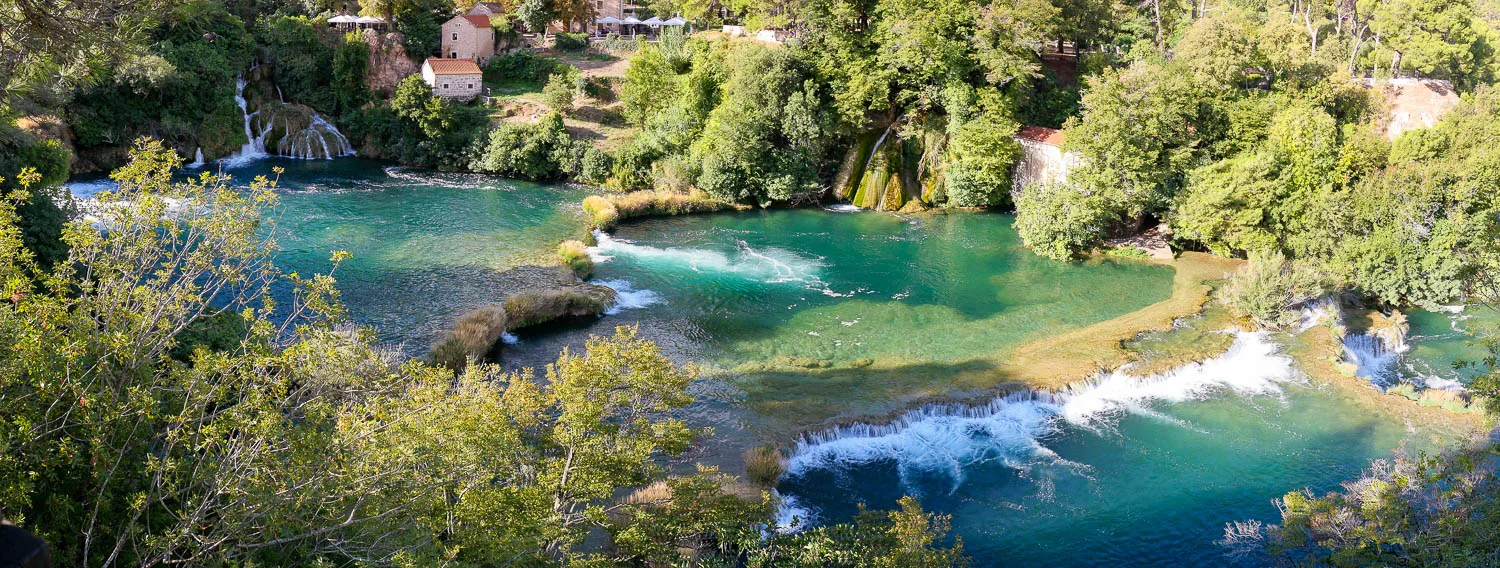
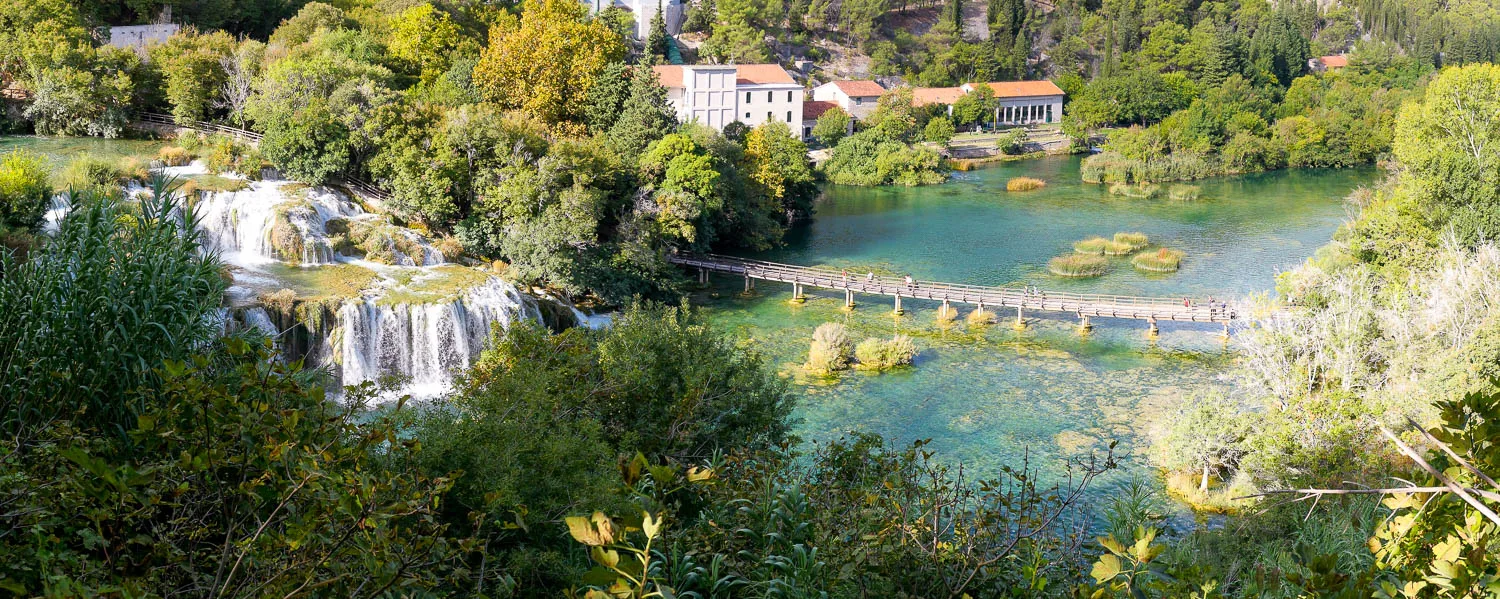
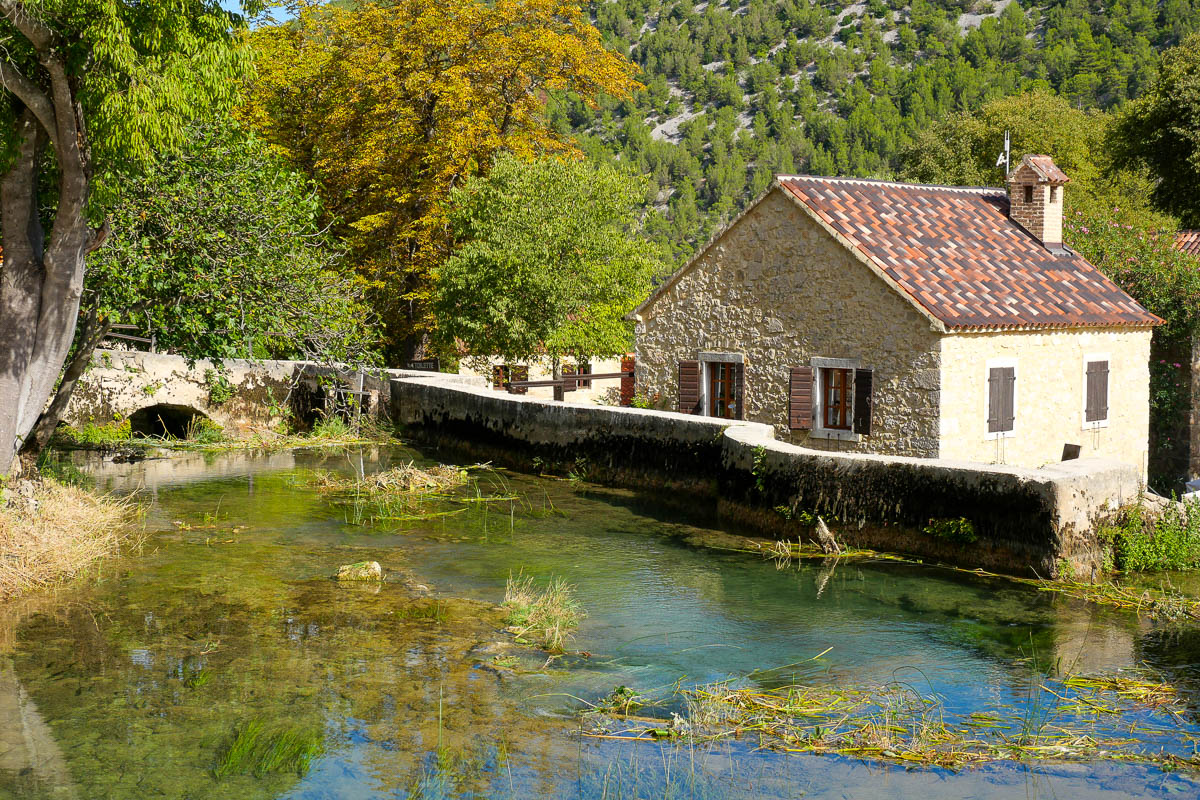
The park features a collection of structures built along the Krka River in the pre-industrial era, including water mills. They have been converted into small museums to learn more about past activities (the preserved mills date back to the 19th century). Water mills were used to grind wheat, prepare food, wash clothes, weave bags and carpets, and forge horseshoes.
Just before completing the full loop of the boardwalks, you’ll come across the remains of the old hydroelectric power station, which began operating in 1895. Thanks to this structure—the first in Croatia—the city of Sibenik was able to enjoy electric power well before many other cities in Europe.

Visovac Island and monastery
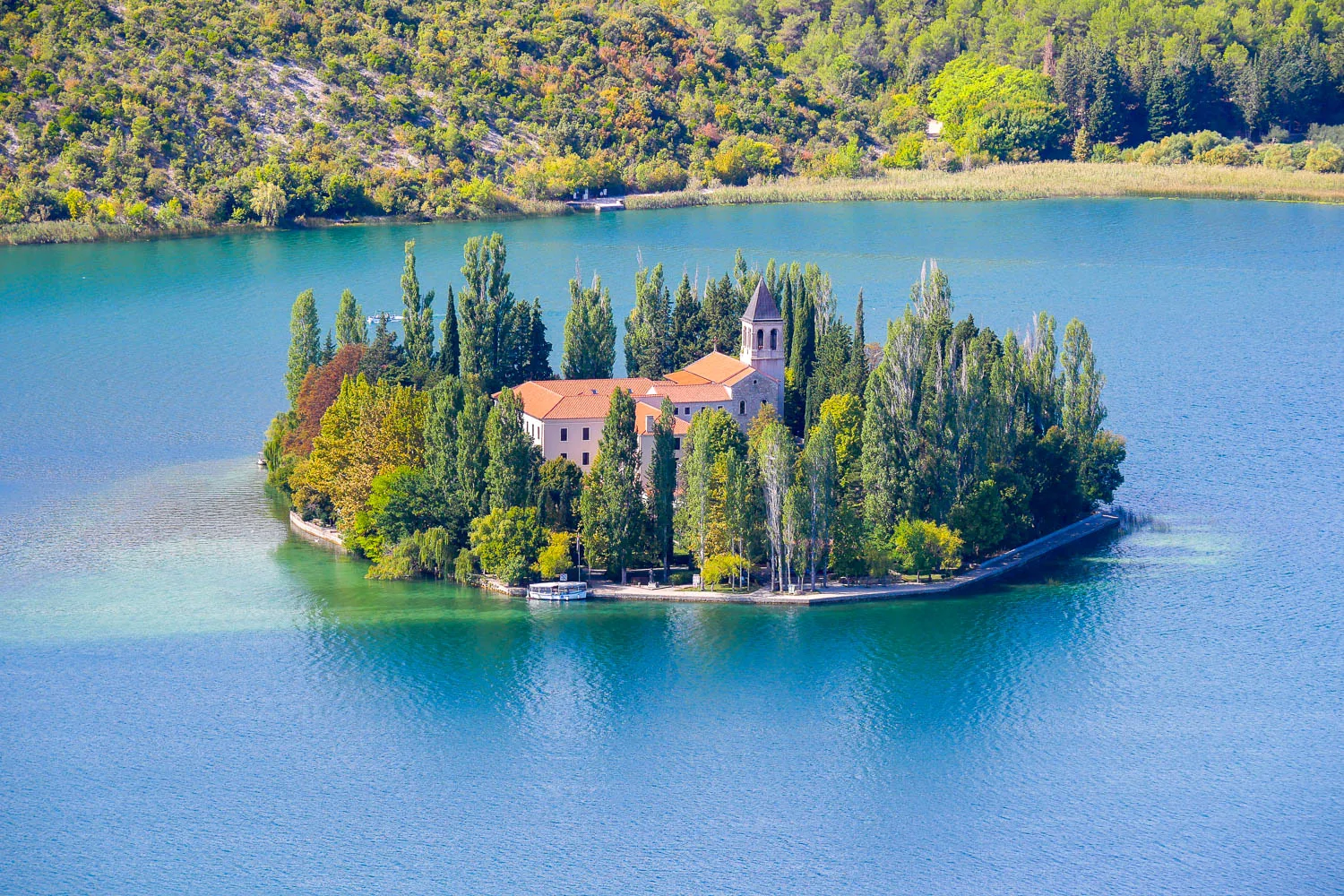
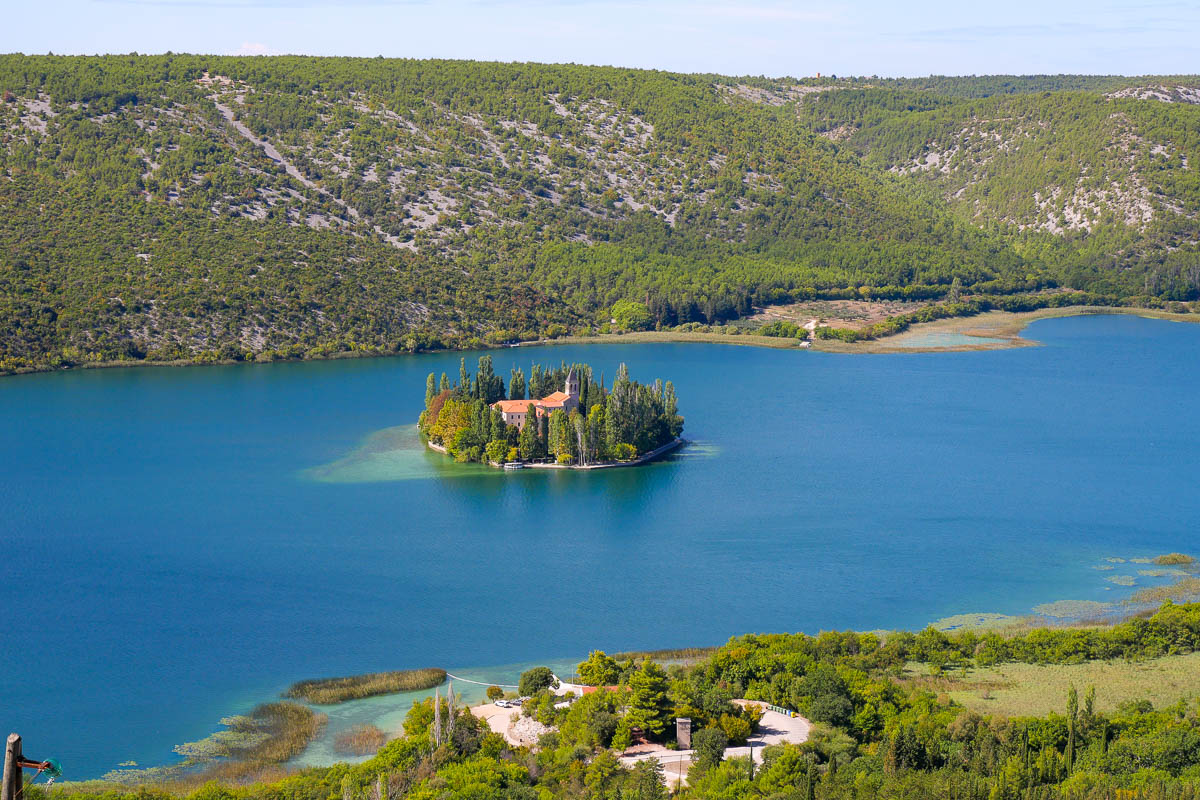
This is one of the most photogenic sites not to be missed when visiting Krka National Park. This islet in the middle of the river has been home since 1445 to the Franciscan monastery of Our Lady of Mercy. It’s a small haven of peace dedicated to spirituality and faith, and it also houses a museum.
It’s possible to visit the Visovac Monastery by taking a boat trip from Skradinski Buk (see above), or by boarding a boat at Stinice or Remetic on either side of the islet (5-minute crossing and 30-minute visit). Using a drone to take aerial photos of Visovac is prohibited, as indicated by warning signs. Instead, I recommend heading up to the viewpoint.
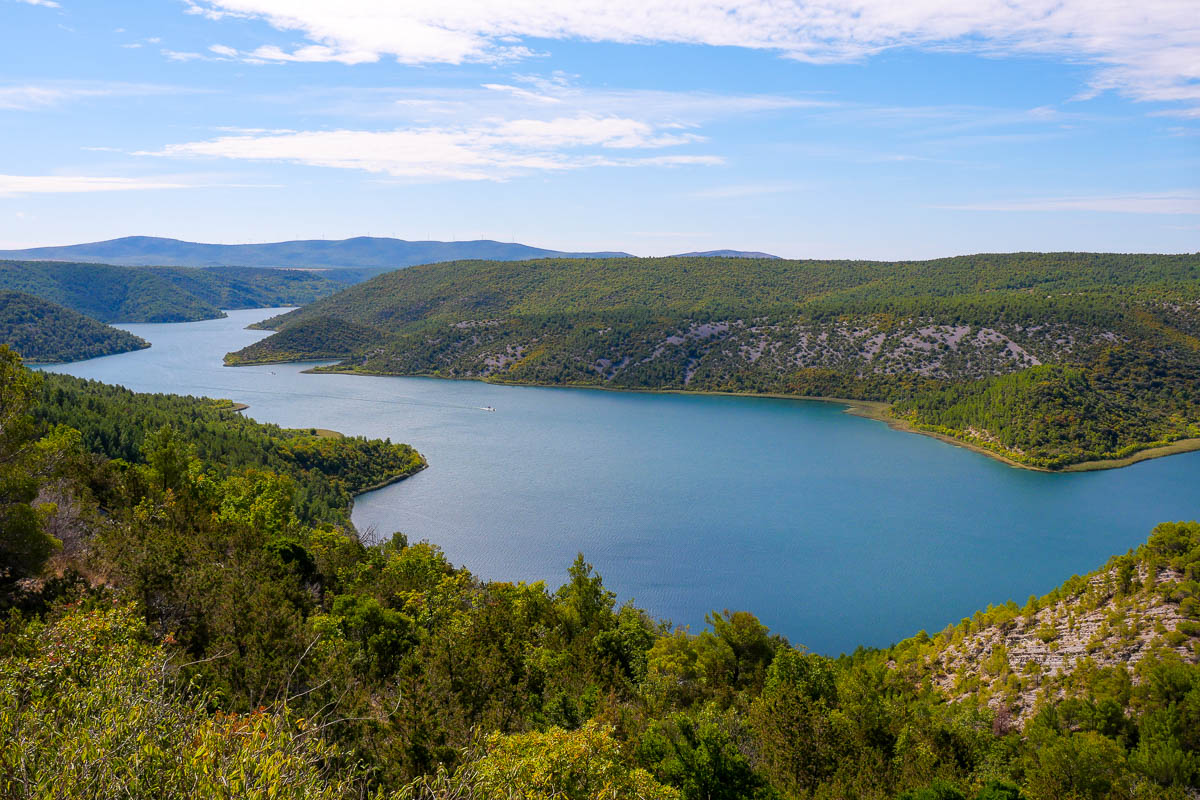
The viewpoint over Visovac Island is located 26 km by car (26 minutes) from the Lozovac entrance (GPS coordinates). From here, you’ll truly appreciate the beauty of the site, as the perspective from the river is very different. We were satisfied with the viewpoint without visiting the monastery.
Roski Slap waterfalls
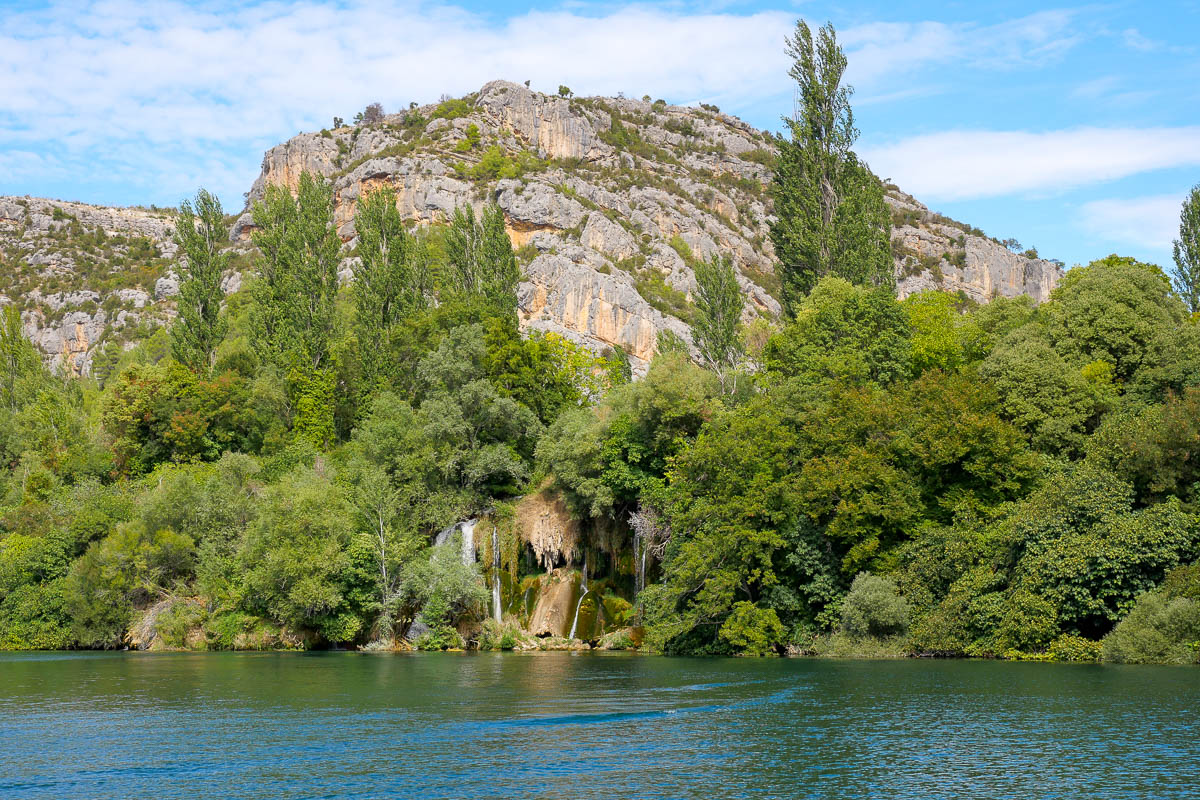
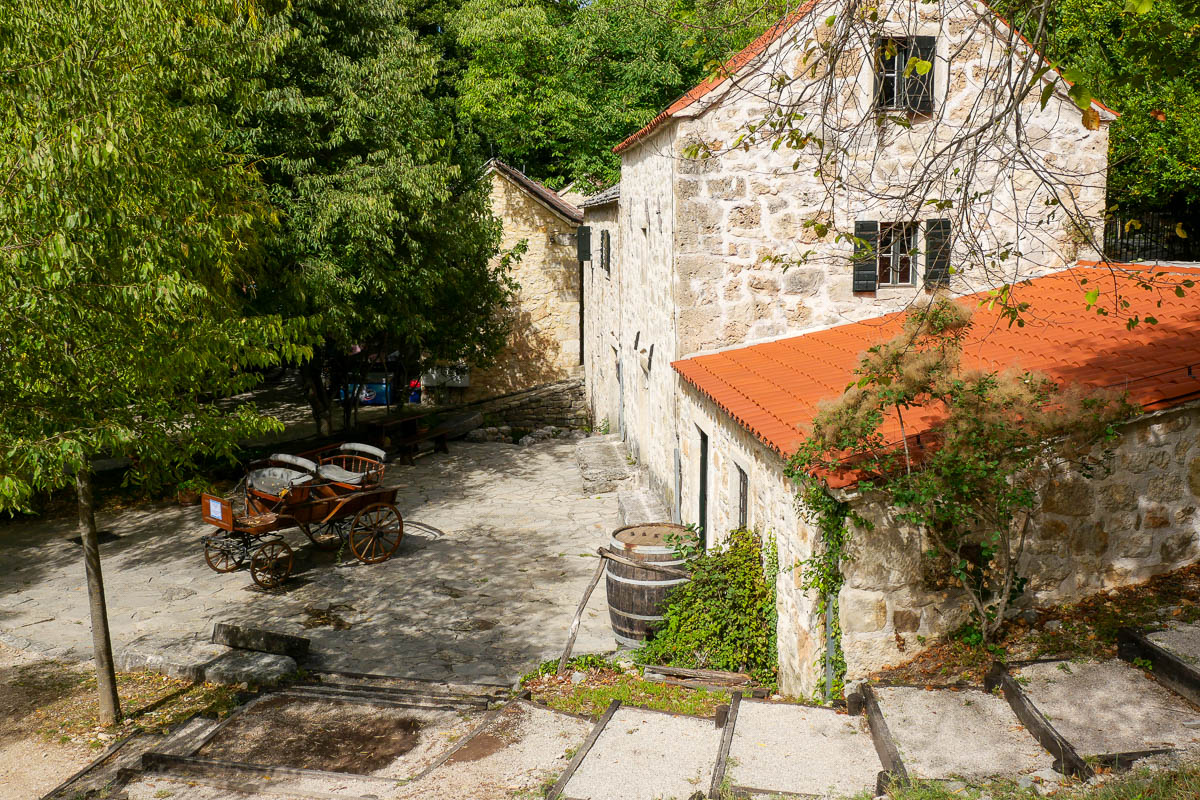
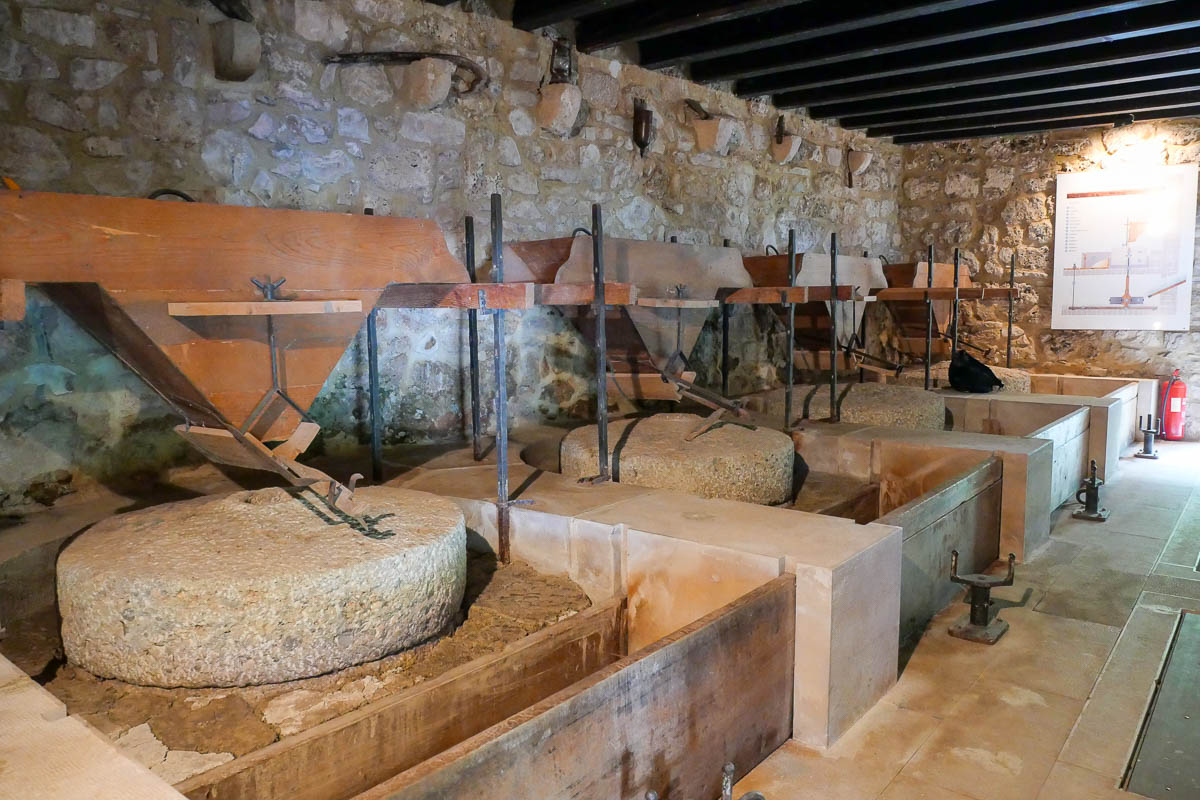
Located 32 km from Lozovac and 8 km north of the viewpoint over Visovac Island, the Roski Slap waterfalls take their name from the Rog fortress that once stood on the right bank of the river. They stretch gently over 650 m before dropping 15 m into Lake Visovac. On the left bank, you’ll find old mills converted into a museum and dining area.
To visit the waterfalls, you can take a boat trip or follow an 8.5 km discovery trail. We didn’t find this trail on site, but after checking, it starts north of the parking area by following the dirt path just before the bridge that crosses the river (GPS coordinates).
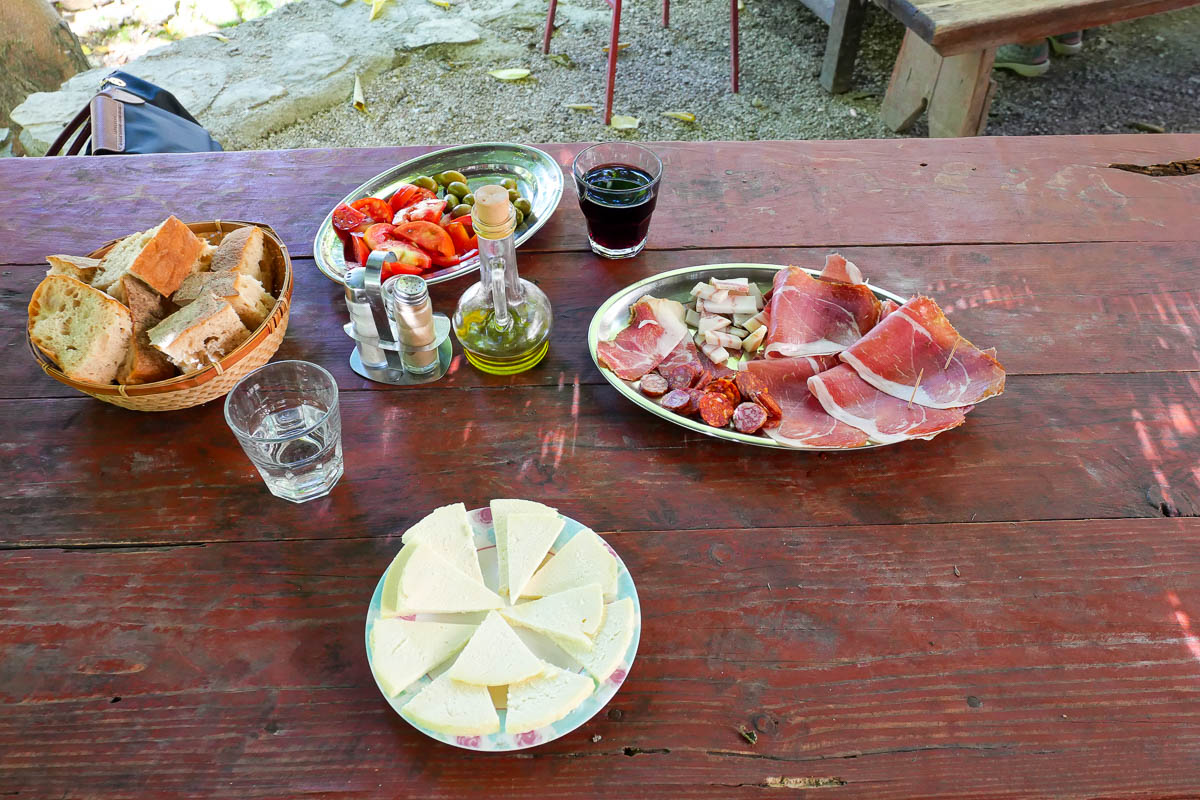
This is where we took our lunch break at one of the two small restaurants by the water. The single dish offered (€15) consists of a platter of cured meats and cheese, accompanied by tomatoes, olives, and bread.
My opinion on Roski Slap is quite mixed. First of all, the parking lot is tiny—it was quite difficult to find a spot, even during our road trip in Croatia in September. Once there, signage to see the waterfalls is very poor. By following the path after the ticket checkpoint, you reach the mills and a viewpoint of the waterfall where you don’t see much (you need to go to the end of the boat dock). If you’re short on time when visiting Krka National Park, you can skip Roski Slap.
Krka Monastery
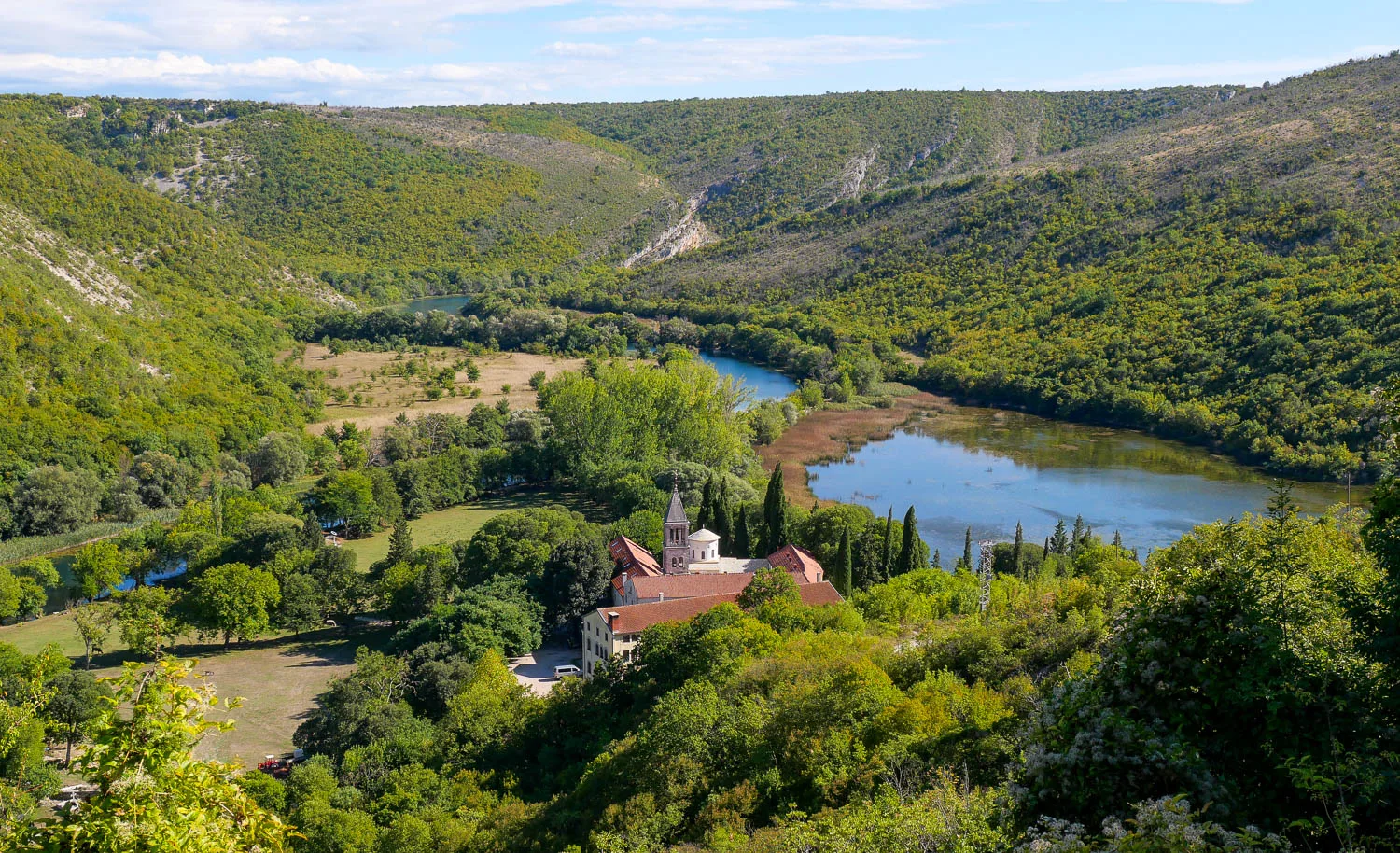
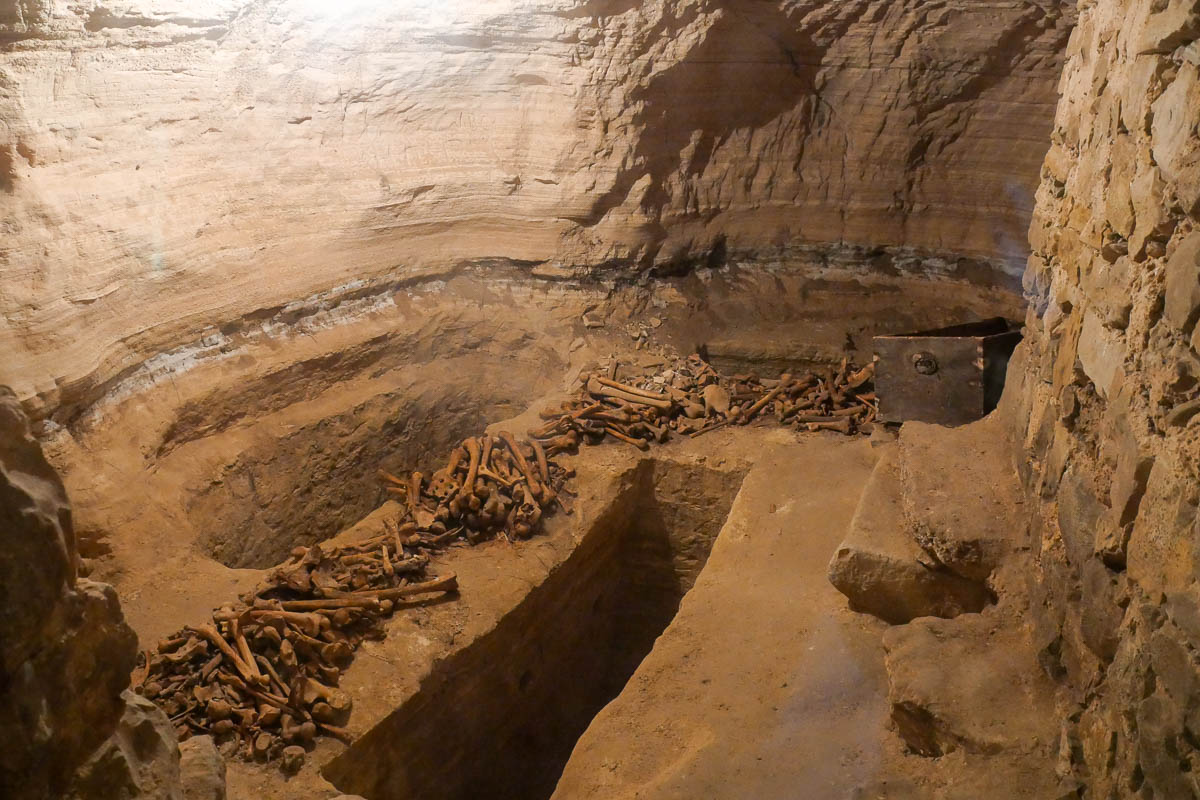
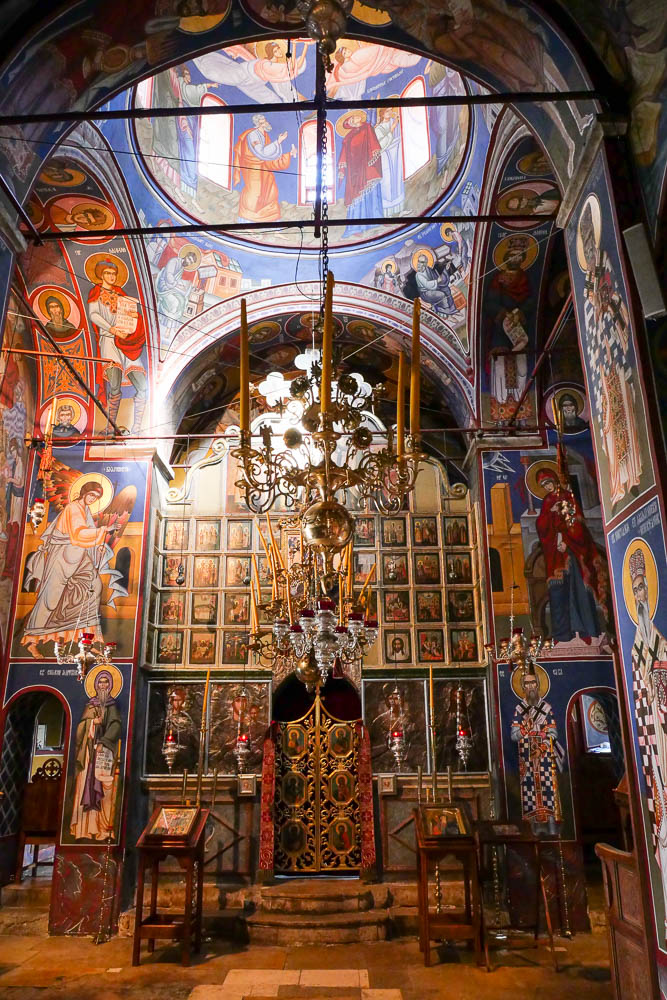
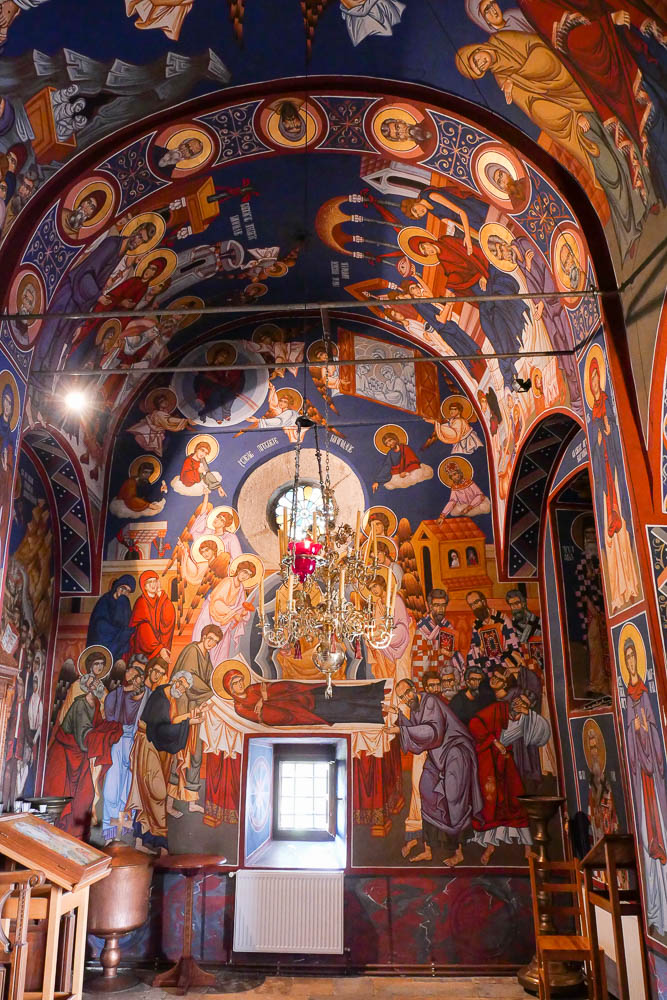
At the far north of the park, in a bend of the river, lies a small gem you absolutely shouldn’t miss when visiting Krka National Park. The Krka Monastery is one of the most important sanctuaries for Orthodox Christians. It was built in 1345, but the site is much older, as Christian inscriptions dating back to the 1st century can be found in the catacombs of the adjacent church.
From mid-June to mid-October, a guide will show you around (included in the park entrance ticket). After a quick visit to the Roman catacombs to see the inscriptions, you enter the Orthodox church, whose architecture blends Byzantine and Mediterranean styles. The richly decorated interior, with frescoes, icons, artworks, and precious books and manuscripts, is magnificent.
The monastery is located 16 km by car from Roski Slap (33 km from Lozovac). It can also be reached by boat excursion from Roski Slap (see above). It is open year-round from 10 am to 6:30 pm.

Manojlovački waterfalls
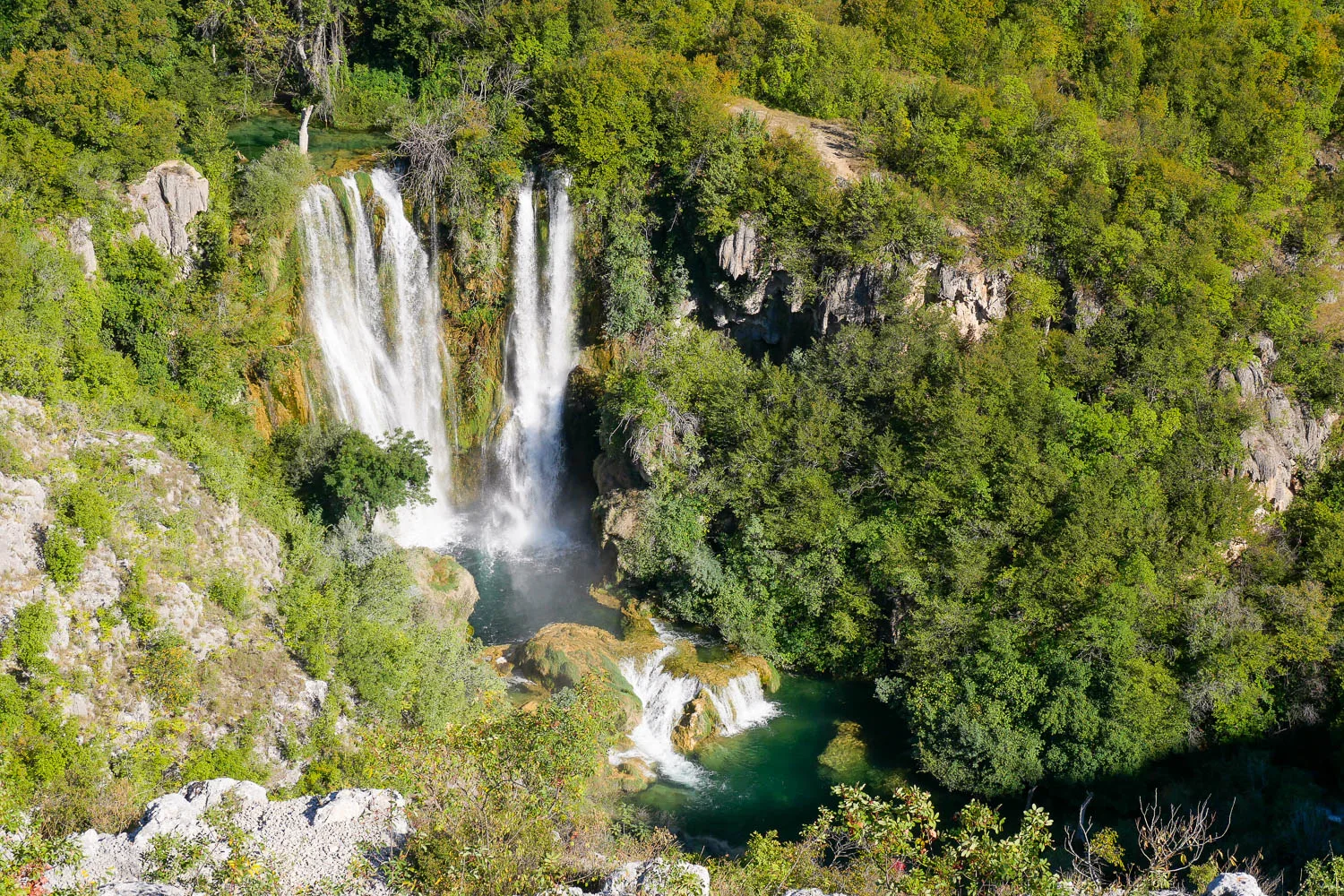
Continuing north, 10 km after the Krka Orthodox Monastery, you’ll reach the Manojlovački waterfalls. At 47 km from the Skradinski Buk falls, very few tourists come this far—we were almost alone on site. Yet these waterfalls are among the most beautiful in the park and also the tallest, with a total height of 59 m (the highest drop is 32 m).
A viewpoint has been set up (take the path on the right) next to a commemorative plaque honoring Emperor Franz Joseph I of Austria, who, along with his wife Sissi, admired the beauty of the landscape in 1875. By taking the path on the left, you can get closer to the waterfalls, but we didn’t have time to do so.
Cirsten, a blog reader who visited Krka National Park in 2022, notes: “The visit to the waterfall via the trail is really worth it. But be careful: entrance must be paid in cash only. You need to wear sneakers because at the end it feels like a Tarzan-style course. Quite interesting, but I would only recommend it for children over eight who listen to their parents. No strollers possible—I’d even say it’s very difficult with a baby carrier. Then take the trail leading down to the base of the waterfall and always keep right at intersections (it’s not signposted). It’s magnificent, at least as beautiful as the Skradinski Buk waterfalls. Some people swim even though it’s prohibited.”
Burnum Roman military amphitheater
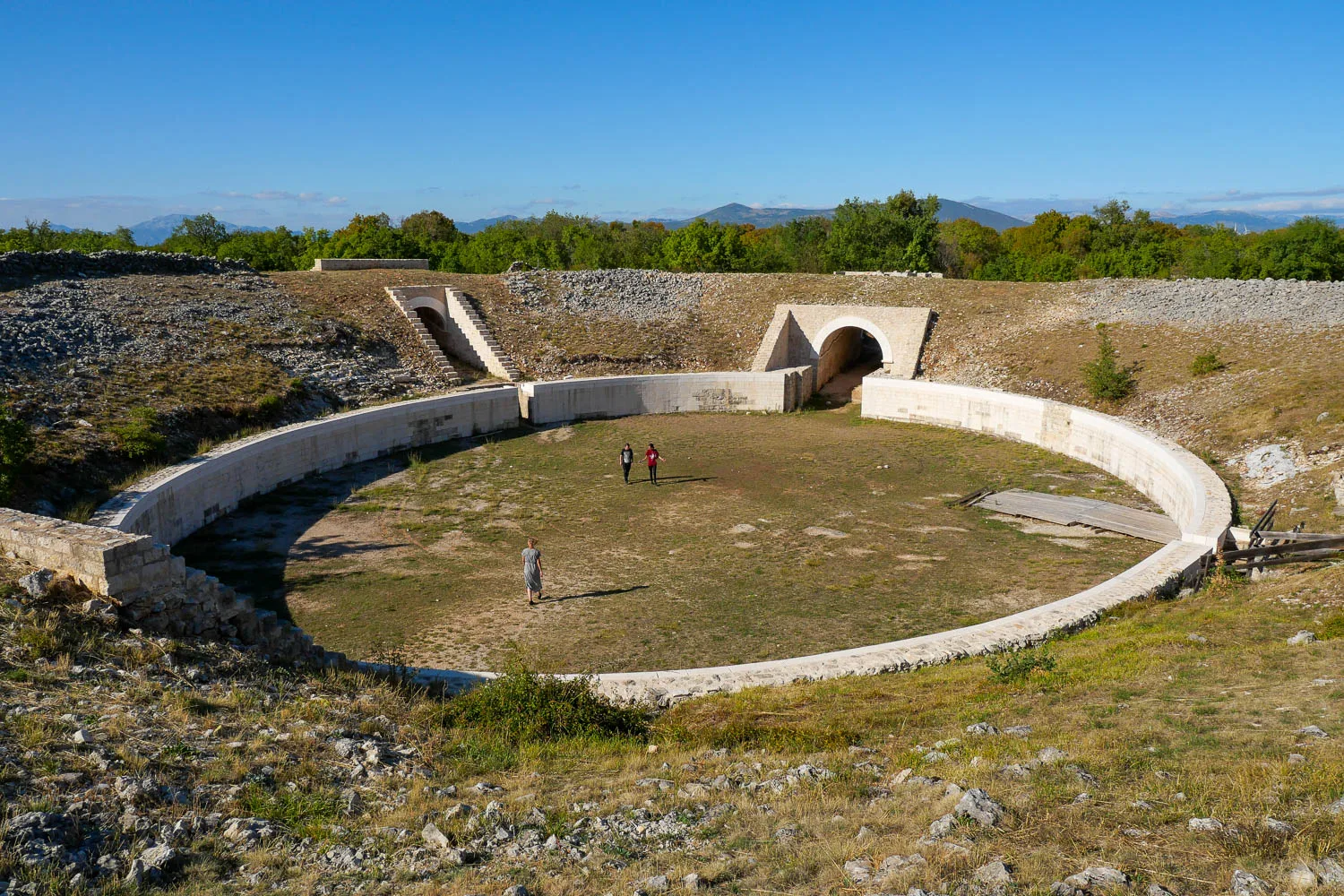
The ruins of this Roman military camp are located right next to the Manojlovački waterfalls. To be honest, we probably wouldn’t have come this far if it weren’t for that, as there isn’t much to see except for fans of Roman ruins. On site, you can see the arches of the camp’s command building and a small military amphitheater—the only one in Croatia.
Worth a quick stop if you’re heading to the Manojlovački waterfalls, otherwise it’s clearly not one of the main highlights of Krka National Park. After this final visit, we returned to Sibenik (51 km), where we had our accommodation.
Tours to visit Krka National Park
For those without a rental car or traveling by public transport, it’s possible to visit Krka National Park by joining a tour. These activities are offered from the most touristy cities such as Sibenik, Trogir, and Split. You’ll find many different options, with or without a guide during the visit. The entrance ticket is not always included, so make sure to check all conditions.
If you’re traveling during high season, I recommend booking your tour in advance, as there is high demand in July and August. Cancellation is free up to 48 or 24 hours in advance depending on the activity.
- From Split: Krka Waterfalls Trip with Boat Cruise and Swimming
- From Trogir: Krka Waterfalls Day Tour with Boat Ride
- From Sibenik: Krka National Park excursion
- From Zadar: Krka National Park and Waterfalls Day Trip

Where to stay near Krka National Park?
Krka National Park can easily be visited as a day trip from Sibenik, Trogir, or Split. You can choose one of these coastal cities as your base. For our part, we spent two nights in Sibenik—one day to explore the city and one to visit Krka National Park, which is less than 20 minutes away by car.
If you prefer to stay closer to the river, here are a few good options (note that camping is not allowed inside the park). Most accommodations near Krka are located in the village of Skradin. Prices vary greatly depending on the season—unsurprisingly, July and August are the most expensive months. Between June and September, I recommend booking your accommodation in advance.
- 37 € : Apartments & Rooms Formenti, this guesthouse offers rooms with river views at excellent value for money in Skradin. One of the cheapest options near Krka. Private parking included.
- 40 € : Apartmani Krka Kistanje, located in the far north of the park near the Krka Monastery, this 33 m² apartment can accommodate up to 4 people. Best suited for low budgets or if you’re arriving from the north, as it’s quite far from the coast.
- 60 € : Peaceful house in nature, this 50 m² holiday home with a garden and vegetable patch is located not far from Visovac Island and Roski Slap. It can accommodate 4 people, making it great value for families.
- 62 € : Viola, a 32 m² apartment with two sleeping spaces located in the village of Skradin, making it easy to take the boat shuttle—especially since private parking is included.
- 72 € : Hotel Vrata Krke, this hotel with a pool is located at the Lozovac entrance of the park. You won’t even need to drive to reach the waterfalls. Breakfast and private parking included.
- 119 € : Hotel Bonaca, a 4-star hotel in the village of Skradin by the river, yet far enough to feel peaceful. Modern rooms with balcony, pool, and on-site restaurant. Breakfast and free private parking included.
You now have all the useful information to visit Krka National Park in Croatia. If you still have questions, feel free to ask them in the comments. And don’t forget to share this article on social media using the buttons below if you enjoyed it 🙂